

What cricket odds mean: common formats and basic definitions
Cricket odds are market prices that express a provider's view of an outcome's likelihood and include the operator's margin; they are not guarantees of what will happen. For a clear, practical explanation of common formats used today see the betting guide overview from Betfair Betfair betting guide.
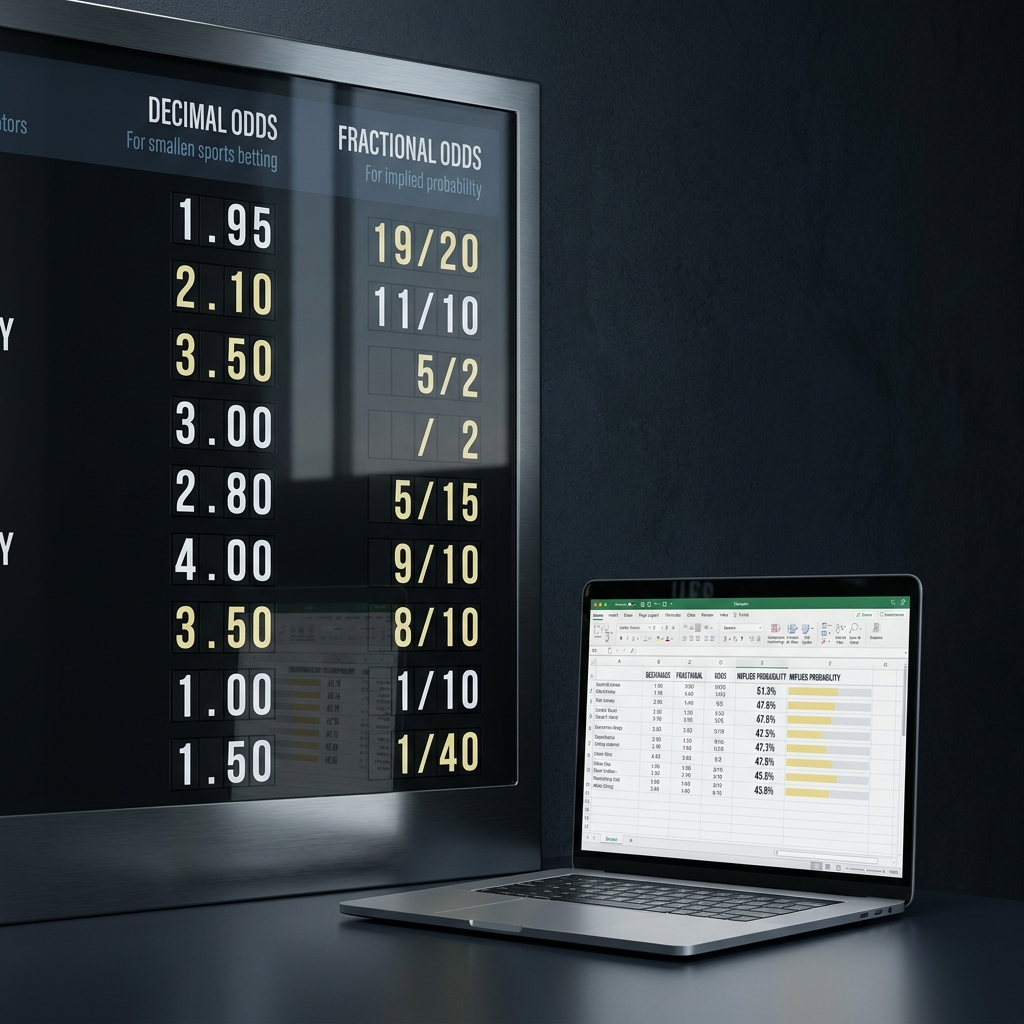
Decimal odds, fractional odds and American odds are the three formats you will most often see across pre-match and in-play markets. Decimal odds show the total return for a one-unit stake, fractional odds show returns as a ratio of profit to stake, and American odds show how much you must stake to win a fixed amount or how much you win on a fixed stake.
Decimal, fractional and American formats
Decimal odds look like 2.50 and are simple to read: a one-unit stake returns 2.50 units total if successful. Fractional odds appear as 6/4 and mean you win six units for every four staked, while American odds appear as +150 or -200 depending on whether the outcome is an underdog or favourite.
Each of these formats can be converted into an implied probability using standard formulas discussed in betting education resources Investopedia on implied probability or try a free implied probability calculator from TheRundown TheRundown calculator.
Convert common market prices into an implied probability
Enter a decimal price to get the implied probability
What odds express about likelihood and market view
Odds communicate two things at once: an implied chance for the outcome and the market margin that pays the operator. Reading a price is therefore both a probability exercise and a market-structure exercise, because summed implied probabilities often exceed 100% due to the margin placed into the prices for commercial reasons.
Knowing the format a price is quoted in helps you convert it quickly and compare it with your forecasting model or checklist for a given match.
How to convert cricket odds to implied probability
Decimal conversion: 1 / decimal
Decimal conversion is the most straightforward: implied probability equals 1 divided by the decimal price. For example, a decimal market price of 2.50 converts to an implied probability of 1 / 2.50 = 0.40, or 40 percent, a standard method explained in introductory guides on implied probability Investopedia on implied probability. You can also consult Smarkets' how-to guide Smarkets guide.
Write the formula as a single calculator entry: implied probability = 1 / decimal odds. This yields a market-implied percentage you can use to benchmark against your model.
Convert the quoted price to implied probability using the format-specific formula, rescale to remove the bookmaker margin, adjust for cricket-specific uncertainty such as DLS and the toss, then compare the adjusted market probability to your model estimate to decide if an edge exists.
Fractional and American conversion formulas
Fractional odds such as 6/4 convert by dividing the denominator by the sum of numerator and denominator and then converting to a percentage: implied probability = denominator / (numerator + denominator). American odds convert with two algebraic forms: for positive American odds (+150) use 100 / (American + 100), and for negative odds (-200) use -American / (-American + 100). For user-friendly examples and equivalent formulas see the educational conversion article at Pinnacle Pinnacle conversion guide. You can also use an implied probability calculator from OddsJam OddsJam calculator.
Label each step when you work through a market price: state the format, apply its conversion, and record the implied probability in percentage form so multiple markets are comparable.
Why cricket odds often add up to more than 100%: understanding the bookmaker margin
When you convert prices across all outcomes and sum their implied probabilities, the total typically exceeds 100 percent because bookmakers include a margin or overround in the prices. This margin is how operators build a commercial edge into markets; for background on implied probability and market totals see Betfair's explanation of odds formats Betfair betting guide.
A simple way to estimate fair probabilities is proportional scaling: convert each market price to implied probability, sum the implied probabilities, then divide each implied probability by that sum to rescale them so the total is 100 percent. This produces an adjusted set of 'fair' probabilities that remove the operator margin proportionally, noting that the result is an approximation rather than a definitive truth.

Keep in mind different adjustment methods exist, such as removing margin only from the favourites or applying weightings by selection liquidity; none produces a single objective 'true' probability, so treat adjusted probabilities as a practical tool for comparison.
How live events and timing cause cricket odds to reprice
Live, or in-play, cricket markets are highly sensitive to on-field events: wickets, sudden scoring bursts and long partnerships change the game's expected outcome in real time and prompt immediate repricing. Market education resources note that visible events and new information drive real-time price moves Pinnacle market education.
A wicket typically increases the fielding side's win probability, while a rapid partnership can swing the advantage back to the batting side; both effects usually show up in prices within seconds as traders and algorithms update positions based on the new match state.
Market liquidity and timing also matter: thin markets with few active bidders can see larger jumps when one trade arrives, while deep markets generally absorb single events with smaller price swings because more counterparties are smoothing the moves.
Duckworth-Lewis-Stern (DLS) and weather: why interruptions change cricket odds fast
The Duckworth-Lewis-Stern method recalculates targets and remaining resources when overs are lost due to interruptions, which directly alters each side's expected chance of winning and triggers immediate market repricing; a clear primer on the method is available from ESPNcricinfo ESPNcricinfo DLS explainer.
Because the match target and effective resources change, in-play probabilities before and after an interruption are not comparable without applying the revised DLS outputs; operators and exchanges update prices to reflect the method's recalculated expectations.

The ICC's playing conditions formally codify when and how DLS is applied in major events, so market participants rely on those rules when anticipating how an interruption will be handled and when markets will restart pricing under the revised conditions ICC playing conditions.
Pre-match drivers of cricket odds: pitch, toss, team news and availability
Pre-match markets move as teams confirm lineups, injuries surface, or pitch and outfield reports change the expected scoring pace and wicket risk; trading guides note that team news and availability are primary drivers of short-term market moves Pinnacle market education.
Pitch assessments that describe grass cover, hardness or expected turn suggest different scoring patterns: a flat, dry pitch typically reduces early wicket risk and can favour batting, while a green or damp surface increases the chance of early wickets and slower scoring, all information markets price into pre-match odds.
The coin toss changes who faces the new ball and which side bats under particular light or weather conditions; because batting order affects risk exposure and scoring opportunities, markets commonly adjust after the toss and before the first ball is bowled.
A simple framework to adjust market cricket odds to your model
Step 1: convert to implied probabilities
Start by converting the market price into implied probability using the correct formula for its format. Record the decimal-implied percentage so you have a consistent basis for comparison with your model.
After conversion, note the summed implied probabilities across mutually exclusive outcomes to estimate the overround before you adjust for margin.
Practice the framework on a real match using FundedPlays challenges
Try these steps on one upcoming match: convert the quoted price to implied probability, rescale for the margin, and compare the adjusted result to your model without changing stake size yet.
Step 2: adjust for margin and match-specific uncertainty
Remove the bookmaker margin using proportional scaling, then add a model-specific uncertainty buffer for cricket factors you consider important, such as DLS exposure, toss influence or pitch report uncertainty. This buffer reflects how much extra caution you want to add to account for cricket-specific variability.
Compare your model probability plus buffer to the adjusted market probability; a consistent positive gap that exceeds your predefined edge threshold is the basis for taking a trading or prediction decision, remembering to include execution costs and timing.
Decision criteria: when to accept market cricket odds and when to look for value
Define an edge threshold for your process in advance, for example a minimum percentage point gap between your model probability and the adjusted market probability that justifies placing a prediction or taking a position. The precise threshold should match your variance tolerance and account size.
Consider market liquidity and timing when acting: if a market is thin, the quoted price may move against you when you try to execute, eroding the edge. Also check multiple sources for price confirmation to avoid trading on a stale or misquoted price.
Watch out for cognitive biases such as confirmation bias or overreacting to recent events; disciplined systems use a recorded decision rule and post-event review to prevent chasing losses or overweighing single-match outcomes.
Common mistakes and pitfalls when interpreting cricket odds
A frequent error is ignoring the overround and treating summed implied probabilities as if they were fair. Failing to remove margin leads to overestimating the market edge and can distort position sizing decisions.
Another common pitfall is neglecting DLS exposure in reduced-over games. When a match is shortened, the DLS adjustment changes the expected outcome and a model that does not account for that can be badly misaligned with the market.
Overreacting to in-play swings is also risky: single events can produce sharp price moves that look like edges but reflect transient volatility or low liquidity rather than a true change in the long-run probability.
Practical examples: converting real cricket odds and comparing to a model
Worked example one, decimal conversion: a market lists Team A at 2.50 in decimal format. Convert to probability: 1 / 2.50 = 0.40 or 40 percent. If the market also lists Team B at 1.70, convert that price the same way to compare relative chance and then sum both implied probabilities to see the overround; refer to basic conversion methods for details Investopedia on implied probability.
Worked example two, fractional and American: a fractional price of 6/4 converts using denominator over total method and an American +150 converts with the positive-American formula described earlier. After converting each, rescale to remove the margin and compare the adjusted market probability to your model's estimate.
When comparing, document assumptions: the buffer you use for pitch uncertainty, whether you applied a DLS adjustment for potential interruptions, and the execution costs you expect if you place a position in a thin market. Keep the focus on interpretation, not on guaranteed results.
Scenario walkthroughs: rain-affected match and toss-influenced game
Rain interruption scenario: a T20 game is interrupted with the chasing side at a fragile stage. Once the umpires and officials apply DLS, the target is recalculated and win expectation often shifts materially; markets then update prices to reflect the DLS-adjusted target and resources, a mechanism explained in cricket technical guides ESPNcricinfo DLS explainer.
In this scenario a model that anticipates likely DLS outcomes will be better prepared to judge whether the post-interruption market price represents value than a model that ignores interruption effects.
Toss-influenced scenario: the toss favours the fielding side on a pitch expected to deteriorate under lights. Markets commonly move after the toss because batting order affects exposure to the new ball and late conditions. If your model had pre-toss estimates that did not incorporate the toss result, re-evaluate and compare to the adjusted market probability before making a decision.
Using implied probability in skill-based prediction platforms and virtual funded accounts
Implied probability is a useful benchmarking tool when participating in evaluation challenges or virtual funded account programs because it reveals the market consensus you are competing against; comparing your model to that consensus helps you measure where your predictions differ in a structured way (see the Funded Plays blog).
When sizing positions in a virtual account, adopt conservative position-sizing rules and track predictions consistently; skill-based simulation environments reward process and consistency, not one-off outcomes. (Learn more at Funded Plays.) Applying fair-probability thinking and recording your decisions supports learning without implying guaranteed earnings.
Checklist: quick steps to read, convert and act on cricket odds
1. Identify the quoted format and convert the price to implied probability. 2. Sum probabilities to estimate the market overround. 3. Remove the margin using proportional scaling. 4. Add a match-specific uncertainty buffer for DLS, toss and pitch. 5. Compare adjusted market probability to your model. 6. Apply a predefined edge threshold and check liquidity before acting. 7. Record the decision and the reasoning for later review.
Before you act, always confirm final team news and the pitch report; small late details often change the value proposition and your execution plan.
Conclusion: interpreting cricket odds responsibly
Market prices are a view, not a guarantee: convert quotations into implied probabilities, adjust for the bookmaker margin, and factor in cricket-specific uncertainties such as DLS and toss effects when comparing to your model. Use these steps as tools for disciplined decision-making rather than as promises of results.
Regularly recording outcomes and refining your buffer sizes for DLS and pitch uncertainty will improve your judgment over time. Treat implied probabilities as part of a repeatable process and keep risk management front and center when you act.

Divide 1 by the decimal price to get the implied probability, then express the result as a percentage.
Sums exceed 100 percent because operators include a margin, called the overround, which can be removed by proportional scaling to estimate fair probabilities.
DLS recalculates targets and resource shares after interruptions, which changes win expectations and prompts immediate market repricing.
References
- https://betting.betfair.com/academy/betting-basics/understanding-betting-odds.html
- https://www.investopedia.com/terms/i/implied-probability.asp
- https://therundown.io/betting-calculators/implied-probability-calculator
- https://www.pinnacle.com/en/betting-articles/Betting-Strategy/convert-odds-to-probability/9TLJGL2XW4V4H7N3
- https://oddsjam.com/betting-calculators/implied-probability
- https://help.smarkets.com/hc/en-gb/articles/214058369-How-to-calculate-implied-probability-in-betting
- https://www.espncricinfo.com/story/explained-what-is-the-duckworth-lewis-stern-method-in-cricket-1220495
- https://www.fundedplays.com/challenges
- https://www.icc-cricket.com/about/cricket/rules-and-regulations/playing-conditions
- https://www.fundedplays.com/blogs/how-fundedplays-evaluations-work
- https://www.fundedplays.com/blogs
- https://www.fundedplays.com