
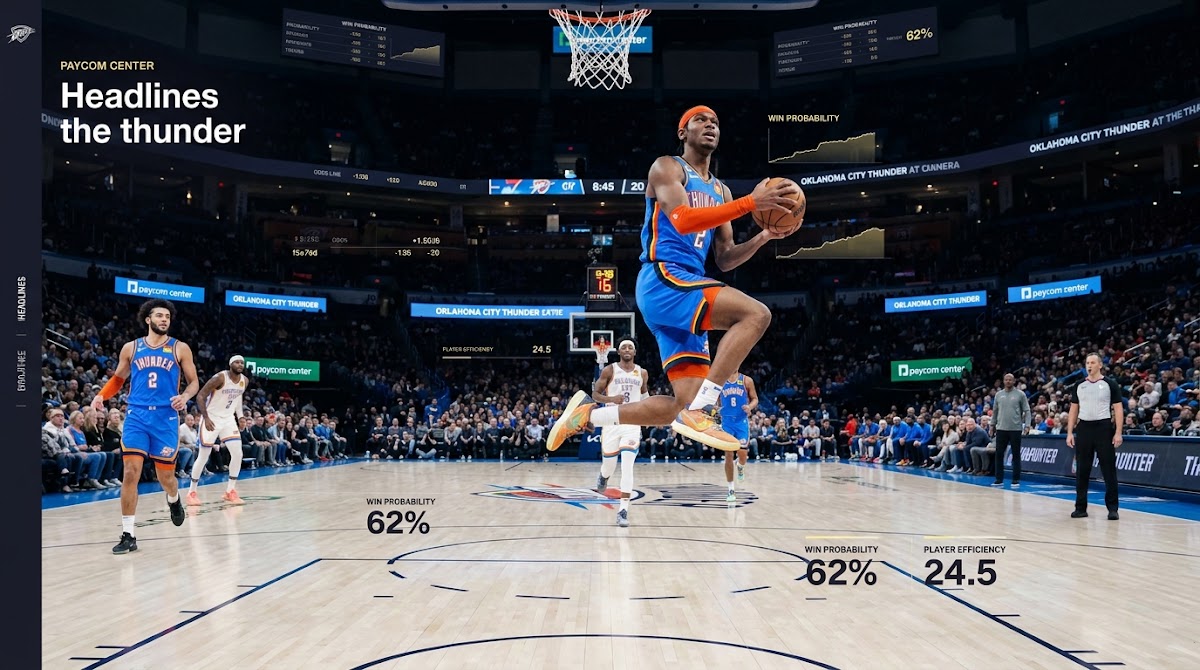
Quick answer: what covers nba odds and where OKC stands
Short headline verdict, covers nba odds
Short answer: in 2026 the Oklahoma City Thunder were treated as a realistic title contender by major futures markets and by several model-based probability screens, but that status is conditional on health and matchup path.
Major futures screens placed OKC among the league's top contenders, reflecting money flow and sentiment from bettors and market participants; that market placement is visible on mainstream odds pages that track NBA futures Covers NBA futures odds.
The picture from probability models complemented market signals by putting OKC in the upper tier of title likelihood through the season, which gives a consistent cross-check against price-driven signals Basketball-Reference playoff probabilities.
a concise set of live feeds to follow for odds and model monitoring
use daily checks during trade and injury windows
Why that matters: markets condense public and sharp money, while models translate performance into forward probabilities; reading both together gives a balanced baseline for updating expectations.
How to read covers nba odds and other futures screens
What covers and similar odds screens report
Odds screens like Covers and other futures pages show the market price for a given outcome, typically displayed as an American or decimal price plus an implied probability derived from that price.
Those pages also show movement over time, which helps you see whether a market is drifting or being supported by new money; your interpretation should start with price, then consider context like recent news or sharp action VegasInsider futures odds.

Differences between market odds and model probabilities
Market odds reflect money and liquidity, which can incorporate information not in your statistical model, such as a large bet from a sharp or hedge flows from books; models instead convert performance and matchup data into probabilities using a fixed methodology.
Because markets and models use different inputs and incentives, they can diverge during the season; price changes may be faster around news events, while models update when new performance data is added or when you rerun assumptions.
Season snapshot: what markets and models said about OKC in 2025-26
Futures market placement
Across the 2025-26 season, major futures markets consistently listed the Thunder among the top title contenders, a steady signal that OKC was viewed as within the championship conversation by bettors and market makers Covers NBA futures odds.
OKC was a plausible contender in 2026 according to markets and models, but their ultimate chance depends on health and the playoff path; treat probabilities as conditional and update them with confirmed information.
Those market placements were mirrored by other futures trackers that show similar top-tier listings and occasional week-to-week reordering based on results or news VegasInsider futures odds.
Model-based playoff and title probabilities
Model outputs, such as the season-long playoff and title probabilities on Basketball-Reference, repeatedly placed OKC in the league's upper tier of title likelihood during 2025-26, providing an independent model baseline to compare against market prices Basketball-Reference playoff probabilities.
When markets and models aligned, the signal was stronger; when they diverged, that usually reflected timing differences, injury news, or recent performance swings that markets reacted to faster than some models.
Team profile: the aspects that make OKC a contender
Offensive identity and efficiency
OKC's offensive profile leaned on high-value shot creation and efficient scoring from its primary creators, a structure that models reward because it produces repeatable scoring advantages over long samples.
Analytics writeups and team metrics in 2025-26 described the Thunder as possessing a top-tier net rating and an offense capable of sustaining high-level efficiency, which is a core reason models and rankings elevated their title probability Oklahoma City Thunder team metrics.
Defensive profile and net rating
On the defensive side, OKC showed the kind of two-way cohesion and matchup versatility that helps in playoff series, where half-court execution and switchable lineups become more valuable than in the regular season.
Power rankings and contemporary analytics noted that the Thunder's defensive numbers and net rating were among the league's best at various points in the season, which strengthens a model-based case for them as a contender NBA.com power rankings.
Key players: why Shai Gilgeous-Alexander and Chet Holmgren matter
Player-impact models and roles
Player-impact models in 2025-26 rated Shai Gilgeous-Alexander and Chet Holmgren as elite contributors, and that individual talent level is a major reason OKC's team probability sits where it does in many projections Oklahoma City Thunder team metrics.
When a roster includes players who can consistently generate offensive value and influence defense, single-game win probabilities move materially in the team's favor, and over a series those advantages can compound into a higher title likelihood.
How star availability shifts title probability
Availability of those stars is a core pivot: when top contributors play at full strength, models and markets both credit the team with a higher baseline probability than when minutes or roles are uncertain.
That sensitivity is why analysts watch minute distributions, load management notes, and injury status closely when assigning or interpreting OKC championship odds.

That sensitivity is why analysts watch minute distributions, load management notes, and injury status closely when assigning or interpreting OKC championship odds.
Injury availability and the official NBA Injury Report
Why availability moves both odds and models
Injury status is routinely a primary driver of short-term swings in both market odds and model probabilities because a confirmed absence of a key player reduces lineup quality and shifts matchup edges; the official NBA Injury Report is the primary real-time source for these status updates Official NBA Injury Report.
Markets can price expected absences or rest patterns quickly, and models that accept updated player availability will reassign probabilities based on the revised lineup quality and substitution impact.
How to track and interpret injury updates
Useful practice: treat the NBA Injury Report as a trigger. When a report changes a starter's expected availability, re-evaluate your model inputs, cross-check team injury pages like CBS Sports' OKC injury page, and check futures line movement for immediate market reaction.
Also remember that some injury news is ambiguous; distinctions like questionable versus out matter for both short-term betting decisions and longer-run probability estimates.
How to weigh covers nba odds versus model projections
A simple framework for combining signals
Start with a model baseline, then layer in confirmed availability changes and market movement; a common sequence is: 1) model rerun with updated minutes and matchups, 2) check futures line moves for sharp reaction, 3) adjust probability for any non-public information implied by persistent market support Basketball-Reference playoff probabilities.
Keep odds and models in sync for clearer decisions about OKC
Track both market prices and probability outputs daily around injury windows, and use consistent rules for when to adjust your forecast.
When markets diverge from models, ask whether the market is reacting to confirmed new information like injuries or to transient factors such as a single blowout result; favor the market when there is credible external information, and favor models for measured, season-long signals.
When to favor markets or models
Favor markets for short-term tactical moves that follow confirmed news and for liquidity-driven signals that imply professional hedging. Favor models for season-long baseline probabilities where a disciplined, repeatable method is less likely to be swayed by noise Covers NBA futures odds.
Always avoid overreacting to a single data point; combine signals and weight them according to the checklist above before making a decisive change.
Championship path: matchups, series risk, and the Western Conference gauntlet
Likely playoff opponents and matchup edges
The Western Conference depth matters: a tougher bracket with multiple elite defenses or interior size can reduce OKC's conditional title probability by creating matchup mismatches that exploit their weaknesses.
Models and markets both price matchup risk into series predictions, so assessing potential opponents and their defensive profiles is critical for translating regular-season strength into playoff probability Basketball-Reference playoff probabilities.
How matchup math changes title odds
Some opponents are a stylistic problem even for elite teams: size advantages or elite interior defense can neutralize perimeter creation, while teams that can limit transition scoring reduce OKC's fast-break leverage.
Mapping expected matchups and simulating series outcomes with adjusted lineups will give the clearest sense of how a specific playoff path changes the Thunder's title odds.
Decision framework: criteria to update your view on OKC's championship chances
Checklist of signals to watch
Concrete signals to monitor include model probability shifts, futures line moves, confirmed injury reports, rotation and lineup changes, and head-to-head results; these items give a balanced set of triggers to update your view Covers NBA futures odds.
Suggested short-term weighting: model baseline 50 percent, confirmed injury and lineup news 30 percent, market movement 20 percent. For season-long positions, increase model weighting and reduce weight for single-game noise.
How to weight each signal
Use a sliding rule: if a market move accompanies confirmed injury news, lean toward the market adjustment. If a market move has no clear news and your model shows stable probabilities, treat the shift as noise until further evidence emerges.
Document each adjustment so you can audit decisions later and avoid repeating cognitive errors when markets return to prior levels.
Common mistakes and cognitive traps when interpreting odds and models
Recency bias, survivorship bias, and overfitting
Recency bias causes readers to overweight the latest outcome relative to long-term trends, which can push you to update probabilities too aggressively after a single game or short streak; comparing rolling windows helps avoid that trap Basketball-Reference playoff probabilities.
Survivorship bias shows up when you only remember successful long-shot calls and forget the many similar calls that failed, which distorts your perception of model accuracy over time.
Overreacting to single-game outcomes
Overfitting to small samples, such as using a one-game offensive anomaly to rework season assumptions, will reduce predictive performance; prefer multi-game windows and clear roster changes as the basis for model updates.
Simple fixes: use rolling averages, cross-check with at least one independent model, and require a threshold of evidence before changing a season-long forecast.
Practical scenarios: example updates and what they'd mean for OKC
Scenario A: key injury to a starter
Hypothetical: a clear out for a primary starter should reduce short-term win expectancy and prompt both a model rerun and a check for immediate futures line moves; if markets move significantly, that confirms the scale of impact and may be a signal to reduce position size or hedge.
Actionable step: rerun your baseline with the starter removed, compare the new title probability to market moves, and choose whether to adjust based on the alignment between model and market.
Scenario B: sustained hot streak or cold stretch
Hypothetical: a multi-week surge in team efficiency that is accompanied by improved lineup health should raise model probabilities and often attracts market support; treat a sustained trend differently from a short-run streak.
Actionable step: require at least a two-week sample before updating longer-term forecasts, and watch for accompanying market support as confirmation.
Scenario C: favorable matchup bracket emerges
Hypothetical: if bracket outcomes project easier matchups in early rounds, models should increase OKC's conditional title probability even if the baseline market price drifts only modestly; use bracket-aware simulations to quantify the change.
Actionable step: run a quick bracket simulation to measure the percent change in title probability and compare that to the futures line for possible value adjustments.
How to monitor OKC's title outlook in real time
Best feeds and what to watch daily
Daily or weekly monitoring should include futures odds pages, Basketball-Reference probability updates, and the NBA Injury Report; those three sources together capture market prices, model baselines, and availability triggers Covers NBA futures odds Basketball-Reference playoff probabilities Official NBA Injury Report, and local beat reports such as The Oklahoman.
Set alerts for significant line moves, large probability shifts, and any injury listing changes for projected starters so you can act within appropriate time windows.
Set alerts for significant line moves, large probability shifts, and any injury listing changes for projected starters so you can act within appropriate time windows.
How often to update model inputs
Rerun full-season models weekly during stable stretches and immediately after any confirmed injury to a core player or after a sustained change in lineup patterns. For short-term tactical positions, check markets daily for liquidity and sharp activity.
Record each rerun's assumptions so you can compare how different inputs affected the probability and whether market moves were predictive of subsequent outcomes.
Conclusion: a balanced view on 'Will OKC win a championship?'
Recap of evidence
Markets and models in 2026 generally treated the Oklahoma City Thunder as a viable title contender, with futures screens listing them among the league's top teams and probability models placing them in the upper tier of title likelihood Covers NBA futures odds Basketball-Reference playoff probabilities.
Final takeaway: OKC is a plausible championship contender, but their ultimate probability depends on health, matchup path, and the day-to-day variables that markets and models both respond to.
Resources and next steps for readers
Key sources to follow
Primary sources to track: futures odds pages that list championship prices, Basketball-Reference playoff probability updates, the NBA Injury Report, and reputable analytics writeups that examine team metrics and matchups VegasInsider futures odds Official NBA Injury Report, and reporting from outlets such as SI
Suggested next actions
Set up alerts on your chosen futures screen, subscribe to Basketball-Reference probability updates, and make a short monitoring checklist that triggers model reruns after specified events such as injuries or sustained trends.

Consider using structured challenge platforms to practice applying this framework and to test forecasting discipline in a low-friction environment; Funded Plays offers resources and challenges on its homepage, a blog with practical writeups, and a guide on how evaluations work. Treat any results as learning data rather than guaranteed outcomes.
Use covers nba odds as a market signal that reflects price and money flow; compare it with model probabilities and injury reports before changing a season-long view.
Models give a disciplined baseline for season-long probability, while market odds are useful for short-term signals and hedging when they reflect confirmed news.
Player availability is the single most impactful factor because injuries to core players materially alter lineup quality and series math.
References
- https://www.covers.com/nba/futures/nba-championship-odds
- https://www.basketball-reference.com/friv/playoff_prob.html
- https://www.vegasinsider.com/nba/odds/futures/
- https://dunksandthrees.com/teams/Thunder
- https://www.nba.com/news/power-rankings-2025-26-week-16
- https://www.fundedplays.com/challenges
- https://www.nba.com/injury-report
- https://www.cbssports.com/nba/teams/okc/oklahoma-city-thunder/injuries
- https://www.oklahoman.com/story/sports/nba/thunder/2026/05/30/thunder-spurs-injury-report-jalen-williams-status-tonight-nba-playoffs-okc-san-antonio-prediction/90324234007/
- https://www.si.com/betting/jalen-williams-injury-update-doesnt-shift-thunder-s-nba-finals-odds
- https://www.fundedplays.com
- https://www.fundedplays.com/blogs
- https://www.fundedplays.com/blogs/how-fundedplays-evaluations-work