

What probability means in betting and basic definitions
Probability in applied forecasting starts with a simple frequentist idea: when outcomes are equally likely, probability equals the count of favorable outcomes divided by the total number of possible outcomes. This classroom definition underpins how implied probabilities are computed from quoted prices and helps clarify why a market price is not the same as an empirical long-run frequency OpenStax introductory statistics
The phrase convert odds to probability describes the arithmetic steps that translate a published price into an implied chance. In practice, implied probability is a market-derived number that reflects how the market prices an outcome, including bookmaker stake conventions and any embedded margin; it is not a guaranteed measure of the true, objective chance of the event occurring Investopedia explained
Key terms to keep in mind are sample space, event, stake, payout, odds format, and implied probability. Stake refers to the amount returned with a winning decimal bet, while fractional formats typically quote net winnings relative to stake; these conventions explain small differences in conversion formulas across formats Wikipedia odds overview
Try the conversion steps in your calculator or spreadsheet
Try the step-by-step formulas below with a single example in your calculator so you can see how stake conventions change the numeric result.
When you work through conversions, keep two practical habits: preserve several decimal places in intermediate calculations, and label values clearly (for example, write decimal odds = 2.50, fractional = 3/2, moneyline = +150) so you do not mix stake and net amounts when interpreting results.
Why implied probability matters for sports forecasting
Implied probability gives a standardized numeric basis to compare prices across different odds formats and across markets, which makes it useful for model calibration and evaluating relative value. Converting prices to implied probabilities lets analysts compare a model's output directly with market-implied chances rather than comparing odds that use different payout conventions Wikipedia odds overview
Markets and bookmakers introduce limits and biases: most price lists include a bookmaker margin, or overround, that intentionally inflates the sum of implied probabilities above one. That margin means the raw implied probability should be treated as a market price, not a definitive chance, and analysts often normalize probabilities if they need a margin-free comparator Wikipedia overround

Responsible uses include model calibration, where you compare your model probabilities to normalized market-implied probabilities to look for consistent edges or systematic biases, and cross-market comparisons that expose divergent pricing. Use implied probability as a diagnostic, not as a guaranteed forecast, and preserve precision when comparing many outcomes.
Core formulas: how to convert odds to probability
Decimal odds: p = 1 / decimal
Decimal odds quote the total return for a one-unit stake, so converting decimal odds to implied probability is the simple reciprocal p = 1 / decimal. For example, decimal odds 2.50 imply p = 1 / 2.50 = 0.40, or 40 percent, which already reflects the stake-inclusive payout convention Investopedia implied probability
Fractional odds a/b: p = b / (a + b)
Fractional odds a/b express net winnings a relative to stake b; the equivalent decimal odds equal 1 + a/b, and implied probability follows p = b / (a + b). For a 3/2 fractional quote, decimal = 1 + 3/2 = 2.5 and p = 2 / (3 + 2) = 0.40. The fractional-to-decimal mapping explains why fractional odds show net returns while decimal odds include the stake Wikipedia odds overview
American (moneyline) odds: formulas for +A and -A
Moneyline odds use a sign convention. For positive moneyline +A, the implied probability is p = 100 / (A + 100) using A as the absolute number. For negative moneyline -A (where A is the absolute value), the implied probability is p = A / (A + 100). For example, +150 implies p = 100 / (150 + 100) = 0.40, while -200 implies p = 200 / (200 + 100) = 0.667. These rules follow the standard moneyline conventions used in contemporary explainers Investopedia moneyline guide
All three formulas are compact and copy-ready: decimal p = 1 / decimal, fractional p = b / (a + b), moneyline p = 100 / (A + 100) for +A and p = A / (A + 100) for -A. When you apply them, label each input and preserve extra decimal places before final rounding, see Covers odds converter for an interactive converter.
Simple three-field calculator to convert common odds to implied probability
Keep inputs in numeric form and preserve precision
Use a basic calculator or spreadsheet formula that implements the short formulas above. You can also use the Omni Calculator implied probability tool. For example, in a spreadsheet place decimal odds in A1 and compute =1/A1 to get implied probability. For fractional input, compute =B1/(A1+B1) after parsing numerator and denominator, and for moneyline use conditional logic based on sign to apply the relevant formula Investopedia implied probability
Step-by-step conversions between formats
Fractional to decimal is a one-line conversion: decimal = 1 + a/b. Then compute implied probability with p = 1 / decimal. Example algorithm: (1) parse fractional a/b, (2) compute decimal = 1 + a/b, (3) compute p = 1 / decimal. This sequence preserves the stake convention and keeps intermediate precision for later normalization Wikipedia odds overview
Decimal to moneyline requires a sign rule and scale. If decimal >= 2.00, the moneyline is positive and you can compute A = round((decimal - 1) * 100). If decimal < 2.00, the moneyline is negative and A = round(100 / (decimal - 1)) with a negative sign; practitioners often keep extra precision and apply rounding only for display. After computing moneyline A, use the moneyline formulas to recover implied probability when needed Investopedia moneyline guide
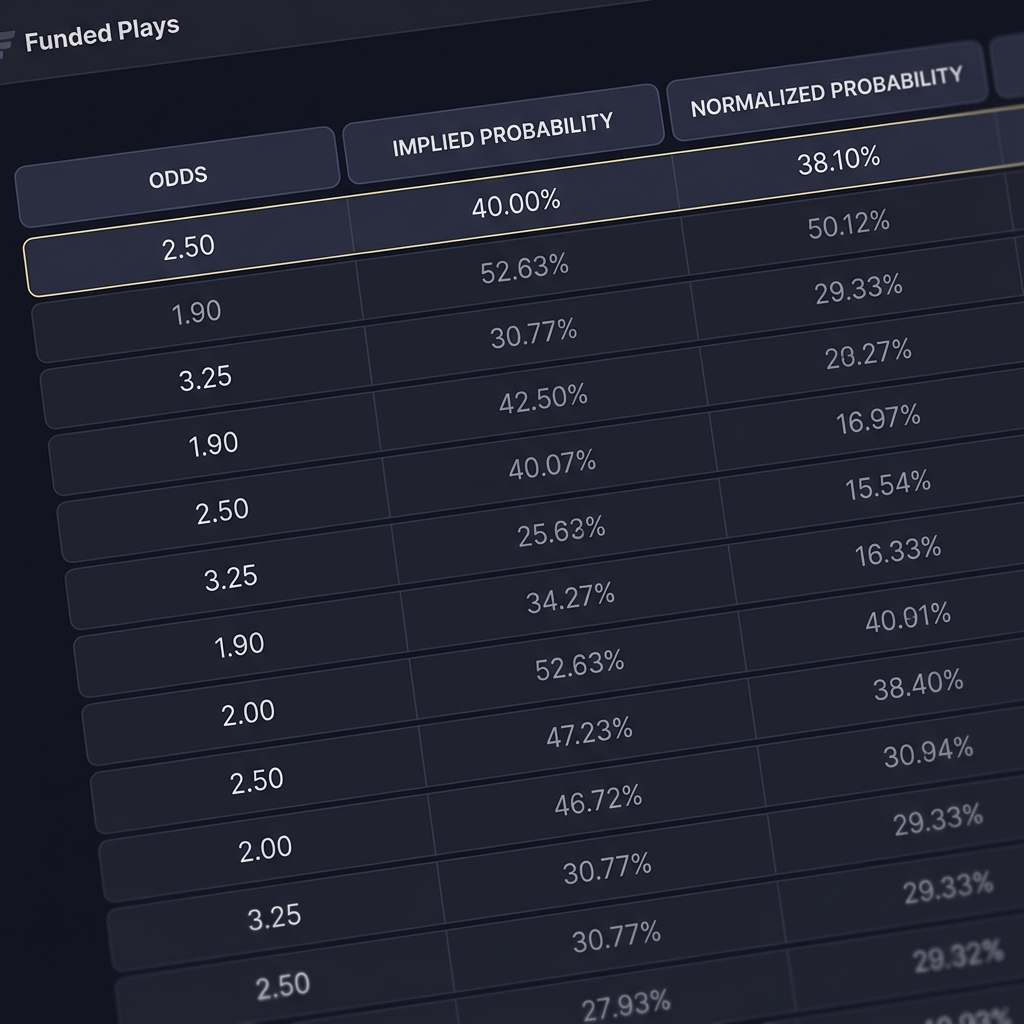
When converting step-by-step, preserve at least three to four decimal places in intermediate results to reduce rounding bias when you later normalize across many outcomes. If you plan to compute normalized fair probabilities, perform normalization after converting every market price into an implied probability and before any thresholding or ranking.
Quick cheat-sheet: formulas and one-line reminders
Decimal: p = 1 / decimal. Fractional a/b: p = b / (a + b), decimal equivalent = 1 + a/b. Moneyline: p = 100 / (A + 100) for +A, p = A / (A + 100) for -A. Keep these three one-line formulas handy for spreadsheets and scripts Investopedia implied probability
Remember: fractional odds show net winnings relative to stake while decimal odds include stake in the quoted return. That distinction is why fractional-to-decimal conversion includes the plus one term, and why you should not mix stake and net values when you compute implied probability Wikipedia odds overview
Normalizing implied probabilities to remove bookmaker margin
Bookmaker margin, or overround, is the reason summed implied probabilities for a mutually exclusive market usually exceed 1. If you convert every quoted price into an implied probability and sum those values, the total will typically be greater than one because the market embeds a margin to ensure a bookmaker edge Wikipedia overround
The simplest normalization rescales each implied probability by the total sum. Compute implied_p_i for every outcome i, sum S = sum(implied_p_i), then fair_p_i = implied_p_i / S. This returns a set of probabilities that sum to one and gives a margin-free comparator you can use for model calibration or portfolio-like evaluations. For online calculators, see OddsJam implied probability calculator.
Numeric example: a three-outcome market with implied probabilities 0.42, 0.35, 0.26 sums to S = 1.03. Normalized fair probabilities are 0.42/1.03 = 0.4078, 0.35/1.03 = 0.3398, 0.26/1.03 = 0.2524. The normalization step is purely arithmetic and useful when you need a common baseline across markets Wikipedia overround

Limitations of this simple normalization include the fact that it assumes the margin is distributed proportionally across outcomes. In some markets the margin is uneven or reflects liquidity and book balancing, so more advanced margin-removal methods may be appropriate when precision matters. (see Funded Plays homepage)
Common mistakes and pitfalls when you convert odds to probability
A frequent error is mixing stake and net conventions: applying fractional formulas while treating the quoted fraction as if it were a decimal that includes stake will produce incorrect probabilities. Keep the fractional-net versus decimal-stake difference explicit in your notes and spreadsheet labels Wikipedia odds overview
Another common pitfall is forgetting to normalize multi-outcome markets when you need margin-free comparisons. Comparing raw implied probabilities across markets without removing overround can mislead model calibration or edge estimation because the summed probabilities overstate true mass Wikipedia overround
Identify the odds format, apply the matching formula to compute implied probability (decimal: 1/decimal, fractional a/b: b/(a+b), moneyline: 100/(A+100) for +A or A/(A+100) for -A), and normalize across outcomes if you need a margin-free set.
Rounding errors and sign-handling mistakes when converting moneyline odds are also frequent: accidentally treating a negative moneyline as positive or rounding too early can flip a probability noticeably. Preserve a few extra decimals, and apply final rounding only for display or reporting.
Practical examples: single-match worked problems
Decimal example: take decimal odds 2.40. Compute p = 1 / 2.40 = 0.4166667. Round for display to p = 0.417 or 41.7 percent after you have preserved precision for any downstream normalization or comparisons Investopedia implied probability
Fractional example: a 5/2 fractional quote. First compute decimal = 1 + 5/2 = 3.5. Then implied p = 1 / 3.5 = 0.2857143. Alternatively, apply the fractional formula directly: p = 2 / (5 + 2) = 0.2857143, which matches the decimal-based result Wikipedia odds overview
Moneyline example: +250 gives p = 100 / (250 + 100) = 100 / 350 = 0.2857143. For a negative moneyline like -150, p = 150 / (150 + 100) = 150 / 250 = 0.60. These examples show the two moneyline formulas and how they map to the same probability scale as decimal and fractional formats Investopedia moneyline guide
Practical examples: multi-outcome markets and tournaments
Three-way market example: odds for Team A 2.20, Team B 3.30, Draw 3.80. Convert to implied probabilities: 1/2.20 = 0.4545, 1/3.30 = 0.3030, 1/3.80 = 0.2632. Sum S = 1.0207, so the market contains a small overround. Normalized probabilities are each implied_p divided by S to produce a margin-free vector you can use in calibration or ranking comparisons Wikipedia overround
Tournament example: when converting dozens of competitor odds, preserve precision in each implied probability and compute the total sum S across all participants. Small rounding steps applied early can accumulate, so carry 3 to 4 decimal places or more in intermediate calculations, and only round final normalized probabilities when presenting results.
In computational practice, work in arrays or columns and avoid iterative rounding. If you export market prices from an API or feed, convert each price to implied probability in bulk, compute S, then derive fair_p_i = implied_p_i / S before any sorting or thresholding.
In computational practice, work in arrays or columns and avoid iterative rounding. If you export market prices from an API or feed, convert each price to implied probability in bulk, compute S, then derive fair_p_i = implied_p_i / S before any sorting or thresholding.
Rounding, precision, and display conventions
Keep 3 to 4 decimal places in intermediate calculations to avoid bias when normalizing many small probabilities. For single-match displays, two decimal places or a percentage with one decimal place is usually sufficient for readability, but preserve raw values in your model files and spreadsheets.
Remember that display rounding can mislead comparisons: two probabilities that appear equal when rounded may differ meaningfully in raw form. Also note locale differences in decimal formatting; adopt a consistent convention for input and output when sharing spreadsheets or code.
Using implied probability in backtesting and forecasting
To compare a predictive model to the market, convert market prices to normalized implied probabilities and compare those to your model probabilities at the same event level. Consistent gaps between model and normalized market probabilities may indicate either a true model edge or a systematic bias in the model that requires further checks Investopedia implied probability Read more on the Funded Plays blog.
When you see persistent differences, investigate data, features, and calibration; markets reflect information, liquidity, and margin, so differences do not automatically imply exploitable value. Use simple scoring metrics, such as mean squared error on probability estimates or Brier-like checks, to track whether your model forecasts align with normalized market-implied probabilities over time Wikipedia odds overview
When implied probability is not the true probability and final checklist
Markets can misprice for many reasons: asymmetric information, liquidity constraints, and deliberate margining. That is why implied probability is a useful market signal but not a definitive statement of objective chance, and why you should treat normalized market probabilities as comparators rather than truths Wikipedia overround
Checklist to convert odds to probability correctly: identify the format, convert fractional to decimal if needed, compute implied p with the correct formula, sum implied probabilities across mutually exclusive outcomes and normalize if you need margin-free values, preserve precision through intermediate steps, and document final rounding for reporting. Use these steps as a disciplined workflow when building model comparisons or performance reviews Investopedia implied probability See how Funded Plays evaluations work for related process notes.
Implied probability is the chance implied by market prices and quoted odds, reflecting payout conventions and any bookmaker margin rather than a guaranteed true probability.
For fractional odds a/b compute p = b / (a + b); you can also convert to decimal via 1 + a/b and then use p = 1 / decimal.
Markets usually include a margin that makes summed implied probabilities exceed one, so normalization rescales values to a margin-free set that sums to one for fair comparison.
References
- https://openstax.org/books/introductory-statistics-2e/pages/3-1-experiment-sample-space-events
- https://www.investopedia.com/terms/i/implied-probability.asp
- https://en.wikipedia.org/wiki/Odds_(betting)
- https://www.investopedia.com/terms/m/moneyline.asp
- https://en.wikipedia.org/wiki/Overround
- https://www.fundedplays.com/challenges
- https://www.omnicalculator.com/statistics/implied-probability
- https://www.covers.com/tools/odds-converter
- https://oddsjam.com/betting-calculators/implied-probability
- https://www.fundedplays.com/blogs
- https://www.fundedplays.com/blogs/how-fundedplays-evaluations-work
- https://www.fundedplays.com