
How to convert odds to probability: quick definition and formulas
When you need to convert odds to probability quickly, the most direct rule is simple: if odds against an event are a to b, the event's probability p equals b divided by a plus b, written p = b / (a + b). This definition gives an immediate numerical answer and is widely used in statistics education and reference material Wolfram MathWorld.
To complement that, if odds are given in favor as a to b, the probability is a divided by a plus b, p = a / (a + b). The algebraic relation between probability and odds in favor is o = p / (1 - p), which rearranges to p = o / (1 + o). For odds against commonly written as oa, you can use p = 1 / (1 + oa) to get the same result in a compact form OpenStax, Introductory Statistics.
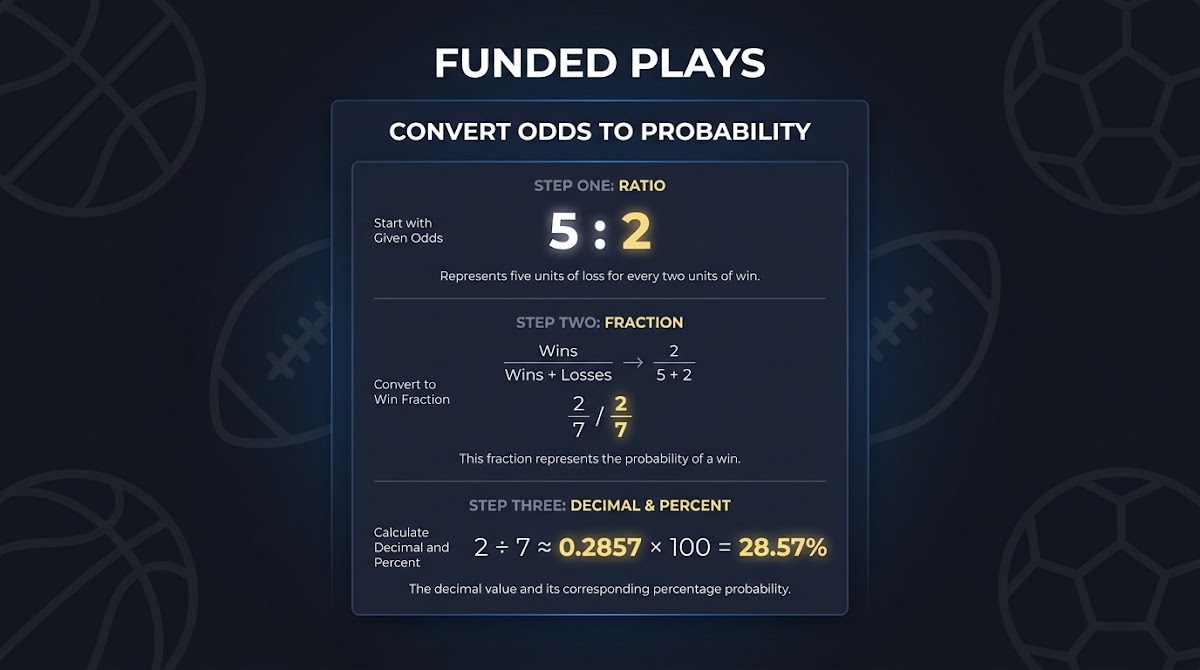
To express probability as a percentage, multiply p by 100. For example, fractional odds written 5:2 against mean p = 2 / (5 + 2) = 2/7, which converts to about 28.57 percent when multiplied by 100 StatLect, Odds and probabilities.
Practice structured sports predictions with clear challenge rules
Try converting a simple set of odds yourself: pick odds against 3:1, compute p = 1/(3+1) and then multiply by 100 to see the percent chance.
Odds against versus odds in favor
Odds against and odds in favor use the same two numbers but swap the role of numerator and denominator when you form the probability. Stating whether odds are 'against' or 'in favor' is essential because swapping the terms inverts the computed probability, a common source of error in casual reading of odds UK Gambling Commission guidance.
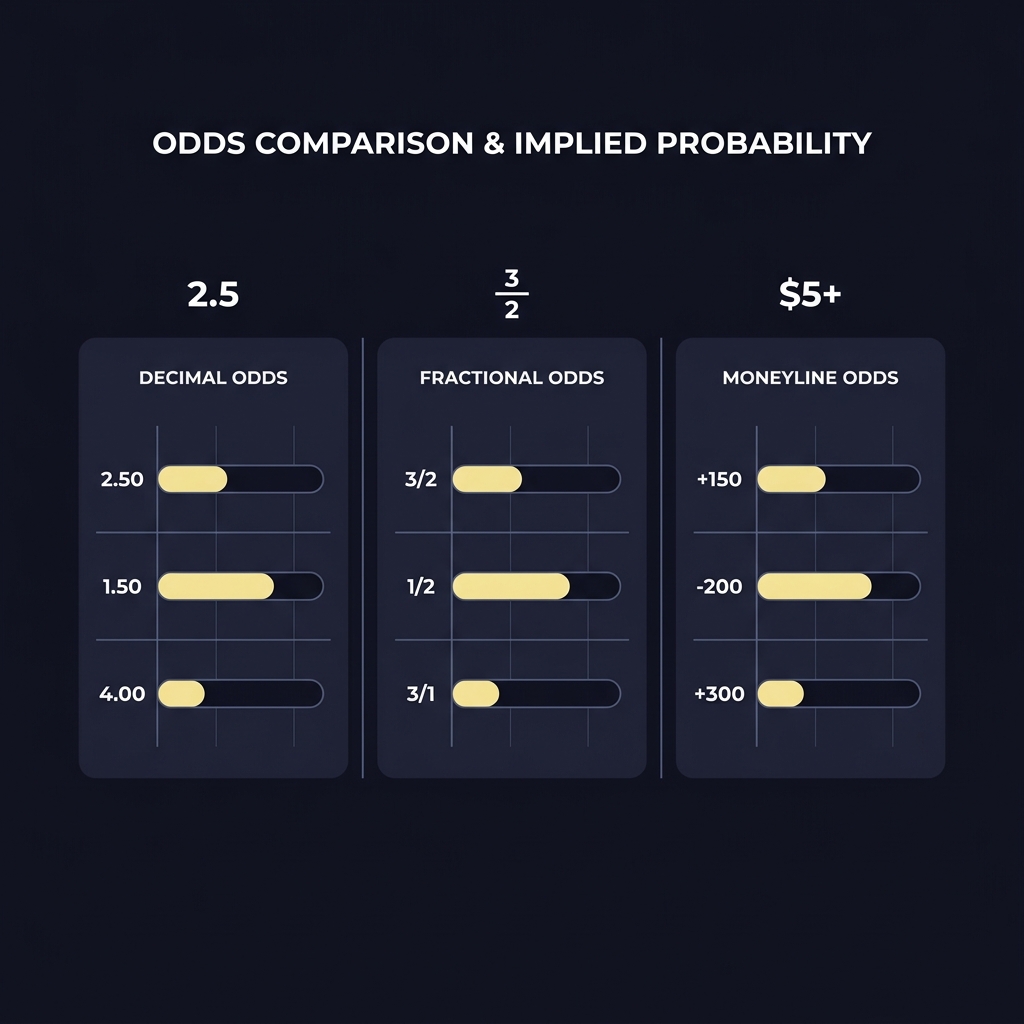
Odds appear in several common notations. Fractional odds, like 5:2, show two integers separated by a colon and usually indicate odds against unless otherwise stated. Decimal odds express the return per unit staked and can be converted to implied probability by taking 1 divided by the decimal odd when the decimal form is presented as the total return; moneyline formats use positive and negative integers common in U.S. markets and require a short adjustment before applying the same probability conventions Wolfram MathWorld.
Misreading which side of the colon represents the favored outcome is easy and changes the numerator in the probability fraction. For example, 5:2 written as odds against gives p = 2 / 7, but if someone mistakenly treats it as odds in favor, they would compute p = 5 / 7, which is the inverted estimate and clearly wrong for the original statement Encyclopaedia Britannica.

Decimal and moneyline forms are helpful in some workflows but always confirm the conversion rule the tool or site uses. For instance, converting decimal odds to probability typically involves p = 1 / decimal when decimal odds are the total-return style, and you can express that result as fractional odds against by rearranging the fraction appropriately Wolfram MathWorld. You can also use online implied probability tools such as OmniCalculator's implied probability calculator for quick checks.
Step-by-step method to convert odds against to probability
Follow a short, three-step manual method each time to avoid slip-ups: (1) identify a and b in the odds a:b, confirming whether the phrase is 'against' or 'in favor', (2) compute p = b / (a + b) when odds are against, (3) multiply p by 100 to report a percentage if you need a percent. This sequence is compact, repeatable, and reduces notation mistakes OpenStax, Introductory Statistics.
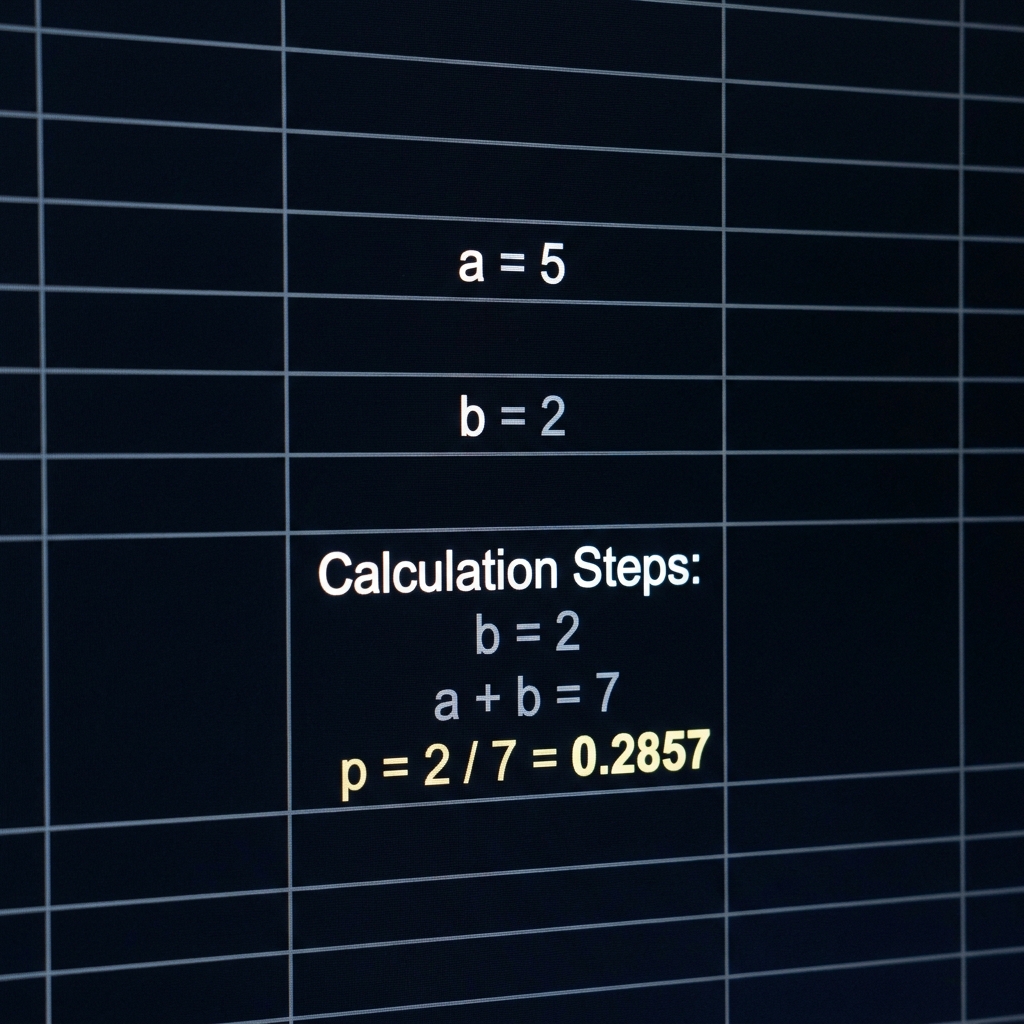
Apply the method to 5:2 (odds against) as a worked example: identify a = 5 and b = 2; compute p = 2 / (5 + 2) = 2/7; then convert to percent: (2/7) * 100 = 28.571... percent. That final percent is typically rounded to two decimal places for reporting as 28.57 percent.
If odds against are a to b, compute probability p as b / (a + b); convert to percent by multiplying p by 100. Verify using p = 1 / (1 + oa) or p = o / (1 + o) for alternate formats.
As a second verification, use the alternate formula p = 1 / (1 + oa) where oa is the odds-against ratio. For 5:2 against, oa = 5/2 = 2.5, so p = 1 / (1 + 2.5) = 1 / 3.5 = 2/7, which matches the direct fractional computation and confirms the result StatLect, Odds and probabilities.
Always state whether odds are 'against' or 'in favor' before starting arithmetic; documenting that choice in your notes or spreadsheet prevents later confusion, especially when sharing results in sports forecasts or model outputs.
A three-step manual method
Step 1: Read the statement and note the pair a:b and whether the wording is 'against' or 'in favor'. Step 2: Use p = b / (a + b) if 'against' and p = a / (a + b) if 'in favor'. Step 3: Multiply by 100 for percentage reporting and round sensibly. These steps map neatly to a spreadsheet formula and are simple to memorize Penn State STAT 504 lesson.
Worked fractional example and percentage conversion
The 5:2 against example demonstrates the arithmetic: a = 5, b = 2, p = 2 / 7 ≈ 0.285714, percent = 28.5714 percent. If you prefer two-decimal reporting, write 28.57 percent. This direct approach keeps the calculation transparent for later review and comparison to model forecasts OpenStax, Introductory Statistics.
Formula relationships: deriving and switching between odds and probability
You can derive p = o / (1 + o) by starting with the definition of odds in favor, o = p / (1 - p). Rearranging gives p = o (1 - p), then solving for p results in p = o / (1 + o). This algebraic identity is a compact way to move between probability and odds in favor StatLect, Odds and probabilities.
For odds against oa, substitute oa = (1 - p) / p and rearrange to get p = 1 / (1 + oa). That relation is useful when a market quote is expressed explicitly as odds against and you want the probability in one step instead of decomposing numerator and denominator separately Penn State STAT 504 lesson.
To convert a known probability back into fractional odds in favor, compute o = p / (1 - p) and then express that ratio as a simplified pair of integers when practical. If p = 0.2857, for instance, o ≈ 0.2857 / 0.7143 ≈ 0.4 which corresponds to fractional odds of 2:5 in favor when inverted to match usual integer notation after simplification; always double-check arithmetic when converting between floating values and small integer ratios.
Derive p = o / (1 + o) from p = a / (a + b)
Start with p = a / (a + b) and divide numerator and denominator by b to obtain p = (a/b) / (a/b + 1). Let o = a/b for odds in favor; then p = o / (1 + o). This short algebraic manipulation clarifies why the two forms are equivalent and helps when you have a decimal or ratio form of odds rather than whole-number fractions StatLect, Odds and probabilities.
Convert probability back to odds and odds against
Given p, compute odds in favor as o = p / (1 - p). The odds against are simply oa = (1 - p) / p. Both forms are useful: odds in favor are often used in logistic interpretations, while odds against are common in many betting displays. Remember that p = 0 or p = 1 are edge cases where the odds formulas produce infinite or zero denominators and must be handled separately Penn State STAT 504 lesson.
Common errors when you convert odds to probability
One of the most frequent mistakes is misreading 'odds against' as 'odds in favor', which in practice swaps a and b and inverts the intended probability. This simple wording confusion leads to dramatically wrong forecasts if not checked Encyclopaedia Britannica.
Another typical error is forgetting to add a + b in the denominator, for example dividing b by a instead of by a + b, or swapping numerator and denominator during manual arithmetic. Simple checklist-style verification reduces these slip-ups.

Rounding mistakes are common when reporting percentages. Keep a consistent rule for precision, such as two decimal places for most public reports, and document how you rounded to avoid confusion in comparisons. For more context see our homepage.
Edge-case handling is also necessary. If a = 0 in a to b odds against, the formula yields p = 1 (certainty). If b = 0, p = 0 (impossibility). Flag these cases in your workflow so they do not produce invalid arithmetic in automated spreadsheets StatLect, Odds and probabilities.
Typical calculation mistakes
Common arithmetic mistakes include swapping the numerator and denominator, misreading the notation, and copying the wrong values into a calculator. A short habit of writing down a and b before calculating prevents many errors.
Notation and rounding pitfalls
Be explicit about the notation style and keep rounding consistent. When converting to percentages, choose a sensible precision tied to the decision context; for casual forecasts two decimals is usually adequate while operational models may carry more digits during intermediate calculations UK Gambling Commission guidance.
Edge cases and what they mean for probability
Edge conditions follow directly from the algebra. If a = 0 in odds against a to b, then p = b / (0 + b) = 1, which indicates certainty. Conversely, if b = 0 then p = 0, which indicates an impossible event. These boundary outcomes are direct consequences of the base formula and should be handled with clear labels in any report Penn State STAT 504 lesson.
When a is very large compared with b, p approaches 0 but is not exactly zero unless b is zero. That limiting behaviour helps interpret very long odds: they indicate extremely small probability but not literal impossibility unless the numerator is zero StatLect, Odds and probabilities.
In spreadsheets and calculators, guard against division-by-zero errors by checking inputs before computing. If your pipeline could receive zeros, add conditional logic that maps a = 0 to p = 1 and b = 0 to p = 0 to avoid runtime failures.
Worked examples: convert odds to probability with practice problems
We start with fractional odds as the clearest worked case. Revisit 5:2 against step by step: identify a = 5 and b = 2; compute p = 2 / (5 + 2) = 2/7; convert to percent: 2/7 * 100 ≈ 28.5714 percent, commonly reported as 28.57 percent. This walkthrough shows each arithmetic step so you can replicate it in a spreadsheet or on paper OpenStax, Introductory Statistics.
Next, a decimal-odds example. If a bookmaker lists decimal odds of 4.0 as the total-return style, the implied probability is p = 1 / 4.0 = 0.25 or 25 percent. To express that as odds against, compute oa = (1 - p) / p = 0.75 / 0.25 = 3, so decimal 4.0 corresponds to 3:1 against. Confirm conversions both ways to avoid format mismatches when sharing results UK Gambling Commission guidance.
Moneyline formats require a short adjustment step before converting. For a positive moneyline like +300, implied probability is 100 / (moneyline + 100) = 100 / 400 = 0.25 or 25 percent, which corresponds again to 3:1 against. For negative moneyline like -150, use -moneyline / (-moneyline + 100) to obtain the probability. Confirm the formula your source uses before applying it in bulk conversions.
quick verification of fractional odds to probability in a spreadsheet
verify result by converting back to odds
Practice problems, try these on your own before checking answers below: (1) Convert 7:1 against to a percentage. (2) A decimal odd reads 2.5; what is the implied probability and the equivalent odds against? Solutions: (1) p = 1/(7+1) = 1/8 = 12.5 percent. (2) p = 1/2.5 = 0.4 = 40 percent, which is 3:2 against when expressed as a ratio of (1 - p) to p.
Verification tip: after you compute p, convert back using o = p / (1 - p) or oa = (1 - p) / p to ensure that the round-trip gives the original odds within rounding limits. Doing this check in a spreadsheet helps catch format or copying errors.
Fractional example (5:2) worked fully
Write the arithmetic in full: 5:2 against means p = 2 / (5 + 2) = 2 / 7 ≈ 0.285714. Multiply by 100 to report 28.5714 percent and round as needed. Keep the intermediate fraction 2/7 shown in notes to make exact comparisons later.
Decimal and moneyline examples
Decimal 3.25 gives p = 1 / 3.25 ≈ 0.307692 or 30.7692 percent. To express as odds against, compute oa = (1 - p) / p ≈ 2.25 which corresponds to about 9:4 against when converted to small integers. Always document the conversion steps to avoid ambiguity.
Short practice questions for the reader
Two short exercises to try: convert 11:4 against to percent, and convert decimal odd 1.8 to probability and then to odds against. Work them out and then use the verification formulas to confirm your answers.
Quick checks and verification methods
Two fast sanity checks help catch mistakes: first, compute the complement probability and ensure the pair sums to 1 when comparing an event and its opposite; second, recompute using p = o / (1 + o) or p = 1 / (1 + oa) to ensure consistent results. These quick cross-checks are easy to run mentally or in a spreadsheet Penn State STAT 504 lesson.
Spreadsheet validation is straightforward: store a and b in cells, compute p = b / (a + b), and then compute oa = (a / b) and confirm p = 1 / (1 + oa). If the two computed p values differ beyond rounding, inspect the original inputs for mis-typed notation.
When results look suspicious, examine three sources of error: incorrect interpretation of 'against' versus 'in favor', a misplaced decimal point, or a rounding rule applied too early. Holding intermediate values without rounding until final reporting reduces rounding drift.
Two fast sanity checks
Check 1: complementary probability adds to 1 with the event opposite. Check 2: compute via the alternate formula and confirm the same p within rounding. These checks quickly catch swapped numerators or omitted terms.
Using complements and alternative formulas
Using complements means verifying that p + (1 - p) = 1, which is trivial but a useful debugging step when you have several derived probabilities in a model. The alternative formulas p = o / (1 + o) and p = 1 / (1 + oa) offer immediate cross-validation.
When to use odds versus probability in analysis and communication
Pick the representation that matches your audience. For general readers and decision-making, probabilities or percentages are clearer because they correspond directly to chances. Odds are often the industry standard in betting interfaces and some statistical models, so present both forms when communicating with mixed audiences Wolfram MathWorld.
In modeling, probabilities are typically the input to most statistical methods, while odds or log-odds appear in logistic regression interpretations. Use consistent labeling and document conversion steps when moving between representations to preserve reproducibility.
When sharing chances publicly, label the format explicitly (for example, '28.57 percent' or '5:2 against') to avoid readers misinterpreting the numbers. Clear labels prevent the most common communication mistakes in forecasts and reporting Encyclopaedia Britannica. For guidance on how Funded Plays presents results, see our blog.
Applications for sports prediction and responsible usage
Converting odds to probability helps compare market-implied chances to your model forecasts, letting you identify areas where your model diverges from public pricing. That comparison is a core task for sports prediction workflows and for disciplined evaluation of forecasting performance Wolfram MathWorld. For one view of how our evaluations work internally see how Funded Plays evaluations work.
Use probabilities to compute simple expected-value checks: expected value per unit can be approximated by p times return minus cost, using the probability you calculated from the quoted odds. Remember that converting odds to probability does not imply a guaranteed edge; it only provides a common scale to compare forecasts and market-implied chances UK Gambling Commission guidance. For a general primer on the math behind betting odds see Investopedia.
Responsible presentation matters. When publishing probability estimates, state assumptions, rounding rules, and the conversion method you used. This transparency keeps comparisons fair and helps readers interpret your forecast responsibly.
Converting probability back to odds: the reverse calculation
To convert probability p into odds in favor, use o = p / (1 - p). If p = 0.285714, then o ≈ 0.285714 / 0.714286 ≈ 0.4, which corresponds to fractional odds 2:5 in favor. For odds against, compute oa = (1 - p) / p and express as a simplified integer ratio where practical StatLect, Odds and probabilities.
Be careful with p = 0 or p = 1; these boundary probabilities do not produce finite odds because division by zero would occur. Flag such probabilities and handle them as special labels like 'impossible' or 'certain' rather than trying to express infinite odds Penn State STAT 504 lesson.
When presenting converted odds, choose a human-friendly integer approximation and document the rounding. For instance, if oa = 2.25, present 9:4 or state 'about 2.25:1 against' so readers grasp the scale clearly.
Tools and calculators: when to use them and what to watch for
Online converters and spreadsheet formulas save time when processing many odds, but validate a few random outputs manually using the base formulas to ensure the tool interprets inputs the same way you do. Mismatched input conventions are the main source of tool misreports UK Gambling Commission guidance. Try an online odds converter such as AceOdds odds converter for quick conversions.
When building a spreadsheet, use a consistent cell layout such as cells A and B for odds a and b, and a formula cell for p = B / (A + B). Include an explicit check cell that recomputes p via 1 / (1 + (A/B)) to catch input-format issues quickly.
For bulk conversions, document the assumed format and run cross-checks on a sample set. Tools are helpful but do not replace a short manual verification routine that ensures correctness across formats.
Three-line checklist: 1) Confirm notation and whether odds are 'against' or 'in favor'. 2) Compute p using p = b / (a + b) for odds against, then multiply by 100 for percent. 3) Verify by converting back using o = p / (1 - p) or p = 1 / (1 + oa) and check rounding.
Final reminders: handle edge cases a = 0 or b = 0 explicitly, keep rounding consistent, and label the format in all shared outputs. Practice with a few examples to build a quick habit and reduce mistakes in live reporting.
Further reading and authoritative references
For deeper algebraic explanation consult StatLect or Penn State for lesson-style derivations. For accessible textbook treatment see OpenStax, and for concise reference overviews consult Wolfram MathWorld or Encyclopaedia Britannica. For consumer-facing guidance on betting odds formats, the UK Gambling Commission provides practical examples and conversion notes Wolfram MathWorld. For practical online calculators see OmniCalculator and general reference material such as Investopedia.
When odds are given as a to b against, compute p = b / (a + b) and multiply by 100 to get a percentage.
Convert decimal odds with p = 1 / decimal when decimal is total-return style; adjust moneyline using standard sign rules before converting.
Treat a = 0 as certainty (p = 1) and b = 0 as impossibility (p = 0); for very large odds interpret p as near zero and avoid dividing by zero in tools.
References
- https://mathworld.wolfram.com/Odds.html
- https://openstax.org/books/introductory-statistics-2e/pages/3-4-odds
- https://www.statlect.com/fundamentals-of-statistics/odds
- https://www.gamblingcommission.gov.uk/consumers/advice-and-guides/understanding-betting-odds
- https://online.stat.psu.edu/stat504/lesson/3/3.1
- https://www.britannica.com/science/odds-probability
- https://www.fundedplays.com/challenges
- https://www.fundedplays.com
- https://www.fundedplays.com/blogs
- https://www.fundedplays.com/blogs/how-fundedplays-evaluations-work
- https://www.omnicalculator.com/statistics/implied-probability
- https://www.aceodds.com/bet-calculator/odds-converter.html
- https://www.investopedia.com/articles/dictionary/042215/understand-math-behind-betting-odds-gambling.asp