
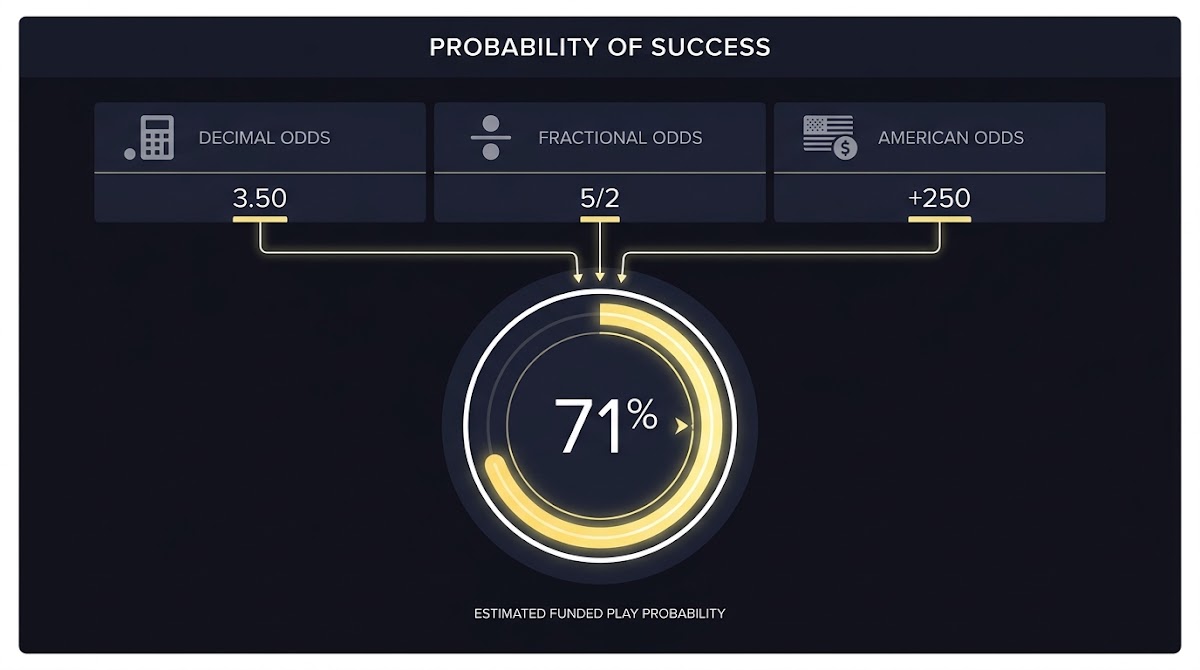
What it means to convert odds to a percentage
Converting odds to a percentage means turning the quoted market price for an outcome into an implied probability, a simple percent that expresses how likely the market thinks that outcome is. This process, often called implied probability, helps you compare lines shown in different formats and see where the market places weight without assuming guaranteed results.
Implied probability is best understood as the bookmaker or market implied chance for an outcome, not a promise of what will happen. Treating the percent as the market view makes it easier to measure differences across decimal, fractional, and American displays and to test those numbers against your own estimates.
Users should be cautious: market odds normally include a bookmaker margin that inflates the total implied probability across all outcomes, so the raw percentages are not exact forecasts and must be read with that context in mind. For a clear primer on the concept of implied probability, see Investopedia's overview of implied probability Implied Probability: Formula and How to Calculate.

Why implied probability matters
Implied probability gives a consistent unit for comparing prices from different displays. When you convert odds to percentage, you can quickly compare whether two offers express similar expectations or whether one looks overpriced relative to another. That clarity is useful for deciding where to allocate attention and for testing whether a line matches your own forecast.
Remember that implied probability is a tool for comparison and decision making rather than a certainty. Use it to find disagreements between market prices and your estimates, and then apply disciplined staking instead of assuming guaranteed outcomes.
How market prices differ from true probability
Market prices incorporate the bookmaker's view, risk management, and margin, so they often differ from an independent or objective probability estimate. The difference between market implied probability and a thoughtfully derived estimate can indicate potential value or a need for caution, depending on your confidence and edge.
Because market prices reflect house rules and commercial incentives, always combine conversion with responsible assessment and bankroll-aware sizing.
Canonical formulas: decimal, fractional, and American odds, convert odds to percentage
Decimal odds convert to implied probability with the reciprocal of the decimal number: implied probability = 1 / decimal. To express that as a percent, multiply by 100, or use 100 / decimal for a direct percent result. This formula is the standard conversion for decimal odds and clarifies that decimal quotes include the stake in the returned amount; Investopedia documents the decimal odds convention and formula Decimal Odds Definition.
Fractional odds written as a/b convert to implied probability using b / (a + b). Multiply by 100 to get a percent. Fractional odds express net profit relative to the stake, so remember that the stake handling differs from decimal format; the fractional conversion and its interpretation are described in educational references Fractional Odds Definition.
American, or moneyline, odds use two cases. For positive moneyline +A the implied probability percent is 100 / (A + 100). For negative moneyline −A use A / (A + 100), where A is the absolute value of the quoted number. These formulas reflect the $100 reference convention used in moneyline quotes and are standard in betting education materials Moneyline (American) Odds Explanation.
To avoid conversion errors, note the stake convention difference: decimal odds include the stake in the returned amount, fractional odds state net profit versus stake, and American odds reference profit on a $100 base or the stake needed to win $100, or use an odds converter like AceOdds. Misreading stake treatment is a common source of mistakes when you convert odds to percentage.
Practice converting odds before comparing lines
Try these formulas on a single line to confirm you understand the stake conventions before you move to multi-outcome or parlay calculations.
Decimal odds formula
The decimal formula is compact: implied probability = 1 / decimal. For an easy percent, use 100 / decimal. Because decimal odds include the stake, the conversion directly gives the market implied probability for the full return, stake included. See Smarkets' how-to.
That stake inclusion is why a decimal figure of 2.00 corresponds to a 50 percent implied probability: 100 / 2.00 = 50. This check helps avoid typical misreads where a user treats decimal like fractional odds.
Fractional odds formula
For fractional odds a/b, calculate implied probability as b / (a + b), then multiply by 100 to see the percent. The formula reflects that the quoted fraction focuses on net profit relative to the stake rather than the total returned amount.
For example, fractional 3/1 means a = 3 and b = 1, so implied probability = 1 / (3 + 1) = 0.25 or 25 percent. Keeping the stake-versus-return distinction in mind prevents applying the decimal reciprocal by mistake.
American (moneyline) odds formula
American moneyline odds use the $100 reference: for +A, implied probability percent = 100 / (A + 100); for −A, use A / (A + 100) where A is positive. That split accounts for how bookmakers express profit relative to $100 stakes in the moneyline convention.
As an illustration, a moneyline of +250 becomes 100 / 350 = about 28.57 percent implied probability, while a moneyline of −150 gives 150 / 250 = 60 percent. Remember that the moneyline formulas are numeric conventions for translation, not guarantees of real-world outcomes, and are covered in standard references Moneyline (American) Odds Explanation.
Worked examples: step-by-step conversions
Concrete steps help lock in the formulas. Start by identifying the format, apply the matching formula, and then sanity-check by converting back or comparing with an intuitive expectation. The following examples use those steps so you can follow along and verify the stake handling.
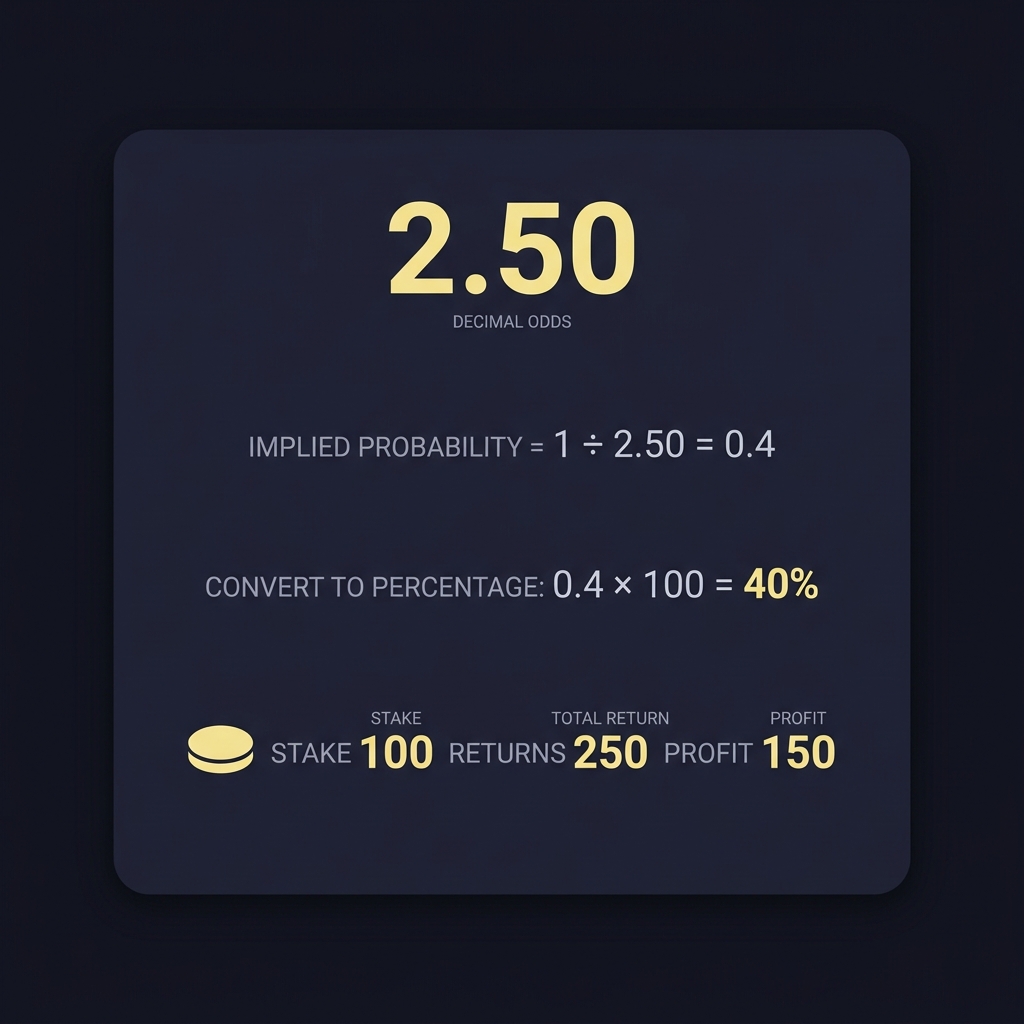
Decimal example: take decimal 2.50. Apply the formula implied probability = 1 / decimal, so 1 / 2.50 = 0.4, or 40 percent when multiplied by 100. Confirm the stake convention by noting that a winning unit returned at 2.50 yields 1.50 net profit plus the stake, and the conversion matched that total return understanding.

Fractional example: take 5/2. Set a = 5 and b = 2. Compute implied probability = b / (a + b) = 2 / (5 + 2) = 2 / 7, or about 28.57 percent. As with the decimal example, double check by thinking in terms of net profit per stake: fractional expresses profit relative to the stake, which explains the numerator and denominator roles in the formula; see the fractional odds educational note for the conventional interpretation Fractional Odds Definition.
American examples: positive moneyline and negative moneyline. For +180, implied probability = 100 / (180 + 100) = 100 / 280, or about 35.71 percent. For −120, use 120 / (120 + 100) = 120 / 220, or about 54.55 percent. These calculations reflect the $100 standard used in moneyline displays and help you translate profit references into probability space; the moneyline conventions are explained in betting education materials Moneyline (American) Odds Explanation.
Practice checks to avoid stake mistakes: 1) Identify whether the format includes stake; 2) Convert and then think through a 1-unit or 100-dollar win to see if numbers align; 3) If results look inconsistent, re-check which side of the fraction you used. These quick verifications reduce mechanical errors when you convert odds to percentage. You can also check results with an implied probability calculator like OmniCalculator.
Why implied probabilities often add to more than 100 and how to normalize
Bookmakers add a margin into prices so the sum of implied probabilities across all mutually exclusive outcomes typically exceeds 100 percent. That excess is known as the overround or bookmaker margin and explains why raw implied percentages need context before direct comparison. A practical overview of overround shows why sums over 100 percent are common in market prices Overround explanation.
Use the standard formulas for each format, convert every line to implied probability, normalize across mutually exclusive outcomes if needed, and compare the market percent to your own estimate to assess value.
Normalization rescales each implied probability so the total equals 100 percent and gives a simple estimate of 'fair' probabilities across mutually exclusive outcomes. To normalize, sum the raw implied probabilities for all outcomes, then divide each outcome's implied probability by that sum and multiply by 100 to get the normalized percent. This method is a practical tool to compare lines on a common footing, but it does not remove structural market bias or account for correlated market factors.
For example, in a two-outcome market with implied probabilities of 52 and 54 percent (total 106 percent), dividing each by 1.06 yields normalized probabilities of about 49.06 and 50.94 percent respectively, a simple way to see where the market's adjusted view falls after removing the margin's scale effect.
Using converted percentages to find value and compare lines
The core value principle is straightforward: if your independent probability estimate for an outcome is higher than the market implied probability, that line may contain value. That comparison works the same whether you use raw implied probabilities or normalized percentages, but normalization often makes comparisons fairer across outcomes when a visible overround exists.
To run a compact value check, convert the market line to a normalized implied probability, estimate your own probability for the same event, and compare the two. If your estimate exceeds the market number by an amount that covers your required edge and staking plan, you may consider allocating stake according to bankroll rules rather than chasing a single perceived win. Find more guidance in how Funded Plays evaluations work.
Example comparison: suppose a normalized market implied probability for a team to win is 45 percent, and your model estimates 52 percent. That 7 point gap suggests a potential edge, but you should translate that edge into a staking decision consistent with your bankroll limits and risk tolerance rather than assuming repeated success.
Implied probability is a decision aid, not a certainty. Pair percentage conversions with sensible stake sizing and consistent record keeping so you can measure whether your estimates produce positive outcomes over time.
Common mistakes and how to avoid them
Misreading stake conventions is a frequent error. Treat decimal, fractional, and American formats as distinct and apply the correct conversion formula for each. If you apply decimal reciprocal to a fractional quote, the implied percentage will be wrong and will mislead any value check.
Forgetting to normalize when comparing multi-outcome markets is another common trap. Raw implied probabilities from an overrounded market will overstate the market probability and can produce misleading comparisons if you do not rescale them to 100 percent across mutually exclusive outcomes.
Mixing formats without consistent conversion causes avoidable mistakes. Always convert every line into the same percentage basis before comparing; do not compare a fractional percent with a moneyline percent directly without confirming both are expressed as the same implied probability type.

Practical fixes: double check the format, run a quick sanity test by thinking in units or in the $100 moneyline reference, and normalize when multiple mutually exclusive outcomes exist. See Funded Plays.
Advanced scenarios: multiple outcomes, ties, and parlays
In multi-outcome markets the exact same conversions apply for each outcome; calculate each outcome's implied probability using its format-specific formula, then include all outcomes in any normalization step so the rescaled probabilities sum to 100 percent. This preserves consistency when markets offer more than two mutually exclusive outcomes.
Ties or draws are treated like any other outcome and must appear in the total when you normalize. Omitting the draw from the sum produces incorrect rescaling and undermines any fair comparison you attempt to make with normalized percentages.
Parlays combine implied probabilities differently. To get the parlay implied chance from market odds, convert each leg to decimal implied probability (that is, 1 / decimal), then multiply the decimal probabilities together. The product is the parlay implied probability under the market's pricing; note that this reflects combining market prices, not an assertion that events are independent in reality.
As a practical note, parlays amplify both the bookmaker margin effect and any model error, so convert carefully and consider the compounded impact on value assessment and bankroll exposure.
Checklist and next steps
Use this quick conversion checklist before you place any stake: 1) Verify the odds format. 2) Apply the correct formula. 3) Check stake convention. 4) Sum implied probabilities across mutually exclusive outcomes. 5) Normalize if necessary. 6) Compare the normalized market number to your independent estimate before sizing a stake. Find more guidance in how Funded Plays evaluations work.
quick conversion checklist to use when checking lines
mark each step as done
Recommended practice exercises: convert three sample lines, normalize a three-way market that includes a draw, and compare your estimate with the normalized market number to determine if a value edge exists. Recording results and decisions builds discipline and helps you learn which checks matter most for your process. (see our blog for more examples)
Responsible participation reminder: converting odds to percentage is an interpretive skill that supports disciplined decision making. It does not remove risk or guarantee outcomes. Use the conversions to inform careful, repeatable choices rather than chasing immediate wins.
Divide 1 by the decimal odds and multiply by 100 to get the implied probability percentage.
Overround is the bookmaker margin that makes the sum of implied probabilities exceed 100 percent in a mutually exclusive market.
Normalize when comparing mutually exclusive outcomes so the probabilities sum to 100 percent, but recognize normalization only approximates a fair price.
References
- https://www.investopedia.com/terms/i/implied-probability.asp
- https://www.investopedia.com/terms/d/decimal-odds.asp
- https://www.investopedia.com/terms/f/fractional-odds.asp
- https://www.investopedia.com/terms/m/moneyline.asp
- https://www.en.wikipedia.org/wiki/Overround
- https://en.wikipedia.org/wiki/Overround
- https://www.aceodds.com/bet-calculator/odds-converter.html
- https://help.smarkets.com/hc/en-gb/articles/214058369-How-to-calculate-implied-probability-in-betting
- https://www.omnicalculator.com/statistics/implied-probability
- https://www.fundedplays.com/challenges
- https://www.fundedplays.com
- https://www.fundedplays.com/blogs
- https://www.fundedplays.com/blogs/how-fundedplays-evaluations-work