
Quick answer: what does 1% mean in betting odds?
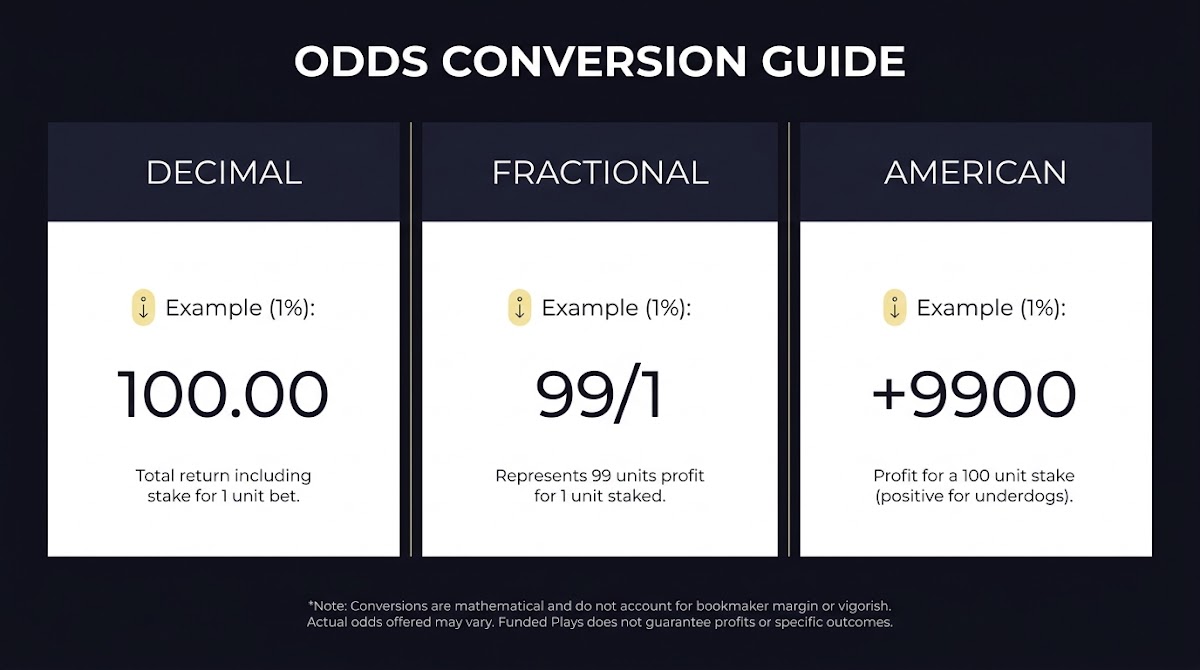
A 1% probability corresponds to fair, margin-free odds of decimal 100.00, fractional 99/1, and American +9900; these are notation changes for the same underlying 1 percent chance, not different probabilities, and they follow the standard conversion relationships used across odds formats Wikipedia article on Odds.
Stating these equivalents lets you translate between how probability is shown and how payouts are expressed without changing the actual chance of the event. For clarity: decimal 100.00 means a one unit stake returns 100 units including stake, fractional 99/1 means 99 units profit for 1 unit staked, and American +9900 indicates a 1 unit stake would profit 99 times the stake scaled to the American convention.
Practice converting probabilities and compare with market prices on the FundedPlays Challenges page
Use the worked examples below to translate any percentage you use in models into the odds format your workflow requires.
At-a-glance equivalents
Immediate equivalents for a fair 1 percent probability are: decimal 100.00, fractional 99/1, American +9900. This is a direct application of the reciprocity and moneyline formulas that define notation-conversion, not a market price or bookmaker offer Investopedia implied probability guide.
Why a simple conversion matters
Knowing how to convert odds to percentage quickly helps with model checks, communicating chances, and spotting value relative to market prices where margins exist. When you report or compare probabilities, using the same notation keeps comparisons accurate and repeatable.
How to convert odds to percentage: core formulas for decimal, fractional, and American
Decimal odds: reciprocity formula (convert odds to percentage)
Decimal odds and probability are reciprocals. The formulas are D = 1/p and p = 1/D, where p is the probability expressed as a decimal (for example, 0.01 for 1 percent) and D is decimal odds. Plugging p = 0.01 gives D = 1/0.01 = 100.00 as the decimal result, a straightforward calculation often used in software and spreadsheets Wikipedia article on Odds.
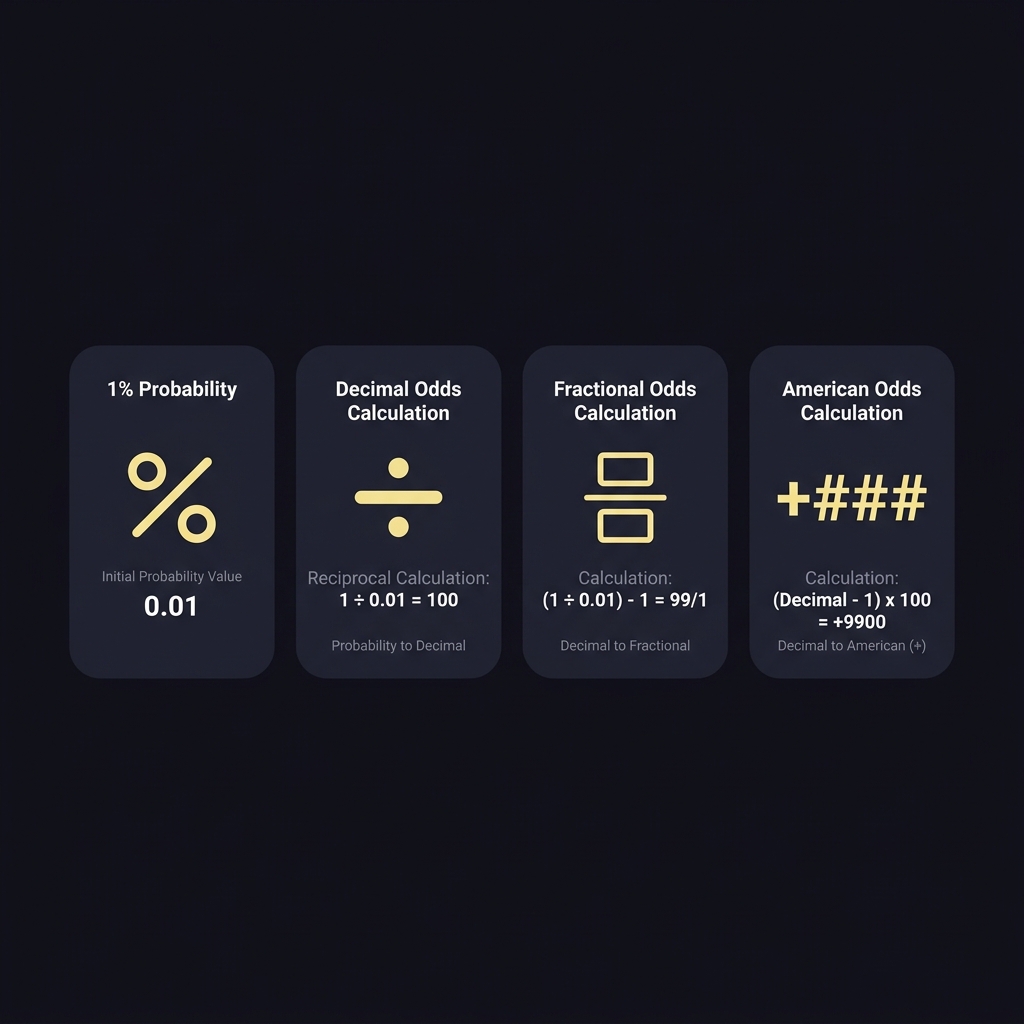
In plain terms: to convert a percentage to decimal odds, divide 1 by the probability expressed as a fraction of 1. To convert from decimal odds back to a percentage, take the reciprocal and multiply by 100 for percent form.
Fractional odds: relation and inversion
Fractional odds F relate to probability by p = 1/(F + 1) and equivalently F = (1 - p)/p. Using p = 0.01, F = (1 - 0.01)/0.01 = 0.99/0.01 = 99, so the conventional fractional display is 99/1, which reads as 99 units of profit per 1 unit staked. The fractional formulas are standard and worth memorizing for quick manual conversion Wikipedia fractional odds.
Fractional odds are especially useful when you want to express profit per unit staked in a compact form; convert a fraction back to probability by adding the numerator and denominator and dividing the denominator by that sum.
American (moneyline) formulas for underdogs and favorites
American moneyline odds use different formulas for positive (underdog) and negative (favorite) numbers. For positive A, p = 100/(A + 100). For negative A, p = -A/(-A + 100). The inverse for underdogs is A = 100*(1 - p)/p. Applying p = 0.01 to the underdog formula gives A = 100*(1 - 0.01)/0.01 = 9900, so the standard American representation is +9900; these conversions follow the moneyline conventions used in U.S. markets Wikipedia moneyline article.
Use the American formulas when your workflow or audience prefers moneyline notation; keep in mind the sign indicates whether the price is a favorite or an underdog and the scale changes accordingly.

Step-by-step examples: converting common percentages (including 1%)
Exact worked example for 1 percent, step 1: start with p = 1% = 0.01. Step 2, decimal: D = 1/p = 1/0.01 = 100.00. Step 3, fractional: F = (1 - p)/p = 0.99/0.01 = 99, displayed as 99/1. Step 4, American: for an underdog use A = 100*(1 - p)/p = 9900 and show as +9900. These calculations follow the standard conversion rules used by practitioners Wikipedia article on Odds.
Keep each step separate when you work manually: convert the percent to a decimal fraction first, then apply the appropriate formula for the target notation. This reduces arithmetic mistakes and makes it easier to trace errors.
Other useful examples, first 5 percent: p = 0.05. Decimal = 1/0.05 = 20.00, fractional = (1 - 0.05)/0.05 = 19/1, American = +1900 for the underdog form. Use the same formulas as above to keep consistency in reporting Investopedia implied probability guide.
Use the standard formulas: decimal D = 1/p gives 100.00 for p = 1 percent, fractional F = (1 - p)/p gives 99/1, and American underdog A = 100*(1 - p)/p gives +9900; adjust market odds for bookmaker margin before treating them as fair probabilities.
Small probability example, 0.5 percent: p = 0.005. Decimal = 1/0.005 = 200.00, fractional = 199/1 using F = (1 - p)/p rounded to the nearest whole fraction, and American = +19900 for the underdog computation. Very small probabilities magnify rounding effects, so use enough precision in your calculations Wikipedia fractional odds.
Check your math with simple reciprocal tests: after converting percent to decimal, convert decimal back to percent with p = 1/D and verify you recover the original value within the rounding tolerance you expect. These checks catch misplaced decimal points and sign errors quickly.
Understanding bookmaker margin and why listed odds rarely equal fair probabilities
What overround means
Bookmakers build a margin into posted odds so the sum of implied probabilities from market prices typically exceeds 100 percent; this surplus is called the overround or book margin and explains why listed odds are usually different from fair, margin-free odds Wikipedia overround article.
Because of overround, a displayed market implied probability for an outcome will generally be larger than its fair probability when the book is balanced to earn a margin. If you want to use market prices as true probabilities you must first adjust for the margin, otherwise comparisons to model probabilities will be biased.
How margin inflates implied probabilities
When a bookmaker prices an event, they scale prices to include a profit margin across the book. The practical consequence is that a market-implied figure labeled 1.2 percent might correspond to a fair probability closer to 1.0 percent after removing the overround. Professionals explicitly remove or normalize the margin before using market-implied probabilities in models Wikipedia overround article.
Understanding and adjusting for margin matters when you convert odds to percentage for decision-making, because unadjusted market probabilities can systematically understate or overstate real value relative to a model.
How to adjust listed odds to estimate true probability
Proportional (normalization) method
A common and simple approach is proportional normalization. Convert each listed market price to implied probability, sum those implied probabilities for the full book, then divide each implied probability by the sum and rescale to 100 percent. This rescales the market probabilities back to a fairer set while preserving their relative magnitudes.
Example numeric workflow: suppose a listed implied probability reads 1.2 percent for a longshot and the total book implied probability sums to 102 percent. Dividing 1.2 by 102 gives 0.0117647, which rescaled to percent is about 1.176 percent; normalizing the whole book brings each figure down so the total becomes 100 percent and the longshot falls closer to 1.0 percent in fair terms. This proportional method is a straightforward practical adjustment widely used in margin handling Wikipedia overround article (see online converters such as ACEOdds).

Simple scaling example using a two-outcome market
For a binary market, normalization is especially simple: convert both prices to implied probabilities, sum them, then divide each by the sum. If outcome A implies 60 percent and B implies 45 percent in raw market terms (summing to 105 percent), normalize by dividing each by 1.05 to get 57.14 percent and 42.86 percent as approximate fair probabilities.
Note that normalization gives an estimate, not a perfect truth. Different normalization techniques exist and professionals sometimes apply additional adjustments for liquidity, correlated markets, or cross-market edges Investopedia implied probability guide.
Which odds format should you use and when it matters
Regional preferences and clarity
American moneyline notation is common in the U.S., decimal odds are widespread in Europe and within many analytics tools, and fractional odds have historical use in the UK; all three are deterministic notational variants for the same underlying probabilities and convert with fixed formulas Wikipedia article on Odds.
Choose the format that aligns with your audience and tools. Decimal odds are often easiest for quick expected-value math because they work directly as multipliers, fractional odds clearly show profit per unit staked, and American odds are standard in many U.S.-facing reports.
Choose the format that aligns with your audience and tools. Decimal odds are often easiest for quick expected-value math because they work directly as multipliers, fractional odds clearly show profit per unit staked, and American odds are standard in many U.S.-facing reports.
When decimal vs fractional vs American matters for workflows
Decimal odds simplify spreadsheet calculations because multiplying stake by decimal gives gross return directly. Fractional odds are compact when communicating profit per stake to audiences used to that notation. American odds may require conversion before you aggregate or compare cross-regional prices in analytics pipelines.
When building dashboards or backtests, standardize on one format internally and convert at input or output boundaries to avoid repeated conversion errors and rounding inconsistencies. See the Funded Plays blog for examples of analytics workflows.
Common mistakes when you convert odds to percentage
Misreading American odds is common: positive and negative signs mean different formulas and scale differently, so treating them the same will flip probabilities or produce large errors. The correct formulas and sign handling are part of the moneyline conventions and should be checked before trusting a conversion Wikipedia moneyline article (see the Covers converter for quick checks Covers).
Convert a percentage into decimal, fractional, and American odds
Use high precision for very small probabilities
Forgetting to remove margin leads to biased comparisons. Always check whether posted market odds include overround and normalize if you want fair probabilities; failing to do so wrongly inflates the apparent chance of unlikely outcomes.
Rounding errors are another frequent source of trouble with very small probabilities. When percentages are small, keep extra decimal places until final presentation to avoid producing materially different decimal or American odds.
Practical scenarios: using percentage conversions in models and value checks
Value betting: comparing model probability to market odds
A simple value check compares your model probability to the market implied probability after margin removal. If your model yields a 1.5 percent estimate and the normalized market implied probability is 1.0 percent, that suggests value according to your model, subject to model quality and market dynamics Investopedia implied probability guide (see how Funded Plays evaluations work).
Always be conservative about claiming 'value': model error, sample limits, market liquidity, and transaction costs can all erode apparent edges. Use conversions to inform decisions, not to guarantee outcomes.
Integrating conversions into simple spreadsheets or dashboards
In a spreadsheet, store probabilities in a single canonical cell as a percent or decimal fraction, then compute decimal odds with a reciprocal formula, fractional odds with the (1 - p)/p formula, and American odds using the moneyline equations. Keeping one canonical source reduces duplication and rounding drift.
Log the raw market implied probability and the normalized fair probability side by side to track changes over time and to backtest how often your model identifies profitable discrepancies before costs.
Cheatsheet: quick conversions and mental shortcuts
Instant checks for very small probabilities: approximate decimal by D ≈ 1/p when p is expressed as a fraction; for p = 1 percent, D ≈ 100 is a fast mental check. Fractional follows roughly as (D - 1)/1 and American for underdogs is roughly +100*(D - 1).
When converting, use reciprocal for decimal, fractional formula for profit-per-stake intuition, and remember American signs indicate favorite or underdog status. Always note that market-listed odds may require margin adjustment before treating them as fair probabilities Wikipedia overround article.
Keep a short list of reference formulas near your tools so you can sanity-check outputs: D = 1/p, F = (1 - p)/p, A = 100*(1 - p)/p for underdogs.
How exchange odds and bookmaker odds differ in implied probability
Exchange markets operate by matching counterparty offers and typically show prices closer to fair probability because they have lower built-in margin, while bookmakers set prices and include a margin that increases overround; the conversion formulas remain the same but expectations about margin differ by venue Wikipedia overround article.
When pulling prices from exchanges versus traditional books, expect smaller adjustments on exchanges and consider liquidity and depth when interpreting implied probabilities. A price that looks like value on a thin exchange market may not be practically achievable at size.
Further reading and formula reference
Compact formula summary: decimal reciprocal D = 1/p, fractional F = (1 - p)/p, American underdog A = 100*(1 - p)/p and the moneyline inverses derived from these relationships. These deterministic relationships let you convert any percentage to the notation you need Wikipedia article on Odds (see Pinnacle's guide here).
For authoritative examples and definitions check reputable references on implied probability, fractional notation, and moneyline conventions to verify implementation details in code or spreadsheets Investopedia implied probability guide.
Conclusion: key takeaways on converting percentages and using the results responsibly
Recap: using standard formulas, 1 percent equals decimal 100.00, fractional 99/1, and American +9900 as fair, margin-free equivalents; these are notation conversions and do not change the underlying probability Wikipedia article on Odds.
Practical advice: always check for bookmaker margin, apply normalization when comparing to market prices, maintain sufficient numeric precision for small probabilities, and use conversions as tools within a broader, disciplined evaluation process rather than as guarantees. For more on our resources visit Funded Plays.
Appendix: quick reference table and one-line formulas
One-line formulas: D = 1/p, p = 1/D; F = (1 - p)/p; p = 100/(A + 100) for A > 0; p = -A/(-A + 100) for A < 0. Inverses: F = (1 - p)/p and A = 100*(1 - p)/p for underdogs. These are the compact conversion rules to keep at hand Wikipedia moneyline article.
Quick checklist: 1% -> decimal 100.00, fractional 99/1, American +9900. Remember rounding caution and margin adjustment before using market odds as fair probabilities.
Take the reciprocal of the decimal odds and multiply by 100. For example, decimal 100.00 corresponds to 1 percent because 1/100.00 = 0.01, or 1 percent.
American +9900 is the underdog representation for a 1 percent fair probability when using the standard moneyline formula; it indicates the payout scale rather than a changed probability.
Convert listed odds to implied probabilities, sum them for the full book, then divide each implied probability by the total and rescale to 100 percent to approximate fair probabilities.
References
- https://en.wikipedia.org/wiki/Odds
- https://www.investopedia.com/terms/i/implied-probability.asp
- https://en.wikipedia.org/wiki/Fractional_odds
- https://en.wikipedia.org/wiki/Moneyline
- https://www.fundedplays.com/challenges
- https://en.wikipedia.org/wiki/Overround
- https://www.aceodds.com/bet-calculator/odds-converter.html
- https://www.fundedplays.com
- https://www.fundedplays.com/blogs
- https://www.fundedplays.com/blogs/how-fundedplays-evaluations-work
- https://www.covers.com/tools/odds-converter
- https://www.pinnacle.com/betting-resources/en/educational/how-to-convert-between-decimal-american-odds/pbs2vkqz7zb5tzdb