
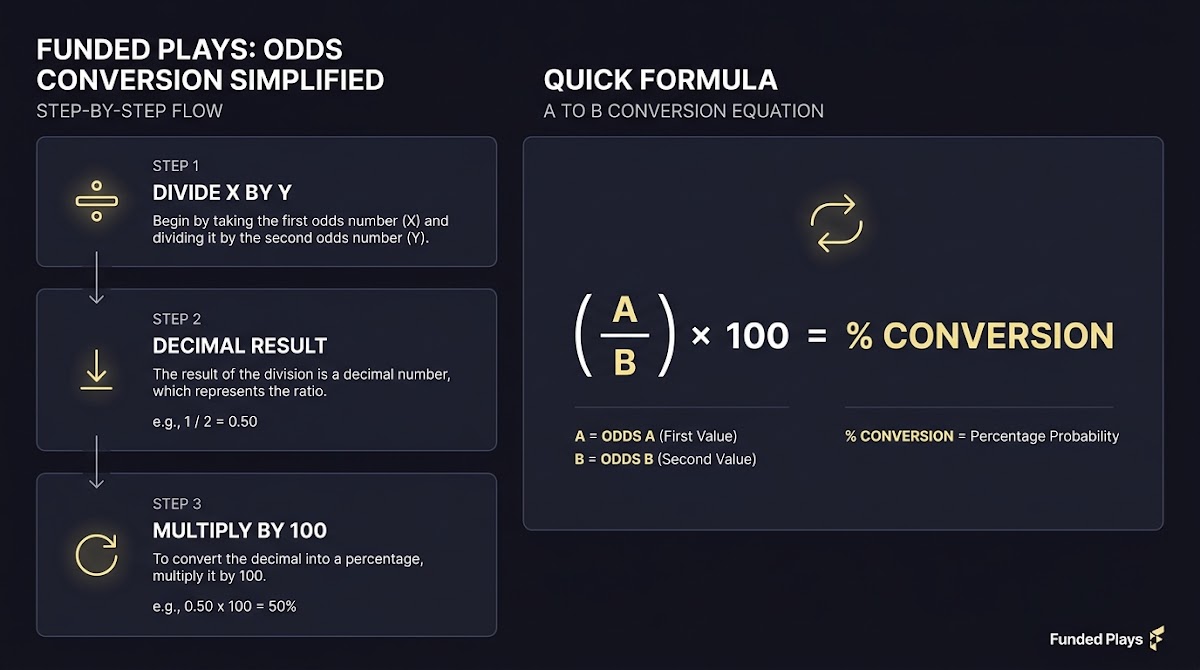
What does '1 in 100' actually mean?
When someone says "1 in 100," they are stating a probability: one successful outcome out of 100 possible, or one chance per 100 tries. Written as a decimal that is 1 divided by 100, which equals 0.01, and expressed as a percent that becomes 1% by multiplying by 100. For the basic conversion steps and classroom rules on fractions, decimals, and percents see the explanatory section in OpenStax on converting fractions, decimals, and percents, which lays out the same arithmetic relationships used here OpenStax on converting fractions, decimals, and percents.
The short numeric example is straightforward: 1 divided by 100 equals 0.01; 0.01 times 100 equals 1%. That identity is exact for the "x in y" phrasing because percentage is defined as the fraction of the whole multiplied by 100. In plain language, the phrase communicates the probability directly rather than an expression of betting odds, so treat it as a probability statement.
Yes, when phrased as '1 in 100' it equals 1% because 1 divided by 100 equals 0.01 and multiplying by 100 gives 1%; however, fractional odds written as '1 to 100' are a different expression and must be converted before comparison.
Try dividing small numbers by their denominators to see the same result in practice: 2 in 100 is 0.02 and 2%, 50 in 100 is 0.5 and 50%.
Step-by-step rule: convert 'x in y' to a percentage
Keep two simple formulas in mind and you can convert any "x in y" quickly. First, decimal probability equals x divided by y. Second, percent equals that decimal times 100, so percent equals x divided by y times 100. These two formulas form the basic conversion rule and are the same approach taught in standard prealgebra resources OpenStax on converting fractions, decimals, and percents.
Step 1: write the phrase as a fraction, x/y. Step 2: divide x by y to get a decimal probability. Step 3: multiply the decimal by 100 to get a percentage. Use these steps without rounding early; if the decimal repeats, decide how many significant digits you need for the context before you round.
Worked example 1: convert 1 in 100. Write 1/100, divide to get 0.01, and multiply by 100 to get 1%. Worked example 2: convert 3 in 250. Write 3/250 equals 0.012, multiply by 100 to get 1.2%. That second example shows how small numerators over larger denominators create small percentages that still follow the same simple rule.
On rounding: for most practical uses two or three significant digits are enough, but keep one extra digit when you might compare close values. If precision matters to a calculation or decision, keep the decimal until the final step to avoid cumulative rounding error.
Odds versus probability: why 'A to B' is not the same as 'x in y'
People sometimes confuse two related but distinct ways of reporting chance: probability statements like "x in y" and fractional odds phrased as "A to B." Probability gives the chance that an event happens, while odds express the ratio of success to failure. A formal relationship links them, but they are not interchangeable without conversion. The NIST e-Handbook explains the mathematical distinction and the standard definitions for odds and probability used in statistical contexts NIST e-Handbook on odds.

Define probability p as the fraction of favorable outcomes out of total outcomes. Define odds (for) as p divided by 1 minus p. In plain words, odds compare how likely an event is to happen to how likely it is not to happen. Because the formulas are different, a statement that reads "A to B" is an odds statement and must be converted before you treat it like a percent.
Check an odds or probability statement with a quick conversion
If you want a quick check, convert the odds or the "x in y" phrase to the same metric, usually percent, before you compare numbers.
Recognize phrasing: when you see "x in y" or "one in y" the writer is usually stating a probability directly. When you see "A to B" or "A:B" the author most likely means fractional odds. Treat the two as different starting points and convert them to the same metric before comparing claims or making decisions.
How to convert fractional odds (A to B) into an implied percentage
To turn fractional odds written as A to B into an implied probability, use the formula implied probability equals B divided by A plus B. This is the standard method for interpreting fractional betting odds and is discussed in resources that explain implied probability and odds calculation Investopedia on implied probability. For a simple step-by-step guide, see Smarkets' help page.
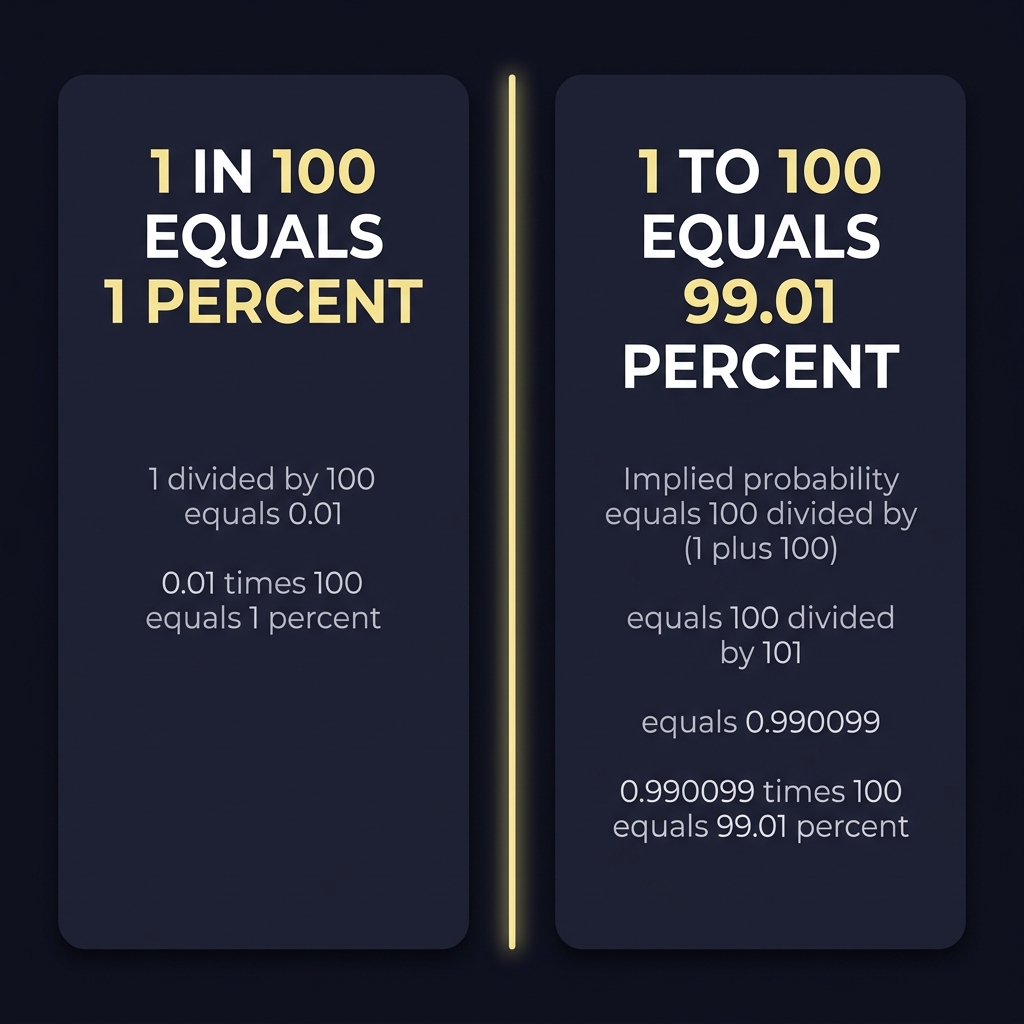
Work through two compact examples to see the difference clearly. Example 1, fractional odds "1 to 100" means A equals 1 and B equals 100. Plug into the formula B divided by A plus B equals 100 divided by 1 plus 100 equals 100 divided by 101, which equals about 0.9901, or 99.01% when converted to percent. Example 2, fractional odds "100 to 1" means A equals 100 and B equals 1. Using the same formula gives 1 divided by 101 equals about 0.00990099, or 0.99% as a percent. These steps show why reading A to B as if it were an "x in y" probability leads to the wrong interpretation.
After you get the decimal implied probability from the fraction, multiply by 100 to express it as a percentage. Note that many texts round such values to two decimal places for readability, but keep more digits if the comparison is tight or the stakes require precision.
When and how to convert odds before comparing with percentages
Before you compare an odds statement to a percentage, follow a short decision checklist: identify whether the item is phrased as "x in y" or "A to B," select the correct conversion formula, compute the decimal probability, and then convert to percent if you need a percentage for comparison. The statistical literature describes these conversion steps and the need to convert to a common metric before direct comparison NIST e-Handbook on odds.
Quick conversion checklist to compare odds and percentages
Follow the steps in order
Use the explicit odds-to-probability formula when needed: if you are given odds as o (where o equals p divided by 1 minus p), you can solve for probability p using p equals o divided by 1 plus o. That rearrangement is handy when you are given decimal odds or an odds ratio and want a direct probability to compare against a stated percent StatPearls on odds ratios and conversions. For quick conversions you can also try online tools or converters such as AceOdds' odds converter.
In practice, convert fractional odds or odds ratios into a decimal probability first, then multiply by 100 for a percent. Doing the math in that order avoids confusion and helps you spot errors where someone may have written an odds expression but treated it as a percent without conversion.
Common mistakes and pitfalls to avoid
A frequent mistake is reading "1 to 100" as if it were "1 in 100" and assuming it means 1%. That misread changes the interpretation by a large margin because "1 to 100" fractional odds imply about 99.01% probability after conversion, while "1 in 100" means 1%. The distinction between odds and probability is formalized in statistical guidance and must be respected to avoid incorrect conclusions NIST e-Handbook on odds.

Rounding and scale errors are another trap. Very small probabilities reported as "1 in X" can look negligible, but their percent equivalents may still matter depending on context. For example, public agencies sometimes express lifetime risks as "1 in 1,000,000," which corresponds to a tiny percent but is communicated that way for clarity in risk discussion EPA on risk assessment communication.
Check original phrasing and convert to the same metric before you compare claims. If a source uses fractional odds, convert to an implied probability. If a source gives a ratio or rate, write it as x in y or percent consistently so readers can compare like with like.
Practical examples and quick practice conversions
Public-risk example: convert 1 in 1,000,000 into a percent to see the scale. Write 1 divided by 1,000,000 equals 0.000001; multiply by 100 to get 0.0001%. Agencies use this style to convey tiny lifetime risks in a way that is readable, and the arithmetic is the same rule applied to any x in y statement EPA on risk assessment communication.
Sports example: suppose a bookmaker or commentator gives fractional odds of 5 to 1. Using the implied probability formula, compute 1 divided by 5 plus 1 equals 1 divided by 6 which is about 0.1667, or 16.67% when written as a percent. Compare that with a claim such as "1 in 6" and you will see they match because "1 in 6" equals 16.67% directly under the x in y rule described earlier Investopedia on implied probability. Tools such as OmniCalculator's implied probability calculator can do this, and you can also see examples on our site.

Quick practice set for the reader: convert the following and then check your math on the Funded Plays blog. A) 7 in 200. B) Fractional odds 2 to 5. C) 1 in 250,000. Use the two-step x divided by y then times 100 process for the "in" phrases and the implied probability formula for fractional odds to keep the comparisons fair.
Three-step takeaway checklist: 1) identify phrasing, 2) convert to decimal probability using the correct formula, 3) multiply by 100 to express as percent for comparison. Keep these steps handy when you read public risk statements or betting odds so you maintain a consistent metric for comparison. See Funded Plays' evaluations for examples.
Yes. The phrase "1 in 100" is a probability equal to 1 divided by 100, which as a percent is exactly 1%.
Convert fractional odds to implied probability using B divided by A plus B, then multiply that decimal by 100 to get a percent.
Because "1 to 100" is fractional odds, which compare success to failure; converting those odds to probability yields about 99.01%, very different from 1%.