

Quick overview: why combat-sports trading is different
How MMA and boxing markets move compared with team sports, Common MMA and Boxing Trading Mistakes
Combat-sports markets shift differently than team-sports books. Price moves in MMA and boxing often reflect single-event volatility, where one big finish or a short-notice lineup change can swing implied probabilities sharply. These dynamics create conditions where Common MMA and Boxing Trading Mistakes become more likely for traders who treat fight prices like game lines from seasonal sports.
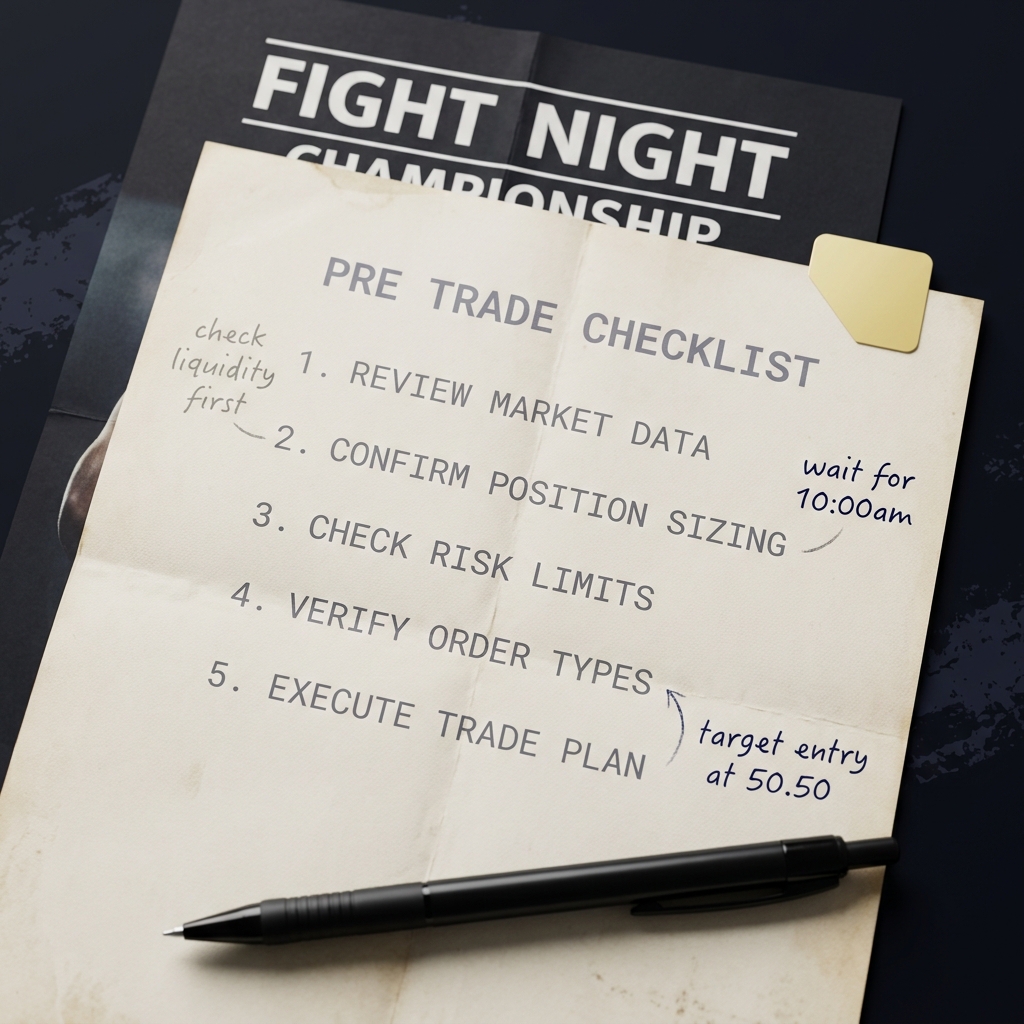
Fighters do not produce long sequences of independent outcomes like teams across a season. Instead, small sample sizes and knockout variance mean that a few lucky or unlucky events can obscure a real edge. That makes edge estimation harder, and it increases the importance of careful pre-trade checks and conservative position sizing.
What makes fight outcomes harder to predict
Fights are high-variance events. A single punch or submission ends a matchup quickly and can invalidate signals that look convincing in aggregate data. Late-notice changes, weight misses, or last-minute injuries further increase uncertainty, because preparation and conditioning may be disrupted.
Late-notice changes, weight misses, or last-minute injuries further increase uncertainty, because preparation and conditioning may be disrupted.
Liquidity also matters in fight markets. Thin books amplify price swings and widen execution slippage, so account-level rules need to account for the higher variance and lower trade capacity compared with many team-sport markets.

Common cognitive biases that lead to losing trades
Availability and recency bias in fighter evaluation
Two of the most persistent cognitive traps are availability bias and recency bias, where vivid recent highlights dominate judgement. Traders often overweight a recent knockout clip or late stoppage in making predictions, even when the film does not reflect a durable advantage over a comparable opponent.
Traders often overweight a recent knockout clip or late stoppage in making predictions, even when the film does not reflect a durable advantage over a comparable opponent.
Confirmation bias compounds this problem. After a noteworthy win, it is easy to search for evidence that a fighter is improving, and to ignore countervailing details like style matchups or conditioning. This is a common path to overfitting to highlight reels and making larger-than-warranted stakes based on emotion rather than a reproducible edge.
The most common mistakes combine cognitive biases, poor technical adaptation, and weak operational rules. Fix them with a repeatable pre-trade checklist, strict sizing limits, documented rationales, and routine post-trade reviews aligned to your platform rules.
Emotional staking after a dramatic outcome is another risk. Increasing a stake because a highlight made you confident can accelerate drawdowns. Consistent, rule-based sizing helps blunt the harm from bias-driven position mistakes.
Confirmation bias and overfitting to highlights
To counter these biases, create objective filters for what evidence changes your view. Decide in advance which kinds of film or performance metrics will alter a prior, and which kinds will not. That discipline reduces the chance you will chase a narrative after a single memorable finish.
Make it a habit to record why a trade looked valuable before you place it, then compare that rationale to the outcome. Over time, this documentation exposes when you are influenced more by vividness than by replicable signals.
A step-by-step framework for disciplined pre-fight analysis
Essential data points to check before placing a prediction
Use a compact, repeatable process before every trade so decisions are consistent and auditable. Key objective signals include recent activity, styles matchup, short-notice changes, weight or class moves, and public liquidity in the market. Checking these items reduces impulsive entries and helps you measure where the real uncertainty lies.
Documenting reasons before entry is critical to avoid hindsight bias. Write a short hypothesis, list the limited signals that change that hypothesis, and note your planned stake and stop rules. That record will be invaluable in later post-mortems.
pre-trade fight analysis checklist used before each prediction
Complete before you size the trade
A simple checklist reduces mental friction. Work through the same sequence each time: confirm the opponent list and any late replacements, verify official weigh-in status, check the styles matchup and cardio risk, confirm market depth and how available liquidity is, then size strictly according to your rules. If a key item is unclear, pause and do not trade.
A simple checklist to standardize entries
Adopt a minimal pre-trade checklist you can follow under time pressure. That checklist should prioritize clarity on the three most impactful items for a fight: availability of reliable opponent data, recent activity or ring rust, and any physical changes such as weight class moves or visible injury concerns. If any item is ambiguous, downgrade stake or skip the trade.
Standardizing entries also makes it easier to test hypotheses. When many trades follow the same documentation format, you can aggregate results and detect which signals actually produced value, rather than relying on memory or post-hoc rationalization.
Decision criteria: when to take a trade and when to sit out
Edge threshold and acceptable volatility
Define a clear edge rule before you trade. If you cannot quantify edge, use a qualitative threshold that requires at least two independent, objective signals that point the same way. Require a pre-specified minimum market depth and a maximum stake relative to your allowed per-trade limit.
For fights with high knockout variance or short-notice replacements, raise your edge threshold. In practice, that means either reducing size or asking for a larger difference between your estimate and the market price before committing capital.
When market movement signals value vs noise
Not every price move is informative. Early public money can reflect noise or sharps sizing; late, abrupt price moves near fight time can indicate new information but can also be liquidity-driven spikes. Look for corroborating evidence, such as consistent size on a side or confirmation from official news, before assuming the market has revealed genuine value.
Avoid trades with thin liquidity or extreme variance. If you cannot get the stake filled without moving the market further, the effective cost erodes any potential edge and raises the chance of execution slippage turning a small edge into a loss.
Top technical mistakes traders make in fights
Misreading striking and grappling styles
One frequent technical error is transplanting analytics designed for team sports directly into fight analysis without adapting for context. Raw volume metrics, like activity counts from team play, do not map cleanly to fight outcomes because a single strike can be decisive, and style interactions matter more than aggregate counts.
Fighters have complementary and opposing attributes that must be weighted qualitatively. Reach and distance control matter for strikers, while wrestling base and takedown defense matter for grapplers. Ignoring how styles interact with rulesets and rounds can produce systematic prediction errors.

Using inappropriate metrics from other sports
Common modeling mistakes include overweighing historical wins without context and applying ELO-like systems without accounting for small samples and matchup sensitivity. These approaches can give a false sense of precision, leading to confident but poorly grounded stakes.
When you build or adapt models for fights, prefer simple, interpretable features rather than opaque composites. Keep a small set of plausible inputs and test how each affects out-of-sample performance. That way you avoid overfitting to idiosyncratic histories and can better judge whether a supposed signal holds across comparable matchups.
Typical operational and risk-management errors
Poor bankroll rules and inconsistent staking
Poor staking rules are a primary operational cause of career-limiting drawdowns. Violations include repeatedly increasing stake after wins or losses, switching sizing methods mid-challenge, or ignoring per-trade caps that were meant to protect the account.
Position sizing in thin pre-fight markets should be more conservative than in deeper markets. Thin liquidity increases execution risk, and a single adverse move can consume a large fraction of available capital if sizing is loose. Firm per-trade limits, combined with daily caps, help prevent small mistakes from compounding into larger losses.
Chasing losses after quick swings
After a string of quick losses, many traders increase stakes to try to recover, which often accelerates ruin. Structured rules for drawdown management, such as reducing maximum stake after a defined losing streak or pausing trading after a fixed percent loss, preserve optionality and prevent emotional recovery trades.
Finally, failure to track results and review trades systematically prevents learning. Without objective logs, it is impossible to tell whether mistakes come from sizing, selection, or pure variance. Tracking forces you to confront repeatable errors and adjust rules accordingly.
Case scenarios: three real-world examples and how to avoid the mistake
Late-notice replacement and its market effects
Scenario one, short-notice replacement: a late substitute enters and the market prices the favorite less aggressively. Traders who react instantly to the new line without checking preparation time and style compatibility can misprice risk. The corrective process is to pause, apply the checklist, and downgrade size unless multiple signals support the new price.
In practice, a clear sequence helps: confirm the replacement, check recent activity and film, verify training camp reports if available, and then decide on a scaled entry. That sequence prevents emotional overreliance on a newly available price.
Overreacting to a highlight knockout
Scenario two, highlight overreaction: after a spectacular knockout, traders assume the finisher is now a significantly better fighter across contexts. The mistake is ignoring matchup dependency. Correct practice is to treat highlight outcomes as one data point among many, and to look for corroborating signs like consistent volume of finishes or a change in the fighter's style that explains the result.
Size conservatively after headline wins, and require additional data before increasing exposure. That approach reduces the chance that a single vivid outcome causes outsized position increases that lead to rapid drawdowns when the next fight goes differently.
Misreading a fighter moving up a weight class
Scenario three, weight-class moves: a fighter moves up or down in weight and the market reacts. Misreading that reaction often comes from failing to separate physical performance from competitive context. The corrective steps are to analyze pace, power translation, and historical success across weight changes, then record a conditional stake aligned to the uncertainty.
Using the pre-trade checklist in these scenarios makes the correct process simple and repeatable. Checklist discipline helps keep sizing proportional to uncertainty and reduces the chance of emotional or headline-driven errors.
Practical rules for integrating trades into a funded challenge workflow
Adapting staking and risk limits to virtual funded accounts
When trading within a funded challenge or simulated funded account, align per-trade limits and daily caps with the platform's drawdown rules. Many evaluation challenges impose strict peak-to-trough rules that require conservative sizing and an emphasis on consistency rather than chasing large, high-variance wins.
Document your trade rationale as part of the evaluation process. A written note that explains the hypothesis, signals relied upon, and stake sizing demonstrates discipline and creates a replayable record for platform reviews or self-assessment. This habit supports objective evaluation during and after the challenge.
Practice disciplined entries with a simple trade-log
Try a brief trade-log template and a short pre-trade checklist before you enter any fight market trade to preserve discipline and make evaluation easier.
How to document trades for evaluation challenges
Keep entries minimal but precise: date, event, stake, rationale, and expected risk factors. Combine that with a short post-trade note within 24 to 48 hours describing whether the outcome matched the hypothesis and what you learned. That documentation habit is especially valuable in funded evaluation workflows, where consistent process is often often as important as raw results.
Practice at lower sizes and under reduced risk limits until your process produces repeatable outcomes. Treat simulated accounts as training ground for discipline and rule enforcement rather than as a permission slip to take oversized risks.
Recovery and iterative improvement after losing streaks
A simple post-mortem template
Use a compact template to review losing runs. Each post-mortem should capture the initial hypothesis, what happened, execution quality, any deviations from rules, and the concrete change you will make for the next set of trades. Keep it objective and short to encourage consistent completion.
After a defined losing threshold, take a structured pause. Reduce position sizes on return and re-run a small sample of trades under stricter limits to rebuild confidence and test whether changes in process improved outcomes.
When to pause trading and how to rebuild discipline
Pausing is not failure; it is a risk-management tool. When tracking shows repeated rule violations or a cluster of losses tied to a common mistake, schedule a break, review the logs, and return only after documenting a clear remedial plan. Rebuilt discipline typically starts with smaller stakes, a short list of allowed trade types, and strict adherence to the pre-trade checklist.
Use tracking data to identify recurring errors. If you find repeated misreads of a particular style or recurring sizing mistakes, make a small, focused change and test it over a modest sample before increasing exposure.
Summary and next steps for becoming a consistent fight-market trader
Key habits to adopt
Three habits produce disproportionate benefits: consistent pre-trade documentation, strict per-trade and daily sizing rules, and routine post-trade reviews. These practices reduce the most common operational and cognitive errors and create a pathway to measurable improvement.
Weekly practice routines should include scheduled review sessions, small-sample backtesting of rule changes, and simulated trades under the same limits as your target funded challenge. Remember that platform rules vary, and success depends on consistent application of process and discipline rather than guaranteed outcomes.
Resources and practice habits
Commit to a short weekly cycle: pick a small set of testable changes, run them in simulated conditions, and review results. Over time, this iterative approach improves decision quality and reduces the chance that Common MMA and Boxing Trading Mistakes will repeat.
Be realistic about limits and focus on long-term improvement. Consistency and documented process are the pathways to better performance in fight markets.
Higher volatility means smaller stakes and stricter edge requirements; use tighter per-trade limits and require multiple independent signals before entering a trade.
Include recent activity, styles matchup, short-notice changes, weight movement, liquidity, and a planned stake with stop rules.
Pause after a defined drawdown or repeated rule violations, run a focused review, then return with reduced risk limits and a clear corrective plan.
References
- https://trendspider.com/blog/the-most-common-trading-mistakes-and-how-to-avoid-them/
- https://www.oanda.com/us-en/skills-and-insights/education/trading-psychology/common-mistakes/most-common-trader-mistakes/
- https://www.fundedplays.com/blogs/how-fundedplays-evaluations-work
- https://www.fundedplays.com
- https://www.fundedplays.com/blogs
- https://www.fundedplays.com/challenges
- https://www.ig.com/en/trading-strategies/top-10-common-trading-mistakes-and-how-to-avoid-them-190123