
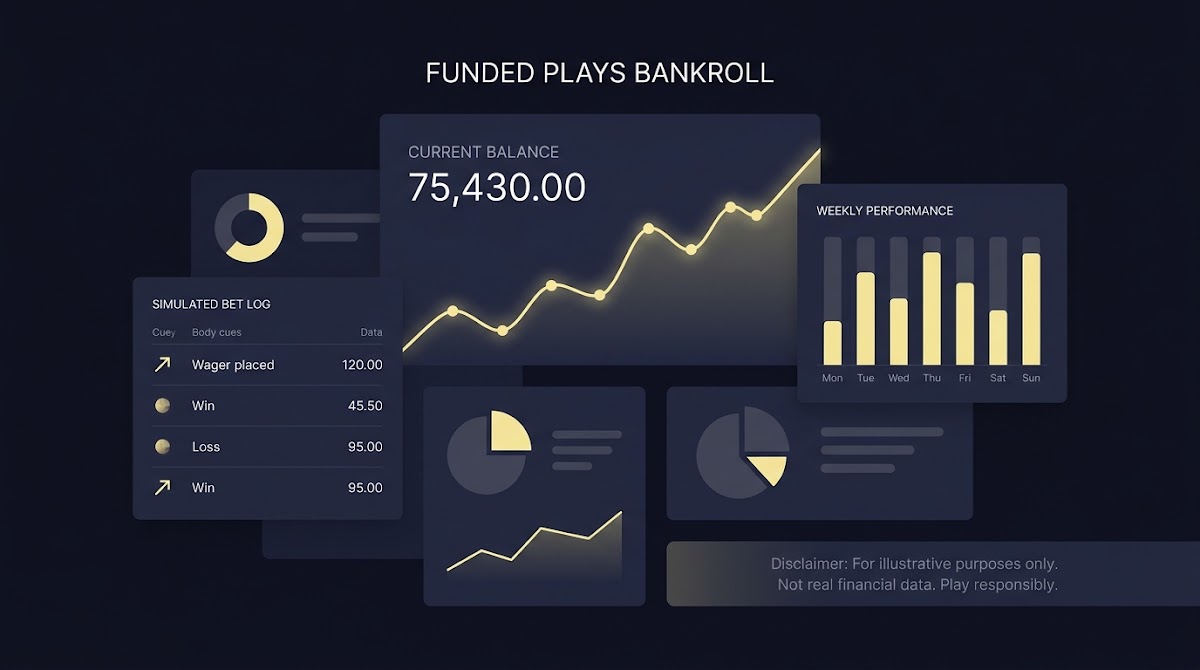
What simulated funded accounts are and why platforms use them, Common Misconceptions About Simulated Funded Accounts
A simulated funded account is a structured testing environment where a user makes predictions or places simulated positions using a virtual bankroll rather than real money. Platforms use these accounts to run evaluation challenges that measure consistency, risk management, and forecasting skill without exposing the operator or the user to real financial transfers. This setup differs from a live funded account or sportsbook wager because outcomes affect eligibility or rewards under platform rules rather than representing actual wins or losses that change a user s real cash balance.
Common uses include skill evaluation, onboarding new users, experimenting with strategies, and letting participants practice bankroll controls and stop rules before risking any real funds. Simulations simplify some operational details on purpose so they remain predictable and instructional, but that simplification also means simulated outcomes do not automatically translate to live performance.
Ready to check a simulation carefully?
Keep reading for a compact verification checklist later in the article that helps you spot credible simulations and avoid relying on headline numbers alone.
Regulatory landscape: what U.S. rules require when hypothetical performance is shown
U.S. regulators require clear limits and disclosures when hypothetical or model performance is presented to the public. For example, CFTC rules require prominent limitations disclosures and prohibit misleading presentation of simulated performance in advertising, which is intended to prevent consumers from drawing unsupported conclusions about future results CFTC 17 CFR 4.41 (CFTC release)
The National Futures Association has long warned that hypothetical performance has inherent limitations and set conditions for promotional use that reduce the risk of misleading claims. Those interpretive standards emphasize that any simulated results used in marketing or outreach need context and careful caveats NFA Compliance Rule 2-29 (NFA rulebook)
The SEC has also clarified expectations for hypothetical performance in its Marketing Rule FAQs, noting that advisers must implement policies and procedures and ensure presentations are relevant to the intended audience, and they must include appropriate disclosures so that hypothetical outcomes are not treated as guarantees SEC Marketing Rule FAQs
Misconception 1: simulated results equal live performance
Why in-sample performance can be misleading
One common mistake is to treat simulated top-line results as if they predict live outcomes. Research on backtest overfitting shows that in-sample or purely historical-fitting results can overstate true performance unless validated out of sample and adjusted for realistic execution assumptions The Probability of Backtest Overfitting
Interpret simulated results as informative experiments that can show process and consistency but may not reflect live outcomes unless the simulation includes conservative cost assumptions, out-of-sample validation, and clear methodology documentation.
What differences matter in practice
Even when a simulation uses a sensible model, practical frictions like execution delays, slippage, position limits, and behavioral differences under real stakes all change outcomes. Market-based cross-checks such as closing line value can help indicate whether forecasts have a plausible long-run edge, but they do not guarantee profitability and should be treated as one of several sanity checks Closing line value explained
Misconception 2: a small sample proves skill
Short-term success in a simulation can be due to chance. Statistical variance means small samples will often produce false positives, and a handful of winning days or events does not reliably indicate repeatable skill. This is a common pitfall in backtesting and simulated results evaluation and is why reviewers recommend multi-period validation and out-of-sample testing The Probability of Backtest Overfitting

Better checks include asking for performance across different seasons or event windows, reviewing the distribution of wins and losses rather than just averages, and checking that the apparent edge persists when key assumptions are varied. These steps reduce the chance of mistaking luck for skill.
Misconception 3: simulations that omit costs mirror real trading
Some simulations present gross returns without modeling common execution and friction costs. Typical omitted costs include slippage, transaction fees, market impact, and delays in order fills. Leaving these out tends to make simulated results look better than what a live participant would likely realize.
Applying conservative cost assumptions in the simulation changes the headline performance and gives a more realistic sense of what live results might look like under similar behavior. Industry guidance and methodological standards recommend explicitly modeling reasonable costs when the goal is to approximate live execution GIPS Advertising Guidelines

Methodology checklist: what a credible simulation must disclose
A credible simulation should include a clear, readable methodology section that lists the core assumptions. Key items to expect are the simulated time periods covered, sample selection rules, specific performance calculation methods, how returns are annualized or expressed, and any excluded events or filters. Where regulators require prominent limitations, that language should be obvious and easy to find GIPS Advertising Guidelines
Beyond the basic inputs, look for explicit statements about cost modeling, order fill assumptions, position and risk limits, and whether results are in-sample or include an out-of-sample validation. Consistency of calculation matters because inconsistent definitions can make apples-to-apples comparisons impossible and may mislead users if not disclosed.

How to validate simulated results: practical checks and proxies
One useful market proxy is closing line value, which compares the forecast or position edge against the market closing benchmark and can indicate if the forecasting process consistently captures value. CLV is not proof of profitability, but it is a practical cross-check for forecasting quality Closing line value explained
Other sanity checks include checking for stable edge over time rather than a short burst, requesting out-of-sample splits, and reviewing stress windows such as busy schedules or unusual market conditions. Also ask for any simulated order fill logs or aggregated fill assumptions so you can see how the operator modeled execution.
Ask for a methodology document that includes time periods, sample selection, calculation methods, and cost assumptions. Request either raw trade logs or aggregated fill assumptions, and ask whether the provider uses out-of-sample splits for validation. These items let you test the durability of the reported edge SEC Marketing Rule FAQs
Quick CLV-based verification and basic simulation cross-check
Use these checks to flag potential overstatement
When you run these checks, document what you see and compare the claimed methodology to the actual sample and cost assumptions. If a platform cannot or will not provide reasonable detail on these points, treat the simulation as illustrative rather than definitive.
Decision framework: when to trust a simulated funded account
Use a three-step decision framework. First verify that the operator publishes clear methodology and prominent limitations language. Regulatory standards such as CFTC advertising rules and SEC guidance increase confidence when they are followed and clearly referenced CFTC 17 CFR 4.41 (CFTC final rules)
Second, validate the methodology by checking for out-of-sample tests, cost modeling, and consistent calculation. Third, test market proxies such as closing line value or similar metrics. If all three steps align, the simulation is likely informative; if not, treat outputs as illustrative teaching tools rather than predictors of live results SEC Marketing Rule FAQs
Typical mistakes and red flags when evaluating simulations
Watch for presentation red flags such as missing methodology, absent cost modeling, selective time windowing, and reliance on headline averages without a distributional view. These are common signs that results may be overstated or not representative of live conditions NFA Compliance Rule 2-29
Analytical pitfalls include cherry-picking the best-performing periods, excluding realistic fills, and failing to disclose whether results include fees or other platform-specific frictions. Ask for full documentation and follow-up questions; vague or evasive answers are themselves a red flag.
Practical examples and scenarios (what to expect in real evaluations)
Scenario A is a clean simulation with full disclosures: methodology document, clear cost assumptions, out-of-sample validation, and alignment with market proxies such as CLV. In that case the simulation offers useful, actionable insight into how a participant might perform under similar rules.
Scenario B is a glossy promotion that highlights top-line performance, omits cost modeling, uses a short sample, and provides no out-of-sample evidence. In this case you should ask direct questions about fills, lookback choices, and whether reported returns survive conservative cost adjustments. Comparing the simulation to CLV or another market proxy can help separate illustrative results from those that are plausibly predictive Closing line value explained
Step-by-step: how to verify a platform's simulated results
Ask for a methodology document that includes time periods, sample selection, calculation methods, and cost assumptions. Request either raw trade logs or aggregated fill assumptions, and ask whether the provider uses out-of-sample splits for validation. These items let you test the durability of the reported edge SEC Marketing Rule FAQs
Interpret missing or vague answers as cautionary. If an operator cannot supply reasonable detail, ask for conservative re-runs that include explicit slippage and fee assumptions. If responses remain incomplete, consider escalating concerns to consumer protection resources or the relevant regulator for further guidance.
How FundedPlays describes its simulations and what to check for on the platform
As a funded challenge operator, FundedPlays runs evaluation programs where participants complete objectives using virtual bankrolls under defined rules and drawdown limits. The platform s approach is framed around skill demonstration rather than guaranteeing outcomes, and users should expect clear challenge rules, progress tracking, and stated account conditions.
When assessing any funded challenge, look for transparent challenge rules, documented drawdown limits, and easy-to-find progress tracking. These elements help you understand the environment being simulated and whether reported performance is comparable to what you could expect under live conditions.
Avoiding pitfalls: responsible participation and setting realistic expectations
Use simulations primarily as experimental learning tools. Practice risk controls such as explicit bankroll sizing, reasonable position limits, and stop rules inside the simulated account so that behavior under test maps to how you would act with real stakes. Treat simulated outcomes as feedback on process rather than a promise of future earnings SEC Marketing Rule FAQs
Document your experiments, note which assumptions were most sensitive, and iterate on your rules. That disciplined approach makes simulations valuable for skill development without creating unrealistic expectations about live results.
Conclusion: balancing healthy skepticism with constructive evaluation
Simulated funded accounts are useful tools when presented with transparent methodology, conservative cost assumptions, and clear limitations language. Regulatory and methodological guidance underscore the need for prominent disclosures and consistent calculation practices as part of a responsible presentation CFTC 17 CFR 4.41
Before you rely on simulated outcomes, apply the verification checklist in this article: check disclosures, validate methodology, and test market proxies. That combination helps you treat simulations as informative experiments rather than definitive predictions.
Simulated funded accounts use virtual bankrolls and controlled rules to evaluate skill; they omit some live frictions and do not guarantee similar results in real staking.
Closing line value compares your forecast or position to the market closing benchmark and serves as a practical proxy for forecasting quality, though it is not a guarantee of profit.
Ask for the methodology document, cost and fill assumptions, out-of-sample splits, and clear limitation disclosures, then review whether results persist under conservative adjustments.
References
- https://www.ecfr.gov/current/title-17/chapter-I/part-4/section-4.41
- https://www.nfa.futures.org/rulebook/rules.aspx?RuleID=9025&Section=9
- https://www.sec.gov/investment/marketing-rule-faq
- https://papers.ssrn.com/sol3/papers.cfm?abstract_id=2601447
- https://www.pinnacle.com/en/betting-articles/Betting-Strategy/closing-line-value-explained
- https://www.cfainstitute.org/en/ethics-standards/codes/gips-standards
- https://www.fundedplays.com/challenges
- https://www.nfa.futures.org/rulebooksql/rules.aspx?Section=4&RuleID=RULE%202-29
- https://www.cftc.gov/sites/default/files/opa/press98/opa4157-att.htm
- https://www.cftc.gov/LawRegulation/FederalRegister/FinalRules/e7-3122.html
- https://www.fundedplays.com
- https://www.fundedplays.com/blogs
- https://www.fundedplays.com/blogs/how-fundedplays-evaluations-work