
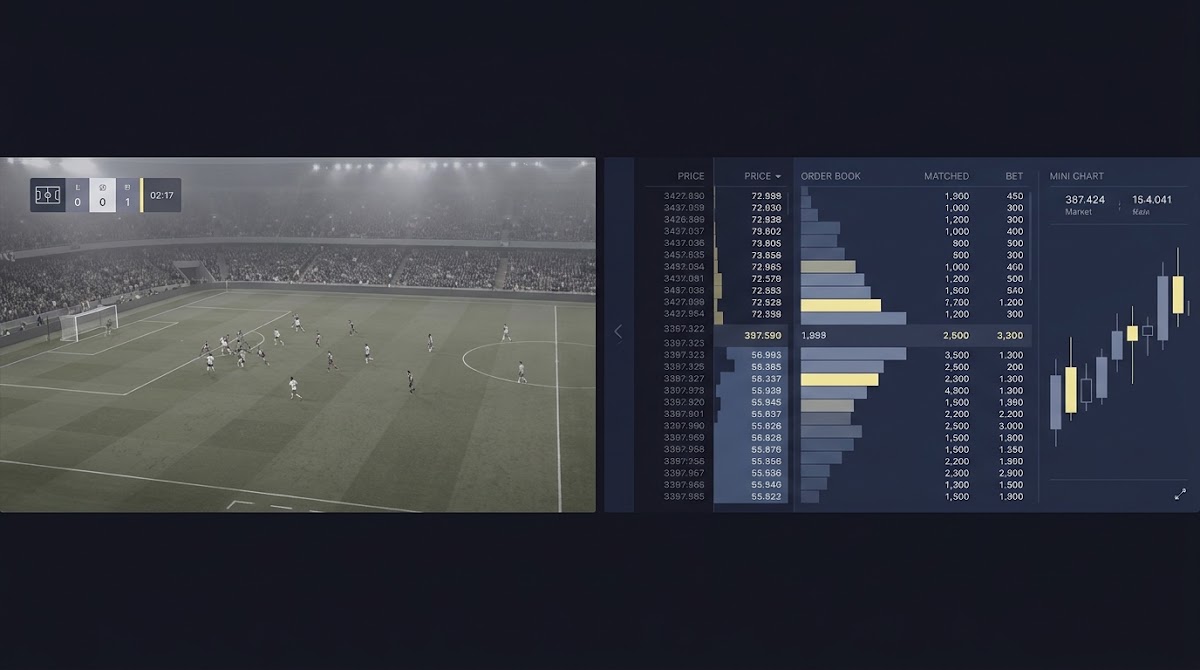
Common Live Sports Trading Mistakes: what this guide covers
Common Live Sports Trading Mistakes often come from execution timing and operational choices rather than poor forecasting. Live sports trading refers to placing and managing positions during an event, where feed delays, platform-imposed bet delays and sudden market moves change the practical mechanics compared with pre-match activity. A clear awareness of these differences helps traders separate model error from execution error; for example, streaming and broadcast timing shifts are documented in industry reporting Ofcom Media Nations 2024 and further analysis appears in Information Asymmetry in Real-Time Sports Betting.
This article maps a focused workflow: a short diagnostic tool, a pre-trade checklist, operational fixes for sizing and hedges, and three practical scenarios with step-by-step corrections. Read the checklist section if you want copyable templates, or the scenarios if you prefer concrete play-by-play fixes. The guide is educational, not financial advice, and outcomes depend on individual skill and platform rules.

How live execution and latency cause mistakes
Streaming latency vs exchange timing
Execution risk in live markets has two common sources: the customer video or data stream and the exchange matching system. Streams and broadcasts can lag the true venue time (see streaming media coverage), and exchanges sometimes add in-play bet delays (see Gambling Commission guidance) to manage information imbalances, so traders who act on a delayed view can be late to market. These mechanics are described in exchange guidance on in-play bet delays and material-event handling Betfair in-play delay guidance.
Practical signs of stream-induced error include fills that consistently arrive after visible game events, and systematic adverse fills during bursts of activity. Treat consistent late fills as a signal to run diagnostics rather than immediately changing your predictive model.
Queueing, slippage and unmatched hedges
When many orders hit a market near the same event, queueing can cause slippage or leave hedges unmatched; enforced delays or material-event suspensions can freeze markets so that a planned hedge never executes. Exchange rulebooks explain how material-event suspensions and enforced delays operate, and why hedges can remain unmatched when orders are queued near event risk Betfair in-play delay guidance.
Signs that queueing drove a loss include multiple small fills spread over time, or a large intended hedge that shows as partially matched and then reversed by a market suspension. These patterns tell you the loss was operational, not necessarily predictive, and they point to specific fixes such as reducing order size or using immediate-or-cancel instructions where available.
Download the FundedPlays pre-trade checklist to reduce execution mistakes
Download the pre-trade checklist to run quick latency and feed checks before your next session.
Tool for diagnosing execution problems in-play
A short diagnostic flow: latency, liquidity, rules, platform
Use a short, repeatable flow when you suspect execution problems: first compare your data feed timestamp to broadcast time, then check recent fills for patterns of adverse timing, and finally confirm whether the exchange has published suspension or delay notices. If any step shows a problem, pause trading and isolate the variable causing the issue.
Run a quick execution diagnostic to spot latency, liquidity or rule issues
Complete this in under five minutes
When to stop trading and perform instrumentation checks
Stop trading when diagnostics show persistent late fills, repeated unmatched hedges, or official exchange suspension alerts. Repeated adverse fills over a session are a clear trigger to reduce stakes and run the diagnostic checklist above rather than continue trading at the same size.
Escalate to a platform support channel if you observe inconsistent timestamps that persist after switching data sources, and log each incident for post-session review so you can correlate fills with market notices and broadcast timing.
Market integrity and abrupt moves: why some sports attract risk
What integrity reports show about football and tennis
Recent integrity reporting highlighted concentrated suspicious betting activity in football and tennis, which increases the chance of abrupt price moves, liquidity surges or market suspensions in play. Traders should treat unexpected, unexplained order flows in these sports as a signal to step back and check market depth before committing size IBIA annual integrity report.
How suspicious concentrated activity appears to traders

Practical red flags include sudden liquidity spikes in small markets, price jumps without a visible game event, and repeat suspensions on the same market. When you see these patterns, scale down size and prefer markets with demonstrable depth and multiple active participants rather than thin or volatile markets without a validated edge.
Cash-out mechanics and exit discipline
Why automatic cash-outs can reduce expected value
Academic analysis has shown that operator cash-out pricing typically embeds a margin, so accepting auto cash-out offers by default can lower your expected value compared with a disciplined, self-managed hedge or exit strategy journal analysis of cash-out mechanics.
When to cash out vs self-hedge
Use cash-out selectively. If the offered cash-out price is close to a hedging alternative and execution risk for the hedge is low, a manual hedge may preserve more expected value. If hedging would be subject to exchange delay or thin liquidity, the cash-out can be a pragmatic choice, but do not make auto cash-out the default without testing.
Test cash-out decisions using a small historical sample of fills or simple simulation: compare realized outcomes when you took cash-outs with outcomes when you executed equivalent hedges, and log the difference to see whether cash-out is value-destroying in your workflow.
Position sizing and drawdown controls - why size matters more in-play
Full Kelly risks and why fractional sizing is safer
The Kelly criterion can maximise long-run growth under ideal estimation, but full-Kelly sizing is fragile to estimation error and increases drawdown risk in volatile live markets. Academic and practical discussions recommend fractional Kelly or simpler fixed loss limits as more robust approaches for in-play trading Kelly theory discussion.
Hard loss limits, session caps and drawdown rules
Operational controls that reduce tail risk include hard session loss limits, per-market exposure caps, and mandatory cooling-off periods after a threshold of adverse sessions. These rules simplify decision-making under stress and limit the chance that a single execution issue causes a large drawdown.
When you design size controls, backtest any sizing rule under scenarios that include slippage and delay, not just ideal fills, so the chosen rule behaves acceptably when execution deviates from expected conditions.
Pre-trade decision framework: a compact checklist
Timing, liquidity, integrity and stake checks
Before each in-play position run a short checklist: verify your feed latency against broadcast, confirm the market shows depth for your intended size, review recent exchange notices for suspensions or delays, set stake using a fractional sizing rule, and predefine hedge triggers and limits.
Most common live trading mistakes stem from execution and process errors: latency, exchange-imposed delays and suspensions, poor sizing, and untested cash-out behaviour. Use a short diagnostic flow, a pre-trade checklist, fractional sizing and predefined hedge rules to reduce slippage and drawdown.
A pre-programmed hedge plan
Create a simple, executable hedge plan before you enter the market: define the hedge trigger, maximum hedge size, allowed execution channels (listed price, market order, IOC), and a fallback if the hedge is partially matched or the market is suspended. Keep the plan short so it can be executed under time pressure.
Integrate these checks into a one-page pre-trade routine so they are habitual: small friction up-front reduces the chance of panic exits or rushed, poorly-sized hedges when an event unfolds.
Common operational mistakes and how to fix them
Mistake: trading with default cash-out or auto-hedge
Many traders accept cash-out offers or auto-hedges as a convenience without testing whether the operator margin makes the option value-diminishing. Because cash-out prices embed operator margin, default acceptance can reduce long-run returns; instead, treat cash-out as one option among hedging alternatives and evaluate it with a simple comparison test journal analysis of cash-out mechanics.
Fix: set a rule that requires manual comparison of the cash-out price to an estimated hedge cost for a fixed sample, or limit auto cash-out to exceptionally small positions where the convenience outweighs potential value loss.
Mistake: over-leveraging on low-liquidity markets
Trading too large in thin markets is a frequent operational error; thin markets can move sharply on small volumes and may attract suspicious concentrated flows in certain sports. If your entry depends on quick in-play hedging, a thin market increases the combined risk of slippage and integrity problems Sportradar integrity report.
Fix: cap maximum size by measured market depth, require multiple price levels of depth for any trade above a low-size threshold, and reduce size dynamically if depth evaporates in play.
Exchange rules, suspensions and hedging pitfalls
How material-event suspensions work
Exchange rulebooks codify material-event suspensions and in-play delays to protect market integrity, which can mean a timely hedge fails to match if a suspension is applied after you place the order. Traders must understand these rules and the typical windows when exchanges are likely to enforce delays Betfair in-play delay guidance.
Managing unmatched hedges and cancellation risk
If a hedge remains unmatched because of a suspension, limit exposure by using staggered hedges, predetermined partial-hedge levels, or pre-authorised stop sizes that kick in if the hedge does not fill within a short time. Testing these patterns in simulated delayed conditions helps you choose the right fallback plan.
A simple operational rule is to avoid queuing large hedges close to known event-risk moments, and to prefer smaller, immediate-or-cancel hedges if your platform supports them.
Selecting markets and liquidity management
Which sports and markets typically show reliable liquidity
Liquidity varies by sport and market type; in general, major football markets and popular tournament tennis matches show more consistent depth, while niche markets or lower-division events often have thin order books with sporadic participants. When trading a new market, observe depth for multiple sessions before committing size.
When to avoid a market
Avoid markets that show wide, inconsistent spreads, vanishing depth at certain moments, or repeated short-term suspensions. These indicators suggest the market may be subject to abrupt moves or integrity-related flows, and scaling down or stepping away is usually the prudent choice IBIA annual integrity report.
When you must trade a marginal market, reduce size, widen acceptable execution ranges, and log fills for detailed post-session analysis so you can refine the size scaling rule later.
Behavioural traps: rush decisions and overconfidence in-play
Why traders chase exits during momentum
Fast, emotional responses like panic exits or revenge trading after a bad fill are common behavioural traps in live trading. These reactions often compound execution losses because they ignore the likely cause of the loss, which may be latency or a temporary liquidity gap rather than a change in the underlying signal.
How fatigue and speed bias affect decision quality
Make these behavioural checks part of the pre-trade routine so they trigger before you act in a stressful moment, reducing the chance of hurried, poorly-sized hedges that worsen drawdown.

Make these behavioural checks part of the pre-trade routine so they trigger before you act in a stressful moment, reducing the chance of hurried, poorly-sized hedges that worsen drawdown.
Practical scenarios: three real-world examples and step-by-step fixes
Example 1: late fill during red card (football)
Symptom: you place a hedge after a red card but your fill arrives after an exchange suspension, leaving a partially matched hedge and a large residual exposure. Diagnosis: queueing and suspension timing produced the unmatched hedge, not necessarily a model failure. Exchange guidance explains how suspensions and delays affect in-play orders Betfair in-play delay guidance.
Fix: predefine a partial-hedge plan with maximum accepted unmatched exposure, reduce per-trade size near likely red-card windows, and use immediate-or-cancel styles when available to avoid long unmatched queues.
Example 2: sudden serve break surge (tennis)
Symptom: a run of aggressive stakes appears on a low-profile match and the market shifts before your hedge completes. Diagnosis: concentrated in-play flows can indicate integrity risk or a sudden liquidity imbalance; integrity reporting has highlighted similar concentrated betting patterns in tennis events Sportradar integrity report.
Fix: when a market shows unexplained concentrated flow, step back and reduce stake size, avoid enlarging positions during the surge, and log the event for later review rather than seeking immediate recovery trades.
Example 3: auto cash-out temptations during comeback
Symptom: a tempting cash-out during a comeback looks convenient but may be priced with an embedded margin. Diagnosis: cash-out offers are operator-priced and can reduce expected value relative to a manual hedge journal analysis of cash-out mechanics.
Fix: set explicit rules for when to accept cash-outs, for example only when the cash-out improves your worst-case exposure and hedging is impractical due to delay or thin liquidity. Otherwise, execute a pre-programmed hedge plan with predefined size and trigger levels.
Quick templates: pre-trade checklist and a hedge decision tree
Copy-paste pre-trade checklist: 1) Check feed vs broadcast lag, 2) Confirm market depth for intended size, 3) Read exchange notices for delays or suspensions, 4) Set stake via fractional sizing, 5) Define hedge trigger and fallback. Keep this to a single page so it can be used in-session.
Decision tree for live hedges: if cash-out is offered, compare cash-out to estimated hedge cost; if hedge cost is lower and execution risk is acceptable, hedge manually; otherwise accept cash-out. Log the choice and the outcome for later review to refine the decision thresholds.
Conclusion: a disciplined approach to avoid common live trading mistakes
Avoiding Common Live Sports Trading Mistakes requires disciplined, evidence-backed controls: be aware of live market latency, use fractional sizing and hard loss limits, prefer markets with demonstrable liquidity, and treat cash-out as a tool to be tested not a default. Keeping a short diagnostic flow and a one-page pre-trade checklist reduces the chance that execution quirks cause outsized losses.
Make logging and post-session review a routine. Iterate on rules based on real fills under the specific platforms you use, because exchange rules and delay mechanics shape how hedges execute in practice. Regular review and controlled experiments will reveal whether your sizing and hedge plans work under real in-play conditions.

Streaming delays can make your view of an event lag the true venue time, which can lead to late orders and adverse fills; compare feed timestamps with broadcast time and run a diagnostic when you see repeated late fills.
Cash-out offers typically embed operator margin, so they are not always the highest-value option; compare the cash-out price with an estimated manual hedge and log outcomes to test which is better for your workflow.
Full Kelly is sensitive to estimation error and can increase drawdown risk in volatile live markets; fractional Kelly or fixed loss limits are generally safer operational choices.
References
- https://www.ofcom.org.uk/research-and-data/tv-radio-and-on-demand/media-nations/media-nations-2024
- https://georgetownlawtechreview.org/already-scored-information-asymmetry-in-real-time-sports-betting/GLTR-02-2026/
- https://www.fundedplays.com/blogs
- https://www.fundedplays.com/challenges
- https://support.betfair.com/app/answers/detail/a_id/405/~/what-is-the-in-play-bet-delay%3F
- https://www.streamingmedia.com/Articles/Post/Blog/Why-the-Gap-Between-the-Game-and-Your-Screen-Is-a-Business-Problem-173844.aspx
- https://www.gamblingcommission.gov.uk/licensees-and-businesses/guide/in-play-or-in-running-betting
- https://ibia.bet/2025/02/ibias-2024-annual-integrity-report/
- https://www.tandfonline.com/doi/full/10.1080/14459795.2022.2115360
- https://sportradar.com/insights/sports-integrity/betting-corruption-and-match-fixing-report-2024/
- https://www.worldscientific.com/worldscibooks/10.1142/7595
- https://www.fundedplays.com
- https://www.fundedplays.com/blogs/how-fundedplays-evaluations-work