

What we mean by a 'sports trader' and why the question matters
When people ask Can Sports Knowledge Alone Make You a Better Sports Trader they usually mean something specific: can knowing players, tactics and injuries by itself produce repeatable, profitable forecasting over time. A sports trader is best defined as someone who produces probability-based forecasts, converts those forecasts into prices or stakes, and manages risk and drawdown across many events rather than placing one-off bets for entertainment.
In regulated markets the cost structure matters because operators maintain a positive margin that must be overcome for net profitability. Industry reporting shows that commercial markets carry a house margin that creates a threshold any trader must clear before they can be profitable net of fees and vig, so thinking about repeatability and risk control is central to defining a trader rather than a recreational bettor State of the States 2025: The AGA Survey of the U.S. Commercial Casino Industry.
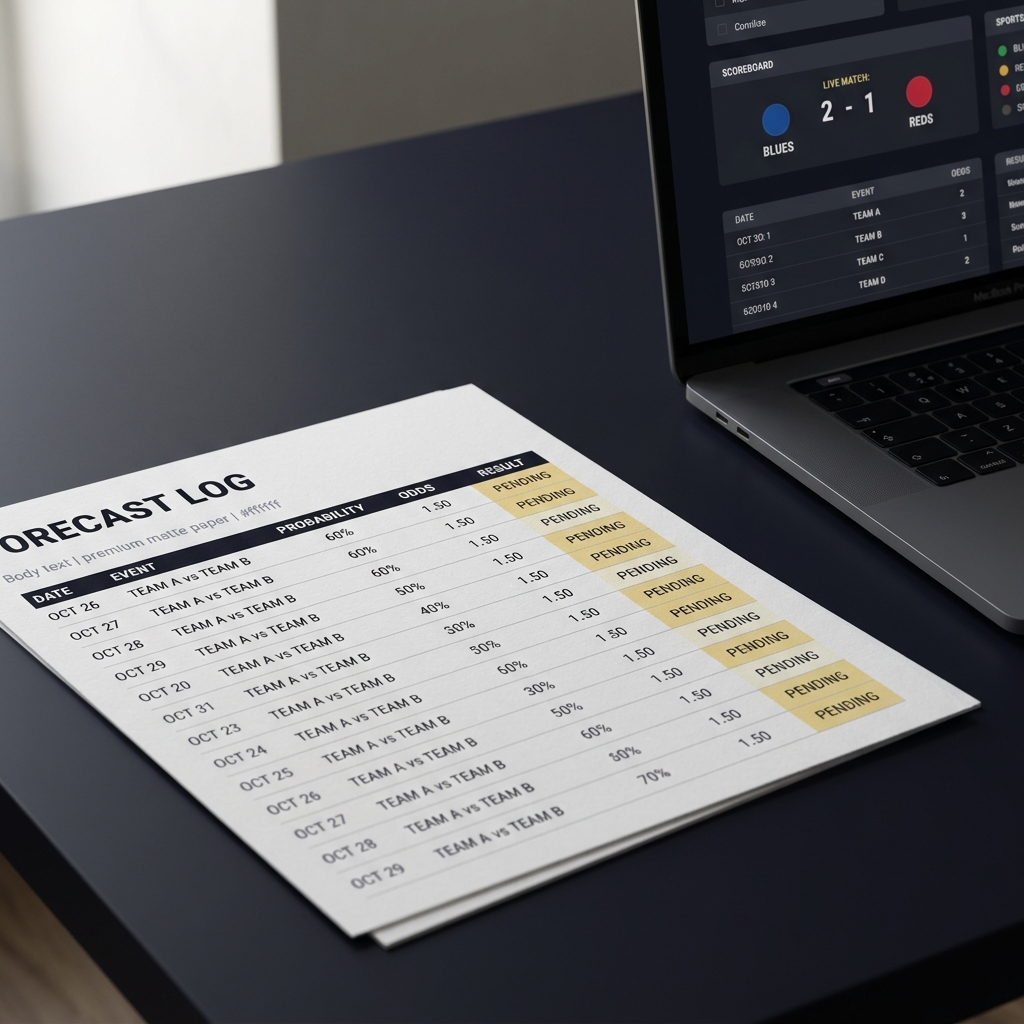
A simple forecast log template to capture predictions and outcomes
Use this to build a performance log
For this article we will treat the sports trader role as one that emphasizes a process: gather signals, turn them into explicit probabilities, apply consistent staking rules, and evaluate performance using proper scoring and calibration checks. Readers should expect practical steps, not promises that knowledge alone guarantees success.
The rest of this guide walks through where domain knowledge helps, where it falls short because of market structure, and how to combine expertise with quantitative discipline, scoring rules and staking governance so that forecasts can be tested and improved.
How sports knowledge genuinely helps a trader
Types of domain knowledge that matter
Domain expertise often shows up as concrete signals you can use to adjust priors: injury reports, lineup rotation patterns, travel and rest schedules, specific tactical matchups, and how coaches react in particular game states. These signals matter because they change the underlying likelihood of a particular outcome and, when observed reliably, can shift a fair probability in measurable ways.

Translating qualitative knowledge into quantitative priors
Turning those observations into useful inputs requires that you express them as probabilities or model features rather than gut impressions. A coach’s likely lineup change is only tradeable if you translate it into a probability that a player will play and then into an adjustment to match outcome probabilities. Practitioners often frame these adjustments as priors that feed into a formal prediction process, then test whether those priors improve forecast accuracy in backtests and calibration checks Understanding the Kelly Criterion.
Domain knowledge also helps identify non-stationary factors, such as schedule clustering or tournament format quirks, that generic models sometimes miss. The value of these insights depends on whether they consistently shift probabilities by enough to clear transaction costs and margin thresholds once priced into the market.
Finally, remember that apparent informational advantages can be ephemeral. As tracking data, public feeds and market participants improve, previously exploitable signals can diminish unless you formalize how those signals are used and continuously measure their contribution to forecast skill.
Why sports knowledge alone is often not enough: market margins and costs
One of the most important reasons knowledge by itself often fails is the presence of house margin and implicit transaction costs. Regulated markets typically include a positive operator margin that reduces the payout to winners and raises the break-even skill threshold for traders. This is not an abstract point: industry statistics show that operator margins are persistent across regulated jurisdictions and therefore must be part of any profitability calculation Industry statistics - April 2023 to March 2024.
Market liquidity and how quickly prices move also matter. If a signal is obvious and many participants can act on it, the market will typically price that information in rapidly and the exploitable window may be short. Liquidity constraints can both create and limit the size of opportunities: thin markets may show mispricings but also make it hard to execute at scale without moving the price.
Test your forecasting edge with scoring and sizing
Before assuming a knowledge advantage is profitable, test it with scoring and sizing experiments to see whether your probability adjustments consistently beat market prices after costs.
Practical implication: small, intuition-driven edges are frequently insufficient. To reliably profit you need precise probability calibration and disciplined sizing to ensure that apparent insights survive the market’s pricing and operational frictions.
How to prove forecasting skill: scoring rules, calibration and backtests
Proper scoring rules (Brier score) and what they measure
Proper scoring rules give you a consistent way to judge probability forecasts: they reward honest probabilities and penalize overconfidence. The Brier score, for example, measures the mean squared difference between predicted probabilities and outcomes, and is preferred to raw win percentage because it evaluates the quality of probability estimates rather than just whether a prediction happened to win Strictly Proper Scoring Rules, Prediction, and Estimation.
Calibration checks and avoiding misleading 'hit rate' impressions
Calibration is the simple test of whether events assigned a given probability actually occur at that frequency. If you predict 60 percent outcomes, roughly 60 percent should happen. Many traders mistake a good-looking hit rate for true forecasting skill; calibration and proper scoring rules protect against that mistake by showing whether probability estimates match reality over many trials.
When you backtest, guard against look-ahead bias by ensuring that no future data leaks into your model at prediction time. Use out-of-sample holdouts, and report scores on data that was not used to tune parameters. A disciplined backtest combined with scoring and calibration checks gives you a defensible measure of whether domain adjustments improve forecast quality.
Bankroll management and sizing: why staking decides survival
The Kelly criterion and why fractional Kelly is common
The math behind staking helps explain why even a true edge can fail if sized poorly. The Kelly criterion describes how to allocate a fraction of bankroll to maximize long-run growth when the edge and odds are known. In practice many traders use a fractional Kelly approach because full Kelly can produce high variance and deep drawdowns; fractional Kelly reduces volatility while preserving much of the growth advantage under uncertainty Understanding the Kelly Criterion. See also Investopedia for a practitioner overview.

Sizing interacts directly with model error. If your probability estimates are off, especially in the direction of overconfidence, aggressive stakes amplify the impact of those errors and increase the risk of significant drawdowns. Conservative fractional sizing, regular review of forecast calibration, and preset drawdown limits are practical controls that protect capital while you validate an edge.
Simple practical rules include capping any single stake as a percent of bankroll, scaling stakes down after adverse runs, and logging each decision so that sizing choices can be reviewed with performance metrics. Those steps help separate genuine edge from luck in the short term and make long-term evaluation meaningful. See research on extensions to Kelly strategies Kelly Criterion Extension.
Behavioral biases and systematic mispricings traders can exploit
Favourite-longshot bias and its implications
The favourite-longshot bias is one of the most reliable behavioral findings in wagering markets: bettors tend to overbet longshots and underbet favourites, creating systematic mispricing patterns that can theoretically be exploited if you can price outcomes more accurately than the market Explaining the Favorite-Longshot Bias.
Other common cognitive biases in sports markets
Beyond the favourite-longshot effect, traders should be aware of confirmation bias, recency bias and overreaction to high-visibility events. These cognitive tendencies can create repeated errors in market prices but exploiting them requires disciplined testing, position sizing and a recognition that transaction costs and sample variability can erode theoretical gains.
When testing bias-based strategies, treat them like other signals: code explicit pricing rules, simulate stakes with realistic costs, and score forecasts with proper metrics. Only then can you tell whether a bias-based idea survives real-world execution and the noise of limited sample sizes.
A practical framework to turn knowledge into a repeatable edge
Turning domain observations into a durable trading edge requires a step-by-step process that can be audited. For further reading and examples see the Funded Plays homepage Funded Plays.
Step-by-step checklist: gather the signal, quantify probability impact, translate to a fair price, decide stake using a preset sizing rule, record the decision and outcome, evaluate with scoring rules and calibration checks. Repeat this process consistently and refine the probability translation step as you collect more evidence about signal quality Strictly Proper Scoring Rules, Prediction, and Estimation.
Sports knowledge helps create better priors, but by itself it rarely produces consistent profits. Sustainable edge requires converting knowledge into explicit probabilities, validating forecasts with scoring and calibration, and applying disciplined staking rules.
Governance suggestions include mandatory recordkeeping, predefined drawdown limits, a clear rule for when to pause or reduce stakes, and periodic calibration reviews where you compare logged probabilities to realized frequencies. This governance helps you avoid ad hoc decisions that often convert transient good runs into longer-term underperformance.
Transparency matters: if you cannot explain how a signal moves probability in plain terms, it will be hard to test and defend over time. Make the probability step explicit, document assumptions and hold to the scoring and sizing rules when reviewing results.
Common mistakes and how to avoid them
Several predictable errors turn promising ideas into losing records. Overfitting models to historical quirks, treating anecdotes or single wins as proof of skill, and failing to account for operator margins and transaction costs are common traps that reduce net returns State of the States 2025: The AGA Survey of the U.S. Commercial Casino Industry.
Do this instead: run blind backtests with out-of-sample holdouts, keep a clear performance log, apply conservative sizing while you validate ideas, and use proper scoring rules rather than raw hit rate to judge progress. These corrective practices are practical and reduce the risk of mistaking variance for skill.
Beware of chasing short-term variance. Large winning streaks and losing streaks can both mislead. Use drawdown limits and a rule-based approach to stake sizing so that short-term outcomes do not cause you to abandon a valid process or double down on a flawed one.
Conclusions, next steps and resources to test your edge
Domain knowledge is valuable, but it is rarely sufficient on its own to create a repeatable trading edge. To turn knowledge into consistent performance you must translate observations into explicit probabilities, evaluate forecasts with proper scoring and calibration checks, and use disciplined staking that controls drawdown risk. Industry evidence on market margins shows why this full stack matters for net profitability Industry statistics - April 2023 to March 2024.
Next steps for readers: start a forecast log using a simple template on the Funded Plays blog blogs, run calibration tests on a sample of predictions, adopt a conservative fractional Kelly or fixed-percent sizing rule, and set a review cadence where you compare logged probabilities to realized outcomes. Practicing in structured environments that emphasize consistent forecasting and evaluation can accelerate learning and provide cleaner feedback on whether your knowledge translates into genuine skill. See how Funded Plays evaluations work here.
In short, sports knowledge helps you generate signals and better priors, but consistent trading success depends on formal probability work, scoring-based evaluation and cautious bankroll management. Treat each forecast as an experiment and use the framework above to test, learn and iterate.
Domain knowledge matters for generating signals and priors, but models and probabilistic methods are typically required to convert that knowledge into consistent, testable forecasts.
Keep a forecast log, score predictions with a proper rule like the Brier score, and run calibration checks on out-of-sample data to see if predicted probabilities match outcomes.
Most practitioners prefer fractional Kelly because full Kelly can cause high variance and deep drawdowns; fractional Kelly reduces volatility while retaining growth benefits.