
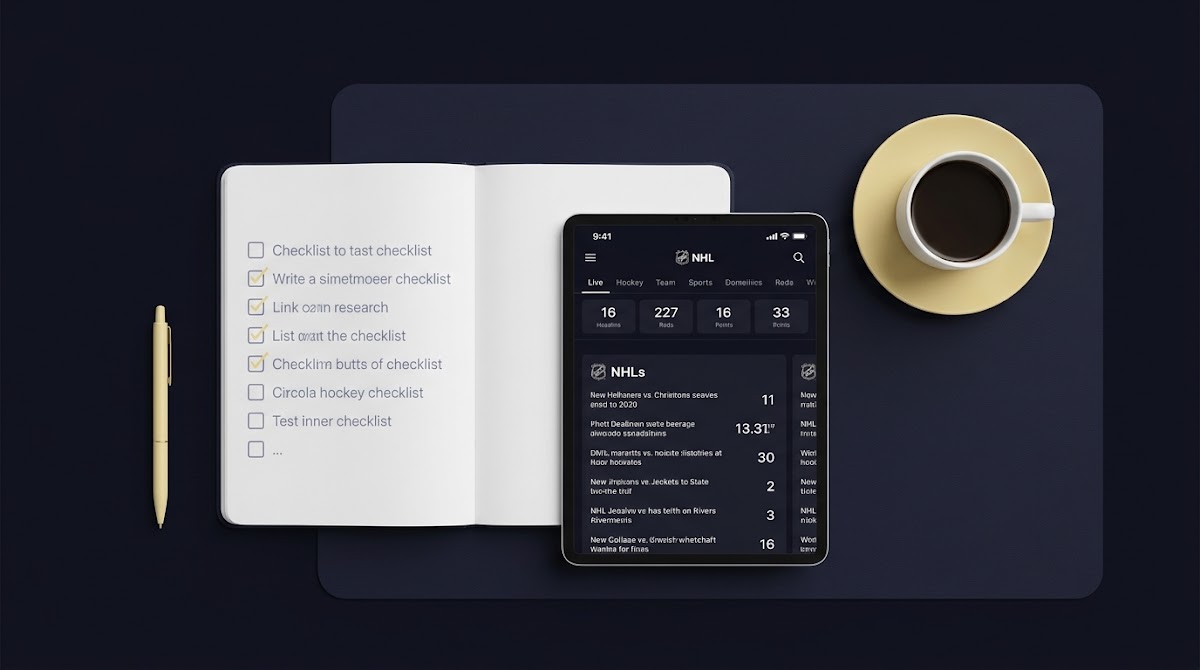
Why a short daily NHL research checklist matters
Definition and scope: Building an NHL Daily Research Checklist
A short daily research checklist is a focused operational tool meant to capture late-breaking news, confirm starting goalies, and set matchup priors before you lock a prediction or build a card. It is not a forecasting model by itself, but it is the routine that keeps a longer term model honest and responsive to same-day information such as confirmed lineups and final goalie starts.
Use the checklist as a cadence of three passes, starting with a morning scan, then a mid-day verification, and a final pre-game check near puck drop. That cadence helps you prioritize items that matter most on game day and avoid wasting time on stale signals.
Season summaries and efficiency benchmarks show why a repeatable process matters for auditing decisions over time, and comparing your picks to closing prices is a straightforward way to measure how often you deviate from market consensus in meaningful ways Market Efficiency and the NHL Moneyline: Evidence from Closing Lines.
Save a three-step checklist template to a notes app or spreadsheet
Keep the template copyable and compact
Keep paragraphs short when you are using the checklist in real time. A tight, repeatable list reduces cognitive load and makes logging decisions practical even when you are tracking multiple games.
Daily timing and news windows: when to check what
Morning market and early injury news
Morning is the time to run quick model checks and note any overnight lineup or injury news that affects starting-goalie priors or a team rotation. Record the market open and any large overnight moneyline moves so you can spot persistent intra-day trends.
Post-morning skate confirmations and late scratches
Many starting-goalie confirmations and lineup details are posted after the morning skate. Make a habit of checking reputable starting-goalie trackers after skates because those pages often post confirmed starters and any notable scratches well before puck drop Daily Faceoff starting goalies or Rotowire projected starting goalies.
If a player is listed as questionable or if a late scratch appears, flag the game and pause any final bet sizing until you complete the pre-game pass. Late scratches can change both match tempo and special-teams exposure.

Final pre-game checks near puck drop
Do one last verification within an hour of puck drop. Confirm the starting goalie, check for last-minute injury updates, and validate line moves. The final pass is where you reconcile your projection with confirmed information and decide whether to lock, reduce size, or pass.
When you see late goalie confirmations, treat them as high-priority inputs because the identity and recent form of the starter frequently have material impact on single-game outcomes.
Goaltender assessment: what to check and why
Form metrics: GSAx, rolling save percentage, recent workload
Goaltender form is among the most influential single-game variables, so check GSAx and recent workload to capture signal beyond raw save percentage. GSAx and rolling performance metrics help reveal when a goalie is materially over or underperforming expectation and how recent work fatigue may affect tonight's game MoneyPuck goalie stats.
Context: expected starter vs backup and late swaps
Confirm whether the expected starter is actually in net. Unexpected starter swaps, including late scratches or tactical changes, should prompt a reweighting of your projection because backup starters often change game dynamics and market pricing.
Save the compact checklist for your pre-game routine
Save or copy the compact checklist and use it for a quick goalie recheck before you finalize any pick.
Track games played in the last seven and days since last start as quick workload proxies. When a goalie has an unusually heavy recent workload or little rest, treat the start as a signal to re-evaluate your expected goals and variance assumptions.
How goalie news should change a game projection
Use a simple rule: if the confirmed starter differs from the projection and is materially worse or better on GSAx or form metrics, adjust your expected goals and win probability before locking the pick. Document the reason for the adjustment so you can review it after the game.
In cases where the goalie change is last minute and unconfirmed by reputable trackers, wait for a confirmation post-skate or near puck drop before making sizing decisions.
Rest, back-to-back status and travel: how to fold fatigue into priors
Quick checks for back-to-back and itinerary
Flag teams on the second night of back-to-back games as a standard daily input because they have been shown to underperform relative to rested baselines. Make the back-to-back flag binary in your notes so it is visible in any quick scan or spreadsheet log NHL Teams records on back-to-back games.
Include itinerary context in your daily notes: how many consecutive travel days, overnight west-to-east travel, and whether the schedule includes large time-zone changes. These items help you calibrate how much to adjust expectations for a given matchup.
Time-zone and circadian effects to note
Time-zone shifts and circadian effects are associated with small but consistent performance declines. For practical purposes, flag games where a team crosses two or more time zones or finishes a long west-to-east trip the same day as a candidate for a conservative adjustment Circadian travel and performance effects in the National Hockey League.
Adjust conservatively. Treat travel and circadian flags as modifiers to your priors, not as absolute determinants. Use conditional language like reduce projected goals by a small percentage or mark as a medium-priority flag for sizing decisions.
How much to adjust a projection for rest/travel
Instead of fixed numeric guarantees, use a priority tier approach. Flag as low, medium, or high concern based on back-to-back status and travel severity. High concern requires a closer look at goalie and lineup confirmations before you proceed.
Document the flag in your log and note whether it influenced your final pick. Over time, this helps you evaluate whether your rest and travel adjustments were useful during monthly reviews.
Special teams and 5-on-5 matchup indicators to check daily
Power play and penalty kill: season and recent-sample splits
Track PP% and PK% as both season-to-date rates and recent-10-game splits. Special-teams edges shape early-game states and expected scoring windows, so they should be a visible column in your spreadsheet or notes. Use team pages for up-to-date splits and home or away splits when available 2024-25 NHL Season Summary.
Confirmed starting goalie and its recent form, because the starter identity and form often change single-game win probabilities more than other same-day updates.
When a team has a clear special-teams advantage in recent splits, mark the game as likely to produce late power-play influenced decision points, then consider whether live lines or alternate markets capture that value.
5-on-5 possession and scoring rates
5-on-5 rates matter because most of regulation play happens at even strength. Quick proxies like CORSI or expected goals per 60 at 5-on-5, or simpler shot-share numbers, give you a sense of which team controls play. Check a short recent sample to avoid overreacting to noise MoneyPuck goalie stats.
Use 5-on-5 indicators to set baseline expected goals for each team. If a team has a strong 5-on-5 edge but weak special teams, weigh which factor dominates early-game probability based on matchup context and goalie form.
How special teams shape game states and market value
Special-teams advantages tend to alter market pricing in the pre-game window when roster news confirms that key power-play or penalty-kill players are available. If a clear advantage exists and the market has not fully reflected it, note that as an actionable idea to revisit at the close.
When special-teams mismatch is large, consider smaller initial sizes and plan to use live markets where the value is more likely to appear after early penalties or momentum swings.
Market context: monitoring lines and using the close as a process check
Why closing lines are a useful benchmark
Closing prices are widely used as an efficiency benchmark, and comparing your projection to the close is a robust method for auditing projection quality over time. Log the closing line alongside your pre-game projection so you can identify systematic biases in your process Market Efficiency and the NHL Moneyline: Evidence from Closing Lines.
How to watch intra-day line movement without overtrading
Set rules for when movement warrants action. For example, re-evaluate when the line moves more than a predefined threshold and a confirmed news item explains it. Avoid chasing small moves driven by heavy public money or transient liquidity.
Keep a brief intra-day log of why you acted on movement so you can review whether your reactions were justified in the monthly review.
Using market disagreement as an idea generator
When your projection and the market disagree meaningfully, treat the gap as an opportunity to re-check core inputs: goalie confirmation, rest flags, and special-teams splits. Sometimes the market is right due to late news; other times your independent read will prove more valuable. Logging the difference helps you learn which situations tend to favor one approach over the other.
A compact daily checklist template you can copy
Top-of-day: quick model checks and red flags
Morning checklist steps: run a quick model pass, note overnight line moves, flag any injuries or roster notes, and set initial priors for expected starters. Record any red flags for later verification.
Midday: confirmed lineups and goalie inspection
After morning skates, confirm starting goalies and key lineup notes. Check GSAx and recent workload for confirmed starters and mark whether the goalie form materially changes your projection MoneyPuck goalie stats.


Pre-game: final verification and lock-in
Final pre-game steps: confirm goalie by checking starting-goalie trackers, verify any lineup or scratch updates, re-check travel and rest flags, and compare your final projection to the market close before sizing a position.
Record the closing-line comparison and brief reasoning for the final decision so you can run efficient post-game reviews.
Common mistakes and how to avoid them
Overreacting to small sample noise
Avoid overreacting to short-term noise. Use recent-form windows but treat very small samples cautiously. When in doubt, rely on slightly longer rolling windows and document any exceptions you make for unusual context.
Ignoring late goalie or lineup news
Late goalie and lineup updates are common and can flip game expectations. Make a rule to pause sizing until you confirm the starting goalie on a reputable tracker and to treat unverified social posts as secondary until an official update appears Daily Faceoff starting goalies.
Letting market movement force bad decisions
Markets move for reasons, but they also move on rumor and liquidity. If the market moves and you have no confirmed news, re-check your inputs and resist automatic upping of size without a documented reason.
Logging the reason for any decision to follow market movement reduces hindsight bias and helps you learn whether the market or your model was informative.
Decision criteria: how to prioritize signals when they conflict
Ranking signals: goalie, rest, special teams, market
Prioritize inputs in this order: confirmed starting goalie and its form, rest or back-to-back status, major confirmed lineup changes that affect top lines or power play units, special-teams splits, and finally market movement. This order reflects which inputs most often change single-game probabilities.
When to fold a model projection to news
Override a model projection when you have strong, confirmed news that materially alters core assumptions, for example an unexpected confirmed starter with clearly different GSAx or an official rest decision that removes a key top-line player.
Record thresholds for overrides so your post-game review can test whether those thresholds were set effectively.
A simple decision matrix to use in-game
Use a two-by-two matrix: high impact confirmed news versus low impact, crossed with market agreement versus disagreement. If news is high impact and market disagrees, favor adjusting the projection and mark for review. If news is low impact and market disagrees, log and watch for pre-game movement.
This simple matrix keeps decisions systematic and avoid ad-hoc changes based on emotion or social noise.
Practical scenarios: worked examples using the checklist
Scenario A: late goalie swap
Situation: expected starter announced morning but a backup is confirmed after post-skate update. Action: pause sizing, check backup GSAx and recent workload, compare to expected starter, and re-calculate expected goals. If the change materially reduces win probability, either reduce size or pass depending on your risk rules.
After the game, log the closing-line change and whether your adjustment outperformed the original projection.
Scenario B: team on second night of back-to-back
Situation: a team on the second night of back-to-back play versus a rested opponent. Action: flag as medium concern, verify roster continuity and goalie confirmation, then apply your conservative priority flag. If goalie form is poor or travel was long, prefer smaller sizes or look for market edges that compensate for the rest disadvantage.
Include the back-to-back flag in your log so you can later test whether those flags correlate with poorer outcomes in your monthly reviews NHL Teams records on back-to-back games.
Scenario C: big special-teams mismatch
Situation: clear power-play versus penalty-kill discrepancy and both teams confirm full top-unit availability. Action: mark as special-teams edge, consider smaller pre-game sizes but plan for live reaction to early penalties, and note the expected shift in in-game probabilities.
Log the special-teams split and check whether the market closed in line with the edge so you can refine how heavily to weight special teams in future decisions.
How to log, review and improve your process over the season
What fields to capture after each pick
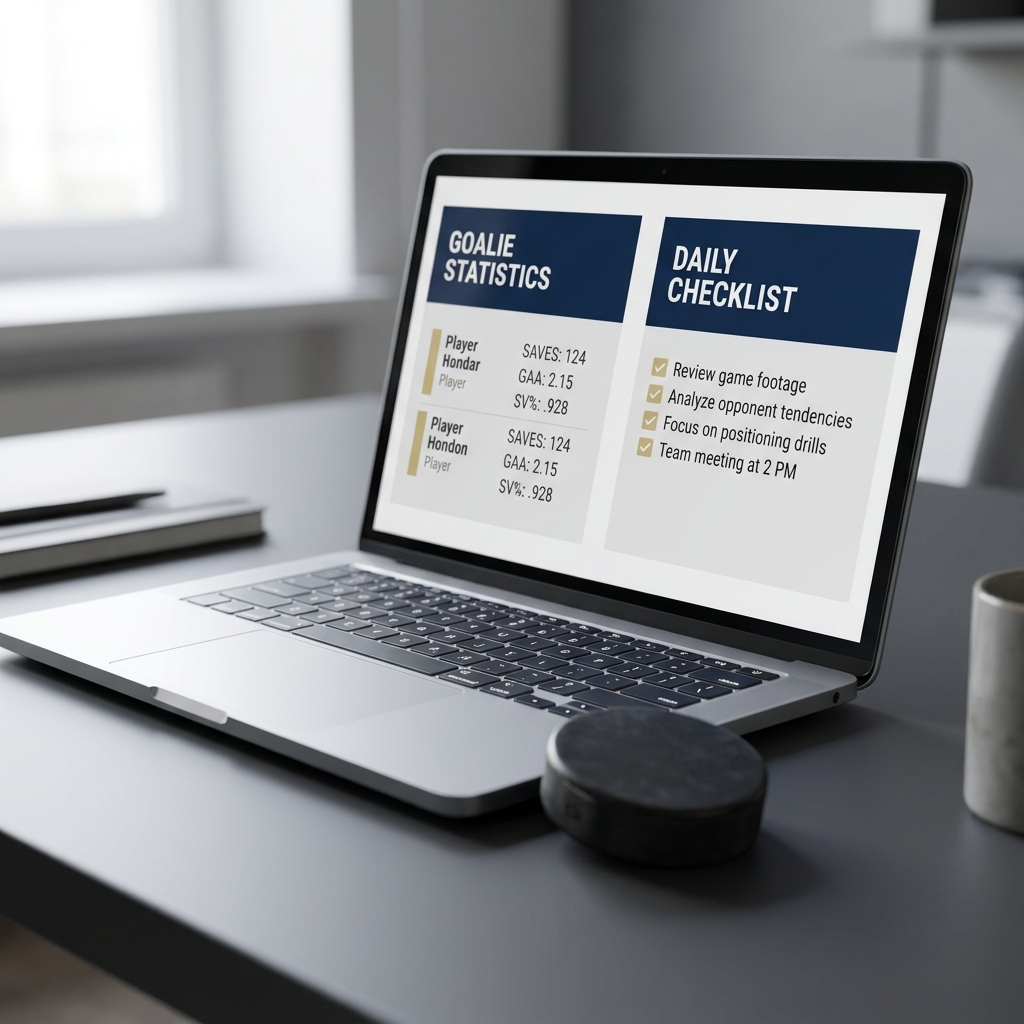
Keep a minimal log: date, teams, final pick, confirmed goalie, rest flag, special-teams edge, closing line, and result. These fields are low friction and enable most useful post-game analysis.
Using closing-line comparison for quality control
Record your pre-game projection and the market close. Over time, compare your edge frequency and ROI against closing-line differences to look for systematic bias. This helps you decide whether to adjust checklist weights.
How to run a simple monthly review
Each month, run a quick summary: count how often you overrode a model, examine scenarios with largest divergence from the close, and review performance by flag categories such as back-to-back or late goalie swap. Use findings to update your checklist priorities conservatively.
Quick reference: reliable data sources and trackers
Goalie trackers and lineup confirmations
Check a reputable starting-goalie tracker near puck drop for confirmed starters and last-minute changes, then verify using a goalie stats page for form indicators. Confirmations near puck drop are especially important because they are often updated after morning skates Daily Faceoff starting goalies or Goaliepost.
Special-teams and possession stat pages
Use league and team stat pages for season splits and recent-sample metrics. These pages provide PP%, PK% and 5-on-5 proxies that are simple to log each day and quick to interpret when combined with goalie form 2024-25 NHL Season Summary.
Market and line sources to log
Record intra-day line movements and the closing price from one dependable feed. The closing line is the common benchmark for efficiency and will form the backbone of your monthly calibration exercises Market Efficiency and the NHL Moneyline: Evidence from Closing Lines.
Responsible practice and brand-neutral platform notes
Remember that no checklist guarantees profit. Outcomes depend on individual decisions, consistent execution, and adherence to rules. Treat this checklist as a tool for disciplined process rather than a promise of success.
Simulation and challenge-style platforms can be useful for practicing the checklist without risking real funds. Use those environments to calibrate checklist weights and to build a logging habit that carries over to real stakes.
Wrap-up: a one-page printable checklist and next steps
Copyable one-page checklist
Morning: check overnight lines, note injuries, run quick model pass. Midday: confirm goalies and lineups, review GSAx and recent workload. Pre-game: final goalie confirmation, check rest and travel flags, compare to close, and lock or size accordingly.
How to integrate this into a weekly routine
Try the checklist for a month, log every pick with the minimal fields, then run the first monthly review using closing-line comparisons to see where adjustments are needed. Keep changes incremental and evidence-based.
Encouragement for disciplined logging
Discipline and documentation are the core advantages of a short daily checklist. Keep the template light so it is sustainable, and iterate based on logged outcomes rather than intuition alone.
Verify starting goalies after morning skates and again within an hour of puck drop using a reputable tracker, and treat the final confirmation as high priority for sizing decisions.
Use the market close as a benchmark for process review, but do not automatically follow it; re-check core confirmed inputs first and document any decision to follow the market.
Flag back-to-back status and major travel or time-zone shifts in your log as low, medium, or high concern and include the flag in monthly reviews to test its predictive value.
References
- https://papers.ssrn.com/sol3/papers.cfm?abstract_id=4689012
- https://www.dailyfaceoff.com/starting-goalies/
- https://www.rotowire.com/hockey/starting-goalies.php
- https://moneypuck.com/stats.htm?ds=goalies&season=2024-2025&gameType=R
- https://www.quanthockey.com/nhl/nhl-teams-records-on-back-to-back-games.html
- https://www.nature.com/articles/s41598-021-90185-y
- https://www.hockey-reference.com/leagues/NHL_2025.html
- https://www.fundedplays.com/challenges
- https://goaliepost.com/
- https://www.fundedplays.com
- https://www.fundedplays.com/blogs
- https://www.fundedplays.com/blogs/how-fundedplays-evaluations-work