
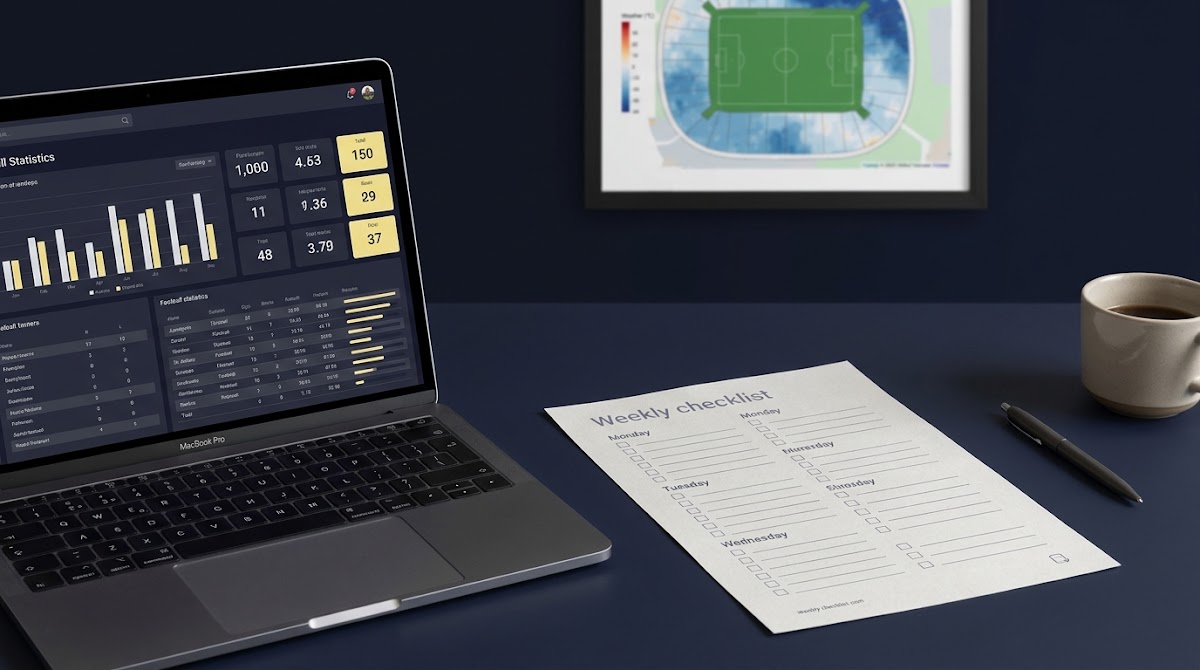
Building an NFL Weekly Trading Checklist: definition and objectives
Building an NFL Weekly Trading Checklist is a discipline tool designed to convert league timing, roster signals and data feeds into repeatable decision steps rather than ad hoc notes. The checklist should define what gets verified, when checks must happen, and what actions are allowed or forbidden when certain triggers occur.
A clear checklist differs from casual game-by-game notes because it enforces time-boxed verification aligned to league deadlines and it records decisions for later audit. For example, roster checks should be scheduled around official league reporting windows so actions are not taken before authoritative information is available, and the NFL Injury Report Policy sets those reporting expectations for practice participation and game-status updates NFL Injury Report Policy.
Get the Weekly Checklist and Start Timing Your Decisions
Download a concise, printable weekly checklist to keep timing and verification steps consistent across your workflow.
The primary goals are consistency, time-boxing and repeatability. Consistency means the same facts are captured the same way each week. Time-boxing means checks are tied to fixed league deadlines so execution is orderly. Repeatability means the checklist can be audited and improved over time, supporting skill-based evaluation rather than guessing.
Finally, the checklist is a tool for disciplined prediction work and does not guarantee profits or outcomes. It supports participation in skill-based prediction challenges by enforcing pre-committed trade sizes and stop-loss rules, which also align with responsible-play guidance.
Building an NFL Weekly Trading Checklist: a high-level framework
1. Pre-week research: set flags and model notes for unusual venues and rule-driven inputs.
2. Mid-week monitoring: check practice-participation and game-status updates as they are released, and log changes.
3. Game-day verification: perform final checks tied to the inactive-list deadline and hourly weather snapshots, then execute or cancel trades according to pre-set rules.
4. Post-week audit: grade model assumptions, edge sources and execution using standardized metrics so learning is consistent.
This phase breakdown ensures each part of the weekly cycle has a clear responsibility and data source. League-defined releases and rule changes map to specific phases: roster and practice reports drive mid-week checks, rule changes like kickoff updates influence pre-week assumptions and post-week audits, and authoritative weather feeds belong in game-day monitoring NFL owners approve kickoff rule changes for 2024 season. You can also consult the 2026 NFL rulebook for formal rule language that may affect model priors.
Bake stop-loss and bankroll rules into the framework so risk controls are enforced automatically rather than decided under pressure. Pre-commit to limits during pre-week planning and make them non-negotiable during execution to reduce behavioral errors.
Pre-week research: schedule, international games and context notes
Start pre-week work by marking any international or neutral-site contests on your calendar. These games often change travel plans, recovery windows and time-of-day factors that your model should note before line release and market activity begins. League announcements about international games provide the schedule drivers you need to flag those weeks NFL announces 2024 International Games.
Adjust model context for travel and time-zone disruption by recording which team has longer travel, early departures or compressed preparation windows. Add a short context note to each flagged game: expected travel fatigue, local kickoff time conversion, and any late-night routine changes that could affect in-game performance.

Use a time-boxed checklist tied to league reporting deadlines, hourly authoritative weather snapshots, and pre-committed risk controls so verifications are consistent and auditable.
Create concise pre-week checkboxes you can copy into a workflow: flag neutral-site games, note origin and destination time zones, and record potential recovery concerns for each team. These items should appear on every pre-week worksheet so none are missed when the schedule is dense.
Game rules and special teams: accounting for the 2024 kickoff rule
The 2024 kickoff rule changes altered return dynamics and expected field position in ways that matter for model inputs and variance assumptions. Traders should explicitly flag kickoff-rule impacts during pre-week setup and mark which teams have above-average return or coverage tendencies that the new rules may amplify or mute NFL owners approve kickoff rule changes for 2024 season.
Practically, this means adjusting expected starting field position distributions and special-teams variance terms in any pre-game simulation or model priors. For teams that gain or lose field-position advantage under the new rule, add a kickoff-adjusted input field and document the assumed shift so it can be audited post-week.
Track special-teams performance as a separate audit metric. Include return yards per kickoff and opponent starting position as distinct post-week items so you can separate special-teams variance from offensive and defensive model performance when reviewing results.
Injury and roster monitoring: structured mid-week checks
Schedule mid-week roster checks around the NFL Injury Report Policy reporting windows so you capture practice-participation and game-status updates as they are published. Time your first mid-week pass to follow the earliest practice reports, then follow up as graded practices provide updated participation notes NFL Injury Report Policy. Also check the official injury listings on the league site NFL injury listings to corroborate reports.
Keep a hard verification step for the final inactive list 90 minutes before kickoff and treat that confirmation as authoritative for execution decisions. Logging the inactive-list verification timestamp and the exact roster snapshot creates a reliable audit trail that shows the information your decisions relied on NFL Injury Report Policy.

Create a compact change log for mid-week moves: date, time, player, reported practice status, game-status note, and a short impact assessment. Use this log to map roster shifts to line movement and to decide whether a reported change crosses your threshold for trade adjustments. You can compare your log with public trackers such as CBS Sports when verifying report timing.
Data feeds and automation: weather, odds, and authoritative sources
Plan an hourly weather check using the National Weather Service public API to capture wind, precipitation, and temperature near stadiums. Hourly snapshots let you detect sudden game-day shifts that should trigger a model reassessment or execution pause National Weather Service API Documentation (weather.gov).

Authoritative roster and rule updates come from league communications and official team releases. Timestamp every feed pull so you can rank information by authority and recency when feeds conflict. A simple rule is to prefer the league release first, then team statements, then trusted aggregated feeds.
Include validation checks for feed integrity: confirm expected fields are present, check that timestamps are recent, and compare sample values with a secondary source. If a feed fails validation, fall back to a manual verification routine so automation does not create blind spots on game day.
Pre-game model adjustments, line flow and execution notes
Define clear criteria for model overrides so last-minute information is handled consistently. Example rules: if a starter is ruled out within the 90-minute window, then apply a documented roster override; if wind exceeds a pre-defined threshold, then adjust passing projections by a fixed factor; if kickoff-related special-teams numbers deviate materially from the season baseline, then widen variance bands before executing.
Use if/then language in the checklist to make these decisions binary and auditable. If a late scratch meets your threshold, then reduce position size by the pre-committed fraction and log the override reason. If a weather or venue flag contradicts market pricing, then pause execution until the validation timestamp is recorded and the feed is reconfirmed.
capture line flow events and model overrides for each game
Keep entries brief and time-stamped
Record line flow and execution notes in real time: the timestamp, market move, your action and the rationale. These logs form the basis of post-week grading for execution quality and timing.
Game-day verification: weather, inactives and timing to trade
Start a timed verification routine at least three hours before kickoff and run hourly weather snapshots until the two-hour mark. Move to 30-minute checks during the final 90 minutes so you capture any rapid changes in wind or precipitation that would alter model outputs National Weather Service API Documentation (weather.gov).
Perform a definitive inactive-list verification 90 minutes before kickoff and treat that roster snapshot as the decisive input for final sizing and execution decisions. Log the verification and do not override it without a clear, recorded justification that references an authoritative update NFL Injury Report Policy.
When conflicting reports appear, default to the league or team official source and delay trading if the conflict affects your primary edge. Immediate logging of any decision to trade despite a conflict is essential so the post-week audit can evaluate whether the action followed the checklist rules.
Risk controls: bankroll limits, stop-loss rules and responsible participation
Embed pre-committed bankroll limits in the checklist and enforce them before any trade. These limits should be set during pre-week planning and remain unchanged through execution unless a pre-defined escalation rule is met. Pre-setting limits reduces the chance of emotional sizing decisions under stress and aligns with safer-play recommendations.
Define stop-loss mechanics clearly: absolute stop-loss thresholds, per-game and per-week caps, and the automatic halt condition that suspends further trades when a limit is breached. Log every stop-loss event and record the trigger so you can assess whether controls prevented larger losses.
Responsible participation principles suggest using established guidance to set limits and intervention points. Treat these best-practice recommendations as minimum standards for checklist controls rather than optional suggestions Responsible Gambling: Tips for Safer Play.
Post-week review: standardized metrics and Next Gen Stats alignment
Create a post-week rubric that captures model accuracy, edge source performance, and execution quality using standardized metrics. Use defined metrics for starting field position, expected points added, and error sources so results are comparable week to week. Standardization reduces ambiguity when grading model assumptions.
Align metric names and definitions with a recognized glossary so everyone reviewing results interprets items the same way. The Next Gen Stats glossary is an example of a source you can follow to keep definitions consistent across audits Next Gen Stats Glossary.
Score edge sources separately from execution. Document whether an edge came from model signal, market inefficiency or game-specific knowledge, then rate execution quality on timing, size and adherence to checklist rules. This separation helps you identify whether losses stem from flawed assumptions or execution faults.
Common errors and checklist pitfalls to avoid
Timing mistakes are frequent. A common error is executing before verifying the inactive list and then discovering a late scratch that materially changed the matchup. To avoid this, hard-lock trade permissions until the 90-minute roster check is recorded and logged NFL Injury Report Policy.
Another pitfall is overreacting to a single noisy data point such as one unusually long return or a single bad feed update. Maintain checklist discipline by requiring corroboration from authoritative sources before large rule-based overrides are applied.
When under time pressure, rely on the checklist to reduce complexity: follow the if/then rules and pre-committed sizing instead of improvising. Regular rehearsal of the checklist in low-stakes weeks helps build the habit of discipline when markets become fast.
Practical examples: a sample weekly checklist and scenario walk-throughs
Sample printable checklist items: pre-week flags for international venues, mid-week roster check times, a 90-minute inactive verification step, hourly weather checks on game day, and post-week audit fields for model assumptions. Keep the checklist compact so it is usable under time pressure.
Scenario 1, weather scramble: forecasted wind spikes appear in hourly NWS pulls two hours before kickoff. The checklist rule calls for a wind override if the forecasted sustained wind exceeds the pre-set threshold. The trader records the NWS snapshot, applies the wind adjustment, reduces position size per the override rule, and logs the decision and timestamp for audit National Weather Service API Documentation (weather.gov).
Scenario 2, late inactive: a starting running back is listed as doubtful throughout the week and then declared inactive 85 minutes before kickoff. The checklist requires the 90-minute inactive confirmation, so the trader waits for the official inactive list, then applies the pre-defined roster override, reduces trade size and records execution details and rationale for post-week review NFL Injury Report Policy.
Conclusion: integrating the checklist into a repeatable routine
Turn the checklist into a habit by using it every week and by keeping the items brief and actionable. Routine logging, timestamped verifications and structured post-week reviews create a feedback loop that improves decision quality over a season.
Iterate the checklist after each post-week audit. Adjust thresholds, add or remove checks based on evidence, and keep a version history so changes are reversible and traceable. Remember that checklist discipline supports participation in skill-based evaluation programs but does not guarantee qualification or outcomes.
Schedule mid-week checks to follow practice participation reports and confirm the final inactive list 90 minutes before kickoff.
Monitor hourly wind, precipitation and temperature near the stadium using authoritative hourly weather feeds.
Pre-commit limits during pre-week planning, automate stop-loss halts where possible, and log any breaches for post-week review.
References
- https://operations.nfl.com/updates/football-ops/nfl-injury-report-policy/
- https://www.nfl.com/news/nfl-owners-approve-kickoff-rule-changes-for-2024-season
- https://operations.nfl.com/rules-officiating/2026-nfl-rulebook
- https://www.nfl.com/news/nfl-announces-2024-international-games
- https://www.nfl.com/injuries/
- https://www.fundedplays.com/challenges
- https://www.weather.gov/documentation/services-web-api
- https://www.responsibleplay.org/
- https://www.nfl.com/nextgenstats/glossary
- https://www.cbssports.com/nfl/injuries/
- https://www.fundedplays.com
- https://www.fundedplays.com/blogs
- https://www.fundedplays.com/blogs/how-fundedplays-evaluations-work