
What a match research checklist is and why it matters
Definition and intended users
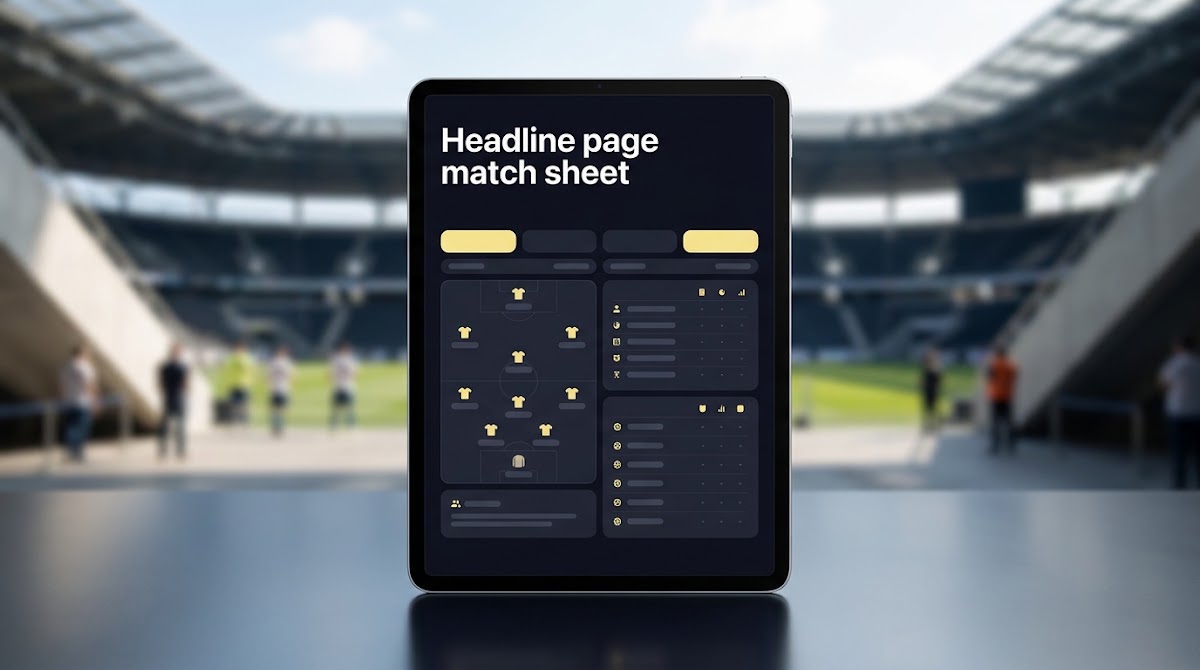
A match research checklist is a structured, time-stamped match-sheet designed to capture the key inputs analysts need before kickoff. It acts as a single reference for selection choices, tactical briefings and last-minute verification in the pre-match workflow.
The checklist purpose is pragmatic: reduce cognitive load, make decisions auditable and ensure consistent treatment of laws, tactical cues, set-piece profiles, workload flags, injury context and environmental risks. It is evidence-based scouting, not a prediction guarantee, and it supports skill-based evaluation without promising outcomes.
Adaptable template for spreadsheet or scouting app
Copyable into any workflow
How the checklist fits into pre-match workflows
Use the sheet as the single source of truth between initial research, lineup confirmation and final match notes. Analysts should update fields when new information arrives and keep the latest timestamp and source for each entry so changes are traceable. single source of truth
Teams, independent analysts and advanced sports fans can all adapt the same structure; the difference is granularity and who owns verification. For platform users, the sheet supports disciplined evaluation without implying guaranteed results.
Quick overview of sections to expect
A practical match-sheet groups content into: laws and rules context, tactical trends and opposition scouting, set-piece profiling, player workload and travel, injury and return-to-play context, environmental checks and core data metrics to capture before kickoff. Each area should include a confidence flag and a timestamp for later review.

Aligning your checklist to the Laws of the Game
Aligning your checklist to the Laws of the Game
Which rule changes affect pre-match choices
Capture the rule items that alter substitution behaviour, offside interpretation, disciplinary processes, added-time handling and set-piece procedures from the latest rules edition. Reference the official guidance when noting substitution windows or set-piece enforcement to reduce misinterpretation IFAB Laws of the Game 2024/25. You can also consult the IFAB single-page laws for quick reference IFAB single-page laws.
How substitutions and added-time rules change rotation notes
Record substitution allowances and any tournament-specific procedures, then note how added-time guidance affects late-game rotation. A standard field should read: "Substitutions allowed: X, windows or procedures: Y, note timestamp and source" so selection staff can make consistent rotation decisions. See recent law changes for procedural updates IFAB law changes.
Practical checklist fields to capture rule-driven items
Suggested fields: substitution limit and procedure, permitted re-entry or special windows, offside interpretation note, added-time expectations and set-piece procedure exceptions. Timestamp every rule entry and include the source name so you can verify changes quickly in the warm-up. Where useful, link to Law 11 for offside interpretation details Law 11.
Capturing tactical trends from elite technical reports
Which trends to prioritise: pressing, build-up, rest-defence
Elite tournament technical reports summarise recurring tactical motifs such as pressing triggers, preferred build-up corridors and rest-defence shapes. Translating those motifs into short checklist items helps you recognise when an opponent is likely to behave in a certain way during phases of play UEFA EURO 2024 - Technical Report.
Prioritise trends that alter immediate selection or early-game tactics: pressing triggers that force quick outlets, a build-up tendency down a flank that demands matchup changes, or rest-defence shapes that create exploitable channels. Keep items concise and actionable.
Get the one-page match-sheet and adapt it to FundedPlays challenge workflows
Copy or download the one-page checklist to adapt the tactical fields and paste into your preferred notes tool.
Translating report findings into checklist observations
Convert a technical insight into a short observation with context, for example: "Pressing trigger: wide pass beyond halfway, frequency mid-to-high, consequences: high turnover risk on left flank". Log a confidence score and the provenance of the insight.
When a report notes repeated set-play designs or pressing sequences, add a tick-box or short field to the sheet so you can confirm whether the live opponent continues that pattern during warm-ups and first 15 minutes.
Examples of concise tactical notes
Examples you can copy: "Build-up: prefers short left-centre progression, goalkeeper often plays long to right channel"; "Pressing trigger: defensive third long ball, aggressive midfield step-up". Keep examples to one line each so they are easy to scan under time pressure. Reference tournament reports where useful to justify the note FIFA WWC 2023 - Technical Report.
Set-piece profiling: what to log and why it matters
Key set-piece categories: corners, free-kicks, penalties, throw-ins
Set-piece outcomes remain a decisive match element, so include dedicated fields per category: corner, direct free-kick, indirect free-kick, penalty and short throw routines. For each, note delivery patterns and primary targets so the coaching team can align defensive assignments and attacking plays.
Delivery types, screeners and primary targets to record
Capture delivery attributes: preferred foot, in-swing or out-swing, short versus full delivery, and whether the opponent uses screeners or blocking runs. When present, mark primary aerial targets and their typical zones to plan matchups and zonal versus man-marking responses Set-piece scoring trends analysis.
How to prioritise set-piece notes for match value
Prioritise set-piece elements that map to likely match situations: corners at late stages, free-kicks inside the box and quick short corners. Use a short-value flag on each set-piece entry so you can focus attention on the routines most likely to produce a scoring event.
Player workload, fixture congestion and travel: checklist fields
Which workload metrics to log: minutes, starts, recovery time
Record minutes played in the last 14 days, number of starts, substitute appearances and minutes per appearance as primary workload metrics. These fields help flag players at elevated short-term fatigue risk and guide rotation or substitution planning Men's player workload monitoring report.
Turnaround windows and cross-time-zone travel
Log turnaround time since the last match and the number of full travel days, plus time-zone changes. Travel burden can compound fixture congestion effects and should be visible on the sheet as a simple numeric field: "travel days: X; time zones crossed: Y".
A 2026-ready checklist should include timestamped fields for laws and rules, tactical trends, set-piece profiles, recent minutes and travel, injury and RTP context, environmental metrics (including WBGT when possible), and a simple readiness score backed by sources.
How to weight short-term fatigue risk in selection decisions
Apply simple rules-of-thumb such as increasing fatigue risk when minutes in the last 14 days exceed a threshold or when turnaround is short. Use a confidence flag for these entries and cross-check with official reports before making last-minute lineup changes.
Injury surveillance and return-to-play context
Reliable sources for availability updates
Prioritise official club reports, league injury lists and governing-body notices for primary availability information. When multiple sources conflict, keep both entries with timestamps and a short note explaining the discrepancy so decision-makers see the record trail.
Standardised reporting terms to include
Use standardised terms such as doubtful, questionable, out and match-fit, and include date of last appearance. Standardising terms makes post-match aggregation and comparisons more reliable and reduces interpretation error across analysts.
How RTP context adjusts selection and risk grading
Treat recent return-to-play cases cautiously unless backed by confirmed match minutes or explicit medical clearance. Down-weight RTP players in your readiness score unless the sheet shows match minutes since return or a clear clearance note from a reliable source Men's player workload monitoring report.
Environment and heat: recording WBGT, temperature and cooling break risks
Which environmental metrics to capture and why
Record ambient temperature, relative humidity and, where feasible, wet-bulb globe temperature (WBGT). These values help anticipate declines in high-intensity running and technical execution and inform whether cooling breaks are likely.

Example logging entry: "Temp: 33C, RH: 65%, WBGT: 28C, forecast source: local meteorology". Keep each entry time-stamped so you can update if conditions change before kickoff.
Example logging entry: "Temp: 33C, RH: 65%, WBGT: 28C, forecast source: local meteorology". Keep each entry time-stamped so you can update if conditions change before kickoff.

How heat and humidity affect high-intensity running and technical execution
Evidence from systematic reviews shows that hot and humid conditions reduce high-intensity running capacity and can impair technical execution, which makes environmental fields operationally useful when planning substitutions and cooling breaks Hot environments and football performance review.
Practical steps to log forecasts and contingency notes
Include a field for forecast source, expected cooling-break likelihood and an action note that links environment to substitution depth. For example: "If WBGT > 26C, recommend +1 substitution priority for wide midfielders at 60 minutes". Keep the action note phrased as a planning option, not a guarantee.
Opposition scouting: pressing triggers and build-up patterns
How to identify and note pressing triggers
Log observable pressing triggers, such as defensive orientation, preferred outlet passes and set-piece restart behaviours. For each trigger, note situational context and frequency so the coaching staff can spot when the opponent is likely to use the trigger during live play UEFA EURO 2024 - Technical Report.
Common build-up channels and goalkeeper involvement
Record the opposition's common build-up channels and whether the goalkeeper frequently participates in circulation or initiates long distribution. This influences how you mark midfielders and which pressing lines the team should attempt to disrupt.
Which opposition tendencies change selection or tactics
Highlight tendencies that directly influence selection: poor full-back recovery distances, goalkeeper distribution bias, or low pressing intensity on certain flanks. Turn those observations into quick selection notes such as matchup warnings or substitution triggers.
Data and stats to collect before kickoff
Essential event and player metrics for quick reference
Keep a short metrics panel: minutes, xG, xA, shots on target, key passes and aerial duel success. Record time-stamped values for each metric and the source so you can compare them with lineup confirmations and in-game adjustments.
Set-piece-specific stats and matchup metrics
Include set-piece stats: goals from set-pieces, opponent's conceded corners per 90 and primary aerial target success rate. These metrics tie directly to the set-piece module and help prioritise defensive assignments Set-piece scoring trends analysis.
How to prioritise stats when time is limited
When pressed for time, capture three core metrics: minutes (recent workload), key passes or xA (creative threat) and set-piece susceptibility (set-piece goals conceded). These three fields give a rapid readiness snapshot for selection decisions.
Designing the match-sheet: fields, timestamps and sources
Recommended field list and layout
Recommended fields: match metadata, squad status with timestamped availability, minutes last 14 days, travel days, substitution notes, primary set-piece profiles, tactical observations, environment fields and a short confidence score. Group related fields visually to speed lookup in the 15-minute pre-match window.
How to timestamp entries and record source reliability
Every entry should include a timestamp and a source label such as club report, official competition release, technical report or data provider. Add a confidence flag (high, medium, low) so users know how much to trust each entry when making last-minute calls.
Version control and post-match updates
Use a simple versioning convention: v0.1 (initial research), v0.2 (lineup confirmed), v1.0 (final match-sheet). After the match, update the sheet with final minutes and any corrections so the next preparation benefits from a clean post-match review.
Decision criteria and risk weighting for selection
How to convert checklist entries into a selection decision
Create a readiness score that sums weighted fields into a single numeric value, with higher scores indicating lower selection risk. Keep the formula visible on the sheet so selection choices are auditable rather than subjective.
Simple scoring or risk-weight system examples
Example framework: readiness = 100 - workload_penalty - RTP_penalty - environment_penalty + tactical_fit_bonus. Define each penalty and bonus on the sheet so users can reproduce the calculation consistently.
Balancing tactical fit versus short-term risk
When tactical fit conflicts with short-term risk, upweight recent workload and RTP concerns to reduce injury or performance decline exposure, but document the rationale. Use cutoffs such as "do not start if minutes last 14 days > X and turnaround < Y" to keep choices consistent IFAB Laws of the Game 2024/25.
Common scouting mistakes and how to avoid them
Overreliance on headline stats
Headline stats can be misleading when taken alone. Always pair a headline figure with immediate context such as minutes, match role and opponent strength so numbers are interpreted correctly.
Ignoring law changes or environmental risks
Not recording law updates or environmental conditions can lead to avoidable tactical errors. Make those fields mandatory on the sheet so they are not omitted by habit.
Failing to timestamp or cite sources
Not timestamping and not recording sources creates ambiguity and reduces accountability. Standardise timestamp and source fields and require them for every entry to make the research defensible and repeatable UEFA EURO 2024 - Technical Report.
Practical examples: three pre-match scenarios and sample entries
Scenario A: congested fixture with travel
Sample entry (timestamped): minutes last 14 days: 320, travel days: 2, time zones crossed: 1, confidence: medium. Decision note: "Avoid starting player X if minutes > 300 and travel days <=2; plan substitution at 55-65 minutes." These fields map directly to workload guidance and help reduce short-term fatigue risk Men's player workload monitoring report.
Scenario B: hot-weather match with cooling-break risk
Sample entry (timestamped): Temp: 34C, RH: 60%, WBGT estimate: 29C, forecast source: local meteorology, action: "Plan early second-half rotation, anticipate cooling breaks". The environment entry makes substitution planning explicit and ties directly to evidence about heat effects on high-intensity output Hot environments and football performance review.
Scenario C: opponent with set-piece threat
Sample entry (timestamped): opponent corners per 90: high, primary aerial target: #9, delivery: outswing right-footed, screeners present: yes. Decision note: "Assign tall central markers on primary zone and rehearse zonal-man hybrid at set-piece warm-up". This links set-piece scouting to concrete defensive steps Set-piece scoring trends analysis.
Putting it together: quick checklist template and next steps
One-page match-sheet checklist
One-page fields to copy: match metadata, squad status with timestamps, minutes last 14 days, travel days, substitution plan, set-piece module, tactical notes, environment fields, core metrics panel and final readiness score. Keep this printable or easily viewable on a tablet for the 15-minute pre-match window.
How to integrate into your workflow and platform
Integrate the template into your preferred notes tool or spreadsheet, then sync verified lineup entries at confirmation. For platform users, the sheet helps you follow a disciplined challenge-style evaluation without implying guarantees about outcome or reward opportunities.
Verification and post-match review steps
At lineup release, verify any club reports and final minutes; after the match, record final minutes and revise confidence flags. Use post-match notes and technical reports to iterate on the template for the next cycle UEFA EURO 2024 - Technical Report.
Finalize the match-sheet at lineup confirmation and again 10 minutes before kickoff to capture any late changes.
If time is limited, prioritize minutes in the last 14 days, a key creative metric (xA or key passes) and set-piece susceptibility.
No. The checklist standardises preparation and helps decision-making but cannot guarantee match results or rewards.
References
- https://www.fundedplays.com
- https://www.fundedplays.com/blogs
- https://www.fundedplays.com/blogs/how-fundedplays-evaluations-work
- https://www.theifab.com/laws/latest/
- https://downloads.theifab.com/downloads/laws-of-the-game-2025-26-single-pages?l=en
- https://www.theifab.com/law-changes/latest/
- https://www.thefa.com/football-rules-governance/lawsandrules/laws/football-11-11/law-11---offside
- https://www.uefa.com/insideuefa/technical/technical-reports/
- https://www.fifa.com/technical/media-releases/fifa-womens-world-cup-2023-technical-report-published
- https://theanalyst.com/eu/2024/02/set-piece-goals-are-on-the-rise-in-the-premier-league-2023-24/
- https://www.fifpro.org/en/industry/workload/men-s-player-workload/men-s-player-workload-2024
- https://sportsmedicine-open.springeropen.com/articles/10.1186/s40798-023-00588-1
- https://www.fundedplays.com/challenges