
Quick answer: bucks prediction: Who is favored in Bucks vs Jazz
Short takeaway, first: the market favorite in any Bucks vs Jazz matchup is the side showing shorter moneyline or the team giving points on the spread, adjusted for last-minute injuries and official status reports.

For same-day clarity, the clearest single inputs are the current moneyline or point spread and the NBA official injury report, which together define which team sportsbooks list as the favorite and by how much. When the league posts pregame statuses, market prices usually react quickly because line setters and modelers treat those designations as authoritative, particularly under the Player Participation Policy.
To quantify how favored a team is, convert moneyline prices into an implied probability using a standard formula. That conversion helps translate a market price into a percent chance such as an estimated win probability, making the market favorite easier to compare across bookmakers and models.
Short summary of the market signal
The simplest market signal is the moneyline, which shows which team the market expects to win straight up. A shorter negative moneyline shows the favored side, and converting that price to implied probability gives a clear estimate of the market view. For a formal explanation of the formula and conversion method, see the Investopedia guide to implied probability Implied Probability Definition and Formula.
When this quick read applies and when to verify
This quick bucks prediction read is ideal within a few hours of tip, once bookmakers have posted lines and the NBA has published its day-of statuses. If either lines or the official injury report are not yet final, re-check both before acting, because late designations and market movement can flip which team is favored.
How market odds and line movement reveal the favorite
Moneyline versus point spread: moneyline prices express the market s straight-up pick, while the point spread shows the expected margin and where the market expects the game to finish relative to that margin. Both are useful, but moneylines are the clearest single indicator of which team is labeled the favorite by the market.
Converting a moneyline to an implied probability turns a price into a percent chance, which makes it easier to compare across books and to measure how much the market favors one side. The standard formulas for negative and positive moneylines are documented in a common reference on implied probability Implied Probability Definition and Formula.

Interpreting line movement, public versus sharp money: watch how lines move after initial release. Sharp or professional market action can move lines away from the public consensus, and late shifts often follow injury news, travel updates, or rest decisions. When you see sudden movement toward one side, treat it as a signal to re-check the official injury report and last-minute lineup notes.
Practical example without live odds: if the market opens a game with a certain spread or moneyline and then drops that team s price after a morning injury, the new moneyline expresses the adjusted market favorite and should be re-converted to an implied probability to measure the change in expected win chance.
Convert moneyline odds into implied probabilities for each side
Use these outputs then adjust for overround
Use a simple spreadsheet or calculator to run the conversions above so you have the market s implied percentages in front of you before weighing injuries and matchup details. See the Funded Plays blog for additional process notes at Funded Plays blog.
Moneyline versus point spread: what each shows
The moneyline shows which team the market expects to win outright, while the point spread expresses the expected margin and is more useful for gauging games where margin and pace matter. Either signal can show the favorite, but moneylines map directly to a win probability when you run the conversion formulas.
Interpreting line movement and public versus sharp money
Line movement often reflects two factors: news driven changes such as injuries and sharp market activity where professional bettors move a price. When the public and sharp sides diverge, the favorite label can shift, so re-check both the moneyline and the official status feed before finalizing a view. For matchup specific injury lists and matchup trackers see TeamRankings matchup injuries.
Why day-of injuries and the NBA Player Participation Policy matter
The NBA s Player Participation Policy requires timely pregame status designations, which makes official player statuses a primary input for market pricing and for deciding who is favored on game day. That policy was approved by the league and is a central reason why markets react strongly to late designations NBA Board of Governors approves Player Participation Policy.
The league s centralized Injury Report hub provides the official, day-of-game statuses that bookmakers and models use to set prices. When the NBA posts a starter as out or questionable, line setters and algorithmic models typically update prices quickly to reflect the new expected on-court roster NBA Injury Report: 2025-26 Season, and third-party trackers such as ESPN also publish team injury status pages ESPN injury status.
Verify game day inputs on the FundedPlays Challenges page
Before you lock a pick, check the NBA official injury report for final pregame designations, since the market favorite can change with a single key status update.
Practical steps to use the injury report: watch for final designations in the two hours before tip, compare the functional role of any listed players to their replacements, and treat a confirmed out for a key starter as a strong signal to update the moneyline to probability conversion. For contemporary injury lists see the SI report on Jazz availability SI Jazz injury report.
How to interpret a questionable tag: consider the context of the player s minutes, role, and teammates who would absorb those minutes. A questionable starter who plays reduced minutes is not the same as a full absence, so weigh the designation in light of realistic lineup changes and rotation depth.
What the Player Participation Policy requires
The policy obliges teams to provide timely status updates so markets rely on the league s designations for near-final lineup information. That reduces ambiguity and gives bettors and modelers a clear signal to price into their projections when the report appears.
How the NBA centralized injury report changes pricing
Bookmakers treat the centralized report as authoritative and frequently update lines after official entries appear. Because the report is a standard league source, it shortens the window for ambiguity and concentrates market reaction into the final pregame hours, which is why a bucks prediction should always check that feed last.
Recent head-to-head and season context for Bucks vs Jazz
A relevant recent meeting: Milwaukee beat Utah 125 110 in Salt Lake City on January 27, 2025, which is a useful head-to-head datapoint when comparing immediate matchup tendencies and how the teams executed on that night Milwaukee Bucks at Utah Jazz Box Score, January 27, 2025.
The market favorite is the team with the shorter moneyline or the side giving points on the spread after accounting for the NBA s official day-of injury designations; convert the moneyline to implied probability to see the market s estimated win chance.
Season-level ratings from Basketball Reference for 2024 25 show Milwaukee grading stronger than Utah on aggregate efficiency metrics, which creates a baseline expectation that the Bucks are the default stronger team when both rosters are near full strength 2024 25 NBA Season: Team Ratings.
Season summary pages for each team provide roster and performance baselines that matter when day-of variables are neutral. Use those pages to understand which team has the deeper rotation and which matchups tend to favor one side before incorporating the final injury and odds signals 2024 25 Season Summary: Milwaukee Bucks and Utah Jazz.
Put simply, recent head-to-heads and season ratings set a baseline. If the baseline favors Milwaukee but the injury report lists a key Bucks starter out, the market favorite can flip to Utah. Always treat head-to-head wins as context rather than a standalone prediction driver.
Key recent meeting: Jan. 27, 2025 recap
That January game shows how Milwaukee executed in Utah under those lineups and rotations, and it is especially useful for identifying matchup edges that might reappear. However, do not use that box score alone without checking if the same players and roles apply on game day.
What season-level ratings tell us about baseline strength
Team ratings summarize the season s offensive and defensive efficiency and give a baseline expectation. When lineups are stable, those ratings correlate with which team will open as favorite, but they need re-weighting when day-of absences change rotation quality.
How to convert moneyline odds into an implied win probability
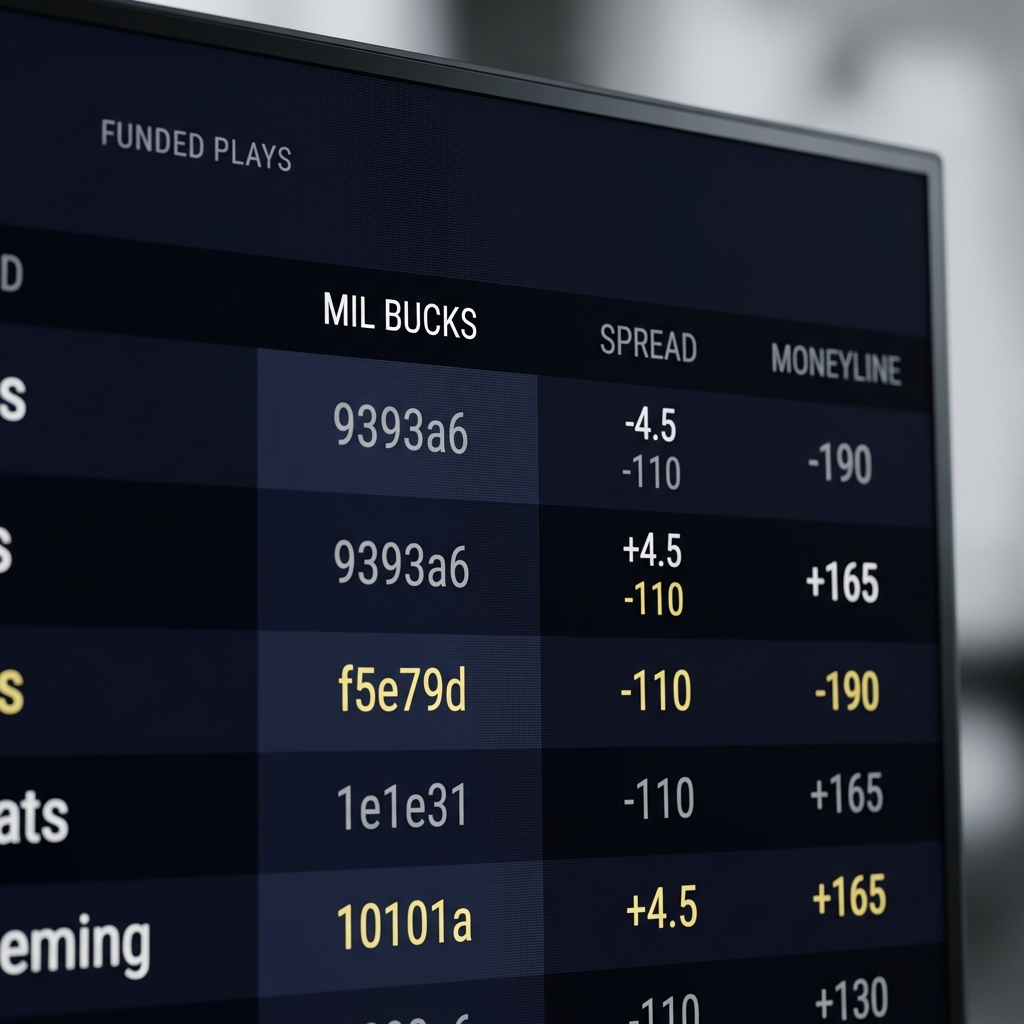
Standard formulas make the conversion straightforward: for negative moneylines use absolute value of the odds divided by that absolute value plus 100, and for positive moneylines use 100 divided by the odds plus 100. This formula set is the standard reference for implied probability conversions Implied Probability Definition and Formula.
Step by step: first identify whether the moneyline is negative or positive. Second apply the appropriate formula to compute the implied probability. Third, if you compare across books, adjust for overround so probabilities sum to 100 percent rather than exceeding it.
The standard formulas for positive and negative moneylines
Negative odds formula, shown generically: absolute value of the odds divided by absolute value of the odds plus 100. Positive odds formula, shown generically: 100 divided by the odds plus 100. After calculating both sides repeat the sum and remove the overround proportionally to normalize the pair to 100 percent.
A worked example using neutral, hypothetical prices
Worked example, no live odds: if Team A is listed at 150 and Team B at -170, calculate Team A s implied probability using the positive formula and Team B s using the negative formula, then normalize for overround to get the final adjusted market probabilities. Running the numbers in a quick spreadsheet prevents math errors and gives you the market s translated view for a clear bucks prediction.
Decision framework: who to favor and when
Apply a short checklist: check the NBA Injury Report for final statuses, note current moneyline or spread, convert the moneyline to an implied probability, compare that number to season ratings and recent matchup context, then adjust for travel or rest factors before deciding which side to favor.
Always quantify how much a late change affects your view by re-running the moneyline to probability conversion after the news. That quantification shows whether the market moved enough to change which team you favor and by how much.
A short checklist to form a same-day view
1) Confirm final player statuses on the official league injury report. 2) Record the current moneyline and spread. 3) Convert moneylines to implied probabilities. 4) Re-weight baseline season ratings for any missing starters. 5) Factor in travel and rest. These steps create a transparent workflow for a data driven bucks prediction.
When to favor Milwaukee, when to favor Utah
Favor Milwaukee when the Bucks are near full strength, the market moneyline reflects their advantage, and season ratings plus matchup signals align. Favor Utah when a key Bucks starter is out or when the Jazz receive a sudden line shortening that survives additional market checks and the injury report shows stable availability for Utah.
Common mistakes and pitfalls in a bucks prediction
One frequent error is relying on a past head to head without checking day-of injuries or current odds. The January 27, 2025 result is useful context but not decisive if rosters differ on game day Milwaukee Bucks at Utah Jazz Box Score, January 27, 2025.
Another mistake is treating an unconverted moneyline as a probability. Without converting odds to implied probability you can misjudge how much edge the market gives one side, which impairs a rational bucks prediction Implied Probability Definition and Formula.
A third pitfall is over-counting season ratings when a key starter is absent. Team ratings are season level and should be reweighted when a rotation change materially alters expected minutes and matchups 2024 25 NBA Season: Team Ratings.
What to avoid on game day
Avoid locking a pick before the official injury report posts final designations, and avoid assuming that a single past meeting implies the same outcome if rosters or roles have changed. Re-run conversions after any meaningful news before finalizing a bucks prediction.
How to cross-check your view
Cross-check using the official injury report, re-run the implied probability math, and compare your adjusted baseline to the current market price. If your internal percentage materially differs from the market, re-examine line movement sources and roster coverage before acting.
Putting it together: a responsible, evidence-based closing for your bucks prediction
Final pregame checklist: verify the NBA Injury Report for final statuses, record current moneyline or spread, convert to implied probability, re-weight season ratings if key players are absent, and factor travel and rest before choosing which side to favor.
Treat every bucks prediction as a probability based view rather than a certainty. Track outcomes over time, refine your process, and use the official injury report and season pages as the recurring inputs that anchor a consistent forecasting workflow 2024 25 Season Summary: Milwaukee Bucks and Utah Jazz.

When you follow this process you create a repeatable approach to deciding who is favored in Bucks vs Jazz matchups, grounded in official designations, transparent math, and season context. Visit the Funded Plays homepage at Funded Plays homepage to track process notes and resources.
Check the current moneyline or spread and confirm final player statuses on the NBA injury report; convert the moneyline to an implied probability to see the market s estimated win chance.
Use the league s centralized NBA injury report for official pregame status updates, then compare that to published moneylines before making a decision.
Use past meetings as context but not as the deciding factor; reweight that information if rosters or roles differ on game day.
References
- https://www.fundedplays.com/challenges
- https://www.fundedplays.com/blogs
- https://www.fundedplays.com
- https://www.investopedia.com/terms/i/implied-probability.asp
- https://official.nba.com/nba-injury-report-2025-26-season/
- https://www.nba.com/news/nba-board-of-governors-approves-player-participation-policy
- https://www.basketball-reference.com/boxscores/202501270UTA.html
- https://www.basketball-reference.com/leagues/NBA_2025_ratings.html
- https://www.basketball-reference.com/teams/
- https://www.teamrankings.com/nba/matchup/jazz-bucks-2026-03-07/injuries
- https://www.espn.com/nba/team/injuries/_/name/mil/milwaukee-bucks
- https://www.si.com/nba/jazz/onsi/news/utah-jazz-injury-report-rules-out-7-players-vs-milwaukee-bucks