

Quick answer and what this article will cover
One-line verdict
Short verdict: given Giannis Antetokounmpo remains under a three-year extension with Milwaukee, the near-term chance that Detroit can complete a trade for him is low unless the Bucks decide to move him or a complex, multi-team package emerges that clears both matching and pick constraints; this piece explains why and what would be required.
Practice scenario work with FundedPlays challenge tools
For a focused look at trade math and example packages below, read the Quick answer and the Trade math primer sections next.
What this article covers: first, the contract facts that anchor Milwaukee's bargaining position; second, the CBA mechanics that most constrain blockbuster trades; third, how Detroit's cap picture changed after the Cade Cunningham extension; fourth, precedent and likely asset demands from the Bucks; fifth, trade-math steps and three concrete hypothetical packages; and finally, a practical watchlist and decision checklist for Detroit's front office.
Throughout the piece we use public contract and CBA references to map realistic Giannis trade scenarios and to show where Detroit's Pistons trade assets would need to line up. Funded Plays
What the question means: contracts, control and timing
Giannis's current contract status
Giannis Antetokounmpo signed a three-year contract extension with the Bucks in October 2023, which keeps him under team control well into the 2026 window and means any acquisition requires Milwaukee's willingness to trade rather than relying on free agency timing, which limits Detroit's leverage and timing options Milwaukee Bucks contract announcement.

Why contract length matters for a trade
A multi-year extension changes how teams value a player in trade talks because the acquiring club inherits a long-term, near-max commitment and the original team has no immediate urgency to trade; that reduces the urgency premium and allows the Bucks to seek long-term assets rather than short-term salary relief. In practice, this means Detroit's best path is to assemble a package that convincingly replaces both present production and future optionality without relying on a market window created by impending free agency.
How the 2023 CBA and apron system shape star trades
Salary matching basics
Under the 2023 CBA, trades for max-salary players are tightly governed by salary-matching rules and aggregation limits that determine what salaries can be paired together, which often requires teams to include several assets or to route salaries through third parties to make the math work HoopsRumors salary-matching explainer.
Given Giannis's multi-year extension and the apron and Stepien constraints in the 2023 CBA, an immediate Pistons acquisition is unlikely without the Bucks' decision to move him or a complex, multi-team package that assembles multiple firsts and salary matches.
Apron thresholds and hard cap consequences
The apron system creates hard thresholds above which clubs face stricter limits on signings, trades, and executive compensation; teams near or above the apron cannot use several flexibility tools and therefore cannot easily construct offers for max-salary stars without triggering additional constraints, which makes assembling an acceptable package for Giannis materially harder for teams close to those lines CBA FAQ on apron and related trade rules. Spotrac apron tracker.
Where Detroit stands after the Cade Cunningham extension
Cunningham extension mechanics
Cade Cunningham and the Pistons agreed to a five-year rookie-max extension in July 2024 that begins in the 2025-26 season, which creates a large potential matching-salary piece but also commits Detroit to a long-term cap figure that reduces pure cap-space avenues for an all-in trade Pistons contract announcement.
Cap room, matching salary and long-term commitments
In practice, Cunningham's contract gives Detroit a key salary that can be used to meet NBA matching rules when assembling offers, but it also consumes future payroll flexibility and increases the importance of unencumbered first-round picks and rookie-scale players in any package; the Pistons face a tradeoff between offering present salary value and preserving future flexibility.
What Milwaukee would likely demand for an MVP-caliber player
Asset types that typically move the needle
Precedent shows teams acquiring MVP-level players usually demand a mix of multiple first-round picks, pick swaps, and substantial player value rather than a single high pick or a lone salary match; this pattern reflects both scarcity and the acquiring team taking on a long-term max commitment, so expect the Bucks to request long-term assets and rotation-level players as part of any serious offer Recent three-team MVP-caliber trade precedent.

Why the Bucks can insist on long-term value: because Giannis is under contract and healthy control of his salary, Milwaukee can prioritize future options, draft capital, and multi-year roster sustainability over immediate swaps; a single first or only salary-matching young player is unlikely to replace that valuation.
Trade math primer: matching formulas and the Stepien Rule
How to do simple matching math
Simple matching math under the 2023 CBA often relies on pairing salaries within defined brackets, and for a trade involving a max or near-max contract the acquiring team needs to offer either nearly equivalent salaries or a combination of smaller salaries whose aggregate fits the defined matching thresholds; those thresholds are fixed in the CBA and are applied strictly at trade time HoopsRumors guide to matching math.
Limits on trading future first-round picks
The Stepien Rule prevents trading a team’s own first-round picks in consecutive future years, which limits how many tradable firsts Detroit can include in a single Giannis offer and forces use of protected picks, pick swaps, or external picks from third teams to meet Milwaukee's likely demands CBA FAQ explanation of the Stepien Rule.
Realistic Pistons package archetypes and limits
Inventory Detroit can contribute today
Detroit's realistic inventory includes unencumbered or protected future first-round picks, pick swaps, rookie-scale players on cheap salaries, and Cade Cunningham as a potential large matching-salary component, but the combined value still falls short of the multiple-firsts-plus-rotation-players market precedent for MVP-level moves.
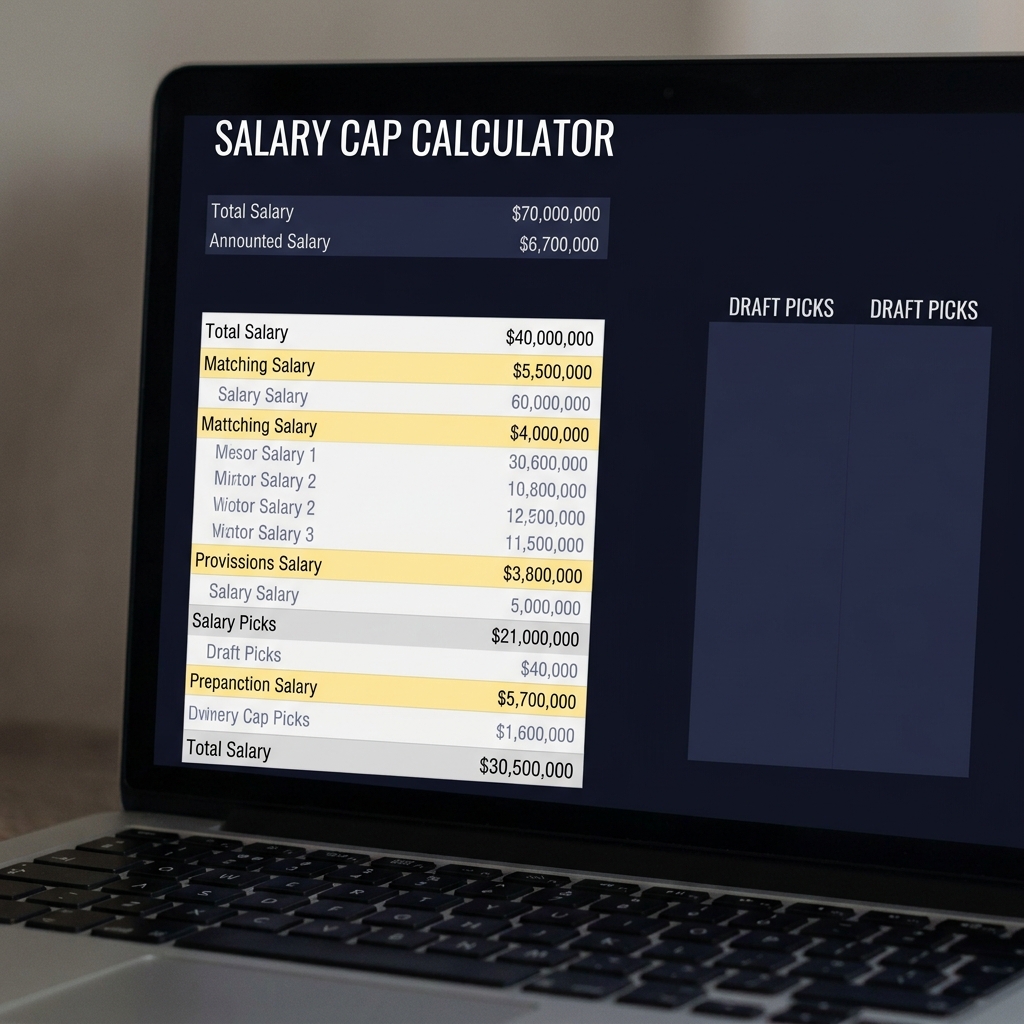
quick match check for offered salary versus target salary and picks
use for first-pass feasibility checks
Why unencumbered firsts and rookie-scale players matter
Unencumbered firsts and players on rookie-scale contracts are valuable because they are tradable without adding long-term salary commitments; when Stepien limits a team from offering consecutive own firsts, outside firsts or swaps become the only way to meet a seller's capital needs, so Detroit's ability to source third-party picks or to include high-upside but low-cost young players is a practical constraint.
Why a multi-team trade is the most plausible path
How additional teams help with salary and pick aggregation
A third or fourth team can absorb mismatched salaries, shuffle firsts and swaps, and move protected picks in ways that let the primary offeror assemble the long-term capital a seller seeks while preserving its own cap profile; this is the usual route when a single team lacks the exact combination of salaries and tradable picks to match a max player's value Example of three-team construction used for a high-profile star trade. HoopsRumors coverage.
Precedent: multi-team star trades
The 2023 multi-team trade that moved a superstar demonstrates how pick aggregation and salary absorption across teams can reconcile Stepien limitations and salary-matching formulas, but even multi-team trades remain subject to apron lines and Stepien constraints and therefore do not eliminate legal or practical hurdles Detailed coverage of the three-team precedent.
Timing, odds and the realistic probability of a Pistons acquisition
Near-term versus long-term scenarios
Key open variables that could change probabilities
Main variables to watch include how many unencumbered firsts Detroit can offer in tradable years, whether other teams will partner to aggregate picks or absorb salaries, and whether the Bucks publicly signal a rebuild or willingness to accept long-term capital rather than preserving the current core. ESPN analysis.
Common mistakes and trade thinking traps to avoid
Overvaluing a single pick
A common error is assuming one high pick or a single promising young contract can replace an MVP-caliber player's multi-year value; in almost all realistic markets, sellers value depth of future capital and rotation players over a single pick because the commitment being exchanged covers multiple seasons.
Ignoring apron and Stepien constraints
Another frequent trap is to imagine simple one-for-one swaps without applying the apron thresholds and the Stepien Rule; these constraints are not theoretical-they directly limit which assets can be packaged and when, and ignoring them leads to implausible hypothetical trades.
Concrete hypothetical packages (3 scenarios) and why each could succeed or fail
Scenario A: heavy on picks and a salary match

Scenario B: multi-team with salary absorption
Structure: Detroit coordinates with one or two partners who absorb mismatched salaries and route additional firsts or draft swaps to Milwaukee while Detroit contributes a core of young players and picks. Pros: solves salary-matching and pick aggregation problems without Detroit surrendering consecutive future firsts. Cons: requires willing facilitators prepared to take on short-term cost for future compensation and must navigate apron consequences for teams that cross certain thresholds Precedent for multi-team star trade construction.
Scenario C: sign-and-trade or long-term asset swap
Structure: a longer-term approach that uses sign-and-trade mechanics if and only if contract timing changes, or a swap emphasizing longer-term veteran contracts and additional picks rather than giving up the best current young assets. Pros: can preserve some of Detroit's future upside while delivering more immediate rotation help. Cons: depends on contract windows and would still be constrained by matching rules and the Bucks' valuation of picks versus players.
How to decide: evaluation criteria for Detroit decision-makers
Short term performance versus long term flexibility
Checklist items: assess cap impact versus championship window, count tradable firsts and their protections to ensure Stepien compliance, evaluate whether the team retains depth after the move, and quantify downside protection such as pick protections or buyback options; these criteria help balance present upside against future risk and should be used as a decision rubric.
Risk management and upside scenarios
Front offices should set guardrails such as minimum retained draft capital, acceptable title-window timelines, and contingency plans if the multi-team venues fail to materialize; prudent decision-making treats a Giannis pursuit as a high-risk, high-reward move that requires explicit thresholds for tolerable long-term cost.
Conclusion: the most likely outcome and what to watch next
Short summary of likelihood
In short, given Giannis's contract security and the apron, matching and Stepien constraints, the immediate probability that the Pistons trade for him is low unless the Bucks choose to trade him or Detroit can marshal a complex, multi-team package with sufficient firsts and salary matches; the market precedent for MVP trades suggests that multiple firsts plus rotation players are the baseline, not a single pick or salary swap Summary of precedent trade elements.
Key signals that would change the outlook
Top signals to monitor: public statements from Bucks leadership indicating a strategic shift, accumulation of tradable outside firsts that Detroit could route in, or credible reports of third-party teams willing to act as salary absorbers and pick aggregators; these factors materially increase feasibility when they appear.
Resources and next steps for readers who want to dig deeper
Key public references and cap calculators
Track official salary-cap and threshold notices from the NBA and consult trusted CBA explainers and cap tools on our blog Funded Plays blog when testing scenarios; public cap tables and pick registries are the primary data sources to verify matching math and Stepien compliance each season NBA salary cap and threshold announcement.
How to track pick inventories and CBA updates
Monitor official team announcements, league filings, and reputable cap-guide explainers for updates to apron levels, matching formulas, and the status of specific picks; because public cap figures update annually, repeated checks are necessary to keep feasibility assessments current. See how we evaluate scenarios.
Giannis is under a multi-year extension and the 2023 CBA apron, salary-matching rules, and the Stepien Rule limit how many picks and which salaries can be included, so Detroit must overcome those constraints.
Yes; adding one or two partners can absorb mismatched salaries and route additional picks, which helps satisfy matching math and pick aggregation requirements.
Key signals include the Bucks publicly signaling a rebuild, Detroit accumulating tradable outside firsts, or credible reports of third-party facilitators willing to structure a multi-team deal.
References
- https://www.nba.com/bucks/news/milwaukee-bucks-sign-giannis-antetokounmpo-to-contract-extension
- https://www.hoopsrumors.com/2024/07/hoops-rumors-glossary-salary-matching-in-trades.html
- https://cbafaq.com/salarycap.htm
- https://www.nba.com/pistons/news/pistons-sign-cade-cunningham-to-multi-year-contract-extension
- https://www.nba.com/news/damian-lillard-traded-to-bucks
- https://www.fundedplays.com/challenges
- https://pr.nba.com/salary-cap-2024-25/
- https://www.espn.com/nba/story/_/id/47723485/nba-trade-deadline-giannis-tiers-draft-picks-players-29-teams-offer-bucks
- https://www.spotrac.com/nba/apron/_/year/2025
- https://www.hoopsrumors.com/2026/06/bucks-to-trade-giannis-antetokounmpo-to-heat.html
- https://www.fundedplays.com
- https://www.fundedplays.com/blogs
- https://www.fundedplays.com/blogs/how-fundedplays-evaluations-work
- https://www.nba.com/d/news/damian-lillard-traded-to-bucks