

Quick verdict for a bucks prediction: which team has the edge right now?
Short answer: Based on season-long advanced metrics together with late-season form, the edge is small and conditional, with the net rating gap and Orlando's recent upward momentum being the two factors most likely to swing a final call; always confirm game-day injuries before locking a pick, since absences can flip expectations NBA.com team advanced stats
Test your prediction process on FundedPlays Challenges
Use the step-by-step framework below to turn these data points into a concise personal call you can track and learn from.
Top factors that change this short verdict:
1) Net rating differential between Milwaukee and Orlando, which captures how each team performs per 100 possessions on offense and defense.
2) Momentum, represented by recent form and the Week 20 power ranking trend for Orlando, which can tighten or widen matchup edges over a short run.
Note: check the NBA Official Injury Report on game day for any starter or rotation change that would materially alter the projection.
Why season context matters for a 2026 bucks prediction
Season context means combining season-long indicators with late-season signals so you do not overweight short samples. For a disciplined bucks prediction, give primary attention to net rating and offensive and defensive efficiency, then use late-season power rankings and schedule timing to adjust the single-game view NBA.com Power Rankings, Week 20
Power rankings capture momentum and form that raw averages may miss, especially close to playoff time. Use them to identify surging teams or those fading into injuries or rest patterns, but treat them as adjustments rather than replacements for season-long quality measures.

Core metrics to compare Milwaukee and Orlando for a bucks prediction
Net rating and its importance
Net rating is the simplest single-number comparison: offense minus defense per 100 possessions. It condenses overall team value into a figure you can compare directly. Pull the official net rating from the NBA.com/Stats advanced leaderboard to maintain consistency across teams when you prepare a bucks prediction NBA.com team advanced stats
The edge is conditional: use net rating as the baseline, then adjust for Orlando's late-season momentum and any confirmed Bucks absences; always check the NBA Official Injury Report before finalizing a pick.
Offensive and defensive rating, pace, and efficiency
Offensive rating and defensive rating show where net rating comes from: one team can outscore opponents because its offense is elite, or because its defense suppresses opponent scoring. Pace matters because possessions determine opportunity volume; a higher pace increases variance and can favor teams that exploit quick scoring chances. For season-wide context, use the Basketball-Reference team pages to cross-check cumulative indicators and to verify sample sizes before adjusting a Bucks vs Magic prediction Milwaukee Bucks season page on Basketball-Reference
Quick reading tip: prioritize net rating differential first, then break it into offensive and defensive contributors. Watch out for schedule effects and small-sample spikes when a team played many weak opponents in a stretch.
How to factor head-to-head results and schedule into a bucks prediction
Head-to-head outcomes tell you about matchup tendencies, but they are not definitive on their own. Use Basketball-Reference team pages to confirm exact head-to-head results from the 2026 schedules before letting them shift your bucks prediction Orlando Magic season page on Basketball-Reference and to examine specific box scores for earlier meetings such as individual game box scores.
Schedule modifiers to watch: back-to-back games, extended travel, and short rest. These factors can impact rotation choices and minutes for key players, which in turn changes the meaningful net rating for a specific game rather than the season average.
Rule of thumb: treat a head-to-head result as useful when it reflects similar availability and venue conditions as the upcoming game. If the earlier meeting had a different injury landscape or multiple key players rested, weight it less.
Recent form and momentum: using NBA Power Rankings in a bucks prediction
The Week 20 Power Rankings noted the Magic were trending upward late in the 2025-26 season; that signal is useful for short-term adjustments but should not override large season-long metric gaps NBA.com Power Rankings, Week 20

To quantify momentum, look at recent net rating over the last 10 games and compare it to the season number. If the recent net rating moves substantially and is backed by stable rotation minutes, give it measured weight in your bucks prediction. A conservative approach is to treat momentum as a 10 to 25 percent adjustment to your short-term projection.
How injuries and the NBA Official Injury Report shift a bucks prediction
The NBA Official Injury Report updates daily and is mandatory to check on game day; a confirmed starter absence or a listed limited status for a core rotation player should change the expected margin immediately NBA Official Injury Report
Which injuries matter most: starter absence, elite role player absence, and late scratch for a primary playmaker. Lesser minutes players usually move the needle less, though cumulative rotation hits can add up.
Quick game-day checklist for injuries:
1) Confirm the official status on game morning
2) If a starter is out, add a conservative margin adjustment (for example, widen by one to six points depending on role)
3) If a secondary rotation player is out, consider a smaller adjustment and check the likely replacement minutes
4) If multiple role players are limited, re-evaluate confidence and consider a lower certainty band on your bucks prediction.
Matchup factors beyond box score numbers for a bucks prediction
Lineup matchups and defensive assignments can alter how simple metrics translate to a single game. For example, switchability and how teams defend pick-and-roll or post-up actions can create matchup edges not obvious from season averages. Consult situational dashboards when available to see how each team performs in specific contexts TeamRankings NBA dashboards
guide for evaluating lineup and situational splits
use as a quick pre-game reference
Pace and situational splits matter because they change the possession structure of a matchup. If Orlando pushes tempo and Milwaukee prefers controlled offense, the variance and expected margin can shift in favor of the team that better enforces its style.
Beware of overfitting tiny lineup samples. When a tactical matchup appears significant, verify it across multiple games or confirm it with consistent minute distributions before letting it dominate your bucks prediction.
A step-by-step framework to produce a transparent bucks prediction
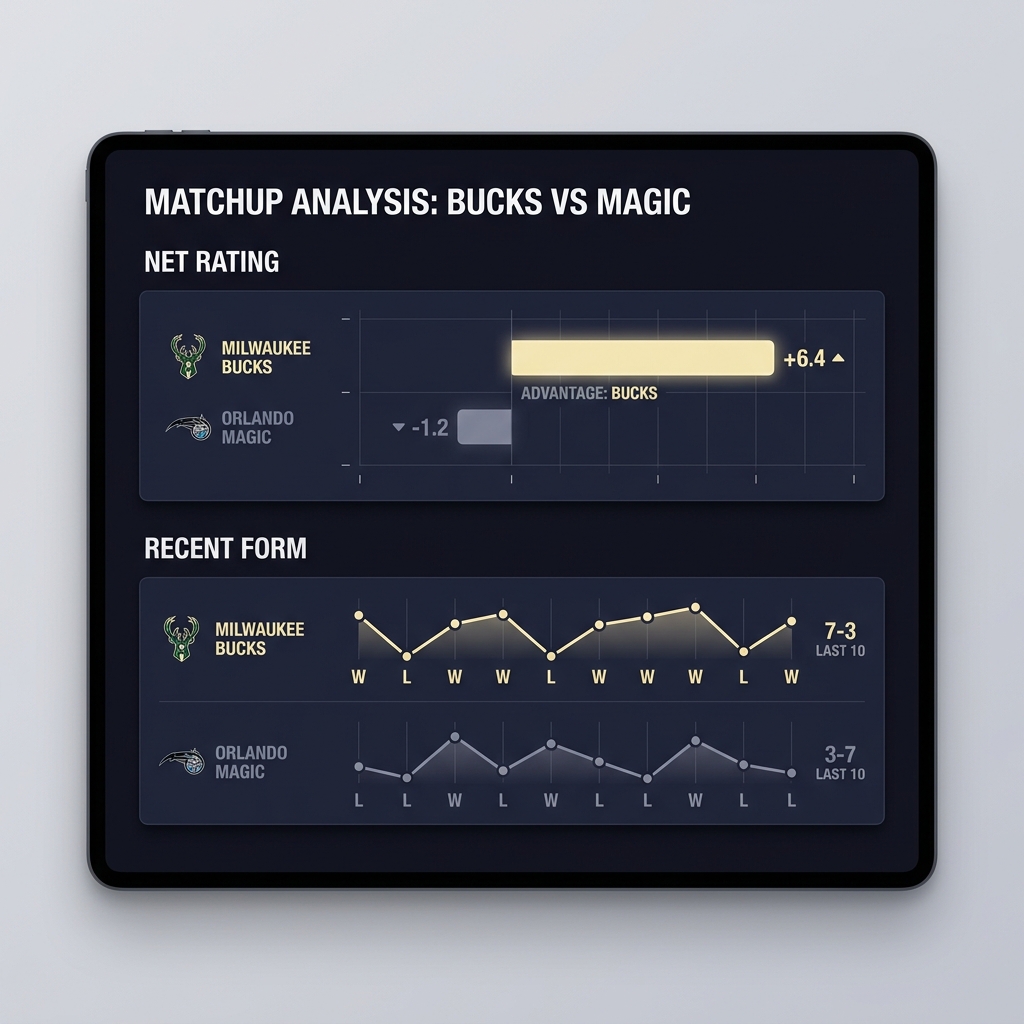
Step 1: Pull season metrics. Gather net rating, offensive rating, defensive rating, and pace from NBA.com/Stats to form a baseline for your bucks prediction NBA.com team advanced stats
Step 2: Check recent form and head-to-head. Look at the last 10 games for both teams, consult the Week 20 power rankings for momentum context, and confirm any head-to-head results on Basketball-Reference.
Step 3: Verify injuries and set confidence. Use the NBA Official Injury Report to identify absences and adjust your margin and confidence band accordingly.
Suggested default weighting ranges (use ranges, not absolutes): season metrics 50 to 75 percent, recent form 10 to 30 percent, matchup and lineup factors 5 to 20 percent, injuries situationally overriding when a starter is absent.
State your final projection using this template: Team + expected margin + confidence. Example format to copy: Bucks -3, medium confidence. Record the inputs and outcome to refine your weights over time.
Common mistakes to avoid when making a bucks prediction
Overvaluing recency. Corrective action: compare recent net rating to the season number before shifting weights; if recent movement is not supported by minutes and role stability, temper your adjustment.
Ignoring roster availability. Corrective action: always confirm the NBA Official Injury Report on game day and adjust margins when starters or primary playmakers are out.
Misreading pace. Corrective action: map pace differences to expected possession changes and adjust projected margins, rather than assuming faster always favors the underdog.
Overfitting small samples. Corrective action: require consistency across multiple games or consistent minute distributions before treating a lineup finding as decisive.
Keep a neutral record of each pick and its reasoning; disciplined recordkeeping is how predictions improve over time.
Practical scenarios: three example bucks predictions and the reasoning
Scenario A: Both teams healthy, neutral site. Inputs: season net ratings and recent form show a close baseline. Weight season metrics 65 percent, recent form 20 percent, matchup factors 15 percent. Call: pick the team with the higher net rating by a small margin and label confidence medium. Evidence used: NBA.com team advanced stats and Basketball-Reference season pages.
Scenario B: Orlando on a clear win streak; Milwaukee missing a starter. Inputs: recent net rating for Orlando elevated, and NBA Official Injury Report confirms a Bucks starter out. Weight recent form 30 percent, injuries override adds decisive adjustment. Call: lean Orlando with increased margin and reduce confidence only if the injury status is uncertain at tipoff. Evidence used: Week 20 Power Rankings, NBA injury report.
Scenario C: Back-to-back or rest edge to one team. Inputs: identify rest differential and likely rotation changes from the injury and official availability notes. If Milwaukee is on a back-to-back and Orlando is rested, adjust baseline margin by the rest factor and lower confidence if minutes are expected to be managed. Evidence used: team schedule checks and situational splits.
Each scenario is an example application of the framework, not a guarantee. Always cite the same sources when you record your result for learning purposes.
Converting your analysis to a single-line bucks prediction and confidence tag
Template for the one-line prediction: Team + margin + confidence. Example: Bucks -3, medium confidence. Keep the wording concise and consistent across picks so your record is easy to analyze.
Mapping evidence to confidence bands: low confidence when injuries or rotations are uncertain, medium confidence for modest net rating advantages with no major absences, and high confidence for clear net rating gaps supported by stable availability and recent form.
Suggestion: track outcomes in a simple spreadsheet with columns for date, teams, inputs used, final prediction, confidence, and result. Over time, use the record to tweak your default weights.
Final synthesis and quick pre-game checklist for a responsible bucks prediction
Synthesis: balance recent form and season-long metrics as your four pillars: season metrics, momentum, head-to-head, and injuries. Let net rating set the baseline, use momentum to nudge the margin, confirm head-to-head only when conditions match, and always check injuries last to finalize the call NBA.com team advanced stats

Pre-game checklist (run this on game morning):
1) Pull net rating and offensive/defensive ratings from NBA.com/Stats.
2) Check Week 20 power rankings or the latest power snapshot for momentum context.
3) Confirm head-to-head history and note any differences in availability using Basketball-Reference.
4) Verify the NBA Official Injury Report for final availability.
5) Note rest and travel differences and any back-to-back effects.
6) State your final prediction and confidence band, and log the decision for later review.
Remember that no projection is guaranteed and that disciplined, transparent recordkeeping is the best path to improving predictive accuracy and responsible participation.
Further reading and primary sources to verify your bucks prediction
Primary sources to verify numbers and availability: NBA.com Power Rankings for late-season momentum, NBA.com/Stats advanced for net rating and efficiency, Basketball-Reference team pages for season aggregation and head-to-head, the NBA Official Injury Report for game-day availability, and TeamRankings dashboards for situational splits and pace context (also see game recaps on ESPN and local updates from local beat coverage).
How often to check each source: daily for the injury report, weekly for power ranking snapshots near the end of the season, and right before lock for advanced stats and situational splits. Cite these same sources when you record your picks so your evidence trail is clear.
Use net rating as your baseline to compare overall team strength, then split it into offensive and defensive contributors to see where the gap comes from.
Treat momentum as a modest adjustment, typically 10 to 25 percent of the decision weight, unless recent form is sustained and backed by stable minutes.
Injuries should override when a confirmed starter or primary playmaker is out, or when multiple rotation players are unavailable, verified on game morning.
References
- https://www.nba.com/stats/teams/advanced?Season=2025-26&SeasonType=Regular%20Season
- https://www.nba.com/news/power-rankings-2025-26-week-20
- https://www.basketball-reference.com/teams/MIL/2026.html
- https://www.basketball-reference.com/teams/ORL/2026.html
- https://www.basketball-reference.com/boxscores/202602110ORL.html
- https://www.nba.com/injury-report
- https://www.teamrankings.com/nba/rankings/
- https://www.fundedplays.com/challenges
- https://www.fundedplays.com
- https://www.fundedplays.com/blogs
- https://www.fundedplays.com/blogs/how-fundedplays-evaluations-work
- https://www.espn.com/nba/game/_/gameId/401810632/bucks-magic
- https://www.jsonline.com/story/sports/nba/bucks/2026/03/08/milwaukee-bucks-injury-report-giannis-antetokounmpo-out-tonight-orlando-magic-live-update/89021983007/