

Quick verdict for bucks bulls prediction: Are the Bucks doing good this year?
Short summary
Quick pre-pick checklist for Bucks vs Bulls projections
Use this before finalizing a pick
The short answer for a bucks bulls prediction is that Milwaukee is broadly performing well in 2025-26, thanks to a positive net rating and a strong offensive profile tracked by league stats, while short-term outcomes still depend on who is available on game day NBA.com team profile.
Key numbers that drive the verdict
Put simply, the season-level drivers are record, net rating, and independent adjusted ratings. Those three together form the practical baseline for a bucks bulls prediction and explain why Milwaukee is favored in many matchups this season without promising results in every single game. See the 2025-26 team ratings for broader context.
To use this immediately: treat Milwaukee as the stronger side when primary starters are active, then shrink your projected edge if late injury tags or clear shooting slumps appear in the pre-game window.
What the numbers say: net rating, offense, and defense
Defining net rating and why it matters
Net rating is the difference between points scored and points allowed per 100 possessions. It compresses offense and defense into one number that is useful for comparing teams across styles and pace. For a bucks bulls prediction the net rating gives a clean first-pass sense of which team is more likely to outscore the other over a full game.
Where Milwaukee sits in 2025-26 advanced stats
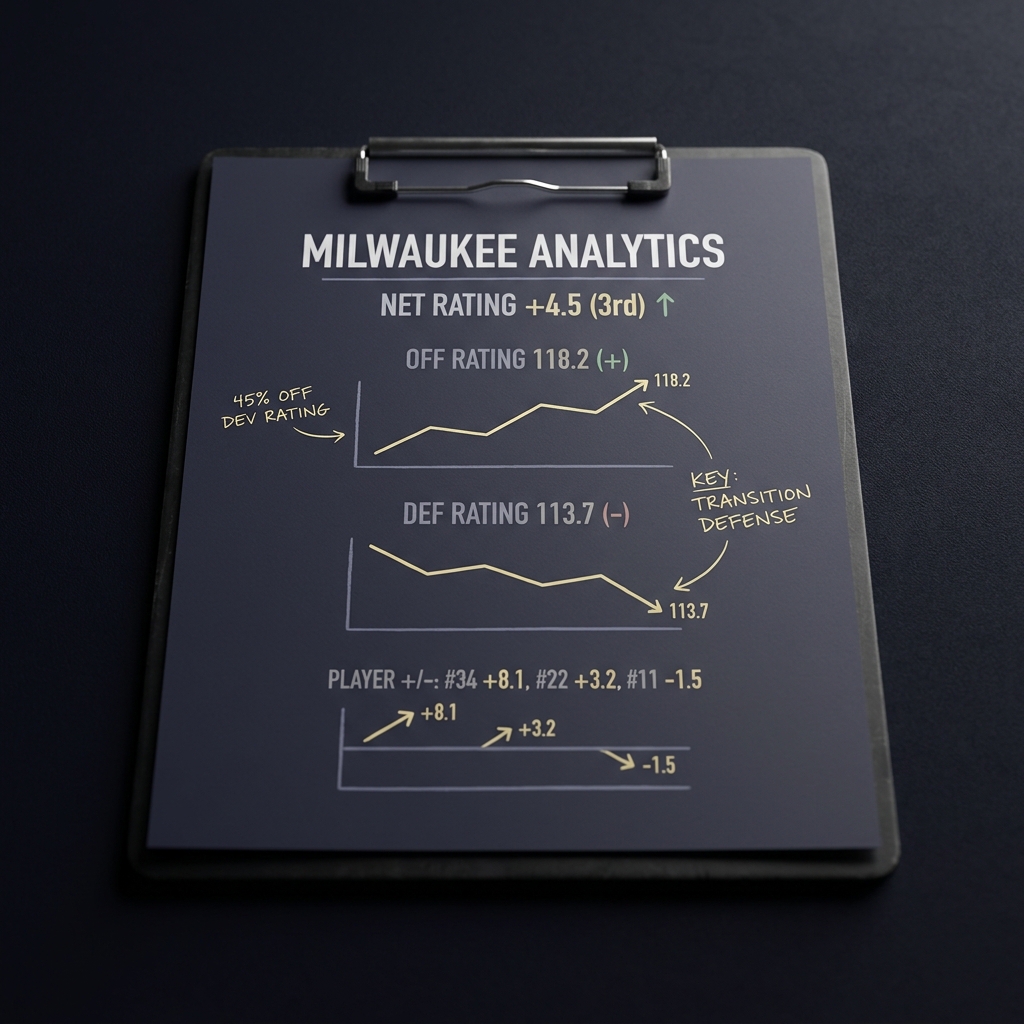
In 2025-26 Milwaukee posts a positive net rating with a top-tier offense and a roughly league-average defense, which helps explain season-long consistency and why the team should be treated as a reliable side in many matchups NBA.com team profile.
Adjusted models that control for schedule and opponent adjustments confirm the same directional view: the Bucks show above-average efficiency overall, which reduces the chance that a single-game line should be interpreted as random without checking injuries or matchup context.

When you convert these metrics into a practical prediction, ask: does the posted line already reflect Milwaukee's season-level edge? If not, the net rating and efficiency gap help justify a lean toward the Bucks in a bucks bulls prediction, provided starters play.
Standings, record, and why seeding matters for a bucks bulls prediction
Where Milwaukee ranks in the Eastern Conference
Milwaukee’s 2025-26 regular-season record places them in the upper tier of the Eastern Conference standings, and that standing shows up on the NBA standings pages as a tangible indicator of season form NBA standings and on ESPN standings.
How record ties into matchup expectations
Record and seeding change incentives across the final weeks of the season: teams chasing seeds may tighten rotations or rest players differently, and coaches will vary matchup emphasis based on opponent rankings; Basketball-Reference provides complementary context for the franchise-level view Milwaukee Bucks season page.
Try structured prediction challenges
Review the scenario examples below to see how standings and seed incentives change rotation choices and how that should alter your prediction approach.
For a bucks bulls prediction, upper-tier standing matters not because seed guarantees outcomes but because it often correlates with steadier rotations, clearer roles, and fewer experimental minutes late in the season. That steadiness can shrink variance when starters are in the lineup.
Offense profile: what makes the Bucks efficient (and limits)
Primary offensive strengths
Milwaukee’s offense rates strongly in 2025-26 thanks to efficient scoring and favorable shot distribution, a combination reflected in offensive efficiency numbers and pace control on NBA team tracking pages NBA.com team profile and in the advanced team stats.
Key traits to translate into predictions are finishing at the rim, transition efficiency, and how the team spaces the floor. Those traits mean that in most full-game projections the Bucks will outperform teams that struggle to defend those areas, which is why offensive metrics should carry weight in a bucks bulls prediction when comparing lineups.
Situations where the offense can dip
No offense is immune to short-term variance. Cold three-point shooting, strong defensive schemes that limit creators, or a minutes cut to a primary ball-handler can all reduce output in a single game. Use recent shooting splits and matchup coverage to judge whether the season-level offense will translate to tonight’s box score.
In practice, if you see a sizeable model edge for Milwaukee driven purely by season offense but the matchup threatens those particular strengths, downgrade the projected margin and account for lineup and minutes questions before locking a pick.
Defense and matchup stability: how Milwaukee contains opponents
Defense basics and league-average context
Milwaukee’s defense in 2025-26 grades around league average, which is important because a team with a top offense and average defense will still be favored in most neutral matchups; that standing appears in the NBA team tracking that summarizes defensive efficiency metrics NBA.com team profile.
Matchups vs perimeter teams like Chicago
Opponent-split data shows Milwaukee with a favorable differential against Chicago during 2025-26, and that head-to-head tendency should be a primary input when making a bucks bulls prediction for a specific meeting NBA.com opponent split.
Translate that split to match-specific thinking: if Chicago’s strongest attack vectors are neutralized by Milwaukee’s defenders on a given night, the season differential matters more. If Chicago runs new lineups or gets hot from distance, the split can narrow quickly, so treat opponent data as directional rather than definitive.
Players, availability, and the impact of the injury report
How availability shifts short-term predictions
Official NBA injury reports through 2025-26 periodically list key Bucks contributors, and those listings have a clear, material effect on week-to-week form and rotation decisions NBA official injury report.
Where to check official injury updates
When a starter is listed questionable or out, adjust expected minutes and usage for remaining players and reduce the modeled edge for Milwaukee accordingly. For most picks, treating a late designation as a significant edge reducer is the conservative approach.

Also monitor team announcements and pregame reports for minute restrictions or coach comments that hint at rotation trims. Those cues are often the difference between a marginal lean and a full fade in a bucks bulls prediction.
Opponent context: reading the Bucks vs Bulls matchup for predictions
Why opponent splits matter
Opponent splits tell you whether season strengths have translated into head-to-head advantages, which is exactly why Milwaukee’s favorable differential vs Chicago is relevant to a bucks bulls prediction NBA.com opponent split.
Yes; combining positive net rating, a top-tier offense, and above-average adjusted ratings, the Bucks are performing well in 2025-26, but short-term picks require checking injuries and matchup signals.
Specifics from 2025-26 Milwaukee vs Chicago data
Use matchup factors like pace, primary defensive matchups, and recent rotation changes to decide how much weight to give the season split. For example, if Chicago is missing a primary perimeter defender who usually checks Milwaukee’s creators, the split can swing in either direction depending on replacements and minutes allocations.
Also remember scheduling elements: back-to-back games, travel, and rest days can change how each team uses its bench and whether starters see full minutes, so slot those items into the final decision before you settle a pick.
How to interpret adjusted models and public projections
What adjusted ratings like DunksAndThrees add
Adjusted ratings control for opponent quality and schedule and rank Milwaukee above league average in 2025-26, which confirms that the team’s season profile is not solely a function of soft matchups DunksAndThrees adjusted ratings.
When to trust models vs in-game info
Models are a baseline. The practical sequence is: check adjusted models for the pre-game baseline, cross-reference NBA.com team metrics for style and current efficiency, then overlay injury reports and matchup signals. If a model and real-time info both point the same way, that increases confidence for a bucks bulls prediction.
Avoid blind reliance on a single model for short-term lines; models smooth sample noise but can miss late scratches and usage shifts that materially swing a single game.
Common forecasting mistakes to avoid with the Bucks
Over-weighting single-game hot streaks
A frequent error is giving too much weight to a recent hot shooting night or cold slump when the season-level metrics still favor the opponent. Sample size matters: one or two games rarely overturn a robust season net rating.
Ignoring minutes and lineup changes
Ignoring official injury listings, minutes restrictions, or role changes is another common mistake. Always confirm starter status and whether a coach has signaled rotation adjustments; those are often the largest short-term predictors of outcome variance.
Simple rules help: downsize the projected edge when a primary creator is absent, and avoid overcompensating by inflating stakes on what may be a random swing.
Three prediction scenarios: how to set a Bucks vs Bulls projection
Scenario A: Full-strength Bucks
Assumptions: Milwaukee fields primary starters, rotation minutes are normal, and no late-designation minutes cuts appear. With a positive net rating and a strong offense, season-level metrics favor Milwaukee and you can reasonably lean toward them in a bucks bulls prediction; the efficiency baseline supports that stance NBA.com team profile.
Scenario B: Key starter limited or out
Assumptions: a primary starter is questionable and either sits or has a minutes restriction. In that case, shrink Milwaukee’s projected edge and recalibrate usage projections for substitutes; check the official injury report and treat a starter absence as a major predictive factor NBA official injury report.
Scenario C: Small-sample variance and shooting slumps
Assumptions: both teams are at or near full strength but one team is on a short shooting variance. Even with season-level advantages, single-game outcomes can flip if a team shoots unusually poorly or well. In these cases, temper your confidence and reduce stake size rather than chasing an outlier result.
Translate each scenario into concrete numbers by adjusting your model’s expected points or win probability and then align stake sizing to the confidence level implied by those adjustments.
Where to check last-minute info before locking a pick
Official sources to refresh
Check the NBA official injury report within 90 minutes of tip and monitor team social channels for coach or center updates; the injury report is the authoritative daily source for designations in 2025-26 NBA official injury report.
What to watch in the 90 minutes before tipoff
Confirm starter status, expected minutes, any rest reports, and look for last-minute lineup confirmations. If a starter is scratched, rerun your quick checklist and reduce the model edge accordingly before locking a bucks bulls prediction.
When time is tight, prioritize starter availability, usage shifts, and whether the opposing team has a matchup that neutralizes Milwaukee’s primary strengths.
How this assessment maps to skill-based prediction platforms
Using season metrics in challenge formats
Structured evaluation challenges reward consistent, disciplined forecasting that combines season-level metrics, matchup context, and strict risk controls. Using net rating, opponent splits, and injury checks fits naturally into a methodical approach for skill-based simulations.
Responsible presentation of performance-based rewards
Platforms that use funded account models emphasize performance and rules compliance rather than guaranteed rewards. Apply the same conservative adjustments described here when making entries in challenge formats and avoid implying certain outcomes are guaranteed. These funded account models are part of the overall skill ecosystem at Funded Plays.
One factual way to practice is to use small, repeatable wagers or simulated entries to calibrate how your predictive adjustments perform across many games.
Short wrap and key takeaways for a bucks bulls prediction
Three quick action points
Verdict: Milwaukee is doing well in 2025-26 on the basis of net rating, record, and adjusted models, but short-term picks must account for injuries and shooting variance NBA.com team profile.
Action items: check the NBA injury report, compare the opponent split for Chicago, and weigh model output against recent sample size before sizing a stake. Also follow a consistent checklist available on our blog as you apply these steps.
Final note: use a consistent checklist and conservative bankroll rules when translating season-level advantage into a single-game bucks bulls prediction to avoid overreach on any one outcome.
In practice, if you see a sizeable model edge for Milwaukee driven purely by season offense but the matchup threatens those particular strengths, downgrade the projected margin and account for lineup and minutes questions before locking a pick.
Adjusted ratings control for opponent quality and schedule and rank Milwaukee above league average in 2025-26, which confirms that the team’s season profile is not solely a function of soft matchups DunksAndThrees adjusted ratings.

Net rating summarizes season-level efficiency and is a strong baseline, but one-game outcomes can still flip due to injuries, shooting variance, or matchup quirks.
Use the NBA official injury report and team pregame updates; treat late designations and minute restrictions as major predictors of short-term changes.
Use adjusted models as a baseline and overlay injury, lineup, and matchup checks; do not rely on any single model for last-minute decisions.