
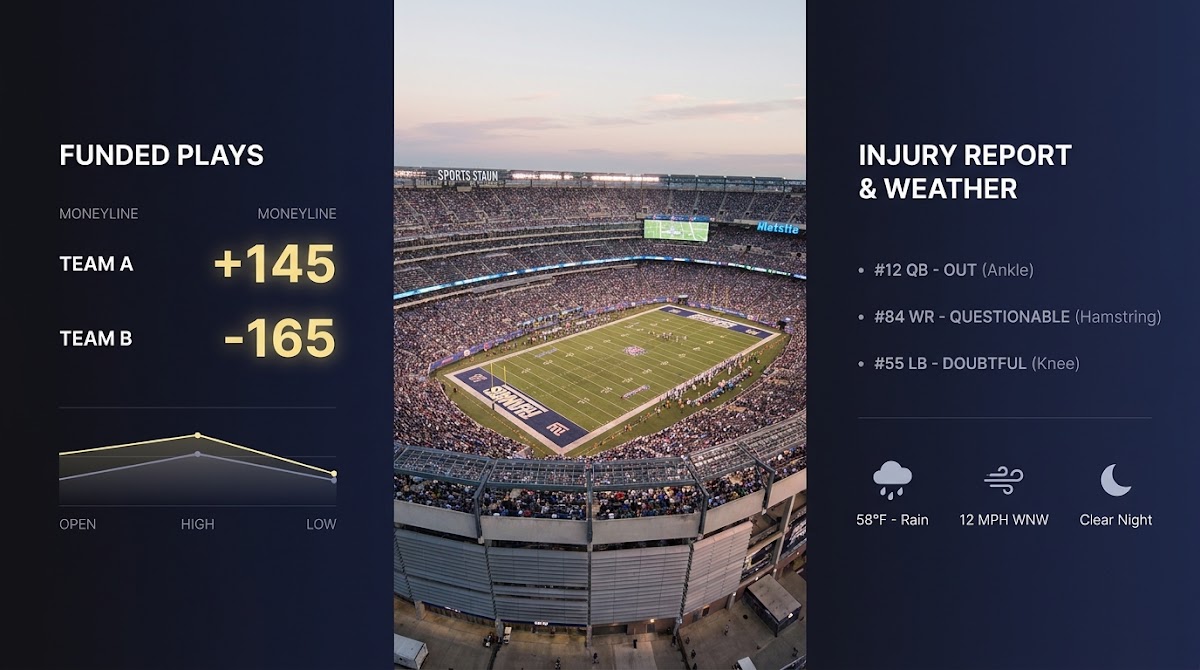
browns steelers prediction: quick overview and what this article provides
What you will learn
This article lays out a two-step, market-first workflow for a browns steelers prediction: first convert the posted moneyline into an implied probability and remove the bookmaker margin to create a fair market baseline, then layer conservative adjustments for verified injury reports and relevant weather or environmental factors.
The goal is a transparent, documented estimate of Cleveland's chances rather than a single declarative forecast. The process relies on market information and official team disclosures so that adjustments are traceable and repeatable.
Convert the closing moneyline to implied probabilities, remove the bookmaker margin to get a fair market baseline, then apply conservative, documented adjustments for verified injury reports and relevant weather conditions.
When to use a market-based probability versus a model-only estimate
Use a market-based probability when you want a baseline that reflects aggregate information and liquidity in the marketplace; use a model-only estimate when you believe your model systematically captures information not yet reflected in price. Start with the market baseline and explicitly record any departures.
Official NFL injury reports are a primary input for adjustments because they are a regulated, repeatedly updated source that often moves markets NFL Personnel Injury Report policy.
How to convert American moneyline odds into implied probability
The conversion formula in plain language
American moneyline odds convert to implied probability using two simple formulas: for positive odds, probability equals 100 divided by (odds plus 100); for negative odds, probability equals the absolute value of odds divided by (absolute value of odds plus 100). These formulas give the raw market view embedded in the posted price.
Remember that the raw implied probability includes the sportsbook margin and therefore overstates the consensus probability. That is why a separate de-vig step is needed to arrive at a fair market estimate Pinnacle guide to implied probability.
Common rounding and display conventions used by sportsbooks
Sportsbooks round posted moneylines to familiar increments and may display early lines that differ from the closing line. Closing lines usually consolidate more information and liquidity, so they are the preferred starting point for a market-based implied probability (see ESPN's NFL odds).
When reading a closing moneyline, note whether odds are shown as a favorite or underdog and apply the appropriate conversion formula. Save the raw implied probability and the source and timestamp for later recordkeeping.

Removing the bookmaker margin: practical de-vig methods
Why de-vig matters for a fair browns steelers prediction
Bookmakers build a margin into odds so the sum of implied probabilities exceeds 100 percent. Removing that margin, or de-vigging, produces a fair baseline probability that is comparable across markets and suitable for adjustments Pinnacle explanation of removing the margin.
Two common de-vig formulas and a worked example using hypothetical odds
Two widely used approaches are proportional scaling and the margin subtraction method. Proportional scaling divides each raw implied probability by the total implied probability and rescales so the sum is 100 percent. The margin subtraction method removes an equal share of the excess from each side before normalizing. Both are accepted; choose one and document it so back-tests are consistent. See OddsJam's no-vig fair odds calculator.
Tool note for computing de-vigged probabilities:
Compute de-vigged win probabilities from two-sided moneyline odds
Paste moneyline values as shown
As an example workflow, convert each side's moneyline to implied probability, sum the two probabilities, then divide each side's implied probability by that sum to get de-vigged probabilities. Record the source of the closing line and the time you pulled it.
How NFL injury reports change the baseline probability
What the Personnel (Injury) Report requires teams to disclose
The NFL Personnel Injury Report is the official, daily disclosure teams must file about practice participation and expected game availability; markets move when these reports show a change in participation or game status NFL Personnel Injury Report policy.
Because the injury report is standardized across teams, it is a reliable first source for adjusting a de-vigged market baseline. Use the official tags rather than social posts when sizing adjustments.
How to translate listed practice participation and game-status tags into probability adjustments
Translate official tags conservatively. Treat out as a clear, sizable adjustment. Questionable and doubtful should move probabilities more modestly and typically less than out. Weight confirmed practice participation changes by how they affect snaps for key players, not by rumor.
A practical rule is to have bounded adjustments: small role-player participation changes produce small shifts, while confirmed starter absences require larger, documented changes. Always cite the time and source when you record the adjustment.
Why quarterback availability matters most for lines and win chances
Summary of research on QB injuries and market reaction
Research shows quarterback injuries are among the most material drivers of point-spread and total adjustments because the position has outsized influence on play outcomes and scoring. Markets often react quickly when a starter's availability changes research on quarterback injuries and markets.
When assessing quarterback news, differentiate between a late practice detail and a confirmed inactive designation. The former can be noisy, the latter should prompt larger, systematic adjustments to the baseline.
How to treat starter versus backup news in a browns steelers prediction
If the starter is questionable, assign a conservative probability mass to the starter playing and a separate case where the backup starts. If the starter is confirmed out, switch to the backup scenario and apply a documented delta to the baseline based on historical performance or simple heuristics.
Maintain a short note explaining how you sized the QB adjustment and the source for the status change. Late confirmed changes near kickoff often move lines more because markets have less time to absorb new information.
Accounting for weather and environmental factors in a Browns-Steelers game
Which weather variables are most relevant for passing and scoring
Peer-reviewed work links environmental conditions such as wind and degraded air quality to measurable changes in short-term NFL performance, particularly passing efficiency. Check relevant environmental forecasts when they are plausible game drivers PLOS ONE environmental study.
Key variables to check are sustained wind speed and direction, precipitation type and intensity, and air quality indices when smoke or pollution is reported. If a forecast shows notable degradation, reflect that in assumptions about passing success and expected scoring.
How to adjust assumptions when air quality or wind is degraded
When environmental indicators suggest a material effect, reduce derived passing efficiency assumptions and increase uncertainty around scoring. Apply conservative, reproducible adjustments and note their rationale so they can be evaluated in back-tests.
Always source the weather or air-quality forecast timestamped to the official weather service or a reputable third-party feed before making sizable changes to your final estimate.
Combined framework: start with the de-vigged market then layer injury and weather adjustments
Stepwise checklist for producing a final browns steelers prediction
Major outlets publish archived game pages that include closing lines and contextual summaries suitable for back-testing a browns steelers prediction approach. These archives let you compare your documented probabilities to historical market consensus and outcomes ESPN game page example.

Record every step, the sources, and the timestamp. Back-testing depends on consistent documentation and a stable process so you can evaluate whether adjustments produced better calibration over time.
Practice the workflow on FundedPlays Challenges
Try the stepwise checklist above with a clear record for each adjustment to see how market and event information change the de-vigged baseline.
How to document your assumptions and edge

Use a simple table or a log that stores: closing moneyline, de-vigged baseline, each adjustment item with magnitude and source, final probability, and time. Include notes about whether the adjustment was conservative or aggressive and why.
When your final probability differs materially from the market, record the rationale and the size of the perceived edge so you can evaluate outcomes against expectations in later back-tests Pinnacle guide on implied probability.
Monitoring the live market: when and how to act on line moves
Distinguishing informative from noisy line movement
Informative moves usually coincide with verified, timestamped items such as official injury status changes or confirmed weather updates. Noisy moves may appear in thin liquidity windows or come from isolated books; check if changes persist and whether other market makers follow.
Persistent moves with volume suggest the market is incorporating credible information. Short-lived spikes without follow-through often revert and should be treated cautiously unless you can verify a sourcing event research on market reaction to injury news.
Timing trades or predictions relative to injury report releases
Official injury-report windows are predictable, so plan to check them and freeze your final estimate only after the last official update unless you have a specific reason to act earlier. Acting on late-confirmed news can be necessary, but expect execution costs or worse fills around high-volume moves.
When you do act on live moves, size conservatively and keep the record of the exact line, time, and source so you can measure whether rapid responses were beneficial in aggregate.
Back-testing and validating your browns steelers prediction method using past game pages
Where to find dated game pages and closing lines for back-testing
Major outlets publish archived game pages that include closing lines and contextual summaries suitable for back-testing a browns steelers prediction approach. These archives let you compare your documented probabilities to historical market consensus and outcomes ESPN game page example.
Collect a dataset of closing lines, the final market-implied probabilities, and actual outcomes. Use consistent de-vig and adjustment rules when applying your historical workflow so the comparison is fair. For examples of current odds pages see CBS Sports odds.
Simple metrics to compare model probability versus market probability
Start with calibration bins and hit rates: group predicted probabilities into deciles and compare the observed frequency of wins to the average predicted probability in each bin. Complement that with Brier score as an aggregate measure of accuracy and keep an eye on systematic biases.
A rivalry sample like Browns versus Steelers may produce small sample sizes. Use pooled samples for heat checks, but track rivalry-specific performance because matchup dynamics can differ from league averages.
Three practical scenarios: how small, medium, and large news items change the estimate
Scenario A: late practice participation change for a role player
If a role player's practice participation shifts from full to limited in the last two days, make a small, bounded adjustment to the de-vigged baseline. Document the source and reduce the adjustment if the change is not repeated on successive reports.
Small role-player changes should rarely be more than a few percentage points of probability. Treat them as information to marginally tweak the baseline rather than as a reason to discard it.
Scenario B: starter questionable at QB
If the starter is listed as questionable for the quarterback position, create two scenarios: starter plays and backup starts. Weight each scenario based on the likelihood the starter actually plays and the expected performance delta. This preserves clarity and forces you to be explicit about assumptions.
Because quarterback availability strongly drives lines, a transition from probable to out will typically move your final probability materially; document the timestamps and your assumed probabilities for each scenario research on QB injuries and market response.
Scenario C: heavy wind and poor air quality forecast
If forecasts call for sustained high winds and an air quality advisory, reduce passing-efficiency expectations and increase scoring variance. Apply a conservative adjustment that reflects reduced passing success and acknowledge higher outcome variance in your notes.
Because peer-reviewed findings tie environmental degradation to measurably different short-term performance, use those findings as a justification for the direction of change and keep the adjustment size modest unless multiple indicators point strongly in the same direction PLOS ONE study on environmental effects.
Decision criteria: when a perceived edge is large enough to act
Sizing confidence and bankroll considerations
Set a conservative minimum edge threshold before acting and size exposures relative to a documented bankroll plan. Smaller edges require better execution and lower variance tolerance; larger edges justify more aggressive sizing but still require discipline and recordkeeping.
Record both the estimated edge and your sizing decision. Over time, your record will show whether your thresholds are sensible and whether your execution captures predicted value Pinnacle resources on implied probability.
Minimum edge thresholds and recordkeeping
Use written rules for minimum edges, for example a minimum differential between your final probability and the market-implied de-vigged probability. Keep the time-stamped snapshot of the market price and your logged assumption so you can judge whether the edge was real.
Conservative thresholds help avoid overtrading on noise. If an edge is marginal, prefer logging the idea for later evaluation instead of acting immediately.
Common mistakes and blind spots to avoid in browns steelers prediction work
Overweighting uncertain information
Avoid letting unverified social posts or single-source rumors drive large adjustments. Rely on official injury reports and confirmed, timestamped weather forecasts when making sizable changes to the baseline probability.
Keep adjustments bounded and reversible; if you must rely on lower-quality information, reduce the magnitude of the change and flag it in your notes for later reassessment.
Ignoring market-derived signals
Failing to de-vig or ignoring the market baseline leads to inconsistent predictions. The market consolidates distributed information and is a useful baseline even if you ultimately disagree with it on principled grounds.
Always save the de-vigged baseline alongside your final estimate so you can see which of your adjustments drove differences and whether they were justified by outcomes.
Pre-game checklist: quick reference to produce a final probability before kickoff
Five items to verify in the final hour
Confirm the closing moneyline, check the official injury report for player status updates, verify final weather and air quality, review any late roster notes, and record your final probability and rationale with timestamps.

FundedPlays is a funded sports prediction challenge platform where you can use practice runs to refine your adjustment sizes and recordkeeping without risking real capital.
Where to record your final estimate and rationale
Record the final probability, the de-vigged baseline, each adjustment with magnitude and source, and the time. Keep the log accessible so you can pull it into a later back-test and learn how your adjustments performed versus market outcomes.
Timestamp each verification so you can map late-moving information to line changes and evaluate whether acting at a particular moment improved outcomes overall.
Conclusion: framing probability, responsible participation, and next steps
Summary of recommended workflow
Recap: convert the closing moneyline into implied probabilities, remove the bookmaker margin for a fair market baseline, then layer conservative adjustments for verified injury report items and environmental factors before recording your final browns steelers prediction.
Probabilities are estimates. Responsible participation means documenting assumptions, acting only on well-justified edges, and treating outcomes as feedback for refining your process rather than as guarantees.
Convert each moneyline to an implied probability, remove the bookmaker margin using a de-vig method, and use the rescaled probabilities as a fair baseline.
Adjust conservatively: treat out as a sizable change, doubtful and questionable as modest shifts, and always document the source and time before increasing adjustment size.
Act when your documented edge exceeds your minimum threshold, size exposure per your bankroll rules, and record the snapshot so you can evaluate outcomes later.
References
- https://operations.nfl.com/updates/football-ops/nfl-personnel-injury-report-policy/
- https://www.pinnacle.com/en/betting-articles/betting-tools/how-to-calculate-margin-and-implied-probability/
- https://www.pinnacle.com/en/betting-articles/educational/how-to-remove-the-margin/
- https://papers.ssrn.com/sol3/papers.cfm?abstract_id=4726389
- https://journals.plos.org/plosone/article?id=10.1371/journal.pone.0302670
- https://www.espn.com/nfl/game/_/gameId/401671613
- https://www.fundedplays.com/challenges
- https://www.fundedplays.com
- https://www.fundedplays.com/blogs
- https://www.fundedplays.com/blogs/how-fundedplays-evaluations-work
- https://oddsjam.com/betting-calculators/no-vig-fair-odds
- https://www.espn.com/nfl/odds
- https://www.cbssports.com/nfl/odds/