
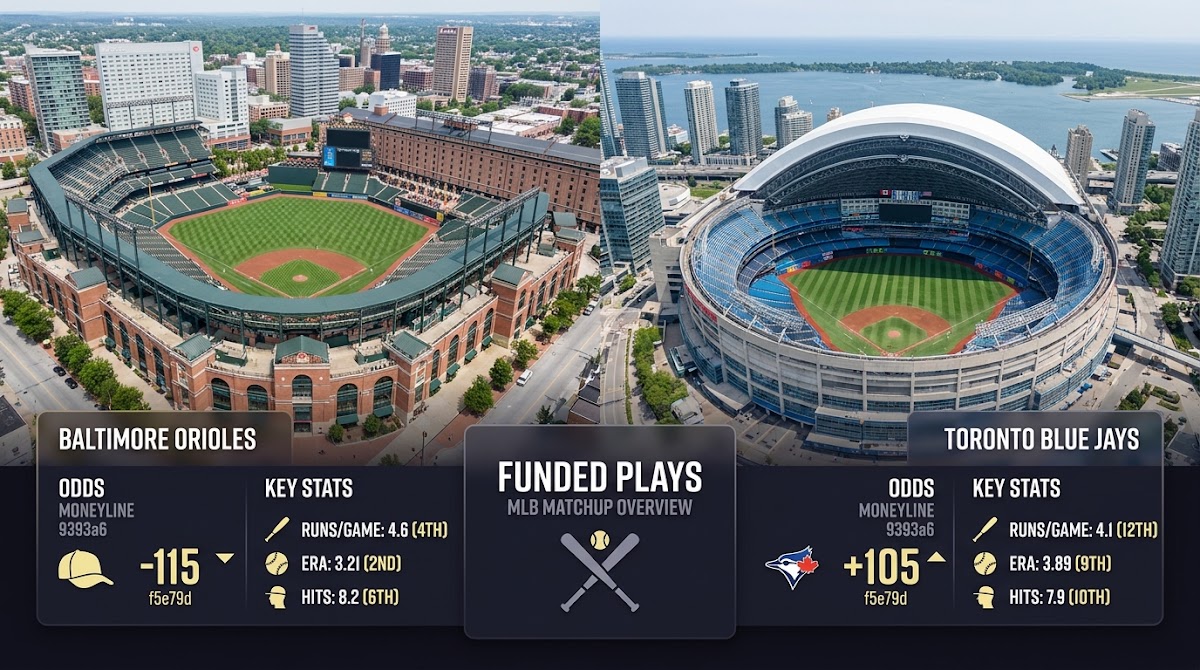
Quick answer: how the market currently decides who is favored
Start with the market, then layer on on-field facts. The betting market expresses a preferred side through the moneyline, and converting those American odds into an implied win probability gives a neutral baseline you can compare across games; this step creates a single, reproducible starting point for any blue jays orioles prediction, without assuming anything about player health or ballpark effects yet Investopedia implied probability article.
From that baseline, confirm the probable starting pitchers and any day-of availability changes. If the scheduled starter is the same as the market expected, the implied probability often stays the dominant signal. If a scratch or late change occurs, that baseline must be updated immediately using the same conversion and a fresh look at the new matchup MLB Probable Pitchers page. For team-level details check the Blue Jays probable pitchers page Blue Jays probable pitchers.
Explore FundedPlays challenge programs for disciplined sports prediction
Check live moneyline odds before finalizing your call
What 'favored' means in a betting-market context
Being 'favored' means the market-implied win probability is higher for one team than the other after converting the moneyline to a percentage. That favoured designation is market-centric, not a guarantee of outcome, and it is the right place to begin a disciplined pregame assessment Investopedia implied probability article.
Why moneyline gives a neutral baseline
Moneyline prices aggregate public action, sharp bettors, and bookmakers balancing risk, so converting those prices into implied probability provides an apples-to-apples baseline across contests. Treat that baseline as the market opinion you evaluate rather than the final answer, because starters, injuries, and park effects all actively change the picture later in the day Investopedia implied probability article.
How to convert a moneyline into an implied win probability
Convert American odds to implied probability with the standard formula most analysts use, which gives you a percentage chance for each side. The formula and rationale are summarized in a practical guide that explains how to handle both positive and negative moneyline numbers and why the conversion matters to any blue jays orioles prediction Investopedia implied probability article.
Remember the vig, sometimes called the overround. Raw implied probabilities from both sides will often sum to more than 100 percent because bookmakers build in a margin. For an apples-to-apples baseline you can either accept the market margin as-is or normalize the two implied probabilities to sum to 100 percent; the key is to be consistent and document which approach you use Investopedia implied probability article.
Refresh the baseline when odds move materially or close to first pitch. Odds movement captures fresh information and moneyflow, so recomputing the implied probabilities after significant line shifts gives you a current market baseline to compare with your on-field adjustments Investopedia implied probability article.

Why probable pitchers matter: using MLB's Probable Pitchers page
MLB's Probable Pitchers page lists the daily starting matchup and each pitcher's handedness, which are a primary driver of pregame win probabilities. Confirming who is scheduled to start - and whether handedness has changed - is a practical, high-impact step for any reproducible call MLB Probable Pitchers page.
Starting pitchers set the innings profile and matchup dynamics. A late scratch or an unexpected bullpen start alters how many innings each starter might realistically provide and thus how you should adjust the market baseline before the game MLB Probable Pitchers page.
Begin with the market-implied probability from the moneyline, then confirm the starting pitchers and check injury trackers; adjust for park factors to produce a transparent favorite call that you can timestamp and revisit before first pitch.
When a listed starter is scratched, the market often reacts quickly; re-check the moneyline and implied probability after any confirmed change on the Probable Pitchers page and treat the new lineup of pitchers as a fresh input for your model MLB Probable Pitchers page.
Check injuries and availability: why MLB injury trackers matter
Injuries to confirmed starters, late-inning relievers, and key hitters can move pregame projections substantially. For day-of verification, turn to the Orioles and Blue Jays injury pages on MLB.com to confirm active or questionable statuses before you finalize a favorite call Baltimore Orioles injuries.
Prioritize scanning four items on each team: the confirmed starting pitcher, the latest reliever availability notes, any lineup absences for top hitters, and any new entries that could change late-inning leverage. These pages provide the near-real-time statuses you need to decide whether to accept the market baseline or adjust it Toronto Blue Jays injuries.
If you find a late scratch or a newly limited hitter, mark that as a trigger to re-run your short model. The initial implied probability is only as good as the assumptions about who is actually playing, so always timestamp your sources and update the baseline if availability differs from what the market priced Baltimore Orioles injuries. Also confirm team-level probable pitchers when checking availability Orioles probable pitchers.
Adjusting for park effects: FanGraphs park factors for Camden Yards and Rogers Centre
Ballparks change run environments and home-run likelihoods; FanGraphs' 2024 park-factor tables quantify how Camden Yards and Rogers Centre historically influence scoring and power events, which lets you adjust a baseline probability in a reasoned way FanGraphs 2024 park-factor tables.
Typically, adjust a close market baseline in the direction suggested by the park factor. If a park is substantially more favorable to scoring for the home team or to home runs, that can widen or narrow the edge implied by the moneyline and should be recorded as a qualitative direction and a magnitude estimate tied to the FanGraphs data FanGraphs 2024 park-factor tables.

Use FanGraphs as a validated first check and consider that park adjustments are an overlay on a market baseline, not a replacement. Document the direction of the adjustment and why it matters to the matchup, then cross-check with batted-ball measures for confirmation. For a practical template, see the Funded Plays blog Funded Plays blog.
Cross-check park effects with Statcast batted-ball park factors
Statcast's batted-ball-based park factors provide a different lens, focusing on contact outcomes rather than final runs. Where FanGraphs measures outcomes, Statcast helps explain whether differences stem from batted-ball behavior and can corroborate or refine the FanGraphs adjustment Statcast park factors.
When the two sources diverge, reconcile them by asking which better fits the matchup profile. For power-oriented lineups or pitchers who induce particular contact types, the batted-ball signal may deserve extra weight. Keep both numbers visible so you avoid leaning on a single methodology.
Using both Statcast and FanGraphs reduces the chance that a single modeling choice drives your favorite call. That cross-check supports a transparent adjustment that you can explain after the fact if odds move or the outcome surprises you Statcast park factors.
Putting it together: a transparent short model to declare the favorite
Follow a fixed order: 1) compute the market-implied probability from the moneyline, 2) confirm probable pitchers and handedness, 3) check injury trackers for starter and key hitters, 4) apply park-factor adjustments from FanGraphs and Statcast, and 5) record a final favorite and a qualitative probability range. This stepwise approach keeps each input auditable and repeatable Investopedia implied probability article.
Quick pregame checklist to decide the market favorite
Work top to bottom
Show the baseline implied probability and then list each adjustment with a short explanation of direction and why it moves the number. For transparency, show the baseline, each qualitative adjustment, and the final stated favorite with a caveat that new information can change the call before first pitch MLB Probable Pitchers page.
Keep the final statement clear: name the favorite, explain which inputs moved the baseline most, and record the timestamped sources you used. That makes your blue jays orioles prediction verifiable later and helps you learn from outcomes without guessing which factor mattered most. Consider noting this process on Funded Plays Funded Plays.
A short reproducible checklist the reader can use pregame
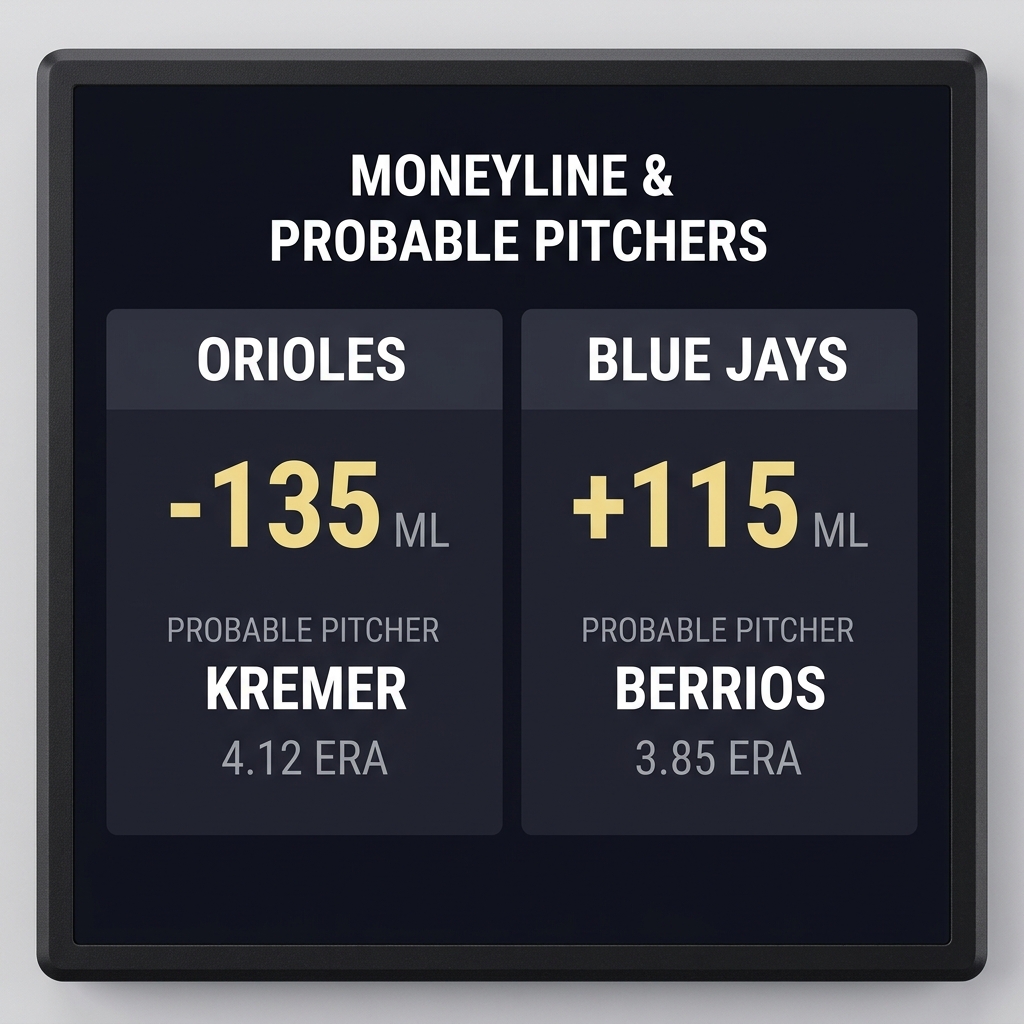
24 hours out checklist: 1) note the moneyline and compute implied probabilities, 2) check the scheduled probable pitchers, 3) scan team injury pages for known absences, 4) review park-factor notes for home field. These items let you prepare a baseline and a likely direction for any adjustments Investopedia implied probability article.
One hour before first pitch checklist: 1) refresh the live moneyline and recompute, 2) confirm the official starting pitchers and handedness, 3) verify the official lineup and late injury entries, 4) note bullpen availability if announced. Items that typically require hourly refreshes are odds, starter confirmation, and injury updates MLB Probable Pitchers page.
Timestamp your sources and record the pages used for each decision. Logging the time and where you checked the moneyline, probable pitchers, injury pages, and park-factor tables makes your call defensible and helps you compare what you believed before the start with what actually happened.

Decision rules and thresholds: when the market baseline is enough
Accept the market-implied favorite when there is no starter change, no major injury, and park-driven adjustments are small relative to the baseline. In those cases, the moneyline often reflects the correct market edge and gives you a repeatable decision rule Investopedia implied probability article.
Override the market baseline when you see clear triggers: a starter scratch that changes the expected innings profile, the confirmed absence of a key lineup bat, or a large park-driven variance that meaningfully alters run-scoring expectations. Those conditions justify moving off the baseline and documenting why MLB Probable Pitchers page.
Always record the rationale. Having a brief note explaining why you accepted or overrode the market baseline makes future review easier and enforces disciplined, repeatable decision-making for your blue jays orioles prediction.
Common mistakes and blind spots to avoid
Do not overreact to small-sample metrics. Short-term streaks or recent games can mislead if you do not consider longer-term tendencies and the matchup context. Treat small-sample signals as hypotheses to be tested by the checklist rather than decisive evidence.
Avoid ignoring lineup and bullpen updates. Late scratches, unexpected bullpen usage, or a suddenly taxed relief corps are common sources of error, so failing to confirm those items is a frequent blind spot. The market often prices expected bullpen usage, so verify whether that expectation still holds.
Resist fitting the analysis to an outcome you want to see. Record your inputs and adjustments, and base changes only on verifiable updates from the moneyline, MLB probable pitchers, injury pages, or park-factor sources. That discipline reduces hindsight bias and improves repeatability.
Practical scenarios: three everyday Orioles-Blue Jays situations and what to do
Scenario A, scheduled aces starting as expected. If both teams send expected starters and no late injury notes appear, accept the market baseline after checking park factors. The implied probability remains the primary input, and minor park adjustments usually do not overturn a clear line advantage MLB Probable Pitchers page.
Scenario B, a late scratch to the starter. If a confirmed starter is scratched, re-check the moneyline and recompute implied probabilities, then reassess expected innings and leverage. A bullpen start or a lesser innings projection can tilt the edge, so mark this as a high-priority override and document the change MLB Probable Pitchers page.
Scenario C, a key hitter ruled out on game day. If a team's top lineup bat is absent, note how that changes run expectancy in the lineup spot and whether it reduces or increases the away or home edge when combined with the park. Use FanGraphs and Statcast park factors to refine how much offensive drop-off to assume, then update your qualitative adjustment before naming the favorite FanGraphs 2024 park-factor tables.
How to update your call close to first pitch
In the last hour, refresh these items in order: live moneyline, official probable pitchers, the announced lineup, final injury updates, and any bullpen notes. Odds move fast as the same information becomes public, so compute a final implied probability immediately after any confirmed change Investopedia implied probability article. You can also review the MLB injury report MLB injury report.
Set minimal change thresholds that trigger a revision. A practical rule is to re-evaluate the call when a starter change or a confirmed lineup absence occurs, or when the moneyline moves by a materially different market message than your earlier assumptions. If none of these happen, you can reasonably stand by the earlier baseline.
If multiple last-minute changes appear, consider pausing or delaying a final public call until the picture clears. Rapid, conflicting updates increase uncertainty, and abstaining from a rushed decision can be the responsible choice when inputs no longer align.
Conclusion: a disciplined, repeatable way to say who is favored
Start with the market-implied probability from the moneyline, then confirm starting pitchers and handedness on MLB's Probable Pitchers page, scan the Orioles and Blue Jays injury trackers for day-of availability, and adjust for park effects using FanGraphs and Statcast. Combining these inputs produces a transparent, reproducible favorite call rather than a guess MLB Probable Pitchers page.
Document each step and timestamp your sources. That discipline helps you learn from outcomes, keeps decisions repeatable, and provides a clear audit trail for every blue jays orioles prediction you make. No method guarantees results, but this approach reduces guesswork and makes your pregame calls explainable and defensible. Learn more about how Funded Plays evaluations work here.
Convert American odds using the standard formula for positive or negative moneylines, then optionally normalize for the bookmaker margin to compare both sides directly.
Check MLB's Probable Pitchers page for the starting matchup and the team injury trackers for day-of availability, plus live moneyline quotes for market pricing.
Park factors can shift the expected run environment and, when combined with matchup specifics, may nudge a close market baseline enough to change which team is favored.
References
- https://www.investopedia.com/terms/i/implied-probability.asp
- https://www.mlb.com/probable-pitchers
- https://www.mlb.com/bluejays/roster/probable-pitchers
- https://www.mlb.com/orioles/roster/probable-pitchers
- https://www.mlb.com/orioles/injury
- https://www.mlb.com/bluejays/injury
- https://www.fangraphs.com/guts.aspx?type=pf&season=2024
- https://baseballsavant.mlb.com/park-factors?year=2024
- https://www.fundedplays.com/challenges
- https://www.fundedplays.com
- https://www.fundedplays.com/blogs
- https://www.fundedplays.com/blogs/how-fundedplays-evaluations-work
- https://www.mlb.com/injury-report