
What betting line movement means and why it matters
Definition of betting line movement
Betting line movement describes changes in the odds offered by bookmakers or exchanges between the time a market opens and the time it closes. Odds are one way of expressing implied probability, and when a price moves it signals that the market is updating its view of an event, whether because of new information, shifts in order flow, or changes in liquidity. For a practical understanding of how odds reflect implied probability and why they move, see a plain explanation in the Smarkets help documentation Smarkets Help Centre.
That movement matters because bettors build expectations, or fair prices, for outcomes. If your fair price disagrees with available odds you either have a positive expected value or you do not. Accepting a worse price than your fair number reduces your expected value immediately, and the tradeoff becomes whether to accept that loss now or try to get back to a better price by waiting.
It depends. Compare the immediate expected value at the offered odds to the expected benefit of waiting, adjusted for the probability you will get filled at a better price. Accept when current EV is superior or when fill probability and opportunity cost make waiting unattractive.
Why movement affects implied probability and EV
Odds express implied probability in a compact form. Converting odds into implied probability lets you compare your estimated chance of an outcome with the market's. Changes in odds therefore change the market implied probability and the expected value calculation you would run for a stake. For a clear primer on implied probability and how to translate odds into chance, consult Investopedia's overview of implied probability Investopedia on Implied Probability.
When you accept a worse price you lower the gap between the market probability and your fair probability, which reduces expected value. The core trade is simple and widely used in practice: accept only when the immediate EV at the offered price remains acceptable versus the chance and benefit of waiting, and track outcomes against closing prices to evaluate process quality. For a concise discussion of expected value and why it matters, see Investopedia's expected value explanation Investopedia on Expected Value.
How markets move: drivers, limits and timing
Sharp money versus public money
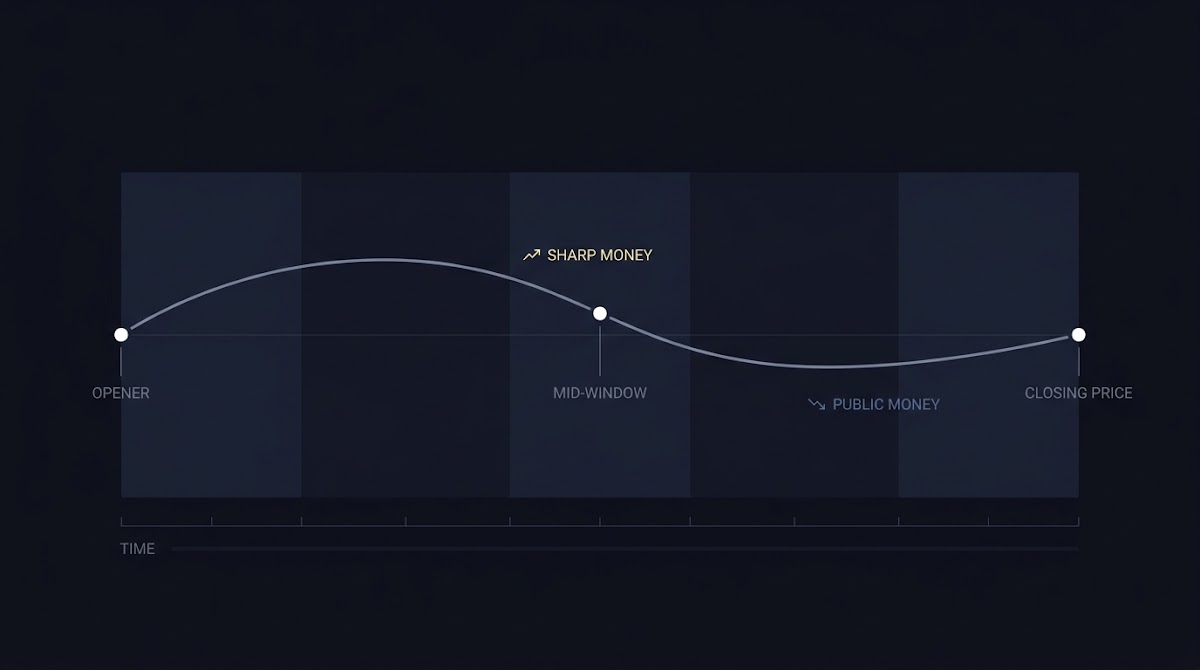
Line movement can have different causes. Sharp money, from professional bettors or exchanges, often pushes early lines when limits are low. Those early adjustments can reveal informed views that the market will later converge to. Conversely, public money, including casual retail action or a large number of small bets on a popular team, tends to move lines later when many people act at similar moments. Pinnacle's description of how betting limits influence price formation helps unpack these patterns Pinnacle on betting limits.
Understanding the source of movement matters for the accept versus wait decision. An early move that comes from a small number of sharp stakes into limited liquidity can indicate either a real information edge or a temporary distortion. A late move on a marquee event could be mostly public handle and less informative about the true probability. In practice, the event context and the market venue are key signals to separate these drivers.
How limits and liquidity change as kickoff approaches
Markets usually become more efficient as kickoff approaches because sportsbooks and exchanges raise limits and more information becomes available. That means late prices often incorporate injury news, starting lineups, weather, and larger wagers, so the closing number is frequently a fuller reflection of consensus probability. Pinnacle's overview of why closing odds are often the most accurate prices provides a useful baseline for that idea Pinnacle article on closing odds.
A simple timeline can help. At the opener there is often wide movement opportunity, limited liquidity, and higher variance. In the mid-window more information arrives and market makers adjust limits. At close liquidity peaks and the market generally tightens. Knowing where you are on that timeline helps decide whether a move is likely to hold or to revert.

Should you accept line movement? A simple decision framework
Compare current EV versus expected future EV
The single most actionable principle is this. Calculate the expected value at the current offered odds using your fair probability. Then estimate the expected value you expect if you wait, accounting for the probability you will get a fill at a better price and the likely size of the price change. Accept when the immediate EV loss from taking the worse odds is smaller than the expected gain from waiting multiplied by your chance of filling at that better price. The logic behind comparing expected values is standard and explained in general terms by Investopedia on expected value Investopedia on Expected Value.
Compact numeric example
Example: your fair probability for Team A is 55 percent. The current market offers decimal 1.85, which implies about 54.05 percent. Your edge is small. If you stake 1 unit at 1.85 your raw expected value is 0.0165 units. If waiting might return you to 1.95 with 40 percent probability and the expected price moves otherwise to 1.80, compare the weighted outcomes. Waiting yields an expected value equal to 0.4 times the EV at 1.95 plus 0.6 times the EV at 1.80, minus the cost of potentially missing the market. Calculating those figures shows whether waiting improves EV net of fill risk. For the core EV calculus see Investopedia's expected value primer Investopedia on Expected Value.
Try the EV checklist in your next challenge evaluation
Try this short checklist on your next selection: compute current EV, estimate fill probability, and decide to accept only if current EV remains preferable to the expected outcome of waiting.
Estimate fill probability and opportunity cost
Estimating fill probability is part art and part market read. For low liquidity markets a better price may be available only briefly. For high liquidity games there is often a reasonable chance to wait and achieve a similar or better price. Exchanges and the sharpest books often lead price moves, and watching their action can provide signal about where fills are likely. The interpretation of such signals is discussed in Smarkets help materials about how odds change Smarkets Help Centre.
A short decision checklist you can memorize
- Compute current EV using your fair probability.
- Estimate the size of the likely future move and the probability of getting a fill at a better price.
- Assess whether event timing and limits make fills plausible.
- Accept if current EV minus waiting cost is still positive or if waiting has low fill probability.
Tracking closing line value for process evaluation in funded challenges
How to record and calculate CLV
Closing line value is the difference between the price you bet and the closing market price expressed in either odds or implied probability. Traders and serious handicappers use CLV as a process metric: consistent positive CLV over many bets signals that your model or judgments beat the market consensus. A clear overview of why closing line is used as a benchmark is available at Unabated's guide to CLV Unabated on closing line value. For another plain CLV explanation see Webopedia's article on closing line value Webopedia on CLV.
To log CLV, record the market opener, your bet price, and the official closing price. Convert each price to implied probability so differences are linear and easier to average. For example, with decimal odds convert to implied probability by taking 1 divided by the decimal price. Over a sample of bets take the average difference between your implied probability and the market close to quantify CLV.
simple logging template to record open price, bet price and close for CLV tracking
Use consistent conversion to implied probability
Benchmarks for consistency in a funded account framework
In structured funded challenge formats the metric matters because the goal is to show consistent skill, not short term variance. Using CLV as a benchmark lets evaluators see whether a bettor repeatedly finds positive value versus the final consensus. For how CLV aligns with funded evaluation practice see a discussion of why closing odds are considered the most accurate prices Pinnacle article on closing odds.
If you are participating in a funded sports prediction challenge, track CLV across at least several dozen qualified bets before drawing strong conclusions. A pattern of small, consistent positive CLV is more informative than a single large winner. Mentioning FundedPlays in an educational context is appropriate when discussing funded account workflows and measurement, but remember that participation rules and outcomes depend on adherence to challenge terms.
Typical mistakes and pitfalls when reacting to movement
Common cognitive errors
A frequent mistake is accepting worse odds because of recency bias or fear of missing out. That behavior shifts your long term expectation downward. If you do not calculate expected value consistently you will erode edge by taking small negative EV bets that compound over time. The basic EV logic that underpins this warning is summarized by Investopedia on expected value Investopedia on Expected Value.
Another cognitive trap is assuming every late move is sharp. Late movement can be entirely public-driven, especially on popular events where many bettors react to the same headline. Misreading the driver of a move leads to systematically poor choices about when to wait and when to accept.
Operational mistakes around limits and fills

Operational errors are common. Bettors sometimes misjudge limits and assume a better price will be available for their stake size. In low liquidity games a better price may be inaccessible at your typical stake, which means waiting has a low fill probability and accepting may be preferable. Pinnacle's explanation of betting limits and their effect on pricing helps illustrate this point Pinnacle on betting limits.
A second operational pitfall is failing to record closing prices and therefore being unable to evaluate whether accepting or waiting improved process metrics. Tracking CLV is a low cost fix that prevents repeated mistakes and surfaces whether your judgment adds value relative to the market.
Practical examples and step-by-step scenarios
Small-market early sharp move example
Scenario 1, early sharp move. Opener: Team B is listed at decimal 3.00 in a small market with limited liquidity. A sharp account places a meaningful stake and the price moves to 2.80. Your model still sees Team B at decimal 2.60. The direct EV calculation at 2.80 versus 2.60 shows you still have an edge. If typical fills at that market size are small and the book's limits are unlikely to increase quickly, accepting a small stake may be justified because the expected EV gain from waiting is small relative to the chance you lose the opportunity.
In this example the move came early and likely reflects sharp action into low limits, which often signals a genuine reappraisal of probability but can also be a temporary distortion. Observing which venues moved first can help: exchanges and sharper books tend to lead moves when an information advantage or a large early wager is present. For how exchanges and sharp books adjust prices first see Smarkets help Smarkets Help Centre.

Late public surge on a marquee event
Scenario 2, late public surge. In a high profile match public money pushes the market late from 1.95 to 1.88 after an injury rumor that proves unfounded. Here the closing price likely reflects the heavier public handle and may overstate the change in true probability. For the general point that late moves can reflect public surges on marquee events see Pinnacle's discussion of limits and market behavior Pinnacle on betting limits.
In this case waiting could have been costly if the rumor proved true and the price moved further. The correct action depends on your read of the catalyst credibility and the fill probability if you try to reenter. If you do not have strong reason to trust the rumor, and your fill probability for a reentry is low, a conservative approach is to preserve bankroll and avoid repeatedly accepting small negative EV bets.
Example inside a funded challenge evaluation
Scenario 3, funded-challenge context. Imagine you are completing a funded prediction challenge where drawdown rules are strict and the program evaluates many bets over a short evaluation window. Accepting marginally worse odds to avoid drawdown can be tempting, but doing so systematically will worsen your closing line value and the evaluation of your process. CLV is widely used as a benchmark in funded evaluations because it separates luck from repeatable edge; for an introduction to CLV see Unabated's overview Unabated on closing line value. Additionally, Primesportsbook offers a practical CLV guide that explains the metric in betting terms Primesportsbook on CLV.
Within a challenge workflow on Funded Plays log each decision to accept or wait and note the result versus the closing price. Over time you can see whether accepting movement preserves challenge progress or whether it quietly erodes your measured skill. That feedback loop is practical and will improve decision consistency without adding risk beyond the challenge rules.
Incorporating movement decisions into bankroll and challenge strategy
Position sizing and expected-value scaling
Stake size should reflect expected value and fill probability. If a trade has smaller expected value because you are accepting worse odds, reduce stake proportionally. Repeating small negative EV bets at normal stake size compounds losses. The basic EV scaling logic is the same whether you are betting in a sportsbook or participating in a funded evaluation, so use conservative sizing when edge is marginal and fill probability is uncertain. The math behind expected value and stake scaling is standard and explained in conceptually useful terms by Investopedia Investopedia on Expected Value.
One operational rule is to predefine maximum stake as a function of your estimated edge. If the edge drops by half when accepting movement, cut stake rather than keep it unchanged. That preserves bankroll resilience and reduces the chance of breaching drawdown limits in structured challenges.
Respecting drawdowns and funded rules
Funded account evaluations often enforce drawdown limits and other operational rules. Those constraints should shape movement decisions. If accepting slightly worse odds prevents a drawdown violation that would disqualify you from a challenge, the pragmatic choice may be to accept once in a while. However, acceptances should be logged and later evaluated against closing line value, because frequent concessions to avoid drawdowns can mask a lack of process edge. For why CLV remains a core benchmark see Pinnacle's discussion of closing prices Pinnacle article on closing odds.
When rules force conservative choices, treat those choices as part of the strategy rather than as skill failures. Track outcomes and review CLV so you can adapt your approach as you collect more evidence during evaluation windows.
Conclusion: quick checklist and next steps
One-page decision checklist
Quick checklist to use before you act
- Compute current EV using your fair probability and the offered odds.
- Estimate the likely better price and your probability of getting filled at that price.
- Compare immediate EV to expected EV if you wait, factoring in fill probability.
- If immediate EV is better or waiting has low fill chance, accept; otherwise wait.
- Log the decision and compare your bet price to the closing price to track CLV.
How to start tracking CLV today
Begin with a simple spreadsheet that records date, event, open price, your bet price, closing price, stake, and result. Convert prices to implied probability and compute the average difference versus the close across a sample of bets. Consistent positive closing line value over many bets is a stronger signal of skill than individual wins or losses. For an introduction to CLV concepts see Unabated's guide Unabated on closing line value. For an alternative primer see Propsbot's CLV glossary Propsbot on CLV. See the Funded Plays blog for related articles.
Responsible participation matters. Track your process, respect challenge rules, and treat the approach as ongoing improvement rather than a promise of guaranteed outcomes.
Closing line value is the difference between your bet price and the final market price; consistent positive CLV suggests your process finds value versus the market over time.
Accept if the immediate expected value remains superior to the expected gain from waiting after accounting for the probability you will be filled at a better price.
Estimate fill probability by considering market liquidity, event profile, time to kickoff, and whether exchanges or sharp books are already moving the market.
References
- https://help.smarkets.com/hc/en-gb/articles/115001312169-How-odds-are-calculated-and-why-they-change
- https://www.investopedia.com/terms/i/implied-probability.asp
- https://www.investopedia.com/terms/e/expectedvalue.asp
- https://www.pinnacle.com/en/betting-articles/education/betting-limits-explained/
- https://www.pinnacle.com/en/betting-articles/education/why-closing-odds-are-most-accurate/
- https://www.webopedia.com/crypto-gambling/sportsbooks/how-to/closing-line-value-clv-explained/
- https://unabated.com/articles/what-is-closing-line-value/
- https://www.fundedplays.com/blogs/how-fundedplays-evaluations-work
- https://www.fundedplays.com
- https://www.fundedplays.com/blogs
- https://www.primesportsbook.com/betting-guides/closing-line-value/
- https://propsbot.ai/glossary/closing-line-value/
- https://www.fundedplays.com/challenges