

Quick answer: Are there free betting calculators or AIs and what they can actually do
What the phrase 'betting calculator free' usually covers
The short verdict is that free tools described as "betting calculator free" do exist in several useful forms, from simple odds converters to implied-probability calculators and basic staking rules, but they are educational aids rather than magic profit machines, and their use around regulated wagering is shaped by technical and transparency expectations.
Simple calculators perform deterministic conversions and arithmetic, while lightweight AI or predictive scripts require data, assumptions and governance to be meaningful; users should treat outputs as inputs to disciplined decision processes rather than as authoritative predictions.
Where to find free odds converters, implied-probability tools and staking calculators
Start with small test inputs
Difference between simple calculators and AI prediction tools
Odds converters and stake calculators return mechanical results you can verify by hand, while AI prediction aids use statistical models and recent data to estimate probabilities or edges; the latter demand careful validation, monitoring and documentation to be useful in practice.
For regulated software, expectations about transparency and testing are relevant when evaluating either kind of tool, because compliance frameworks emphasize demonstrable fairness and traceability in the software that supports decision making UK Gambling Commission RTS.
What free tools you will actually find: types and typical outputs
Odds converters and implied probability tools
Odds converters change between formats such as decimal, fractional and American, and implied-probability tools show the probability a given price implies; these are reliable arithmetic utilities for understanding market pricing and comparing offers.
Many free sports odds converter pages or small browser widgets give immediate clarity when you want to compare markets or check whether a quoted price is in line with your own assessment.
Stake and bankroll calculators
Stake calculators often implement simple rules, from flat-percentage staking to fractional Kelly guidance; they return suggested stake sizes for a given bankroll, target risk level and estimated edge, but their safety depends on the accuracy of the edge input and the chosen fraction of Kelly Kelly criterion definition and formula.
Because Kelly scales stakes according to perceived edge, a correct edge estimate is critical; if edge is overestimated, even a mathematically correct stake suggestion can lead to damaging overbetting.
Open notebooks and simple predictive scripts
Free notebooks and model scripts are common on learning sites and code repositories; they can be useful for experimentation, feature engineering and teaching basic forecasting methods, but they require clean data and validation before any practical use.
These notebooks are best treated as educational starting points: they show how models are built, but they do not guarantee that a model will work on live markets without rigorous testing and governance.

How to evaluate a free betting calculator or sports prediction AI before you rely on it
Check input assumptions and data quality
Start by asking where the tool gets its data, how often data are updated, and whether inputs are sanitized; poor or manipulated feeds can produce misleading outputs that look plausible but are unreliable in practice.
Industry alerts about suspicious betting patterns highlight the risk that contaminated data can bias or break models, so verifying data provenance is an essential first step IBIA Integrity Report 2024.
Free AI and calculator tools exist for odds conversion, implied probability and basic prediction, but they are educational aids that require careful validation, monitoring and conservative staking; they cannot legally or credibly promise guaranteed profits.
Demand transparency and explainability
Look for documentation that describes model type, training window, key features and known limitations; tools that do not explain their assumptions should be treated cautiously because hidden assumptions create blind spots for users.
Adopt governance habits such as versioning, changelogs and clear user-facing limitations to reduce the chance of accidental misapplication, consistent with recommended AI risk management practices NIST AI RMF.
Backtest and out-of-sample performance checks
Run straightforward backtests and out-of-sample checks before you allocate real funds; a model that looks accurate on in-sample data can fail badly when market conditions change, so confirm stability across time slices and event types.
When staking relies on estimated edges, perform sensitivity checks that show how returns and drawdowns change with small shifts in estimated probability; this reveals whether a staking rule like Kelly is safe to apply with the tool's inputs Kelly criterion definition and formula.
Legal and regulatory checkpoints you should know
UK: technical standards and software transparency expectations
In the United Kingdom, remote gambling technical standards set expectations for software fairness, logging, and testability, which is useful context when assessing free calculators or prediction aids intended for use alongside licensed services UK Gambling Commission RTS.
These standards do not directly make a small educational script compliant, but they provide helpful criteria for judging whether a tool documents its logic and preserves reproducible outputs.
U.S.: state-by-state differences in access and product availability
In the United States the legality and availability of betting-related tools vary by state, and you should check local rules before relying on functionality that interacts with regulated products or markets AGA State of the States 2024.
Because oversight and acceptable practices differ across jurisdictions, a tool that is normal in one state may be restricted or require different disclosures in another.
Marketing limits that affect how tools can be described
Responsible marketing codes disallow language that implies risk-free or guaranteed outcomes, so be wary of tools or pages that promise certainty or use promotional phrasing that suggests a prediction aid will always win AGA Responsible Marketing Code.
Good providers include clear disclaimers about variance, data freshness and the limits of model-backed guidance.
A practical checklist: how to test a free 'betting calculator free' step by step
Input validation and constructing test cases
Before trusting a calculator, create small test cases that exercise obvious edge conditions: zero odds, extremely long shots, and tied inputs. Confirm the tool returns expected arithmetic conversions and sensible stake suggestions for those cases.
Document the inputs and outputs in a simple spreadsheet so you can spot unexpected changes when the tool updates or the underlying data feed shifts.
Small-scale simulated bankroll trials
Run simulations with a small virtual bankroll and treat all stakes as hypothetical until you have consistent, repeatable results; simulated trials reveal how drawdowns behave and whether the staking rules are robust when edge estimates vary.
Practice prediction workflows with simulated funded accounts
Try structured, skill-focused challenge platforms such as FundedPlays to practice prediction workflows using simulated funds and clear rule sets without implying guaranteed outcomes.
Simulated bankrolls let you test fractional Kelly approaches, flat staking and stop-loss rules to see which method fits your risk tolerance before any real funds are used.
Monitoring and recording results
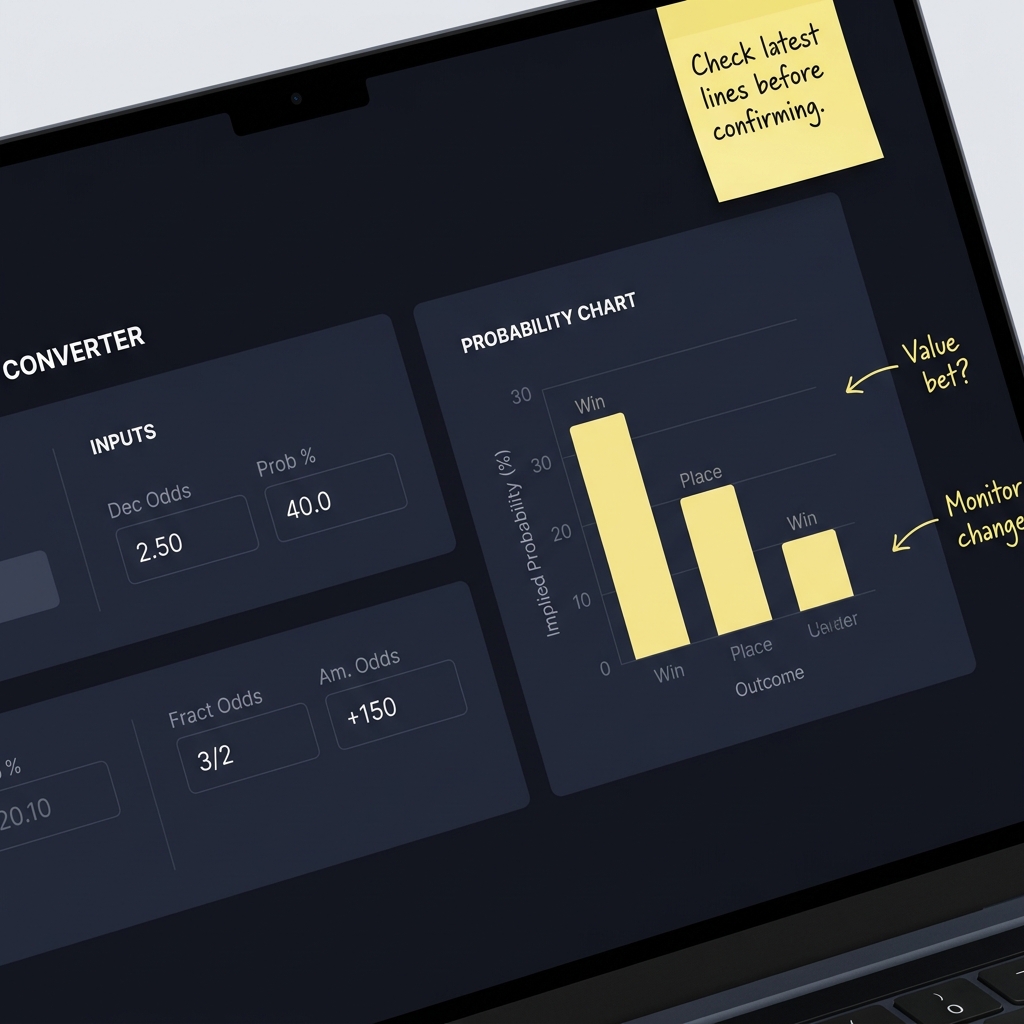
Log each trial, including timestamp, event, quoted odds, implied probability, stake suggested, and outcome. Over weeks this log shows whether the tool produces consistent signals and how sensitive performance is to small input changes.
Pair monitoring with simple analytics: win rate, average return per bet, maximum drawdown and streak statistics give practical signals about whether a free tool is behaving reasonably under live conditions NIST AI RMF.
Common mistakes and overreliance traps to avoid
Overestimating a model's edge
One common error is trusting point estimates for edge without accounting for uncertainty; a slightly optimistic probability estimate fed into Kelly can substantially increase stake size and risk undesirable drawdowns Kelly criterion definition and formula.
Always assume an estimate has variance and consider using a fractional Kelly to reduce exposure to estimation error.
Blindly following suggested stakes
A stake recommendation is only as safe as the inputs and the chosen staking fraction; follow stake suggestions mechanically only after you confirm the calculator is consistent and the edge inputs are conservative.
Combine automated suggestions with manual oversight and stop rules, for example limiting daily exposure or setting a maximum drawdown threshold.
Ignoring data contamination and integrity alerts
Do not ignore integrity reports and alerts: suspicious betting patterns and manipulated data feeds can bias both simple and AI-driven tools, so stay alert for signs of data contamination and unexpected pattern changes IBIA Integrity Report 2024.
If you detect odd clustering of outcomes or implausible odds movement, pause testing and investigate the data feed or the events covered by the model.
Three hands-on example workflows: beginner to advanced
Beginner workflow: odds converter plus fixed staking
1) Use a sports odds converter to translate market prices into implied probabilities for a small set of upcoming events.
2) Apply a flat-percentage staking rule, for example 1 percent of a simulated bankroll per selection, and record outcomes for 50 to 100 bets to assess basic variance behavior.
Intermediate workflow: estimated probability plus fractional Kelly
1) Build or use a simple probability estimate for each event, comparing your estimate to market-implied probability.
2) Calculate a fractional Kelly stake, for example one quarter Kelly, and track how returns change under small shifts to your estimated edge to highlight sensitivity and robustness Kelly criterion definition and formula.

Advanced workflow: backtest, monitor drift, and adjust
1) Backtest your model across multiple seasons and event types using out-of-sample windows to establish baseline performance and variability.
2) Deploy a small simulated bankroll, instrument live monitoring of key metrics and set alerts for model drift or sudden changes in input distributions, following AI risk management best practices NIST AI RMF.
Where a free calculator fits into disciplined bankroll management
Setting drawdown limits and position sizing
Use calculators to convert probability and edge estimates into stake sizes, but combine suggested stakes with explicit drawdown limits and position sizing caps so you cannot consume the bankroll on a short losing run.
Define maximum acceptable drawdown in advance and calibrate your staking method so that the worst plausible scenario remains within that tolerance Kelly criterion definition and formula.
Fractional Kelly and conservative adjustments
Fractional Kelly reduces variance by scaling the full Kelly stake; many practitioners use one quarter or one half of Kelly to balance growth and volatility, particularly when edge estimates are noisy.
When using an unfamiliar free tool, default to conservative fractions and increase stakes only after sustained, validated outperformance.
Tracking key performance indicators
Key metrics to track include realized win rate versus implied probability, return on investment, mean stake size, and maximum drawdown; these help you detect model deterioration or data issues early.
Adopt a simple reporting cadence, for example weekly summaries of performance metrics, and maintain a changelog for model or tool updates so you can correlate changes with outcomes NIST AI RMF.
When free tools are enough - and when to consider paid data or expert help
Symptoms that free tools are insufficient
Signs you need higher-quality data or paid services include large gaps in event coverage, unstable out-of-sample performance, or persistent unexplained biases in predictions that you cannot fix with feature tweaks UK Gambling Commission RTS.
If your free model shows performance that fails to replicate on fresh data, a higher-quality feed or professional validation may be the next step.
What premium data or tools add
Paid feeds often provide cleaner event metadata, faster updates and richer features such as player level statistics or expected-impact metrics; those improvements can reduce noise in probability estimates but come with subscription cost and integration work.
When you pay for data, require sample deliveries and a trial period so you can validate that the new input materially improves out-of-sample performance before full adoption.
How to transition to more rigorous testing
Pilot paid data in parallel with your free tool while keeping identical test cases and tracking changes in a versioned experiment log; if the paid feed produces reliably better out-of-sample metrics, migrate gradually and keep prior results for comparison.
Maintain a conservative staking stance while transitioning to allow time for unexpected differences to emerge in live conditions IBIA Integrity Report 2024.
Responsible language and marketing: what claims to avoid
Phrases that imply guarantees or risk-free outcomes
Avoid phrases such as "guaranteed wins" or "risk free returns" when describing calculators or AI tools because responsible marketing codes specifically advise against implying certainty in outcomes AGA Responsible Marketing Code.
Clear, factual phrasing builds trust and reduces legal and reputational risk for both creators and users of tools.
How to disclose limitations clearly
State data freshness, the size of the training window, expected variance and recommended conservative staking fractions; concise disclosures help end users understand the tool's scope without overstating its capabilities.
Document known failure modes and what to do if model behavior changes, for example stopping real stakes and switching to investigation mode.
Practical disclosure examples
Short sample disclosures include: "This tool provides probability estimates for educational use only, not guaranteed outcomes. Verify inputs and run your own tests before using real funds."
Keeping disclosures visible and simple helps set appropriate user expectations and aligns with good AI governance practices NIST AI RMF.
Mini experiments you can run tonight to test a free tool
A compact 10-step backtest
1) Collect 50 to 100 historical events and the closing market odds for each event.
2) Feed those odds and your probability estimates into the calculator to produce stakes and returns, then compare realized outcomes to implied probabilities to identify bias and calibration issues Kelly criterion definition and formula.
Simple simulated bankroll drill
1) Create a virtual bankroll and limit daily exposure to a fixed percent. 2) Apply a conservative staking rule such as one quarter Kelly or a fixed small percentage and track drawdowns over 100 hypothetical bets.
This drill shows how variance accumulates and whether staking suggestions align with your risk limits; stop if drawdowns exceed pre-set thresholds and investigate.
How to log results and interpret signal strength
Record each trial with a timestamp, predicted probability, implied market probability and profit or loss so you can compute calibration metrics such as Brier score or mean absolute error and assess signal strength.
When a short experiment shows persistent miscalibration or improbable bursts of wins or losses, treat that as a red flag and dig into data sources for contamination or selection bias IBIA Integrity Report 2024.
Where regulation and operator practices appear to be heading
Emerging expectations for transparency and monitoring
Regulators and industry bodies are emphasizing transparency, logging and the ability to reproduce software outputs, so operators and tool creators are likely to be expected to provide clearer documentation and monitoring for predictive aids UK Gambling Commission RTS.
That trend favors tools with explicit governance and simple reproducible test suites rather than opaque, closed black boxes.
How UK and U.S. frameworks inform each other
Although the UK and U.S. systems differ, common themes emerge: the need for demonstrable fairness, transparency and state or national oversight; in the U.S. access and oversight vary by state, influencing which tools can be used freely and how they must be presented AGA State of the States 2024.
Users should watch for changes to disclosure requirements and testing expectations in their jurisdiction.
Practical implications for users and tool providers
For users, the implication is to prefer tools that document assumptions and allow reproducible tests; for creators, the implication is to build simple governance mechanisms, changelogs and user-facing limitations that align with emerging expectations NIST AI RMF.
Conclusion: practical takeaways and a short final checklist
Free calculators and basic AI prediction aids are available and useful as educational and experimental tools, but none should be treated as a source of guaranteed profit; validate inputs, backtest comprehensively and keep real stakes small until you have robust, out-of-sample evidence.
Follow these safeguards: confirm data quality, run small simulated trials, document results and limit real stakes until you are confident in the tool's behavior. When in doubt, prefer conservative staking such as fractional Kelly and keep a tight drawdown cap Kelly criterion definition and formula. Visit Funded Plays for challenge-based practice and resources.
Finally, remember that marketing and claims matter: do not equate a tool's apparent short-term accuracy with an enduring edge, and avoid language that implies guarantees in public descriptions AGA Responsible Marketing Code.
No. Free calculators and AI prediction aids cannot guarantee profits; they are tools for analysis and learning and must be validated and monitored.
Legality depends on your state. Access and acceptable practices vary by jurisdiction, so check local rules before using tools tied to regulated products.
Use conservative sizing, for example fractional Kelly or a small fixed percentage of a simulated bankroll, and only increase stakes after robust validation.