
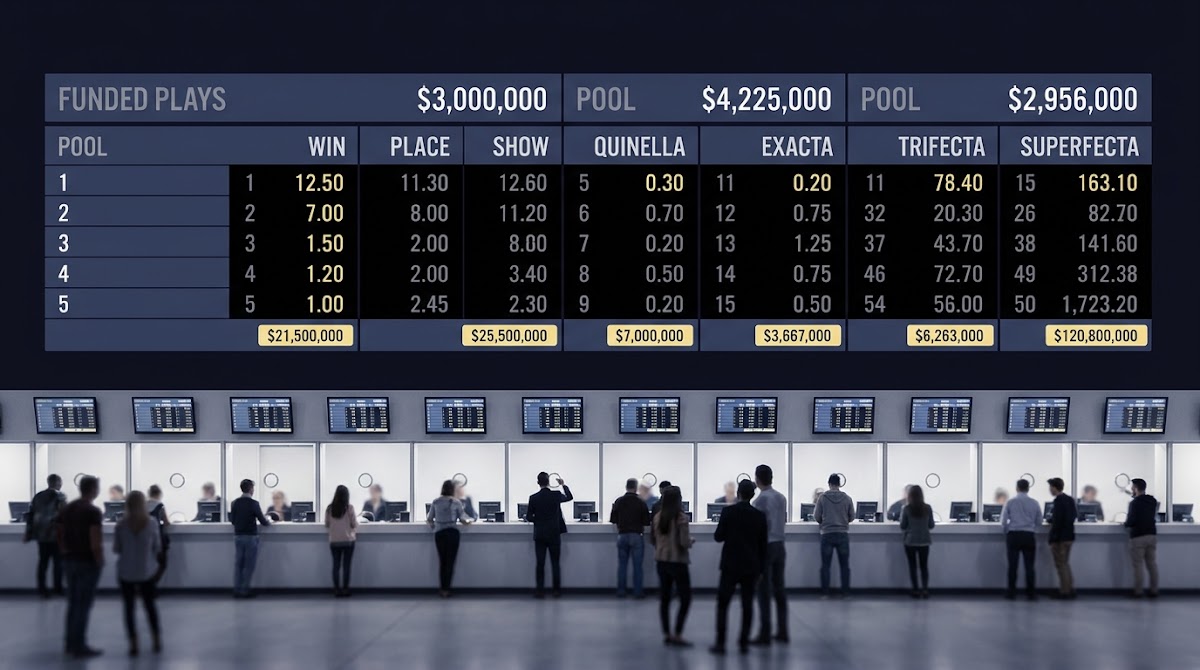
What a trifecta is and how it fits in pari-mutuel wagering
Definition in plain terms
A trifecta requires selecting the race's first, second, and third finishers in the exact order, with winning ticket holders sharing the net pool after the track's takeout, according to standard rule frameworks such as ARCI guidance and state regulations ARCI Model Rules of Racing.
In plain language, a correct trifecta is tougher than picking just the winner because order matters; the wager pays from the combined money bet into the trifecta pool rather than from a fixed table of odds.
How trifectas differ from straight and other exotic bets
Straight bets like win, place, and show pay from pools with lower takeout and simpler hit conditions, while exotics such as exactas, trifectas, and superfectas require multiple correct finish positions and therefore offer higher headline payouts but generally carry higher takeout rates and lower hit frequencies 7877.0185 TRIFECTA POOL.
Because a trifecta demands precise order, it sits toward the higher-variance end of common pari-mutuel exotics and is best treated as an opportunistic tool rather than a routine staple for most bankrolls.
How trifecta payouts are calculated
Net pool, takeout, and payout division
When bettors look at a displayed trifecta payout, the calculation starts with the gross pool, from which the track removes the takeout percentage and any fees; the remainder is the net pool, and that amount is divided among winning tickets to determine each ticket's payout Takeout and Breakage. Calculation of payouts guidance
Walk-through, example only: 1) Start with a labeled example gross pool amount. 2) Subtract the stated takeout percent to find the net pool. 3) Divide the net pool by the number of winning combinations to estimate the per-ticket payout before breakage adjustments.
Explore FundedPlays challenge options
Bookmark this step-by-step payout walk-through. It helps when you review the pari-mutuel tote board and want a quick reference for converting pool information into expected per-ticket payout.
Role of breakage and rounding rules
After the net pool is divided, tracks apply breakage rules to round payouts to the nearest permissible unit; breakage systematically reduces the final payout by trimming fractional values, so winners receive slightly less than the raw division suggests Takeout and Breakage. State payout calculation rules
Because breakage is applied after division, even accurate estimates of the net pool can overstate realized returns unless the rounding rules are considered alongside takeout when modeling outcomes.
Takeout, breakage, and the math of expected return
Typical takeout differences between straight bets and exotics
Exotic wagers like trifectas commonly carry higher takeout rates than straight win/place/show bets, which lowers long-term expected return for bettors even when individual payouts look attractive on the tote board Takeout Rates by Wager Type.
Higher takeout means a larger share of the gross pool is removed before winners are paid, so the fundamental advantage required to make regular trifecta play profitable must be larger than for straight bets to overcome that structural cost.

How takeout and breakage lower expected returns
The combination of higher exotic takeout and breakage compounds the reduction in realized payout, and when that interacts with low hit rates for precise-order bets, the expected value for most bettors becomes negative unless they possess a measurable edge Takeout and Breakage.
Practically, this means bettors should treat trifectas as a tool to deploy when they believe the market price understates the true chance of their chosen ordered finish, rather than as a routine play; otherwise the math favors the house over time.
quick net-pool calculator for practice and modeling
use official takeout table values for accuracy
Ticket construction: boxing, keying, and combination costs
What boxing and keying mean for combinations
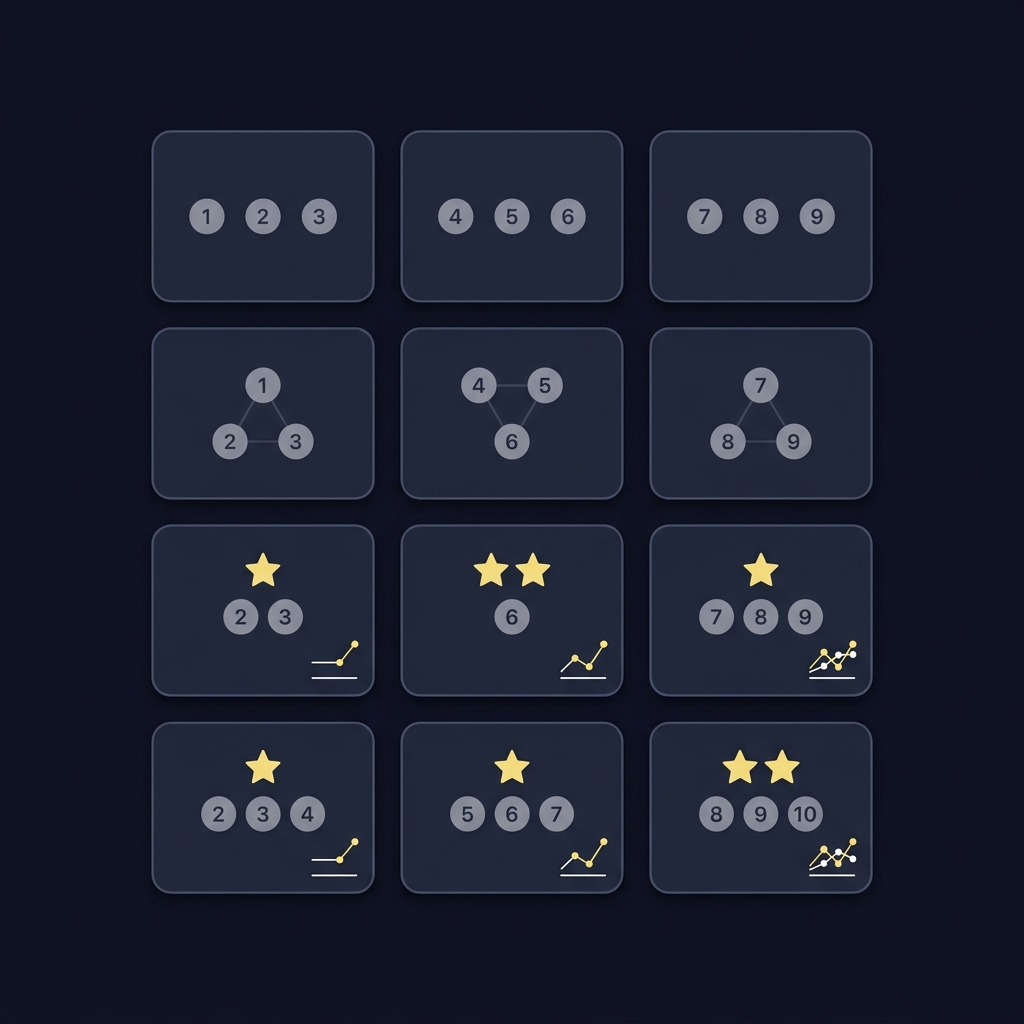
Boxing a trifecta means covering all order permutations for a set of selected horses, which multiplies the number of combinations quickly; keying fixes one or more positions and combines them with multiple horses in other spots to reduce combinations relative to a full box while maintaining targeted exposure Wagering 101: Trifecta.
Because each additional horse included in a box or as a key raises the ticket count geometrically, bettors must be conscious of how those choices translate into cost before submitting tickets.
A trifecta can be a good bet occasionally when you have a measurable edge and size tickets within a disciplined staking plan, but higher takeout, breakage, and low hit rates mean it is not a broadly profitable routine wager for most bettors.
How combination counts translate to ticket cost
The cost of a ticket set equals the base unit wager times the number of combinations; for example, a three-horse straight trifecta is one combination, while a three-horse box covers six permutations and therefore costs six times the unit stake.
When planning tickets, list combinations and multiply by your unit size to understand exposure; this keeps you from unintentionally committing too much of your bankroll to a single race 2024 Breeders' Cup Wagering Guide.
When a trifecta is a good bet: decision criteria
Edge and mispricing: when opinion diverges from the market
Trifectas become more attractive when your independent model or read produces a materially different distribution of likely finishing orders than the market implies, especially if an exotic pool is large enough that mispricing matters; in those moments the potential reward can justify the higher takeout and low hit rate Wagering 101: Trifecta.
Objective signals to watch for include a pronounced favorite with unstable form, late scratches that rearrange expected matchups, or public money that compresses win prices but leaves exotic pools less efficiently priced.
Race conditions and field size factors
Field size and race shape affect the number of plausible finish orders; larger fields increase possible permutations and tend to lower the chance of any one combination hitting, which raises payout variance and required edge to justify a trifecta play Wagering 101: Trifecta.
Smaller fields or races with clear top contenders reduce combinatorial complexity and can make carefully sized boxes more defensible as part of a measured staking plan.
Bankroll control and staking plans for trifectas
Fractional staking and loss-limiting rules
Because trifectas are high variance, a conservative approach is to allocate only a small fraction of your active bankroll to exotic exposure on any given day and to set hard per-race maximums; this preserves capital through inevitable losing streaks and allows you to sample opportunities without excessive risk 2024 Breeders' Cup Wagering Guide.
Simple rules of thumb include capping total daily trifecta spend to a low single-digit percentage of your bankroll and defining a per-race maximum that limits how large a boxed or keyed ticket can be relative to available funds.

How to size multi-combination tickets
When constructing multiple combinations, calculate the total cost first and then scale your unit stake so the aggregate exposure fits within your per-race cap; for example, reduce the unit from a standard amount to maintain the same dollar risk when the combination count increases.
Sizing by percentage, not absolute dollars, keeps staking proportional as your bankroll grows or shrinks and reduces the chance that an outsized combination set will generate negative drift over repeated plays.
Common mistakes and pitfalls to avoid
Over-betting combinations without edge

One frequent error is creating wide boxes or many keys without a proven edge; the cost of coverage plus higher exotic takeout usually outweighs the benefit of marginally increasing your chance to hit a paying ticket 2024 Breeders' Cup Wagering Guide.
Track your hypothesis and only expand coverage when your record indicates a repeatable advantage for similar ticket structures and race types.
Chasing large payouts after losses
Another common pitfall is increasing stakes after losses in pursuit of a big payout, a behavior that ignores base rates and the low hit frequency of precise-order bets and often accelerates bankroll depletion rather than restoring it Wagering 101: Trifecta.
Instead, keep loss limits in place and review results objectively to determine whether a strategy change is warranted, rather than reacting emotionally to a recent losing sequence.
Worked examples: sample tickets and scenario analysis
Small-field example with a boxed trifecta
In a small field where three horses clearly separate from the rest, a three-horse box covers the six possible orders for those three and is a compact way to express a belief that those three will finish in the top three without committing to a full-field coverage.
To size the play, count the six permutations, multiply by your unit, and ensure that total fits within your per-race cap; this keeps the ticket affordable while accepting the modest chance that an outsider interrupts the top three.
Large-field example with targeted keys and bankroll impact
For a large field where you have conviction on one or two horses but uncertainty about the remaining placings, using a key to lock one horse in a specific position combined with a limited selection of others for the remaining slots reduces combination count relative to a full box while maintaining targeted exposure.
Explicitly tally the combinations generated by your key and secondary selections, convert that number to cost at your chosen unit, and compare to your bankroll percentage cap before placing the wager.
Alternatives to trifecta: lower-variance options
Exactas, daily doubles, and conservative exotic play
Exactas and daily doubles demand fewer correct elements than a trifecta and typically have lower takeout on the effective risk-adjusted return, making them useful alternatives when you prefer lower variance or when your information edge is smaller Takeout Rates by Wager Type.
For bettors focused on steady ROI rather than occasional large wins, these lower-variance exotics or straight bets often provide better risk-adjusted outcomes while still allowing strategic play.
When to prefer straight bets instead
If your model is strongest at identifying winners rather than precise finishing order, favoring win or place bets will usually use your edge more efficiently due to lower takeout and higher hit rates for single-horse outcomes Takeout and Breakage.
Use exotics sparingly to complement straight-bet exposure, and test any shift in strategy on a small scale before increasing stakes.
Final checklist: when to use a trifecta and next steps
Quick decision checklist
Checklist: 1) Do you have a measurable model or read that materially differs from the tote? 2) Is the trifecta pool size meaningful relative to your unit? 3) Can you size the combinations within your bankroll caps? 4) Have you accounted for takeout and breakage? If the answer is yes to these, a targeted trifecta may be justified ARCI Model Rules of Racing, ARCI master model rules.
Keep the checklist handy and refer to official takeout tables for the exact rates you should use when modeling expected returns. For related discussion see our blog.
How to test your approach responsibly
Run small-scale tests, record every ticket and outcome, compute realized ROI after takeout and breakage, and adjust unit sizes based on objective performance rather than recent variance; this disciplined feedback loop separates skill from luck over time Takeout and Breakage.
Trifectas are high-variance tools and should be used selectively as part of a broader, disciplined staking plan rather than as a primary wagering vehicle.
You must correctly select the first, second, and third finishers in exact order; winnings are taken from the net pari-mutuel pool after takeout and breakage.
Trifectas can show larger headline payouts, but higher takeout and lower hit rates often make them worse for long-term expected return compared with straight bets unless you have a clear edge.
Limit total daily trifecta exposure to a low percentage of your bankroll and cap per-race spend; size unit stakes so the total combinations stay within those caps.
References
- https://www.arci.com/wp-content/uploads/2024/05/ARCI-Model-Rules-of-Racing.pdf
- https://www.revisor.mn.gov/rules/7877.0185/
- https://www.nyra.com/player-wagers/takeout-and-breakage
- https://rtip.arizona.edu/sites/rtip.arizona.edu/files/ARCI-004-105%20CAlculation%20of%20Payouts%20and%20Distribution%20of%20Pools.pdf
- https://irgc.iowa.gov/media/130/download?inline
- https://chrb.ca.gov/takeout-rates/
- https://www.equibase.com/newfan/wagering/trifecta.cfm
- https://www.breederscup.com/wagering/wagering-guide
- https://www.fundedplays.com/challenges
- https://arci.com/docs/MASTER-MODEL-RULES-VERSION-12.1.1-7-20-23.pdf
- https://www.fundedplays.com
- https://www.fundedplays.com/blogs
- https://www.fundedplays.com/blogs/how-fundedplays-evaluations-work