

What a trifecta is and when to consider it
Definition and three finishers in exact order
A trifecta is a pari-mutuel bet in which you must pick the first three finishers in exact order, so a correct ticket requires naming who finishes first, second, and third in that sequence.
Because the order matters, a single straight trifecta pays only if the three horses you selected cross the line in the precise order you listed; many bettors turn to expanded formats because a straight ticket is hard to hit in most competitive fields, especially when there are several credible contenders Equibase wagering guide.
The best approach is to match ticket format to race characteristics: use targeted keys or small wheels when a few horses dominate and use boxes or broader wheels for competitive fields, while controlling cost through denomination and strict bankroll limits.
Variants that expand coverage: box, key, wheel
To broaden coverage without buying many straight tickets, bettors use variants such as a box, which covers all possible orders for a set of selected runners, a key ticket that locks one or more horses into a particular finishing position while varying the others, and wheels that rotate a selection through first, second, and third positions; these formats increase the number of combinations and the cost of the ticket.
All these forms are still settled through pari-mutuel pools rather than fixed odds, so expanding your coverage increases your chance of holding a winning unit but does not change how the pool is divided at payout time ARCI model rules of racing.
How trifecta payouts are calculated
Net pool, takeout, and statutory breakage
In U.S. pari-mutuel wagering, the total money wagered into the trifecta pool is reduced by the track takeout and any statutory breakage, and the remaining net pool is divided among all winning units to determine individual payoffs; there are no fixed odds for a trifecta.
The key steps are: 1) combine all trifecta wagers to form the pool, 2) subtract the track's takeout and any breakage adjustments, and 3) divide the net pool by the number of winning units to compute the per-unit payout, a process described in the model rules governing pari-mutuel pools ARCI model rules of racing.
How minimum denominations affect ticket sizing
Minimum wager denominations at a track do not change the pari-mutuel formula; they only let bettors size tickets in smaller increments, which can stretch a bankroll across more combinations when the track allows half-dollar or other fractional minimums.
For example, some major jurisdictions list a half-dollar minimum on trifectas, which gives players more flexibility to buy combinations without changing how the net pool is computed or how winners share payouts NYRA takeout and minimums.
Compute ticket cost from combinations and denomination
Enter combinations and denomination to get cost
Common ticket formats: box, key, wheel, and part-wheels
How each format changes coverage and cost
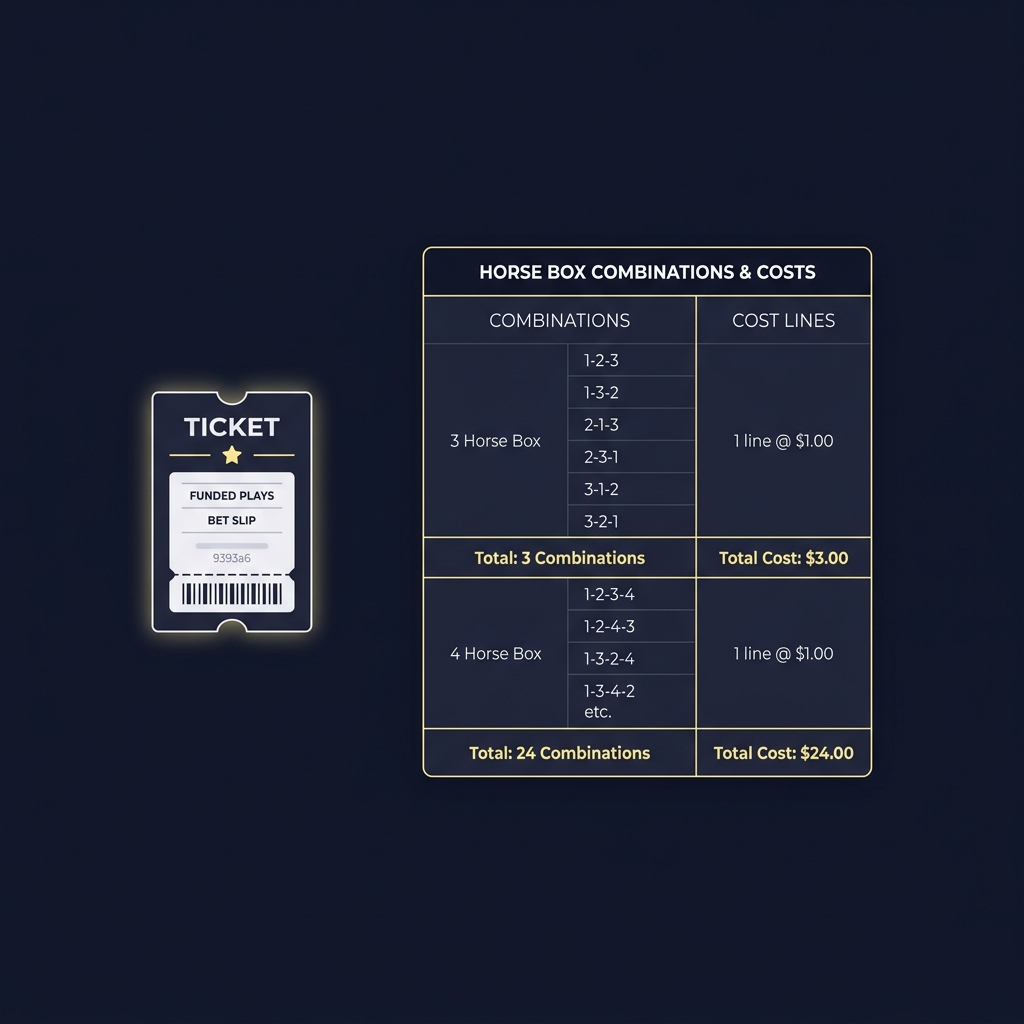
A box creates every possible order of the horses you include, so a four-horse box produces 24 distinct trifecta combinations; a key locks one horse into a specific place while you vary the others, and a wheel rotates selections through the first three positions depending on how you build it.
To compare formats practically, a box is easiest to understand: a $1 four-horse box is 4x3x2 = 24 combinations, so at a $1 minimum it costs $24; this example is commonly used to show how quickly cost scales with each additional horse Equibase wagering guide.
Practice structured prediction with FundedPlays Challenges
Try building a practice ticket with the examples above to learn how combination counts and denominations affect cost; use smaller denominations while you practice and focus on disciplined selection rather than chasing big payoffs.
Concrete pricing examples using $1 tickets
Concrete part-wheel examples illustrate a targeted, lower-cost approach: a part-wheel that puts two horses in the first two positions and three in third can be priced modestly because it restricts orders, for instance a $1 part-wheel with 2 and 3 in first and second and 4-5-6 in third creates six combinations and thus costs $6 at $1 minimum.
These pricing mechanics are a straightforward multiply permutations combinatorics exercise: multiply permutations for ordered spots to count combinations, then multiply by the denomination to get ticket cost; examples like the $1 box of four horses costing $24 and the $1 part-wheel costing $6 are standard illustrations of that math Equibase wagering guide.
Sizing tickets and bankroll planning for trifectas
Using minimum denominations to stretch coverage
Lower minimums permit more combinations for the same outlay, which can make boxed or part-wheel tickets feasible on a modest bankroll; the pari-mutuel payout process itself is unchanged, but smaller denominations let you buy more units without increasing exposure per unit NYRA takeout and minimums.
For bettors with limited funds, the practical choice is often to reduce denomination and tighten selection to keep combination counts manageable; that preserves learning opportunities while limiting downside risk when exploring trifecta structures.

Managing volatility with disciplined stakes
Trifectas are inherently volatile because payouts depend on how many winning units share the net pool; prudent bankroll rules of thumb include capping total trifecta exposure per race to a small percentage of your betting bankroll and sizing individual tickets conservatively.
Emphasize consistent, repeatable stake sizing rather than large, infrequent punts, and remember that no strategy removes the underlying uncertainty created by pari-mutuel pools and variable takeout rates.
Choosing a strategy: box, wheel, or key based on race factors
How field size and favorite density change the efficient play
Decisions about format start with field size and the number of believable contenders: small fields with one dominant favorite often favor narrow, targeted tickets such as key or small wheels, while larger, competitive fields may justify boxes or larger wheels to capture more possible orders.
Takeout and expected pool size also affect the choice; when takeout is high or pools are small, the expected return per unit can shrink, which argues for tighter selection and fewer combinations in order to preserve expected value where possible NYRA takeout and minimums.
When to favor wider coverage versus targeted tickets
Favor wider coverage for unpredictable races with several closely matched contenders, and favor targeted tickets when your handicapping identifies a small group with clearly higher chances; weigh the cost of extra combinations against the likelihood of winning units and the expected pool volatility.
Remember that larger wagering handle can produce bigger exotic pools and therefore larger potential payoffs, but handle and pool size vary by race and by venue, so adjust coverage decisions to the specific race context rather than using one universal rule The Jockey Club fact book.
Common mistakes and how to avoid them
Overspending on coverage and misreading denominational impact
A frequent error is over-boxing without considering the rising cost for each added horse; the marginal benefit of adding another runner often falls faster than many bettors expect, so calculate combinations before you bet and keep total exposure within a pre-set limit.
Use minimums to your advantage for practice, but do not mistake smaller denominations for better expected returns; the pari-mutuel formula still applies and high takeout can erode returns even on low-cost tickets NYRA takeout and minimums.
Ignoring jurisdictional takeout and breakage rules
Another common mistake is assuming payout mechanics are identical across tracks: takeout rates, breakage rules, and minimum denominations differ by jurisdiction, and those differences materially affect how much of the pool goes to winners.
Before you place a ticket, confirm the local takeout and minimums; this is especially important for large exotic tickets where a small change in takeout or a different breakage policy can change the net payout materially ARCI model rules of racing.
Worked examples: building tickets without assuming payoffs
Three practical ticket builds with cost math
Example 2, targeted part-wheel: a part-wheel that holds two choices in first and second and three in third produces 2x1x3 = 6 combinations and therefore costs $6 at $1 denomination, showing how selective structuring can lower ticket price while keeping coverage where you think it matters.
Example 3, key ticket: a key where Horse A is keyed to finish first and Horses B and C rotate for second and third produces 2 combinations for the second and third spots and therefore costs 2 times your denomination; multiply combinations by denomination to get the final ticket price.
Why payoff unpredictability matters
All three examples intentionally omit hypothetical payouts because actual payoffs depend on the net pool and how many winning units share it; the pari-mutuel process means you cannot know a payoff until pools close and payouts are declared, so focus on cost control and selection quality rather than expecting a specific return.
If you want to estimate outcomes, first check the likely pool size and takeout for the race, but do not treat any estimated payoff as a guarantee because pool composition and winning-unit counts change the final numbers.
Summary checklist and next steps
Short pre-race checklist
Before placing trifecta tickets, confirm the takeout and minimum denominations for the track, compute the combination count and ticket cost, set a maximum share of your bankroll to risk on exotics, and pick a format that matches the race profile.
For tax and reporting reminders, large exotic payouts may trigger reporting obligations; refer to official IRS guidance on wagering income for the rules that apply to your situation IRS Publication 3079.
Responsible play and where to check rules
Consult the track's published rules and the jurisdictional authorities to verify exact takeout, breakage, and minimums before you bet, and maintain a disciplined staking plan so that trifectas remain a controlled part of your wagering or practice routine.
Use practice environments or simulation challenges to test ticket-building approaches and refine decision rules without expanding real-world exposure.

A trifecta requires naming the first three finishers in exact order; payouts are pari-mutuel and depend on the net pool after takeout and breakage.
Takeout reduces the net pool available to winners; higher takeout means less money is available to divide among winning units.
You can estimate based on pool size and likely winning-unit counts, but final payoffs are unknown until pools close and payouts are declared.