
Quick snapshot: bengals odds, short answer and key numbers
Short answer: look at the market moneyline, convert it to an implied probability, then compare that figure to model outputs to form a final, defensible estimate of whether the Bengals are likely to win. This quick read uses bengals odds as the starting signal and treats the market view as a snapshot, not a final judgment.
Start with the market moneyline, convert to implied probability, de-vig for a cleaner market view, compare that to FPI, DVOA and Elo outputs, and adjust for injuries and late news to form a defensible pregame probability.
Worked example: a consensus moneyline of -150 implies a market-implied win probability near 60 percent when using the standard American-odds conversion formula. To get that number you apply the usual conversion from negative American odds to implied probability as described in practical guides to implied probability, then remember the result is the market view, which includes bookmaker margin and liquidity effects Investopedia implied probability.
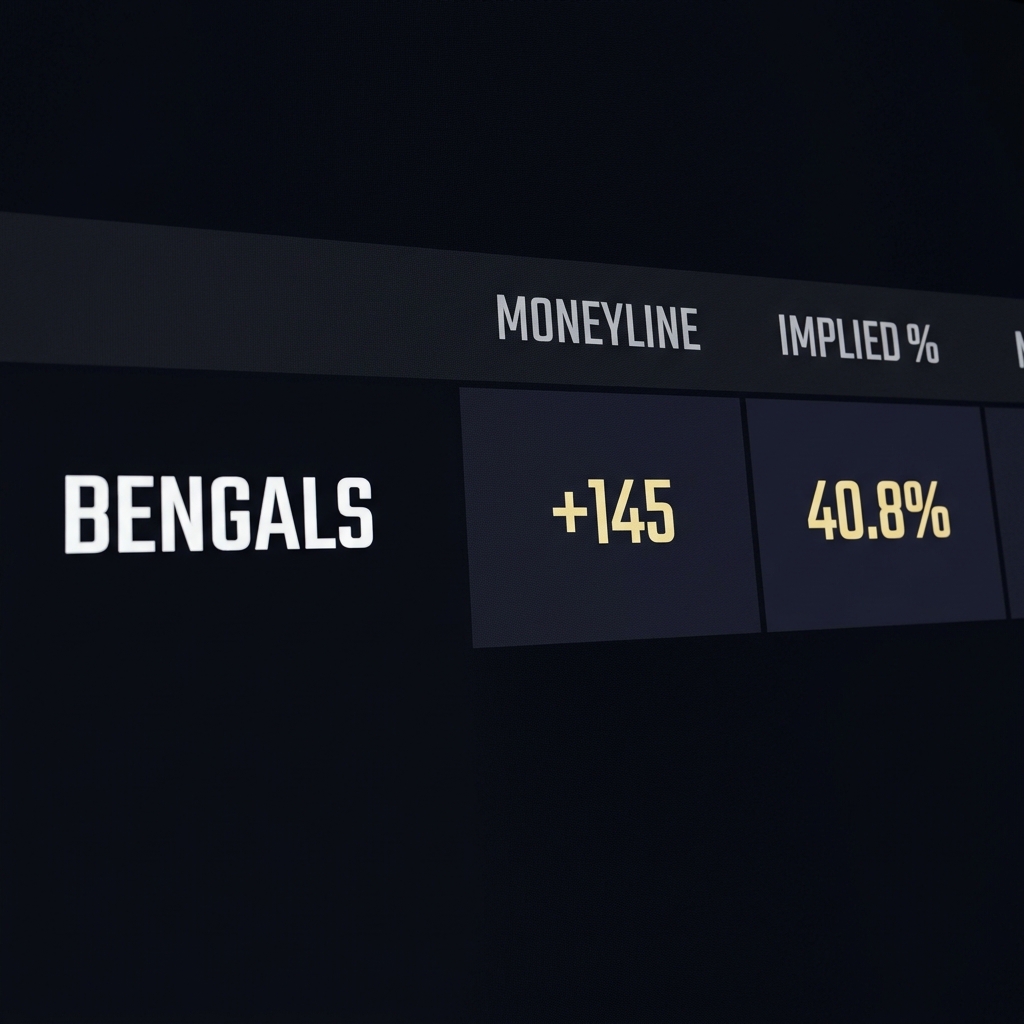
Numbers here are a snapshot. Markets move as news arrives, so refresh your screenshot near kickoff. For many readers the clearest immediate action is to capture the current consensus moneyline, note the implied probability, and treat that as your baseline before pulling model projections and injury updates. Consensus screens provide that snapshot quickly and are useful context even when you plan to rely more on models.
Understanding bengals odds: implied probability and the bookmaker margin
Step 1, convert American odds into implied probability. For positive American odds use probability = 100 / (odds + 100). For negative American odds use probability = -odds / (-odds + 100). Put plainly, -150 converts to roughly 60 percent and +150 converts to roughly 40 percent. These formulas give a first-pass, market-implied probability that is easy to compute and understand when you need a quick baseline.
Worked micro-steps to convert and check your math:

- Record the consensus moneyline for the Bengals from a market snapshot.
- If the number is negative, apply the negative-odds formula; if positive, apply the positive-odds formula.
- Label the result "market-implied probability" and note that it includes the bookmaker margin.
Why de-vig? Bookmakers build a margin into prices so the sum of both sides exceeds 100 percent. De-vigging produces cleaner probabilities that can be compared against model outputs. A simple, common de-vig approach for two-outcome markets is proportional normalization: convert each side to implied probability, sum them, then divide each side by the total so the two normalized probabilities add to 100 percent. This gives you a market view that approximates the market consensus without the built-in bookmaker edge.
Limitations to keep in mind: odds reflect available liquidity and the book's risk posture, not a perfect objective measurement of true outcome chances. Consensus screens help by aggregating visible lines across books, which can reduce noise in a single feed and better reflect market sentiment.
How market signals compare to models: blending bengals odds with FPI, DVOA and Elo
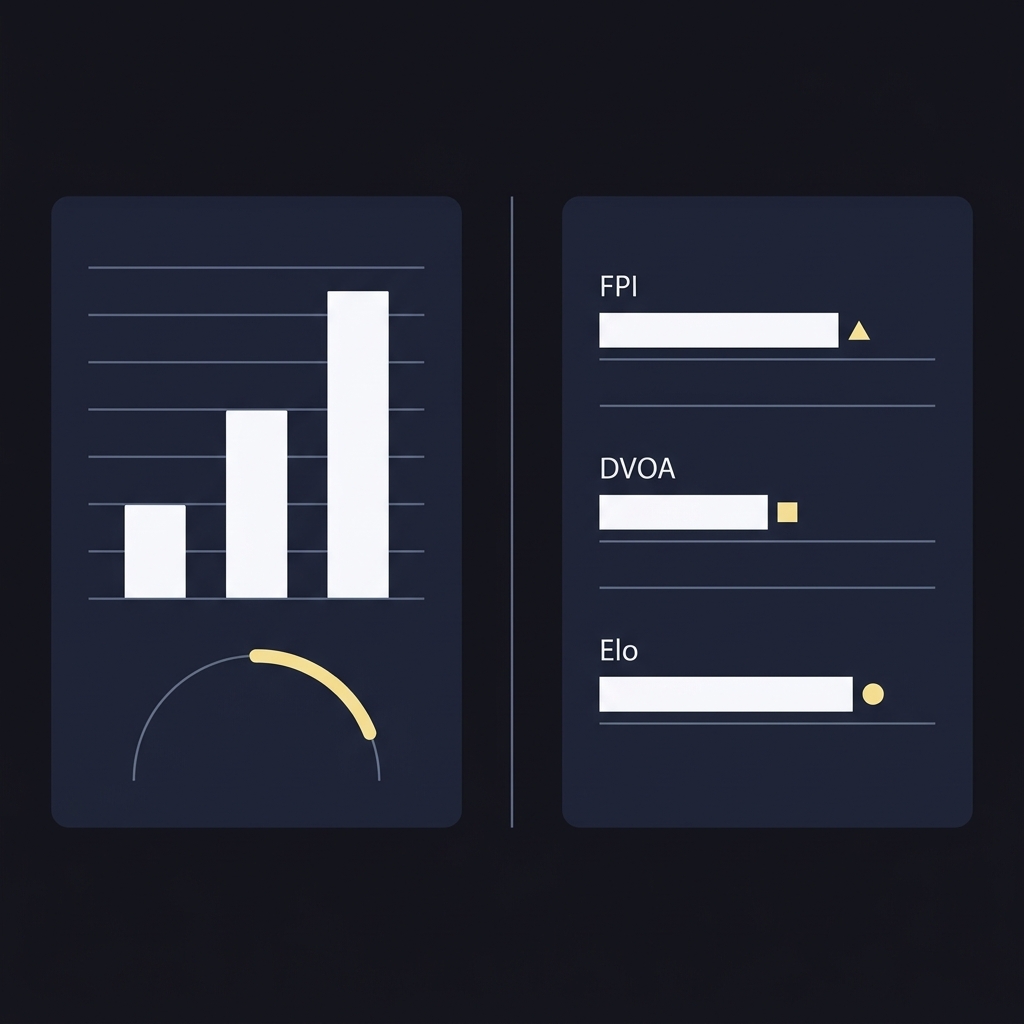
Models and markets measure related but different things, so blending them gives a more resilient pregame estimate. ESPN's FPI produces matchup probabilities from a team-strength model that incorporates recent performance and situational factors, which is useful when you want a continuously updated model baseline ESPN's FPI.
Try the workflow in a structured challenge
The next section gives a practical workflow you can follow to turn a market snapshot and a few model reads into a defensible pregame probability.
DVOA evaluates play-by-play efficiency after adjusting for opponent and situation, which helps explain why a market or FPI probability might miss matchup-specific edges such as a particularly favorable defensive matchup or special teams advantage FTN DVOA guide.
Elo-style ratings offer a transparent, additive baseline for head-to-head probabilities, and they are easy to blend with home-field adjustments when you want a quick sanity check versus both market and more complex models.
How to read disparate outputs: if market-implied probability and two model outputs cluster closely, you have higher confidence in that range. If market and models diverge persistently, that gap can signal either market overreaction, a stale model, or a matchup nuance not captured by one of the sides. Treat persistent gaps as prompts for further checks rather than automatic action.
Practical workflow: from consensus bengals odds to a defensible pregame probability
Step 1: capture a market snapshot. Use a consensus odds screen and record the moneyline and approximate bet spread. This snapshot becomes the baseline for short-term tasks like intraday checks and final decision-making near kickoff. See the Funded Plays blog for related writeups on workflow and discipline. Funded Plays blog
Step 2: run model queries. Pull the latest FPI pregame probability, a DVOA matchup read, and an Elo comparison. Record each model's probability or the implied win rate you derive from the rating differential. Note timestamps so you know how current each input is. For details on how we evaluate inputs, see how our evaluations work how our evaluations work.
Step 3: reconcile and adjust. Put market-implied (and de-vigged) probability side by side with model outputs. Ask these questions: do the models cluster? Does the market reflect a late news event not yet absorbed into models? Is there an injury or weather factor that explains a drift? Use proportional weighting to combine them, for example 40 percent market, 40 percent model consensus, 20 percent discretionary adjustment when late news exists.
Timing guidance: snapshot markets 60 to 90 minutes before kickoff for a stable baseline, but refresh in the final 30 minutes to capture late injury reports and sharp money. Models that update slowly can be stale in that window, so give greater short-term weight to markets when late official injury designations appear.
Accounting for injuries and late news that shift bengals odds
The NFL maintains a standardized weekly injury report with participation levels and game-status designations, and these official fields are central to understanding last-minute probability shifts NFL injury report policy.
Key fields to watch are practice participation tags and the gameday status designations that often appear on the final report. A starter listed as limited or out in final reports can meaningfully alter both model inputs and market lines, so treat final official statuses as higher-weight signals in the last hour before kickoff.

Practical rule of thumb: if a projected starter is downgraded on gameday and models do not already reflect that downgrade, increase your subjective adjustment by a notable margin, scaled to the player's positional importance. For example, losing a starting quarterback or an edge pass rusher typically moves market odds materially; secondary or rotational changes tend to have smaller, more situational effects.
When injury information is uncertain, lean toward probabilistic adjustments rather than binary changes. Translate uncertainty into a range for the Bengals' win probability rather than a single point estimate so you preserve flexibility as new information arrives.
Decision criteria: when bengals odds suggest betting, fading, or watching
Set quantitative thresholds to guide action. As an example framework, consider acting when the model-market gap exceeds a preset band, such as 6 to 8 percentage points, after confirming there is no obvious late news that explains the gap. Use these numbers as illustrative criteria, not prescriptive rules.
Checklist of qualitative confirmations before action: validate injury reports, check recent line movement patterns, confirm weather or travel issues, and review matchup-specific DVOA signals or tendencies that might not be fully priced by the market.
quick decision checklist to confirm model-market edges
Use as a final confirm step
Risk management reminders: size actions relative to bankroll, prefer smaller, repeatable edges over one-off large stakes, and treat single-game variance as noise. If you follow a funded challenge or simulation framework, mirror that discipline by limiting downside and tracking decisions objectively over time. See the Funded Plays homepage for account and policy information Funded Plays.
Common mistakes interpreting bengals odds and model outputs
Double-counting is frequent. For example, a model may already reflect a weak opponent or an injury, while the market also adjusts for the same factor. Counting both independently inflates the perceived edge. When in doubt, trace the origin of each input and avoid stacking the same signal twice Investopedia implied probability.
Avoid relying on stale data. Models that do not update after a late practice report or an official status change will produce probabilities that misalign with the pregame reality. Always compare timestamped inputs and upweight more recent, authoritative signals.
Finally, do not treat raw moneyline odds as the objective truth. Without de-vigging and context, you may overstate the market's implied probability. Normalize and then compare to models before making decisions.
Practical examples and quick case studies + rounded conclusion
Scenario 1, market favors Bengals but models disagree. Suppose a consensus moneyline shows the Bengals at -140 (roughly 58 percent implied). You de-vig and get a market-normalized probability of 56 percent. FPI and Elo lines both settle near 50 to 52 percent, while DVOA matchup adjustments favor the opponent by a few points. This gap suggests either market optimism or a late factor the models miss. Before acting, check recent line movement and injury reports; if none explain the gap, you might log this as a cautious fade candidate or a watch item.
Scenario 2, late injury to a key player. Imagine the Bengals lose a projected starter on gameday and the market shifts from -120 to +110 quickly. That move compresses implied probabilities and likely reflects both official status and market repositioning. If models did not yet incorporate the injury, give the official injury report priority while translating the change into a new model-adjusted probability range.
Closing checklist: capture consensus moneyline, convert and de-vig to get market-implied probability, pull FPI and DVOA reads and an Elo sanity check, reconcile differences with clear weights, and refresh in the final 30 minutes for injury and lineup confirmations. Treat the final probability as an estimate with uncertainty, not a guaranteed outcome.
Putting this into practice will help you convert bengals odds and model signals into a disciplined pregame estimate that is defensible and repeatable over time.
Convert American odds using standard formulas for positive or negative lines, then de-vig the two sides by normalizing their implied probabilities so they sum to 100 percent.
Use a weighted approach: rely on the model that best captures the matchup nuance you care about, combine it with a sanity-check from Elo, and upweight recent official news such as injury reports.
It depends on positional importance; treat key starters as having material impact and translate uncertainty into a probability range rather than a single number.
References
- https://www.espn.com/nfl/story/_/id/40390000/how-espn-football-power-index-fpi-works-nfl-methodology-2025
- https://ftnfantasy.com/nfl/dvoa-playoff-odds
- https://www.nfl.com/news/nfl-picks-week-9-2025-nfl-season
- https://www.fundedplays.com/blogs
- https://www.fundedplays.com/blogs/how-fundedplays-evaluations-work
- https://www.fundedplays.com
- https://www.fundedplays.com/challenges