

What the 1.25 Asian handicap means in plain terms (asian handicap soccer)
The 1.25 Asian handicap is a quarter goal line that splits a single stake evenly across two adjacent handicaps, specifically the 1.0 and 1.5 lines. This stake split removes the draw as an outcome and replaces three-way possibilities with full wins, half wins, half losses or full losses depending on the final score. For many bettors the practical benefit is reduced variance on narrow results because one half of the stake can push while the other half wins or loses, rather than losing everything on a one goal margin official help page.
In notation you will see the line written as -1.25 for a favourite or +1.25 for an underdog, and some operators display that as a split shown on a ticket like -1.0 / -1.5 to make the mechanics explicit. Saying a market is 1.25 therefore implies a 50/50 stake split across those adjacent single-goal lines and the standard settlement logic follows from that split. See Action Network for another clear explanation.
A 1.25 Asian handicap splits your stake evenly across 1.0 and 1.5 lines, producing half-win or half-loss outcomes on narrow margins; settlement follows the stated market period and excludes extra time unless specified.
Which part of this split feels most confusing to you: the push mechanic or the half win arithmetic?
How the 1.25 stake split works step by step
Step 1: When you place a single bet on a 1.25 line your stake is divided into two equal parts, one backing the 1.0 line and one backing the 1.5 line. This 50/50 division is the defining feature of quarter goal handicaps and explains why the market cannot result in a draw in the conventional sense operator help centre rules.

Step 2: Each half of your stake is settled against its specific line. If one half pushes, that portion is returned; the other half is settled as a win or loss and pays or is lost accordingly. The combined settlement of the two halves creates the half-win or half-loss outcomes that distinguish quarter handicaps from whole-number lines.
Step 3: On betting tickets and in settlement ledgers some operators show both component lines explicitly (for example -1.0 and -1.5) and then list the result for each component. This makes it easier to trace why a given stake produced a partial return or partial profit on a close match result helpful reference article.
Track half result settlement and unit performance
Use a single line per placed bet for clarity
Exact settlement for a favorite at minus 1.25
Full win: If a favourite with a -1.25 handicap wins by two or more goals the bettor receives a full winning payout because both the -1.0 and -1.5 parts win. This is the clearest outcome and is settled as a standard winning return official help page.
Half loss on a one goal win: If the favourite wins by exactly one goal the settlement is a half loss. Concretely, the -1.0 portion of the split is a push and the stake on that part is returned, while the -1.5 portion loses and that half of the stake is lost. The net effect is returning half the original stake and losing half, which shows as a half loss on the settlement ledger.
Try challenge-style practice on Funded Plays Challenges
Check the operator rulebook or run the worked example below to confirm settlement language and practise the arithmetic on small stakes.
Full loss: If the match ends in a draw or the favourite loses outright both parts of the split lose and the bettor registers a full loss on the original stake. The settlement applies only to the market period listed and will not include extra time unless the market explicitly covers extra time.
Exact settlement for an underdog at plus 1.25
Full win: An underdog at +1.25 wins the market outright if they win the match or draw. Because both the +1.0 and +1.5 components succeed in those outcomes, the bettor receives a full payout for the full stake official help page.
Half win on a one goal defeat: If the underdog loses by exactly one goal the market produces a half win. The +1.0 component pushes, returning that half of the stake, while the +1.5 component wins and pays profit on the other half of the stake. The overall return therefore mixes a returned portion with a winning portion.
Full loss: If the underdog loses by two or more goals both parts of the split lose and the bettor registers a full loss on the original stake for the stated market period.
Period rules: full time, first half and extra time settlement
Settlement always follows the specific market period that was offered. If the line is for full time, the full time score is used to settle bets. If the market is for first half, only the first half score counts. This distinction matters for bets affected by late goals or stoppage time and is stated in operator rules operator help centre rules.
Extra time is excluded from settlement unless the market explicitly lists extra time as part of the period. For example, a full time market that does not state it covers extra time will always settle against the score at the end of regular play, not the result after extra time or penalty outcomes.
When reading market descriptions, check the period label and any small print or settlement notes because wording determines whether stoppage time is included and whether goals scored in added minutes count toward settlement.
How payouts and half results are calculated
When a half win or half loss occurs the arithmetic is straightforward because the stake was split 50/50. For a half win the pushed half is returned and the winning half pays profit at the quoted odds. For a half loss the pushed half is returned and the losing half is lost. This produces a combined result that is either part-return plus half profit or part-return minus half stake loss official help centre rules.
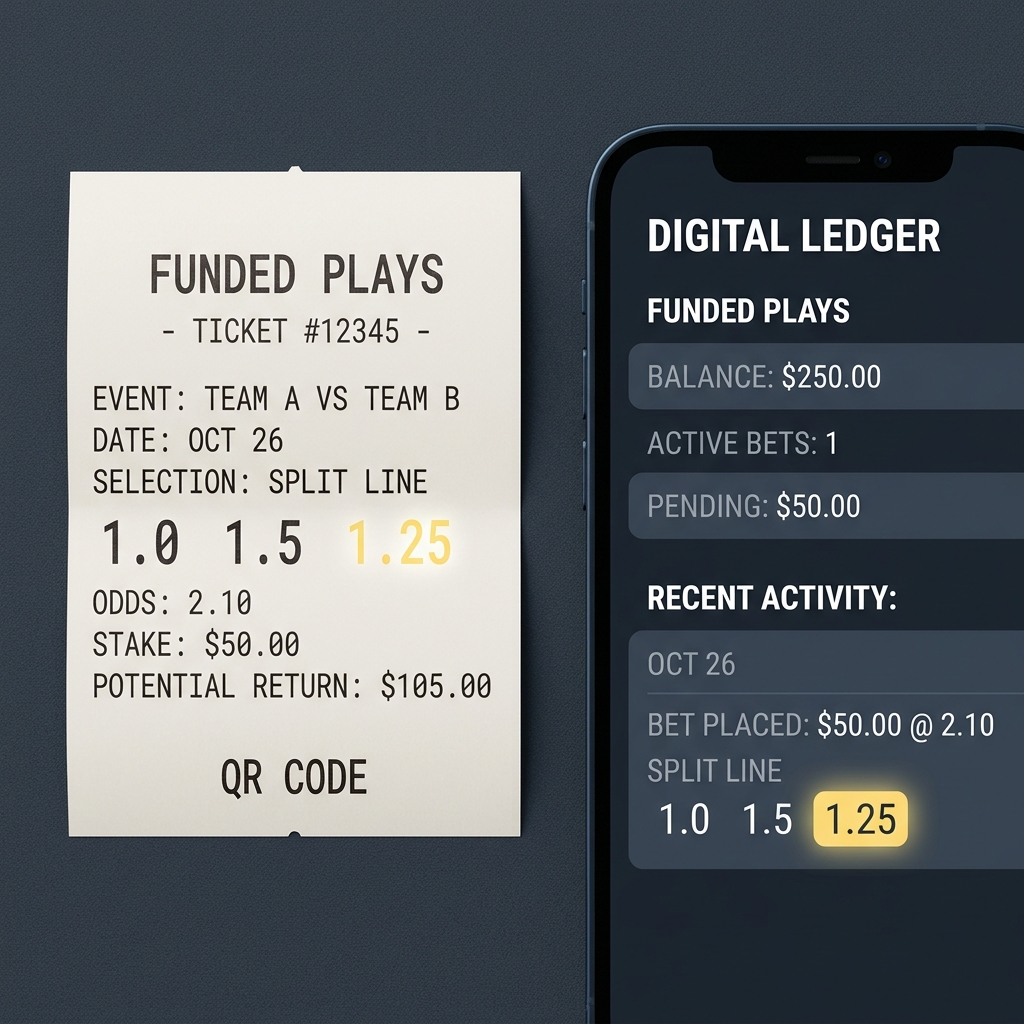
Worked example: Suppose you place a 10 unit bet at a price and the line is -1.25. The stake is split into two 5 unit parts. If the favourite wins 2-0 both parts win and you receive profit on the full 10 units. If the favourite wins 1-0 the -1.0 part pushes and the 5 unit stake is returned, while the -1.5 part loses and the 5 units are lost. Net effect: you get back 5 units and lose 5 units, recorded as a half loss.
Common full time scoreline examples and the exact result mapping
2-0 final score: Favourite at -1.25. Outcome: full win because the margin is two goals or more; both -1.0 and -1.5 parts win, returning full profit on the entire stake reference article.
1-0 final score: Favourite at -1.25. Outcome: half loss. The -1.0 part pushes and the -1.5 part loses. For an underdog at +1.25 the reverse applies: a one goal loss produces a half win because the +1.0 pushes and the +1.5 wins.
0-0 final score: Favourite at -1.25. Outcome: full loss for the favourite because both components lose. For the underdog at +1.25 a draw counts as a full win since both components succeed.
0-1 and 0-2 final scores: These follow the same logic mapped above: a one goal loss for the favourite is a half loss, a two goal loss is a full loss. Operator help pages commonly present compact tables mapping typical scorelines to these outcomes to make settlement transparent.
When traders and bettors prefer 1.25: practical strategy notes
Traders and bettors choose 1.25 when they want a middle ground between the single goal and one and a half goal lines. Because the stake is split, narrow one goal outcomes yield partial protection or partial return instead of an all or nothing result. That reduced variance can be useful when you expect a tight match but favour one side by a small margin reference article. See BettingUSA for a short explainer.

Common tactical uses include backing a slightly stronger favourite with the aim of avoiding a total loss on a one goal slip, or backing an underdog where a close defeat still produces a half win. The choice should be driven by implied value in the odds and the bettor's edge rather than a belief the split guarantees safety.
Bankroll and risk rules to use with quarter goal markets
When you record units and track performance, treat half wins and half losses as distinct events in your ledger: log the returned portion separately and record the net change for the winning or losing half. This clarity prevents unit-tracking errors that commonly happen when quarter markets are used regularly reference article.
Simple unit adjustment example: If your standard unit is 10 and you plan to use 1.25 frequently, expect that a one goal outcome will change your recorded units by half a unit's result. Plan staking so that repeated half losses do not breach your drawdown tolerance and keep clear records of each component result. See BettingUSA for further reading.

Maintain neat records and review performance over sets of bets rather than judging a single half result in isolation. Discipline and record keeping remain central even though quarter lines reduce variance on single events.
Typical errors and settlement pitfalls to avoid
Misreading the market period: A frequent error is assuming extra time counts when the market is full time only. Always read the market period label and any settlement notes on the market page before relying on a late goal to change the outcome official rules page.
Confusing quarter lines with whole number handicaps: Expecting a full win on a one goal margin is a common mistake. Remember that 1.25 is a split; on the favourite side a one goal win is a half loss, not a full win, because the -1 part pushes while the -1.5 part loses.
Reading operator notation incorrectly: Some platforms show the split explicitly as two lines, others display 1.25. If the operator uses -1.0 / -1.5 notation the settlement logic is identical but easier to trace on the ticket. If uncertain, consult the operator's help or rules section to confirm exact wording.
How different operators display and describe 1.25 markets
Operators may show the market as -1.25 or as a split like -1.0 / -1.5 on betting tickets and in bet histories. Either way the settlement mechanics are the same: the stake is divided 50/50 and each component is settled against its line. Most reputable operator help pages use the same settlement logic for quarter goals as of recent rule updates encyclopedia entry.
Because wording varies slightly between help centres, it is good practice to read the specific operator's settlement language and example tables before placing significant stakes. The underlying mechanics you need to rely on remain the same across platforms, but small wording differences can change how ledgers display results.
Two practical full examples: one first half market and one full time market
First half example: You back Team A at -1.25 in a first half market with a 1-0 half time score. Settlement for the first half uses the first half score only. The favourite at -1.25 has a one goal lead at half time, which settles as a half loss on that market because the -1 component pushes and the -1.5 component loses. The same match if settled as a full time market may produce a different result after a second half goal changes the margin official help centre rules.
Full time example: You back Team B at -1.25 in a full time market and the final score is 2-1. The favourite wins by one goal and the result maps to a half loss for the favourite: the -1 portion pushes and the -1.5 portion loses. For the underdog at +1.25 this same 2-1 final score yields a half win because the +1 component pushes and the +1.5 component wins.
A short decision framework: when to pick 1.25
Checklist item 1, expected margin: Choose 1.25 when you expect a one goal match is a realistic outcome but you favour one side slightly; the split provides partial protection against a single goal slip.
Checklist item 2, book odds: Compare the implied probability and potential payout across 1.0, 1.25 and 1.5 to ensure the 1.25 line offers value relative to your estimate of the true probability.
Checklist item 3, downside protection: Use 1.25 when you prefer reduced variance on narrow results and when half wins or half losses fit your unit tracking method.
Checklist item 4, unit fit: Adjust your unit size so that repeated half losses do not threaten your drawdown rules and keep records to monitor the strategy over time reference article.
Final takeaways and safe next steps
Takeaway 1: 1.25 is a quarter goal handicap that splits the stake evenly across adjacent lines, creating half-win and half-loss outcomes instead of a conventional draw outcome.
Takeaway 2: Settlement always follows the market period and excludes extra time unless the market explicitly states otherwise; read operator settlement language for clarity.
Takeaway 3: Practice the arithmetic of half wins and half losses in a ledger or a simulated account to confirm how returns appear on settlement ledgers before using larger units in live markets. Consistent record keeping and cautious unit sizing help turn the lower variance offered by quarter lines into a controlled approach rather than a false sense of security.
A one goal win for a favourite at -1.25 is a half loss: the -1.0 portion pushes and is returned, while the -1.5 portion loses and that half stake is lost.
No. Full time markets usually exclude extra time unless the market specifically states it includes extra time; settlement follows the stated market period.
Record each component separately: log the pushed portion as returned and the winning or losing portion as profit or loss, then compute the net effect for the bet.
References
- https://help.smarkets.com/hc/en-gb/articles/115003288009-Asian-handicap-betting-explained
- https://support.betfair.com/app/answers/detail/a_id/404/~/asian-handicap-(soccer)
- https://www.pinnacle.com/en/betting-resources/betting-strategy/asian-handicap-betting-explained
- https://help.matchbook.com/hc/en-gb/articles/360000672925-Asian-Handicap-Explained
- https://support.betfair.com/app/answers/detail/6418-exchange-what-is-asian-handicap-betting/
- https://www.actionnetwork.com/soccer/asian-handicap
- https://www.bettingusa.com/sports/soccer/asian-handicap/
- https://www.fundedplays.com/challenges
- https://www.fundedplays.com/blogs/how-fundedplays-evaluations-work
- https://www.fundedplays.com/blogs
- https://www.fundedplays.com
- https://help.bet365.com/en/rules/Rules-Sports/Rules-Soccer
- https://en.wikipedia.org/wiki/Asian_handicap