
Quick answer: what +200 means in plain terms (american odds to probability)
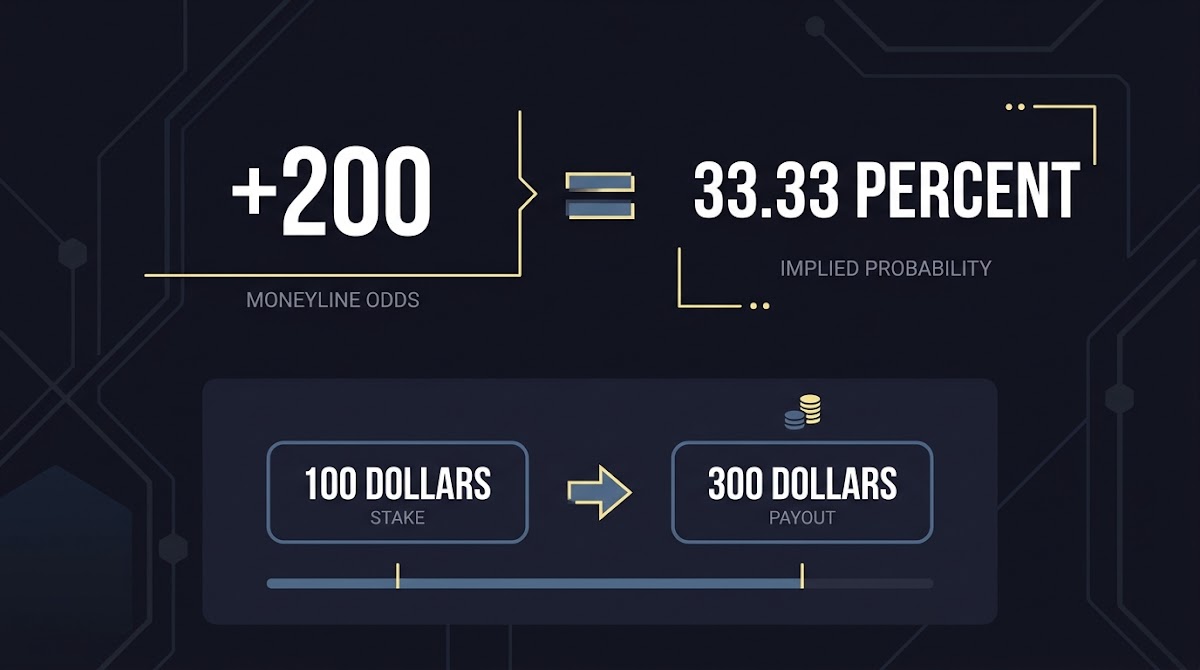
+200 is a positive American moneyline that marks an underdog price. Practically, a $100 stake at +200 returns $300 total if the selection wins, which is $200 net profit on top of your stake; this is the standard interpretation used in U.S. betting education and payout explanations DraftKings Sportsbook Education.
Convert a positive American moneyline to an implied probability with the formula implied probability = 100 / (O + 100). Plugging in O = 200 gives 100 / 300 = 0.3333, or 33.33 percent, which is the quick one-in-three rule of thumb many players use to check value Investopedia implied probability.
Practice converting lines and running simple payout checks
Try the worked examples below on real lines to build quick familiarity with the conversion and payout math.
Short numerical summary
The short numerical summary is simple: +200 => 33.33% implied probability and a $100 stake returns $300 total ($200 profit). Use the one-in-three shortcut to spot whether a price intuitively looks like value before you dig deeper.
Why this matters when assessing bets
Knowing the conversion and payout rules helps you compare your own probability estimate to the market, calculate break-even win rates, and size stakes rationally for longer-term performance. When you treat the market number as a price rather than a true probability, you can focus on edge and risk management rather than guesswork Action Network implied probability guide.
How American odds work: positive vs negative and the moneyline concept
American odds, often called moneyline odds, are the U.S. convention for expressing prices. Positive numbers show how much profit you would make on a $100 stake, while negative numbers show how much you must stake to win $100. This convention is described in standard industry glossaries and education material American Gaming Association glossary.
For example, a positive line like +200 is read as profit per $100 staked, and a negative line like -150 means you must stake $150 to win $100. The same numeric rules apply across major U.S.-facing educational materials, so learning one representation generalizes to most markets DraftKings Sportsbook Education.

Definition of American odds and moneyline
American odds encode the payout relationship directly, which makes mental payout checks quick: if you know the sign and the number you can immediately estimate profit and total return. That clarity is why moneyline formats remain common in U.S. markets and instruction.
When odds are shown as positive or negative
Positive means underdog; negative means favorite. This distinction helps when sizing stakes because the return profile and break-even thresholds differ by sign. For practical work, many players start by translating prices into implied probabilities before applying any model-based judgment American Gaming Association glossary.
Step-by-step: convert American odds to implied probability
Follow these steps to convert positive American odds to an implied probability. Step 1, identify O, the positive moneyline number. Step 2, compute 100 / (O + 100). Step 3, convert the decimal to a percentage by multiplying by 100. The formula and steps are standard and widely taught Investopedia implied probability (try the implied probability calculator Implied Probability Calculator).
Worked example converting +200. Start with O = 200. Compute O + 100 = 300. Then 100 / 300 = 0.3333. Multiply by 100 to get 33.33 percent. This algebraic route is the same method used in educational references and it generalizes to any positive moneyline Smarkets implied probability.
Convert +200 by using 100 / (200 + 100) to get 33.33 percent implied probability; compare this to your own estimate after removing bookmaker margin and size stakes according to your bankroll rules.
Fast mental checks and the one-in-three rule. For quickly checking a +200 price, remember one in three is the shorthand: 33.33 percent. That mental shortcut is reliable for quick screening but only applies to positive lines, not negative moneylines or fractional odds.
The formula for positive American odds
Restating the formula helps it stick: for positive American odds O, implied probability = 100 / (O + 100). Keep this on hand when you build spreadsheets or run quick manual checks; it is the basic conversion taught across betting education resources Investopedia implied probability.
Worked example converting +200
As another quick numeric check, if O = 300 then implied probability = 100 / 400 = 25 percent. The same arithmetic pattern applies: add 100 to O, divide 100 by that sum. Practicing with several O values trains your intuition for whether a line looks overpriced or underpriced when you later compare to your model.
Payout math: how profit and total return are calculated at +200
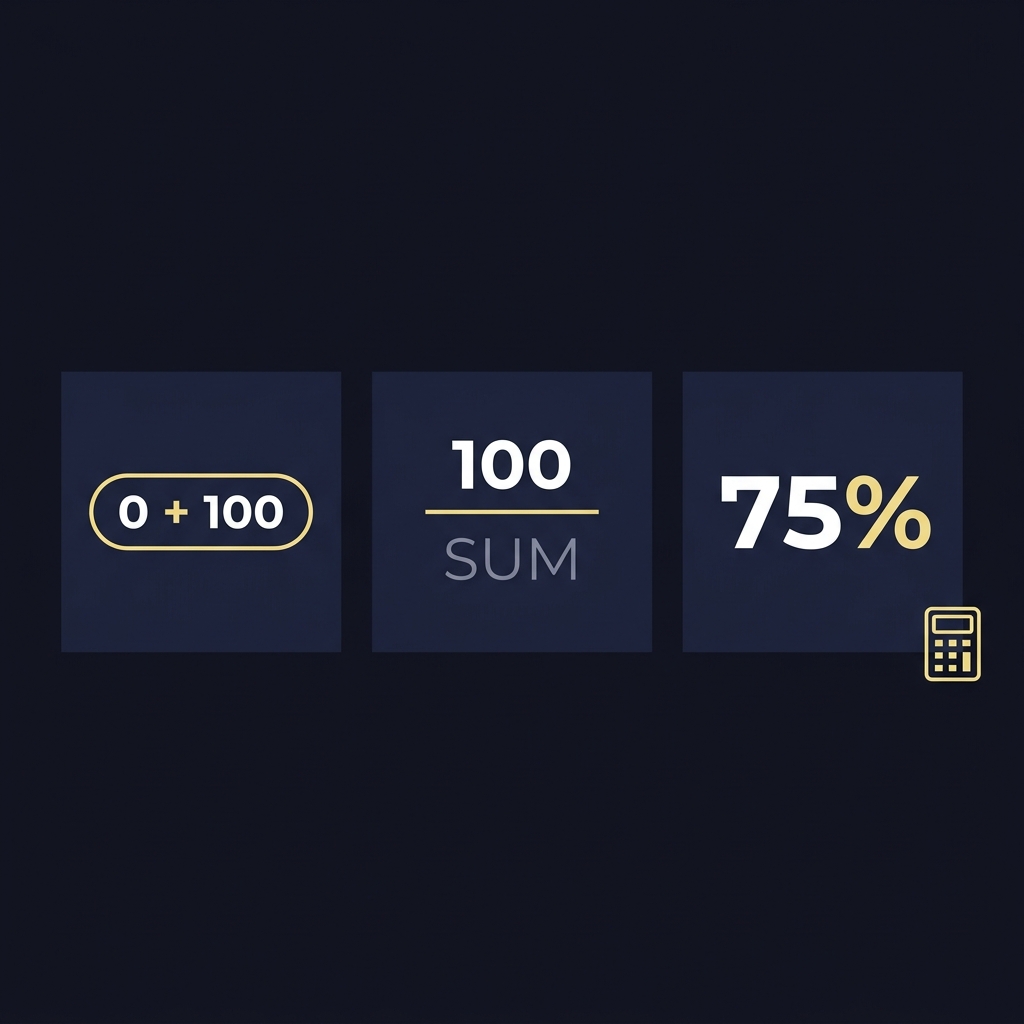
Example calculations. At +200 a $100 stake returns $300 total: profit = (200 / 100) * 100 = $200, total = $100 + $200 = $300. For a $50 stake profit = (200 / 100) * 50 = $100, and total payout = $150. Keep the profit formula handy when you size wagers and test stake plans against expected returns (or verify with an odds converter).
Profit formula for positive moneylines
Because profit scales linearly with stake for positive lines, you can build simple tables or a one-line spreadsheet to compute outcomes for any stake. This makes scenario planning quick and transparent when comparing alternative stake sizes.
Total payout examples with different stakes
Sample stakes at +200. $10 stake => profit $20, total $30. $50 stake => profit $100, total $150. $200 stake => profit $400, total $600. These examples illustrate the predictable scaling and help you plan exposure across multiple simultaneous positions DraftKings Sportsbook Education.
Break-even win rate and expected value at +200
The break-even win rate for a price equals its implied probability. That means at +200 the breakeven is about 33.33 percent; if your true win rate on identical +200 bets equals that number, long-run net outcome will break even before accounting for any bookmaker margin Action Network implied probability guide.
Connecting to expected value. Expected value compares your estimated true win probability to the implied probability. If your estimated win rate exceeds the implied probability you expect positive expected value, and if it is lower you expect negative value. Over small samples variance dominates, so expected value is a long-run concept, not a guarantee for any one bet Action Network implied probability guide (try calculators such as OddsJam).
compute break-even rate and expected value from odds and stake
Use the Edge output to guide stake sizing
Calculating the break-even rate
For +200 the algebra is simple: implied = 100 / (200 + 100) = 33.33 percent, and that is the break-even win rate. Use this as the baseline when you compare your model or read market-implied prices.
Connecting implied probability to long-run breakeven
Think of break-even as a long-run frequency. Over hundreds or thousands of independent bets, if your observed win fraction equals the implied probability your average profit per bet will approach zero; only consistent edges produce positive average returns over many trials Action Network implied probability guide.
Why bookmaker odds do not equal 'fair' probabilities: vig and overround
Bookmakers include a margin, often called vig or overround, so the sum of implied probabilities across all mutually exclusive outcomes typically exceeds 100 percent. That surplus is how the bookmaker builds in a long-term edge, and it means raw implied probabilities are not fair estimates of true outcome chances Pinnacle overround guide.
Simple two-outcome example. If two outcomes have implied probabilities of 52 percent and 52 percent the sum is 104 percent, leaving 4 percent as the bookmaker margin. The presence of that surplus explains why comparing your estimate to a single-market implied number is risky unless you first adjust for the overround Smarkets implied probability.
Definition of vig/overround
Vig is the built-in margin; overround is the arithmetic sum of implied probabilities across outcomes. Both terms describe the same practical effect: a market price that favors the book over the long run.
How the sum of implied probabilities exceeds 100%
Because each price reflects both chance and margin, adding them will usually produce a number above 100. That over-sum is the starting point for normalization methods that recover approximate no-vig probabilities for comparison to your model Pinnacle overround guide.
How to remove the vig and approximate no-vig (fair) probabilities
The common normalization method rescales each implied probability by dividing it by the market sum of implied probabilities, then multiplying by 100 to force the set back to 100 percent. This approach is standard and useful for getting a quick 'no-vig' approximation from quoted market prices Smarkets implied probability.
Worked numeric example normalizing a two-way market. Suppose outcomes A and B have moneylines that convert to implied probabilities 55 percent and 50 percent respectively. The sum is 105 percent. Normalize A: 55 / 105 = 0.5238 => 52.38 percent. Normalize B: 50 / 105 = 0.4762 => 47.62 percent. After normalization they sum to 100 percent and represent the market's relative opinion without the book's surplus Pinnacle overround guide.

Normalization method step-by-step
Steps to normalize: compute each outcome's implied probability; sum them to get the overround; divide each implied probability by the overround; convert to percent. That produces approximate no-vig probabilities you can compare to your internal estimates.
Worked example normalizing a two-way market
In practice, normalization assumes the market's relative pricing across outcomes is informative. It rescales the market-implied split but cannot correct systemic bias across all books; treat the result as an adjusted market-implied probability, not an absolute truth Smarkets implied probability.
Decision criteria: when +200 looks like value for your model
Compare your estimated true probability to the market's no-vig implied probability. If your estimate is meaningfully higher after normalization you may have a betting edge; if not, passing is usually the disciplined choice. The basic comparison between model estimate and implied probability is a core decision rule in betting education Investopedia implied probability.
Practical thresholds and risk tolerance. Many serious players require a margin of safety above the no-vig probability before staking, for example demanding a 5 percent relative edge or more depending on bankroll and volatility tolerance. Your required edge should reflect your stake sizing method and time horizon, and it should be recorded before placing the bet.
Compare your estimated probability to the no-vig market probability
To use the comparison: compute your best estimate, normalize market probabilities, then calculate edge = your estimate - no-vig probability. Positive edge suggests expected value, negative suggests avoid. Document the assumptions you used to arrive at your estimate and track outcomes to improve calibration over time.
Practical thresholds and risk tolerance
Decide in advance what margin of edge you need to act. Smaller perceived edges require conservative stakes and better record-keeping. When confidence is low, skip the bet despite an apparent numerical edge; discipline and consistent tracking are essential to long-term learning Action Network implied probability guide.
Typical mistakes and pitfalls when interpreting +200
Common error one: ignoring bookmaker margin. Using raw implied probabilities without removing the vig overstates the market's implied true chance, which can lead to overestimating your edge and to poor staking decisions Pinnacle overround guide.
Common error two: misreading payout versus profit. Remember that total payout includes your stake; confusing total payout with net profit inflates your sense of return. For +200 a $100 total return is not profit; profit is $200 and total paid back is $300 on a winning $100 bet DraftKings Sportsbook Education.
Common error three: small-sample thinking. Expect variance. Short sequences of identical bets can deviate substantially from long-run expectations; base decisions on expected value and proper bankroll sizing rather than short-term streaks Action Network implied probability guide.
Ignoring bookmaker margin
Treating market prices as fair probabilities without normalization is the textbook mistake. Always normalize before comparing to your model to avoid false positives on value bets.
Misreading payout vs profit
When you read odds quickly, mark whether figures represent profit or total payout. Writing out the profit formula once and checking a sample bet clears up most confusion.
Practical scenarios: examples with single bets, sequences, and bankroll impact

Series example and expected outcomes. If you place 300 identical bets at +200 and your true win rate equals the implied 33.33 percent, you expect roughly 100 wins and 200 losses, leaving your net expected profit around zero before costs. This is why break-even thinking is tied to frequency and sample size Investopedia implied probability.
Single-bet example with stake choices
Working through single bets clarifies risk exposure. A small-stake strategy reduces variance but also reduces upside per winning bet. Decide stake sizes according to bankroll rules rather than wishful thinking.
Series of bets and expected outcomes over time
Because variance causes wide swings in the short term, use realistic simulations or a simple spreadsheet to project likely drawdowns and required bankroll to survive sequences of bad luck.
A simple framework: step-by-step checklist to evaluate a +200 line
Here is a compact five-step workflow you can follow whenever you see a +200 line: 1) Estimate the true probability using your model or research. 2) Convert the quoted American odds to implied probabilities. 3) Normalize across the market to remove vig. 4) Compare your estimate to the no-vig probability and compute edge. 5) Size the bet per your bankroll plan or skip if confidence is low Smarkets implied probability. Find relevant resources on the Funded Plays homepage.
Documenting and tracking. Keep a short ledger of each decision and outcome so you can measure calibration over time. Repeat the checklist and update your required edge thresholds as your results and confidence evolve. See how Funded Plays evaluations work.
Estimate true probability
Start with your best available information and be honest about uncertainty. High uncertainty should lower stake size or eliminate action even if the raw math shows a small edge.
Convert/normalize market odds
Use the conversion formula and then normalize to derive the no-vig probability. Doing both steps consistently keeps comparisons apples-to-apples across markets.
Advanced considerations: multi-book aggregation and dynamic margins
Checking multiple books can improve your estimate of fair odds because one book's margin or relative pricing may differ from another. Aggregation helps if you handle differing vig levels correctly, but it adds complexity because each book may price relative risk differently Pinnacle overround guide.
Live markets and shifting margins. In-play pricing and changing liquidity make no-vig estimation harder, since margins can widen or narrow during an event. For live work, frequent data sampling and conservative adjustments for dynamic vig tend to produce more stable estimates Smarkets implied probability.
Why checking multiple books can change no-vig estimates
Different books may disagree on relative probabilities and margin, so aggregating helps reveal consensus, but you must normalize each book or normalize the aggregated implied probabilities carefully.
How live markets and shifting margins complicate fair-probability estimates
Be cautious in live markets. Rapid price moves can reflect new information, liquidity shifts, or temporary imbalances; treat those moves as signals to reassess, not automatic value opportunities.
Conclusion: key takeaways and next steps
Key takeaways: +200 implies a 33.33 percent chance and a $100 stake returns $300 total ($200 net profit) if the selection wins. Use the conversion formula 100 / (O + 100) to compute implied probabilities for positive moneylines and the profit formula (O / 100) times stake to compute returns Investopedia implied probability.
Remember to remove the vig before comparing market probabilities to your internal estimate, and follow disciplined bankroll rules when sizing bets. Practicing conversions, tracking outcomes, and checking multiple books over time are practical next steps for improving calibration and decision-making Pinnacle overround guide. See the Funded Plays blog for more reading.
Three quick reminders to keep in mind
First, +200 is a one-in-three shortcut for quick checks. Second, always normalize market probabilities to remove vig. Third, treat expected value as a long-run concept and size stakes accordingly.
Recommended next actions for readers
Practice the formula on a few live lines, build a simple spreadsheet to track implied probabilities and normalized numbers, and consider checking several market sources to refine your no-vig estimates.
Use the formula 100 / (O + 100) for positive American odds; for +200 that equals 100 / 300 = 33.33 percent.
Not necessarily; implied probability reflects the market price and includes bookmaker margin, so you should normalize to approximate a fair probability before comparing to your own estimate.
Profit for positive lines is (O / 100) times your stake, and total payout is stake plus profit, so $50 at +200 pays $150 total ($100 net profit).
References
- https://sportsbook.draftkings.com/how-to-bet/odds-explained
- https://www.investopedia.com/terms/i/implied-probability.asp
- https://www.actionnetwork.com/education/implied-probability
- https://www.americangaming.org/resource/sports-betting-glossary/
- https://help.smarkets.com/hc/en-gb/articles/360000109638-Implied-probability
- https://www.pinnacle.com/en/betting-resources/educational/what-is-overround
- https://www.fundedplays.com/challenges
- https://www.omnicalculator.com/statistics/implied-probability
- https://www.aceodds.com/bet-calculator/odds-converter.html
- https://oddsjam.com/betting-calculators/implied-probability
- https://www.fundedplays.com
- https://www.fundedplays.com/blogs
- https://www.fundedplays.com/blogs/how-fundedplays-evaluations-work