
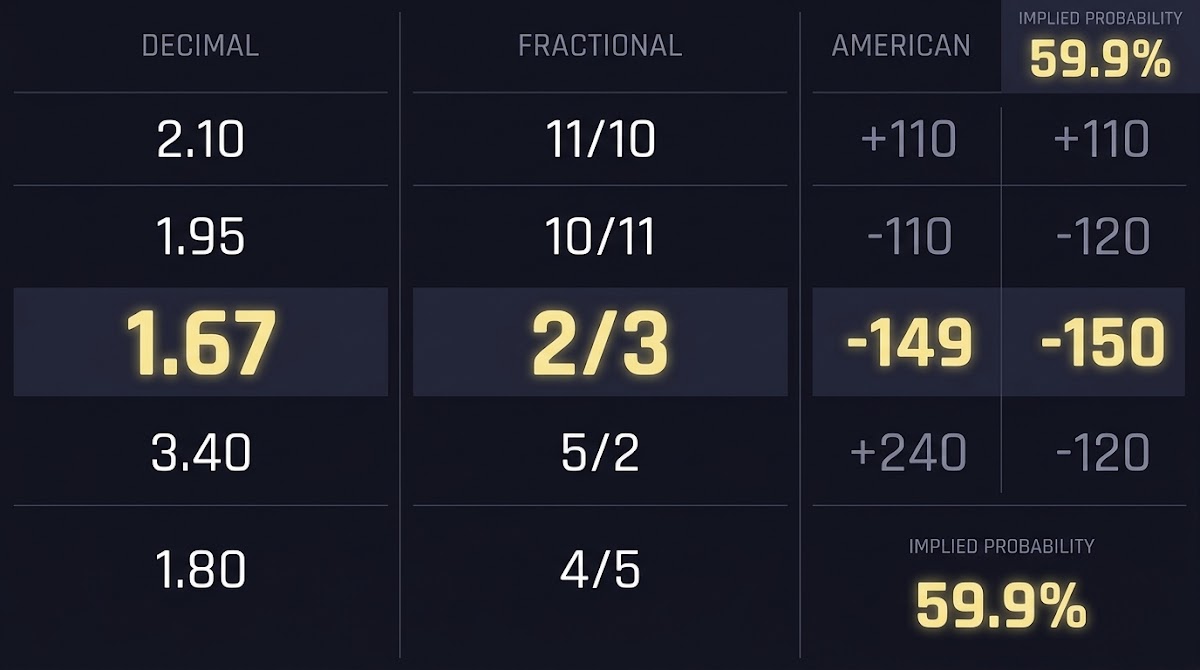
Quick answer: what 1.67 means and how to read it using american odds to probability
Decimal odds of 1.67 imply an underlying probability of 1 / 1.67, which is about 59.88% (commonly rounded to 59.9%). In American moneyline terms that decimal maps to a negative line near -149.25, typically displayed as -149 or -150, so you will usually see a moneyline around -149 to -150 for a 1.67 price, reflecting roughly a 59.9% implied chance Investopedia implied probability.
Practice conversions and sharpen your probability thinking
Read on for the exact formulas, worked calculations, and simple checks you can use in your own analysis.
american odds to probability: how decimal odds encode probability and the basic formula
Decimal odds are a compact way to show how much is returned for each unit staked; they include the original stake in the quoted number, so a decimal must always be greater than 1.00 and values close to 1 indicate very high implied probabilities Wikipedia sports betting overview.
The canonical conversion from decimal odds to implied probability is p = 1 / d. Applying that to d = 1.67 gives p = 1 / 1.67 ≈ 0.5988, or about 59.9% when rounded to one decimal place, which is the standard way to read a single-line implied probability Investopedia implied probability.
Convert 1.67 to American odds step by step and place in the american odds to probability context
When a decimal price is below 2.00 the American (moneyline) equivalent is negative. The standard algebraic conversion for decimal values under 2.00 is A = -100 / (d - 1). This formula produces the moneyline that sportsbooks typically display for favorites Investopedia moneyline definition.
Use p = 1 / 1.67 to get the implied probability (about 59.9%). Then compute A = -100 / (1.67 - 1) to get the American moneyline (about -149.25), which is usually shown as -149 or -150 after rounding.
Using the formula with d = 1.67 gives A = -100 / (1.67 - 1) = -100 / 0.67 = -149.25. Operators usually round that value when they show it, so you will commonly see -149 or -150 for the same underlying decimal price; that rounded moneyline is what appears in markets and on price boards Pinnacle odds formats explained.
How to compute implied probability from a negative American line and back again
The formula for implied probability from a negative American moneyline A is p = |A| / (|A| + 100). This converts a displayed negative line into the equivalent implied probability percentage so you can compare it directly to decimal-based values Action Network implied probability guide.
Apply that to -149: p = 149 / (149 + 100) ≈ 149 / 249 ≈ 0.5984, which rounds to about 59.9%. For -150 the same formula gives 150 / 250 = 0.60, or 60.0%. Those small differences come solely from rounding the moneyline display, not from any change in the underlying decimal calculation Investopedia implied probability.
Rounding, display conventions and practical interpretation for users
Bookmakers typically present moneyline odds as whole integers for readability, so exact algebraic conversions that yield fractional moneyline values are rounded to the nearest whole number or to a conventional step; that is why an exact conversion like -149.25 is shown as -149 or -150 in practice Investopedia moneyline definition.


How decimal, fractional and American formats are equivalent
Decimal, fractional and American odds are simply different representations of the same underlying expected return and therefore the same implied probability; you can move between them deterministically using short conversion rules and the conversions will preserve the probability interpretation Wikipedia sports betting overview.
For a compact conversion example: 1.67 in decimal corresponds to a fractional profit of roughly 67/100 (often written as 2/3 in simplified fractional terms where practical precision allows) and to a negative moneyline around -149 to -150 when displayed; remember decimal odds include the stake while fractional quotes typically show profit relative to stake Pinnacle odds formats explained.
Common mistakes and pitfalls when converting odds
A frequent error is to forget that decimal odds include the stake; treating a decimal as if it were profit-only will produce an incorrect implied probability or an incorrect fractional conversion, so always check whether a quoted number is decimal or fractional before you compute Investopedia implied probability.
quick decimal to American and probability converter
Copy formula into a spreadsheet
Another common mistake is sign or absolute-value errors when using moneyline formulas; remember to use the absolute value of a negative line in p = |A| / (|A| + 100) and to expect negative signs only when decimals are below 2.00. Also watch for mixing up rounded display figures with the underlying decimal when you recompute probabilities free betting odds calculator.

Bookmaker margin, often called the overround, means the sum of implied probabilities across all outcomes in a market can exceed 100%. That is a market structure feature rather than a failure of the single-line conversion formulas, which remain valid for reading any one displayed price Investopedia implied probability.
If you compare multiple outcomes or look for value, you may optionally adjust for overround to estimate a fair implied distribution across outcomes. For single-line interpretation, however, use the standard conversions (p = 1/d or the moneyline formula) and treat overround as a separate adjustment step when aggregating across a market Wikipedia sports betting overview.
Practical examples and scenarios using 1.67
Example 1, single-line interpretation: start with d = 1.67, compute p = 1 / 1.67 ≈ 59.88% and then convert to the moneyline using A = -100 / (d - 1) to get -149.25. When displayed and rounded this shows up as -149 or -150 and so you read the market as roughly a 59.9% chance Investopedia implied probability (try an odds converter: aceodds odds converter).
Example 2, quick market comparison: if a competing line shows -150 instead of -149 for the same event the displayed implied probability is 60.0% versus about 59.9%. That 0.1 percentage point difference is caused by rounding and should be weighed against transaction costs, liquidity, or the margin in your model before treating it as a meaningful edge Action Network implied probability guide.
A quick conversion cheat sheet and formulas to copy
Core formulas to keep: p = 1 / d for decimal to implied probability, A = -100 / (d - 1) when d < 2.00 for decimal to American, and for negative A use p = |A| / (|A| + 100) to go back to probability. These are the steps to move cleanly between the three common formats Pinnacle odds formats explained.
Quick two-step method: compute p = 1 / d, then if you need an American display calculate A according to the sign rule (negative for d < 2.00). Sanity check by converting your displayed moneyline back to p using p = |A| / (|A| + 100) and confirm you get the original p within rounding tolerance oddsjam odds converter.
Rounding checks and quick troubleshooting
If you see a larger mismatch than a few tenths of a percent check whether the market includes overround, whether the bookmaker uses nonstandard rounding steps, or whether you have mistakenly treated a fractional or American quote as a decimal; showing intermediate values reduces these mistakes.
Conclusion and recommended next steps for readers
Summary: 1.67 decimal corresponds to an implied probability of about 59.9% and converts algebraically to -149.25, which is commonly displayed as -149 or -150; the small difference between -149 and -150 is solely a rounding artifact and represents roughly a 0.1 percentage point change in displayed probability.
Next steps: practice the cheat sheet conversions on a few other decimals, keep the three sanity checks handy when you compute prices, and remember that platforms like FundedPlays value consistent, repeatable probability thinking as part of disciplined prediction and challenge work. Also try practicing the conversions on our blog for more examples.
Divide 1 by the decimal odds: p = 1 / d. For 1.67 that yields about 59.9%.
Because decimals below 2.00 correspond to favorites; the standard conversion A = -100 / (d - 1) produces a negative moneyline for those prices.
No, rounding changes only the displayed line and the rounded displayed percent; the underlying decimal calculation remains the accurate representation of implied probability.
References
- https://www.investopedia.com/terms/i/implied-probability.asp
- https://en.wikipedia.org/wiki/Sports_betting
- https://www.investopedia.com/terms/m/moneyline.asp
- https://www.pinnacle.com/en/betting-resources/educational-resources/odds-formats-explained
- https://www.actionnetwork.com/education/implied-probability
- https://www.fundedplays.com/challenges
- https://www.covers.com/tools/odds-converter
- https://www.aceodds.com/bet-calculator/odds-converter.html
- https://oddsjam.com/betting-calculators/odds-converter
- https://www.fundedplays.com
- https://www.fundedplays.com/blogs/how-fundedplays-evaluations-work
- https://www.fundedplays.com/blogs