
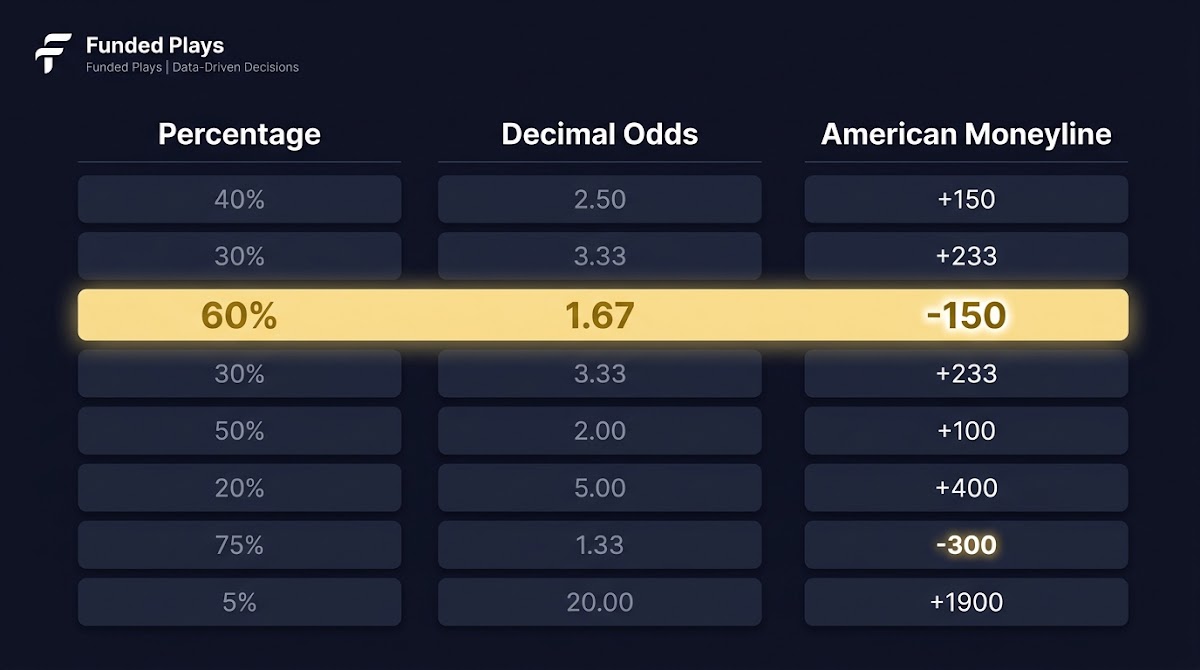
Quick answer: what does 60 percent mean in American odds?
Short summary: 60 percent implied probability converts to -150 on the American moneyline, which means a quoted price where the favorite is shown with a negative number and a bettor would need to risk 150 to win 100 on that outcome. This direct conversion follows the standard odds-to-probability math used in betting education and calculators Pinnacle Betting Resources.

Short summary
One-line conversion result: 60% equals -150. That is the quick, unambiguous answer readers often want when scanning markets or comparing implied prices across formats.
One-line conversion result
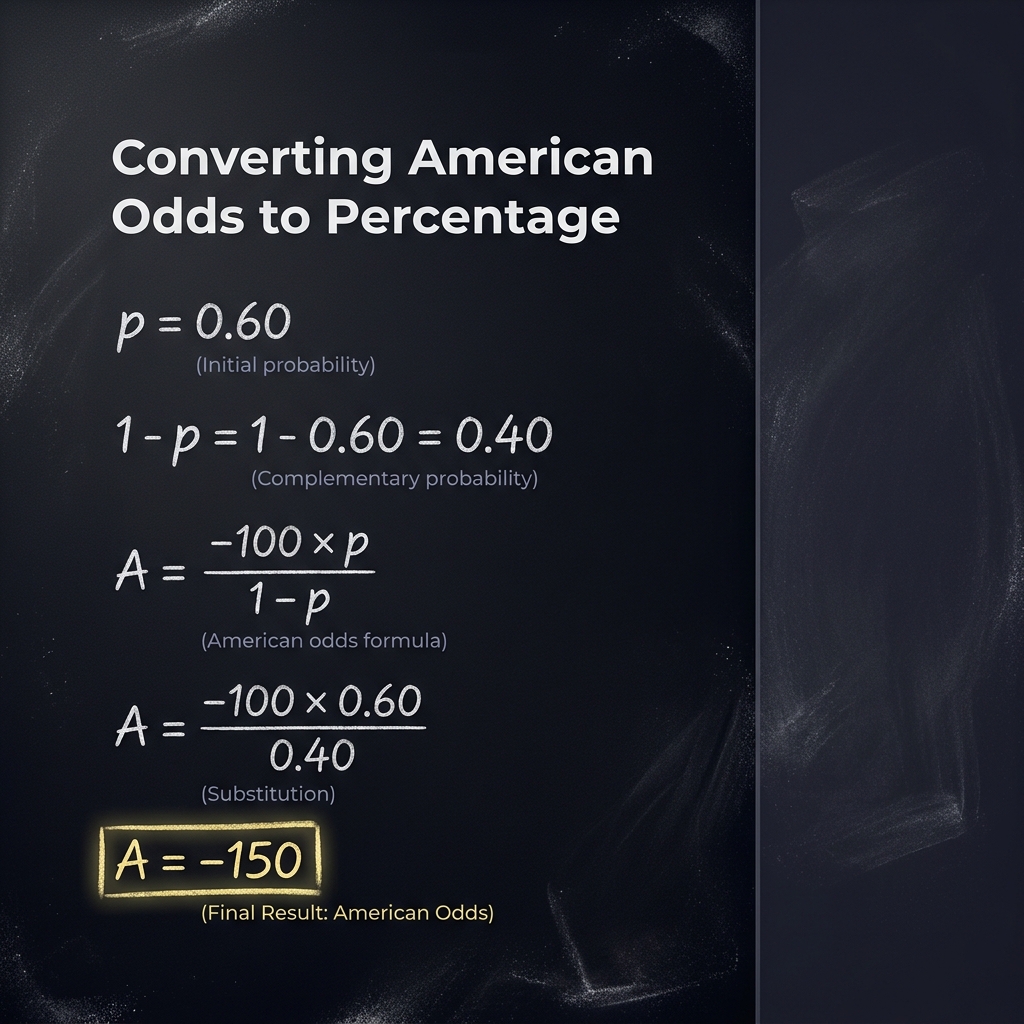
Keep in mind this -150 figure is an implied probability, not a promise that an outcome will occur, and it is shown here so you can compare market prices or plug values into calculators later in the article.
How American moneyline odds work: positive vs negative prices
Sign convention: favorites versus underdogs
In U.S. moneyline notation negative numbers indicate favorites and positive numbers indicate underdogs; even money is commonly shown as +100 in U.S. contexts. Understanding the sign convention is the first step before converting percentages to American odds Moneyline (Wikipedia).
Think of the sign as a simple label: a negative sign shows how much you must risk to win 100, and a positive sign shows how much you would win if you risk 100. This framing helps when you read quotes on a board or compare prices across formats.
Even money and U.S. notation
Even money in many U.S. displays appears as +100, which is useful to remember when you translate percentages near 50 percent into moneyline terms. This notation is standard across most American-facing educational material and market displays Implied Probability: definition and formula (Investopedia).
When you see +100 on a board, interpret it as 50 percent implied probability on its face, before accounting for any bookmaker margin that might be embedded in the market.
Direct formula: converting a percentage into American odds
Formulas for positive and negative American odds
There are standard formulas that link American odds and implied probability. For positive American odds A the implied probability is p = 100 / (A + 100). For negative American odds A the implied probability is p = (-A) / ((-A) + 100). These formulas are the basis for most odds calculators and instructional guides Pinnacle Betting Resources.
Follow these steps to invert the relationship and solve for A when you know p. The inversion differs depending on whether p is greater or less than 0.5, because that determines whether the American odds should be shown as a negative favorite price or a positive underdog price.
Explore skill-based prediction challenges
Try the worked example below to confirm the algebra and see the same result using a decimal-odds check.
Algebraic inversion that gives A from p
When p is greater than 0.5 the American odds A are negative and the inverted formula is A = -100 * p / (1 - p). This algebraic step isolates A on one side and produces the negative number that marks a favorite in U.S. notation. The relationship and inversion are part of standard betting mathematics Implied probability calculator and how to calculate (The Action Network).
Apply the formula directly with p expressed as a decimal (for example p = 0.60 for 60 percent). The negative sign appears because the formula solves for a moneyline price that represents a favorite when p exceeds 50 percent.
Decimal route: convert percentage via decimal odds
Decimal odds basics and relation to probability
For p = 0.60 the decimal d equals 1 / 0.60 = 1.6667, which you can then convert into an American price using the decimal-to-American rules described below.
Decimal odds give another, often simpler route for conversion: p = 1 / d, where d is the decimal price. Convert the percentage to a decimal probability first and then invert to find d. This path is commonly used in calculators and international guides Moneyline (Wikipedia).
Convert decimal to American for d < 2.0 and d > 2.0
When decimal odds d are below 2.0 the equivalent American favorite price is A = -100 / (d - 1). For decimals above 2.0 the conversion produces a positive underdog price using A = 100 * (d - 1). These formulas are the standard conversion rules used across betting education materials Betfair Betting Guide.
Applying the formula with d = 1.6667 gives A = -100 / (1.6667 - 1) = -150, matching the direct formula result and providing a simple cross-check when you use a decimal-format calculator such as AceOdds.
Why 60 percent equals -150: an illustrated step-by-step example
Plugging numbers into the direct formula
Worked example, direct formula route:
1) Write the probability as a decimal: p = 60 percent = 0.60.
2) Use the inversion for favorites: A = -100 * p / (1 - p).
3) Substitute p: A = -100 * 0.60 / (1 - 0.60) = -60 / 0.40 = -150. Each intermediate step follows directly from the algebraic inversion and produces the moneyline price for a 60 percent implied probability Pinnacle Betting Resources.
Convert 60 percent to a decimal probability (0.60), use the inversion A = -100*p/(1-p) which yields -150, and understand this is an implied market price that includes bookmaker margin rather than a guaranteed probability.
Cross-check using the decimal route to verify the result: convert p = 0.60 into d = 1.6667, then apply A = -100 / (d - 1) to get -150, confirming the direct formula.
Cross-check with decimal conversion and a quick chart lookup
Both routes give the same numeric outcome. Reference guides and common conversion charts also list -150 as the American odds equivalent of 60 percent, while mapping +150 to 40 percent, which provides an easy way to confirm conversions without redoing algebra each time Implied probability calculator and how to calculate (The Action Network).
Use either the algebraic steps or the decimal cross-check depending on which format you encounter first; both are standard and interoperable across calculators and educational materials.
Implied probability, bookmaker margin and what the conversion actually means
Difference between implied and true probability
Important caveat: implied probability is the market price expressed as a probability; it reflects how the book prices an event and does not necessarily equal the event's true win probability. This distinction is central when you interpret any conversion from percentage to moneyline Implied Probability: definition and formula (Investopedia).
Bookmakers typically include a margin, or vig, so quoted odds embed that margin; removing vig changes the implied win rates you would use to compare fair value or build a model.
Remove bookmaker margin from two implied probabilities
Use to estimate fair probabilities
How the vig affects break-even and market prices
When a market lists -150 as the moneyline for an outcome it implies about a 60 percent chance before removing vig, but the real break-even for a bettor depends on how much margin the book embeds across the market and how you allocate that margin between outcomes Pinnacle Betting Resources.
In practice you may see two or more markets with the same -150 quote but different implied value after margin removal; that is why experienced users check for overround and use margin-removal methods before treating implied probability as a model input.
Common mistakes and pitfalls when converting percentages to moneyline
Sign errors and formula misuse
Frequent mistakes include using the wrong formula for the sign you need, treating p as a percentage rather than a decimal in the algebra, and accidentally swapping the positive and negative cases when inverting. These are the typical calculation errors students make when they first learn the conversions Understanding implied probability (Smarkets Help Centre).
Correcting these errors is usually straightforward: convert the percentage to a decimal, pick the correct inversion based on whether p is above or below 0.5, and keep track of the negative sign for favorites.
Forgetting the vig and rounding mistakes
Another common pitfall is rounding too early. For example, rounding decimal odds before converting to American can produce slightly different moneyline numbers; do your rounding at the end or use a calculator for precise work.
Also remember that implied probability is a price signal, not a guarantee of outcome. Ignoring vig when comparing to a model's true probability can lead to mistaken betting decisions.
Practical examples and a quick reference chart
Common percentage to American mappings
Simple reference mappings used widely include: -150 = 60 percent, +150 = 40 percent, -200 = 66.7 percent, and +200 = 33.3 percent. These entries match standard conversion charts and serve as quick checks when scanning markets Implied probability calculator and how to calculate (The Action Network).

Having a short mental chart or pocket reference speeds up checks and helps you decide whether to run a more precise calculation for value or arbitrage opportunities. Learn more about how our evaluations work on the Funded Plays blog.
How to check conversions with calculators or simple mental arithmetic
To check conversions quickly without a dedicated tool convert the percent to a decimal and do a 1 divided by that decimal to get decimal odds, then apply the decimal-to-American rule. For p = 60 percent, d = 1.6667 and the favorite price is -150, which you can calculate mentally with a little practice or verify with a calculator such as Covers.
When you need high precision use a reputable online calculator or a spreadsheet with the formulas shown earlier; that avoids rounding drift and keeps your model inputs consistent across markets. See our blog for tips, or try online tools like OmniCalculator.
Bottom line: using the conversion responsibly
Short recap
Takeaway: 60 percent converts to -150 on the American moneyline using standard formulas. That is the quick conversion you can use to compare prices across formats or to express model outputs in a market-friendly way Pinnacle Betting Resources.
Practical next steps: always check the market vig, use precise calculators for model inputs, and practice the decimal cross-check so you can verify conversions quickly when reviewing lines. Visit Funded Plays for more resources.
Convert 60% to a decimal probability (0.60), use A = -100*p/(1-p) for p > 0.5 to get -150, or go via decimal odds: d = 1/0.60 = 1.6667 and A = -100/(d-1).
No. -150 represents the market implied probability around 60 percent; bookmaker margin means true probability may differ and should be estimated after removing vig.
Yes. Removing vig gives a cleaner comparison between your model's probability and the market-implied probability before deciding on value.
References
- https://www.pinnacle.com/en/betting-articles/betting-strategy/how-to-calculate-betting-odds-and-probability/GRNJE3JV92C9W3JV
- https://en.wikipedia.org/wiki/Moneyline
- https://www.investopedia.com/terms/i/implied-probability.asp
- https://www.actionnetwork.com/education/implied-probability-betting
- https://betting.betfair.com/betting-guides/betting-odds-explained-what-do-odds-mean-070115-679.html
- https://www.aceodds.com/bet-calculator/odds-converter.html
- https://www.fundedplays.com/challenges
- https://help.smarkets.com/hc/en-gb/articles/213146885-Understanding-implied-probability
- https://www.fundedplays.com
- https://www.fundedplays.com/blogs
- https://www.fundedplays.com/blogs/how-fundedplays-evaluations-work
- https://www.covers.com/tools/odds-converter
- https://www.omnicalculator.com/statistics/implied-probability