
Quick answer: what 40% means in American odds
One-line conversion
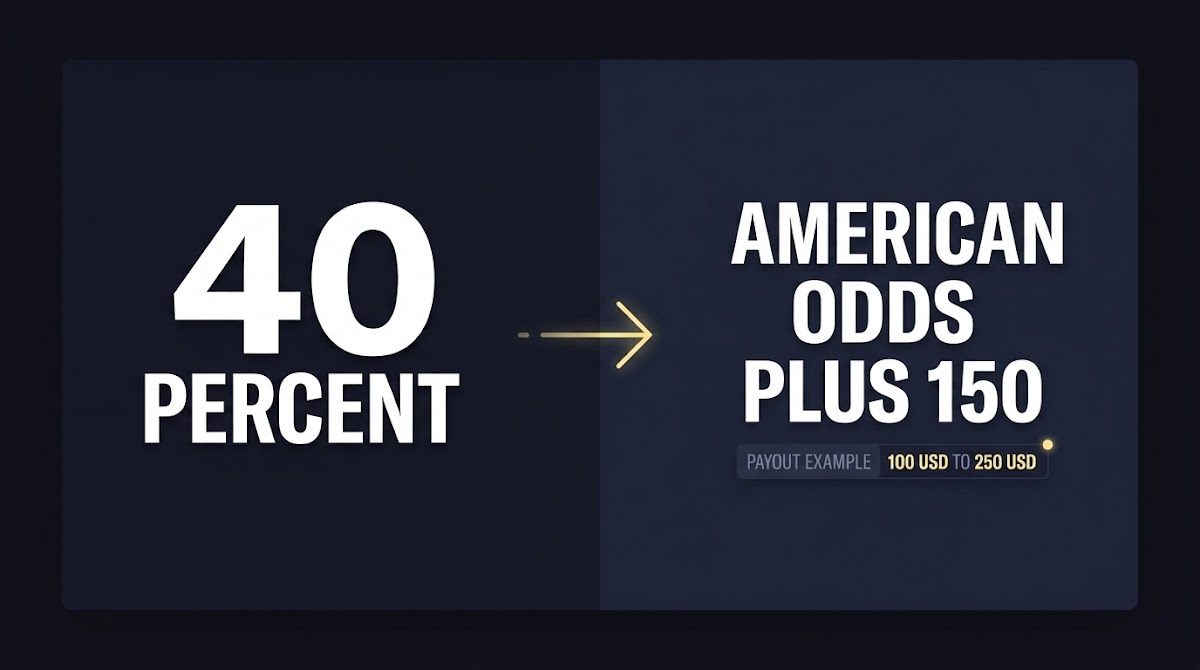
Forty percent implied probability converts to American odds of +150 using the standard positive-odds formula; at +150 a $100 stake wins $150 profit, returning $250 total.
This is the margin-free conversion, which shows the fair implied probability derived from the math rather than the price you might see after a bookmaker adds margin.
Why this matters for reading lines
Knowing that 40% is +150 helps you read moneyline displays and compare model probabilities with market prices, which is useful when you evaluate whether a posted line offers value or reflects bookmaker margin.
Try converting a probability to odds in a FundedPlays challenge
Try the short worked example above yourself: turn 40% into a decimal, apply the formula, and check the payout to confirm you get +150 and a $150 profit on a $100 stake.
What are American (moneyline) odds?
Definition and common U.S. usage
American odds, often called moneyline odds in U.S. contexts, are a way sportsbooks and educational resources display how much you win relative to your stake; they remain the standard odds format used widely in the United States for single-game and event pricing, and many explainers show the same conversion relationships used here Investopedia implied probability guide.
In practice, American odds are one of three common display formats alongside decimal and fractional odds; converters and calculators let you switch between formats quickly when needed.

Positive versus negative odds explained
Positive American odds, written with a plus sign like +150, indicate how much profit you earn on a $100 stake; negative odds, written with a minus sign like -150, indicate how much you must stake to win $100. This sign and stake convention is the key to interpreting payouts at a glance.
American odds are directly linked to implied probability by simple formulas, so learning those formulas will let you translate odds to percent and percent to odds without guesswork.
The exact formula: converting percentages to American odds
Formula when probability is below 50 percent
For probabilities under 50 percent the positive-odds formula is: odds = +[100 × (1 − p) / p]. This standard formula appears in educational material and odds calculators and is the correct way to get American odds from a margin-free probability Action Network odds conversion. You can also consult calculators such as TheRundown's odds converter for quick checks.
Formula when probability is above 50 percent
When the probability exceeds 50 percent, the negative-odds formula applies: odds = −[100 × p / (1 − p)]. Both formulas are algebraically consistent and together cover the full probability range from 0 to 100 percent.
Worked example for 40 percent
Apply the positive-odds formula to p = 0.40: compute 100 × (1 − 0.40) ÷ 0.40 = 100 × 0.60 ÷ 0.40 = 150, so the American odds are +150. This is the direct conversion from percentage to American odds used in calculators and reference material DraftKings odds explainer.
To confirm, use the inverse relation for positive odds: p = 100 ÷ (odds + 100). Plugging odds = 150 gives p = 100 ÷ (150 + 100) = 100 ÷ 250 = 0.40 or 40 percent, which verifies the arithmetic and shows the forward and inverse formulas match.
Convert 40% to decimal p = 0.40, apply odds = +[100*(1-p)/p] to get +150, which means a $100 stake wins $150 profit for $250 total; verify with p = 100/(odds+100).
Step-by-step: convert 40% to American odds by hand
Step 1: express the percentage as decimal probability
Convert 40% into decimal form as p = 0.40. Writing percentages as decimals is the first step for any formula-based conversion and keeps arithmetic straightforward.
Step 2: apply the positive-odds formula
Use odds = +[100 × (1 − p) / p]. With p = 0.40 the numerator is 100 × 0.60 = 60 and dividing by 0.40 yields 150, so the result is +150. Keep the plus sign when the probability is under 50 percent to indicate the profit-on-100 convention.
Step 3: validate with the inverse formula
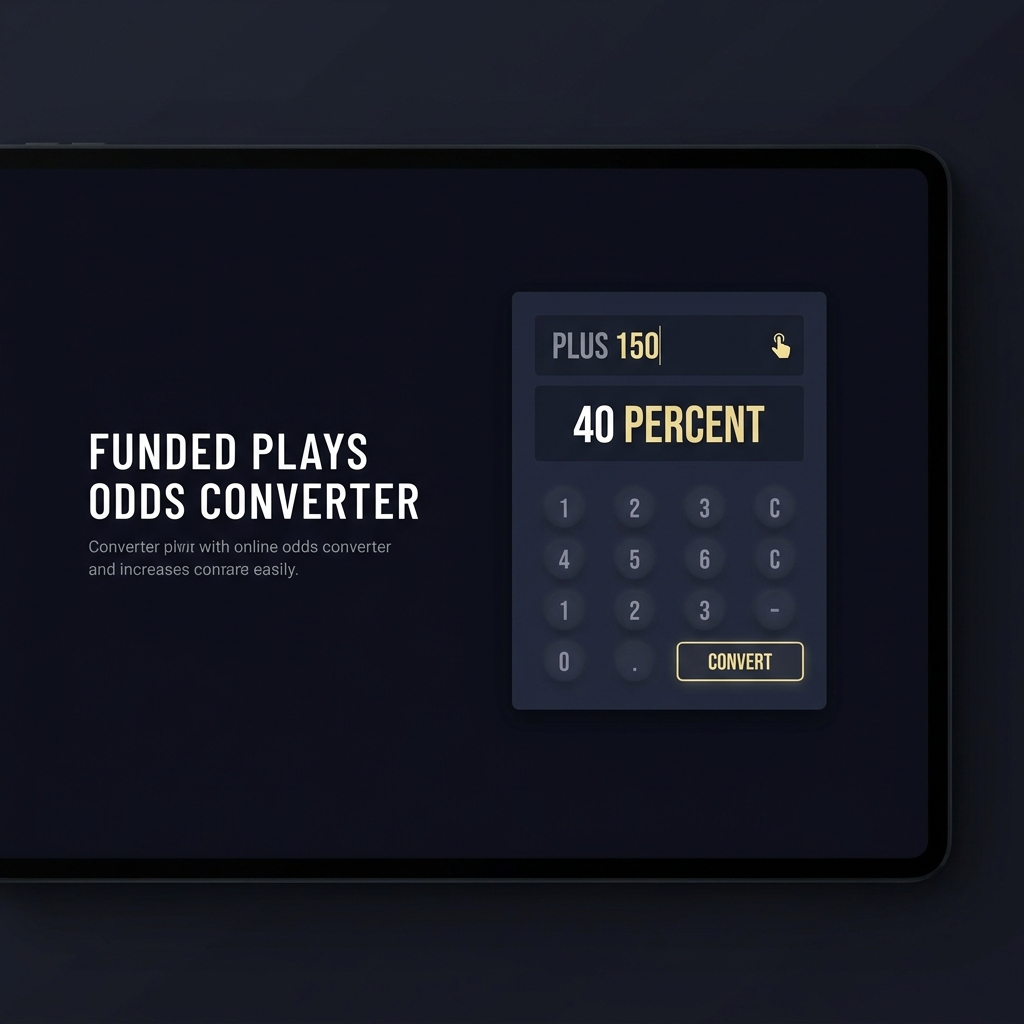
Check the result with p = 100 ÷ (odds + 100). For odds = 150 compute 100 ÷ 250 = 0.40, which written as a percent is 40%. This inverse check is a quick way to catch arithmetic slips when you convert by hand.
What +150 and -150 mean in bets and returns
Payout math with concrete stake examples
At +150 a $100 stake pays $150 profit. The total cash returned equals stake plus profit, so a $100 stake at +150 returns $250 total. This payout convention-profit on a $100 base for positive odds-is standard in U.S. displays and educational explainers DraftKings odds explainer.

Conversely, for the mirror case a 60 percent implied chance corresponds to -150: you must stake $150 to win $100, and the total return on a winning -150 stake is $250. The symmetry explains why +150 and -150 are numerically related through the 40% and 60% probabilities.
The mirror case: 60 percent equals -150
The mirror relationship is useful for quick mental checks: if one side is +150 (40% implied), the opposite fair probability is 60% and displays as -150 under the negative-odds rule, keeping total return symmetry when stakes are adjusted.
Why sportsbooks display different odds: vigorish and market prices
What the bookmaker margin is
Bookmakers add a margin, often called vigorish or vig, to prices so posted market-implied probabilities generally sum to more than 100%. Explainors and betting resources describe how margin creates a difference between a theoretical, margin-free implied probability and a real-market price set for profit management Pinnacle resources on implied probability and margin.

Why implied probabilities from posted lines usually exceed 100 percent
The formulas shown earlier give margin-free implied probabilities; when you use posted market odds you are observing prices that reflect both the market view and the bookmaker margin, so comparing your model conversion with market lines is how you identify potential value opportunities or simply understand where vigorish affects an apparent probability.
Rounding, display conventions, and calculators
Why odds are rounded on U.S. sites
Sites and sportsbooks generally round American odds to whole numbers for display simplicity; rounding can cause tiny differences between a precise arithmetic result and the displayed figure, so calculators often show the precise conversion while markets show a rounded approximation Pinnacle odds converter. You can also check free converters such as Covers' odds converter for comparison.
Reliable calculators and converters
Use reputable online odds converters and sportsbook education pages for quick verification; calculators at major resources let you switch between decimal, fractional, and American formats and are a practical way to avoid manual arithmetic errors. For example, AceOdds odds converter and other tools make this fast.
quick conversion of percent to American odds and inverse check
Verify rounding before using market lines
Common mistakes when converting percentages to American odds
Mixing formats and signs
A common slip is confusing when to use the plus sign versus the minus sign; remember the plus sign for p < 50% where odds show profit on a $100 stake, and the minus sign for p > 50% where odds show required stake to win $100.
Forgetting to account for bookmaker margin
Another frequent mistake is treating margin-free implied probabilities as if they were market prices; always check posted lines against your model because bookmaker margin and market action change the displayed odds.
Rounding errors and arithmetic slips
Small rounding differences and simple arithmetic mistakes can produce mismatches; the inverse check p = 100 ÷ (odds + 100) helps catch those errors quickly.
When a 40% implied chance appears in real markets
Interpreting a 40 percent market line
If you see a market line that suggests roughly a 40 percent chance, remember that the posted American odd may be a rounded or margin-adjusted equivalent of +150; compare the conversion from your model to the posted line to spot discrepancies and potential edge.
How sharps and public action can move lines
Market supply and demand, including action from sharp bettors and public money, can shift posted odds away from a theoretical +150; liquidity and bookmaker risk management determine how and when lines move in response.
Quick toolkit: mental shortcuts and checks
Fast inversion check
Keep this quick inversion in mind: for positive odds, p ≈ 100 ÷ (odds + 100). It is an efficient mental check to confirm a manual conversion or to sanity-check a displayed American odd.
Simple heuristics for common percentages
Memorize these anchors: 40% corresponds to +150 and the mirror 60% corresponds to -150. For other common probabilities, use a calculator to verify non-round results rather than relying on rough mental estimates.
Examples across sports and typical use cases
Single-game outcomes
A single-game example: if a model estimates a team has a 40 percent chance to win, converting that 40% to +150 gives a standardized way to compare with sportsbook moneylines and decide whether to include the selection in a simulation or evaluation.
See our blogs for related examples and writeups.
Using implied odds for evaluation and simulation
Implied odds are widely used in modeling and simulation to assign consistent probabilities across scenarios; tracking margin-free implied probabilities alongside market lines is a useful habit for anyone running prediction challenges or backtests.
How this matters for skill-based platforms and simulations
Interpreting implied probability in evaluation challenges
On skill-based prediction platforms, recording margin-free implied probabilities like 40% and the corresponding American odds (+150) gives a transparent baseline for scoring and for comparing performance across events without conflating bookmaker margin. Learn more about how we evaluate entries in our evaluation process.
Using conversions for consistent record-keeping
Converting percentages to a single odds format helps keep logs and performance metrics consistent; for example, saving both the model probability and the converted +150 line for a 40% forecast lets you analyze where market prices differed from your estimate while keeping records comparable.
Quick reference: formulas and cheat sheet
Two core formulas: for p < 50% use odds = +[100 × (1 − p) / p]. For p > 50% use odds = −[100 × p / (1 − p)].
Inverse formula for positive odds: p = 100 ÷ (odds + 100). Memory anchors: 40% = +150 and 60% = -150.
Conclusion: how to read 40% in American odds and next steps
Forty percent converts cleanly to +150, which means a $100 stake returns $150 profit for a $250 total payout; the conversion comes from the positive-odds formula and the inverse check confirms the arithmetic.
Always compare margin-free conversions with posted market lines to account for vigorish, use a trusted calculator for non-round percentages, and track both model probabilities and market odds when evaluating predictions or practicing on a skill-based platform. Visit Funded Plays for challenges and practice opportunities.
Turn the percent into a decimal p, then use odds = +[100*(1-p)/p] if p < 0.50 or odds = −[100*p/(1-p)] if p > 0.50; verify with p = 100/(odds+100) for positive odds.
No. +150 is the margin-free conversion of 40%, but posted market odds often reflect bookmaker margin and rounding, so displayed lines may differ slightly.
#ERROR! (Formula parse error.)
References
- https://www.investopedia.com/terms/i/implied-probability.asp
- https://www.actionnetwork.com/education/convert-odds-implied-probability
- https://therundown.io/betting-calculators/odds-converter-calculator
- https://sportsbook.draftkings.com/how-to-bet/odds-explained
- https://www.fundedplays.com/challenges
- https://www.pinnacle.com/en/betting-resources/betting-tools/implied-probability
- https://www.pinnacle.com/en/betting-resources/tools/odds-converter
- https://www.covers.com/tools/odds-converter
- https://www.aceodds.com/bet-calculator/odds-converter.html
- https://www.fundedplays.com
- https://www.fundedplays.com/blogs
- https://www.fundedplays.com/blogs/how-fundedplays-evaluations-work