
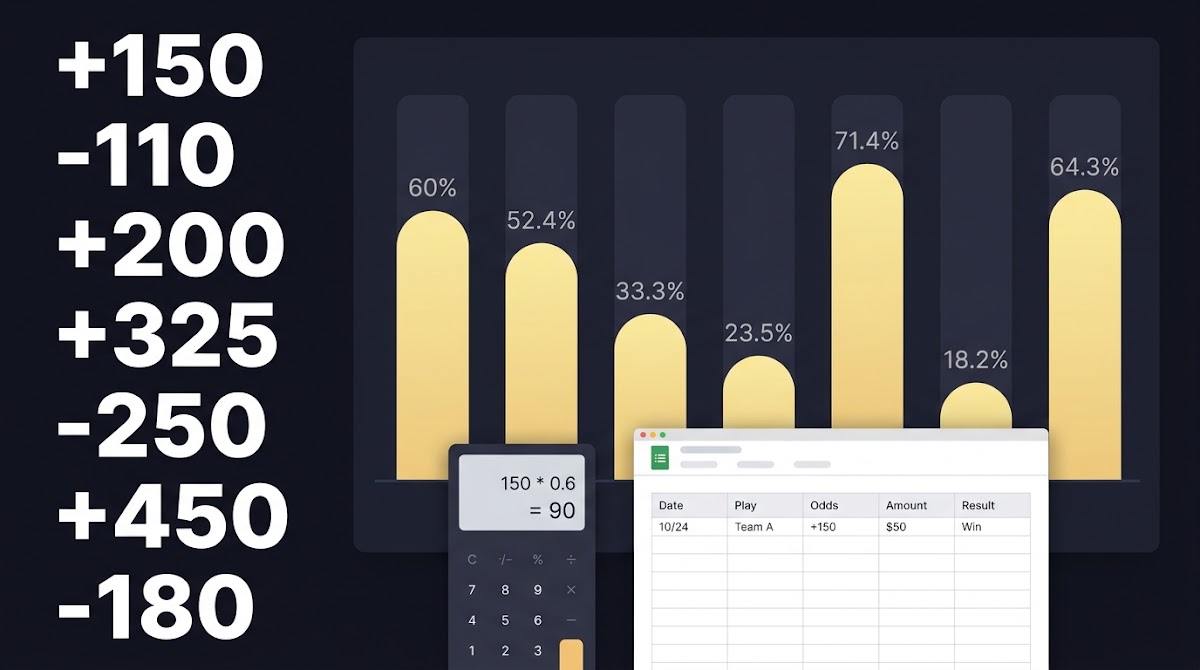
What American (moneyline) odds mean and why convert them to percentages
American odds express how much you win relative to a wager and come in two forms: a positive number for underdogs and a negative number for favorites. Converting american odds to percentage turns those payout relationships into an implied probability, which is the market's breakeven win rate for that price.
For example, positive odds like +150 say how much profit you get on a 100 stake, while negative odds like -200 show how much you must stake to win 100. Explaining this relationship in percentage form makes it easier to compare prices across formats and identify potential value.
Implied probability is a market measure rather than a statement about the true chance of an event, in part because posted prices typically include a bookmaker margin called the overround. That margin causes the sum of implied probabilities across mutually exclusive outcomes to exceed 100 percent, so raw implied percentages should be treated as market signals rather than unbiased forecasts. Investopedia implied probability guide
Practice converting odds and tracking your edges on the FundedPlays challenge framework
Try the formulas in a calculator or notebook with a few lines you care about and compare results before and after adjusting for margin.
The standard formulas: converting american odds to percentage (quick cheat-sheet)
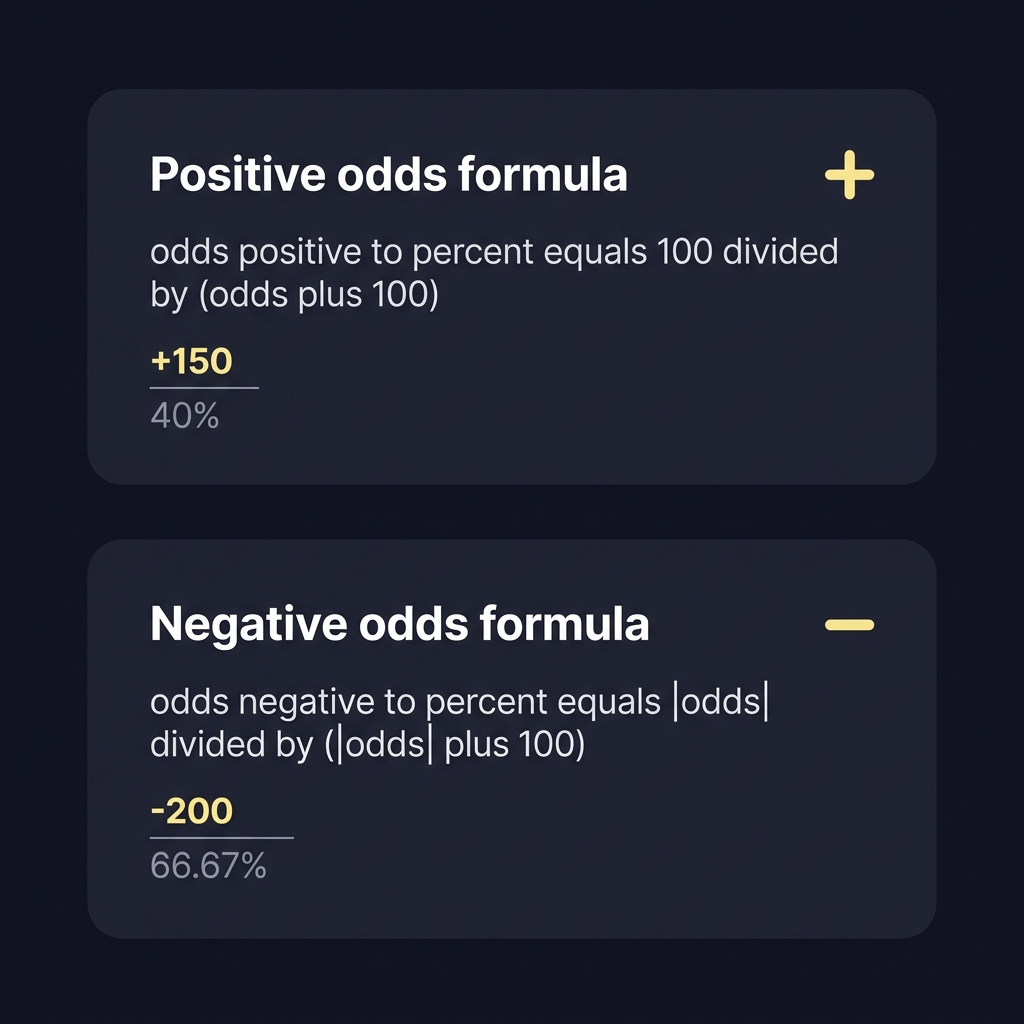
There are two compact formulas you can use immediately. For positive American odds written +A, the implied probability equals 100 divided by A plus 100. For negative American odds written -A, use the absolute value and compute A divided by A plus 100. These expressions are the standard approach used across betting-education and finance sources. Pinnacle explanation of converting odds
To state them as short cheat lines you can copy: implied probability = 100/(A+100) for +A, and implied probability = |A|/(|A|+100) for -A. Using the absolute value for negative odds avoids sign errors and produces a straightforward decimal that you multiply by 100 for a percentage.
When reporting percentages for readability, a common convention is to round to one decimal place, which keeps numbers concise while preserving useful precision for comparison. Many calculators and spreadsheets adopt this rounding for display. CFI guide on implied probability

Convert via decimal odds: an equivalent method and why it matches
How to convert American to decimal odds
An alternative route is to convert American odds to decimal odds and then take the reciprocal to get implied probability. For positive American odds +A, decimal odds equal 1 plus A divided by 100. For negative odds -A, decimal odds equal 1 plus 100 divided by the absolute value of A. This conversion is algebraically equivalent to the direct formula. CFI on decimal conversion
After converting to decimal odds, implied probability is simply 1 divided by the decimal odds. That step is useful for spreadsheet users because many models already work in decimal format and the reciprocal step fits standard expected-value calculations.
Use the standard formulas: for +A compute 100/(A+100), for -A compute |A|/(|A|+100); alternatively convert to decimal odds and take the reciprocal. Adjust for bookmaker margin when needed to estimate fair probabilities.
Showing the algebra briefly: for +A, decimal = 1 + A/100, so implied = 1/(1 + A/100) which simplifies to 100/(A+100), matching the direct formula. For -A, the algebra gives the same result when you use the absolute value for A. Wikipedia on implied probability and odds
Step-by-step worked examples (walkthroughs you can copy)
Example 1, a positive line: +150. Use the direct formula for plus money: implied probability = 100 / (150 + 100). That equals 100 / 250 = 0.4, or 40.0 percent when rounded to one decimal place. This gives the breakeven win rate the market is pricing at this line. Investopedia implied probability guide
Example 2, a negative line: -200. Convert using the absolute value: implied probability = 200 / (200 + 100) = 200 / 300 = 0.666..., or 66.7 percent when rounded to one decimal place. This shows that a favorite priced at -200 needs to win about two thirds of the time to justify the price. CFI on implied probability
Example 3, another positive line: +300. Apply the plus-money formula: 100 / (300 + 100) = 100 / 400 = 0.25, or 25.0 percent with one-decimal rounding. You can reach the same numbers by converting to decimal odds first and then inverting. Pinnacle conversion examples
Each worked example above reproduces the standard textbook conversions and shows the same results whether you use the direct formula or the decimal-odds route. Copy these steps into a spreadsheet to verify other lines quickly.
How to adjust implied percentages for bookmaker margin (overround)
Market odds commonly include a bookmaker margin, often called the overround or vig, which inflates implied probabilities so that their sum across outcomes exceeds 100 percent. That margin funds the bookmaker's spread and causes raw implied percentages to be larger than fair probabilities. Pinnacle on overround and margins
A straightforward normalization method rescales the raw implied probabilities so they sum to 100 percent. Calculate each implied probability with the standard formula, sum those probabilities, then divide each implied probability by the sum. The result is a simple estimate of 'fair' probabilities that removes the proportional margin across outcomes.

For a small numeric illustration, imagine a three-outcome market where the implied probabilities add to 105 percent because of the margin. If one outcome's raw implied percentage is 40 percent, divide 40 by 105 to get about 0.3809, then multiply by 100 to report 38.1 percent as the normalized value. Repeat for each outcome to produce a set that sums to 100 percent. Pinnacle margin normalization
Keep in mind that normalization is an approximation. More advanced vig-removal methods exist and may model asymmetric margins or use market-implied lines from multiple books, but simple proportional scaling is a practical starting point for analysis and dashboard tracking. Smarkets conversion guidance
What implied probability tells you about value and breakeven rates
Implied probability represents the breakeven win rate that makes a wager fair at the posted price. If your assessed probability for an outcome exceeds the implied probability, there may be value before transaction costs and platform rules are applied. This breakeven perspective helps you compare your edge across many lines. Investopedia on breakeven interpretation
When deciding if a price offers value, factor in any fees, limits, or platform-specific rules that affect whether you can act on that edge. A percentage that looks attractive on paper can be less actionable once you include these practical constraints, so track net expected value rather than raw implied-versus-estimated probabilities. Pinnacle on practical decision making
Common mistakes and pitfalls when converting and using percentages
Sign errors are frequent: forgetting to use the absolute value for negative odds will give wrong results. Always convert negative odds using their absolute value before applying the formula. Making this simple arithmetic mistake will distort implied probabilities and any decisions based on them. Smarkets common conversion mistakes
Quick conversion from American odds to implied percentage
Use absolute value for negative odds
Rounding and precision can also cause problems if you round too early. Do calculations at full precision and only round the final percentage for display. Mixing formats without converting first, for example combining American and decimal odds in the same calculation, is another source of error that leads to incorrect edge assessments. CFI on precision and format consistency
A final pitfall is treating implied probability as the true event probability rather than a market price that includes margin and liquidity effects. Use implied percentages as a comparative metric and a breakeven reference, and avoid assuming they are unbiased forecasts without applying appropriate adjustments. Investopedia on market-implied limits
Practical scenarios: using these conversions in prediction challenges and dashboards
Use implied percentages to rank matchups, prioritize lines where your model shows the biggest positive gaps, and calculate expected value across a set of predictions. Converting american odds to percentage makes it easier to aggregate edges across sports and formats in a single dashboard.
For portfolio-style tracking, keep columns for the posted American odds, the calculated implied probability, any normalized fair probability, your assessed probability, and the expected value difference. That structure makes it straightforward to sort by edge and monitor performance over time while keeping conversions auditable.

Skill-based challenge platforms often use percentages to measure forecast accuracy and consistency, so recording both raw implied percentages and margin-adjusted values helps you interpret contest results in context. Mentioning FundedPlays here is only to note that structured challenge environments rely on consistent measures rather than guaranteeing outcomes. Smarkets practical guidance
Quick reference and next steps
Cheat-sheet recap: for +A use implied probability = 100/(A+100); for -A use implied probability = |A|/(|A|+100). You can get the same result by converting to decimal odds and computing 1 divided by the decimal odds. Keep the one-decimal rounding convention for readable displays.
Suggested next actions: practice the conversion on lines you follow, add the conversion to your spreadsheets or dashboard, and track both raw and normalized probabilities over a sample of events to see how margin affects your edge estimates. Remember that implied probabilities are market-derived and do not guarantee outcomes.
Use the formula 100 / (150 + 100) which equals 0.40, or 40.0 percent when rounded to one decimal place.
Because bookmakers include a margin called the overround, which inflates implied probabilities so their sum exceeds 100 percent.
Not without adjustment; implied probability is a market price and often needs normalization or further modeling to estimate fair probabilities.
References
- https://www.investopedia.com/terms/i/implied-probability.asp
- https://www.pinnacle.com/en/betting-articles/educational/convert-odds-to-probability/d2wjgvb48k6r5e2f
- https://corporatefinanceinstitute.com/resources/derivatives/implied-probability/
- https://en.wikipedia.org/wiki/Odds#Implied_probability
- https://therundown.io/betting-calculators/implied-probability-calculator
- https://oddsjam.com/betting-calculators/implied-probability
- https://www.omnicalculator.com/statistics/implied-probability
- https://www.pinnacle.com/en/betting-articles/educational/understanding-betting-margins-overround/2JE2N8G7C2P79Q2Y
- https://www.fundedplays.com/challenges
- https://help.smarkets.com/hc/en-gb/articles/213923929-How-to-convert-odds-to-probability
- https://www.fundedplays.com/blogs
- https://www.fundedplays.com/blogs/how-fundedplays-evaluations-work
- https://www.fundedplays.com/