
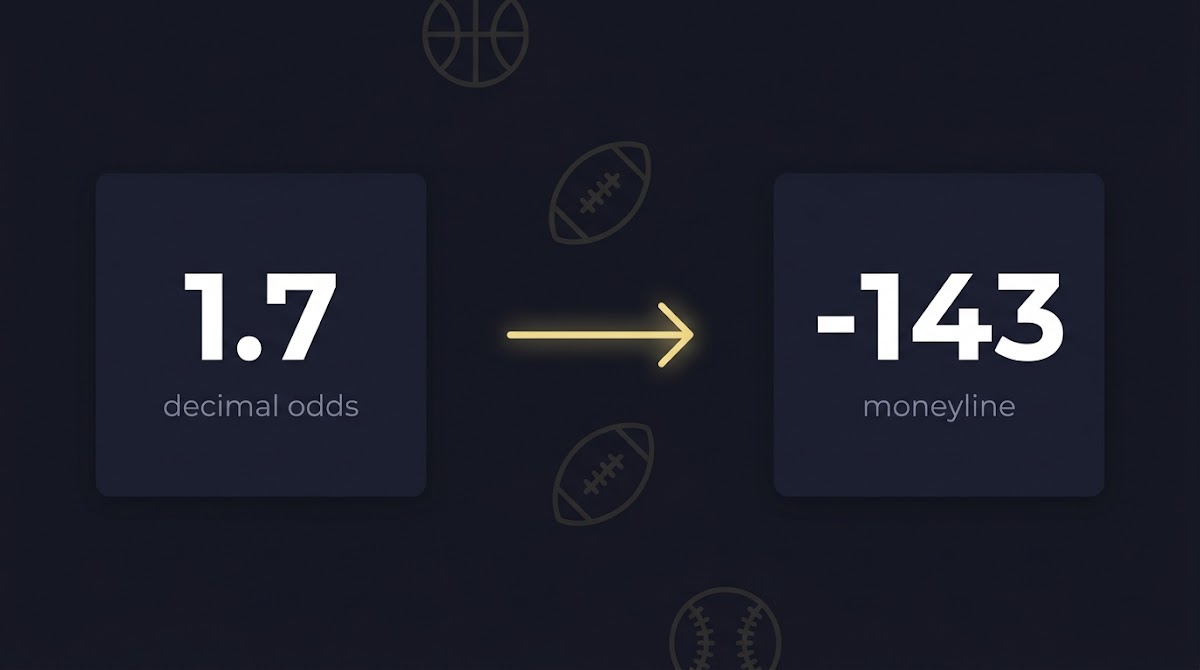
Quick answer and what 1.7 means
american odds conversion
Short conversion result: decimal 1.7 converts to a moneyline of approximately -143 when you apply the standard decimal to American odds formula and round to a whole number for market display. This conversion follows the usual arithmetic used by odds converters and operator guides Pinnacle odds converter. You can also check an alternate converter such as AceOdds odds converter.
Immediate interpretation for a bettor: a -143 moneyline means you must stake $143 to win $100 profit, so a successful $143 bet returns $243 total. In decimal terms, a $100 stake at 1.7 returns $170 total, which equals a $70 profit; the slight cent differences that come up when you compare formats are a result of rounding when American odds are shown as whole numbers Action Network explanation of American odds.
Try the conversion checklist
Use the conversion checklist below to confirm the result and compare payouts in both formats before you place a prediction.
How American odds relate to decimal odds: the formulas
There are two standard formulas to convert decimal odds to American moneyline odds. For decimal odds below 2.0, the formula produces a negative moneyline for the favorite: A = -100 / (d - 1). For decimals at or above 2.0, the formula produces a positive moneyline for the underdog: A = 100 * (d - 1). These are the formulas operators and reference guides use to translate between formats fixed-odds betting overview. Another handy conversion tool is available at Covers odds converter.
Why two formulas? The split at decimal 2.0 comes from how profit and stake are expressed in each system: decimals show total return per unit stake while American odds show how much you must stake or how much you win on a $100 base, so numbers below 2.0 indicate favorites and appear as negative moneylines, while decimals of 2.0 and above indicate underdogs and appear as positive moneylines. Operator documentation and educational resources illustrate the same break in convention Pinnacle odds converter.
American odds are conventionally displayed as whole numbers in market interfaces. That means after computing A with the formulas you typically round to the nearest whole integer for display; the rounding is a market convention rather than part of the underlying arithmetic, and it can introduce small differences when you back-calculate payouts and implied probability Investopedia moneyline overview.
Step-by-step conversion of 1.7 to American odds
Step 1, pick the correct formula: because 1.7 is below 2.0, use the negative formula A = -100 / (d - 1). That choice is essential; using the positive formula would give an incorrect sign and a wrong moneyline. This distinction is part of standard conversion instructions used by bettors and education pages Pinnacle odds converter. See also an alternative calculator at Unabated odds converter.
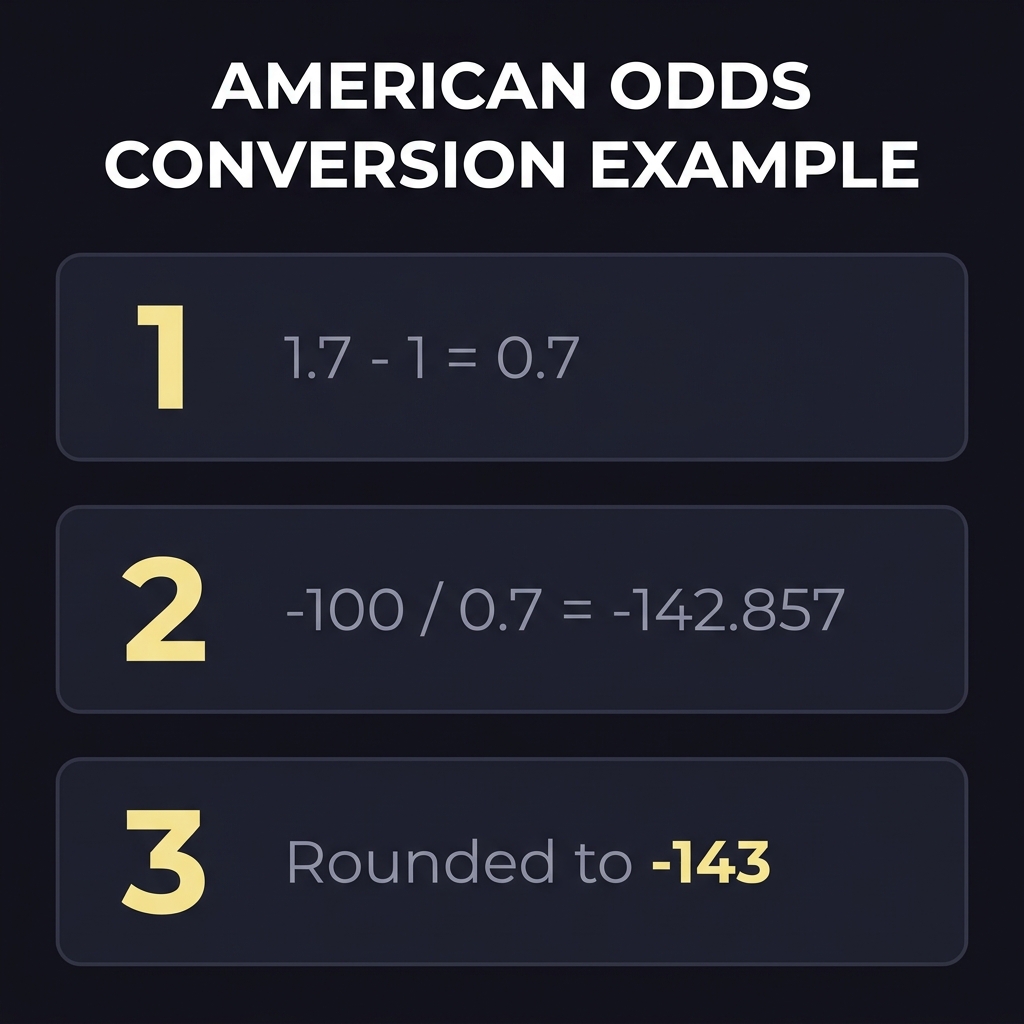
Step 2, do the arithmetic with d = 1.7: compute the denominator d - 1 = 0.7, then compute -100 divided by 0.7, which yields approximately -142.8571429. Writing out that fraction and the long decimal helps you see why the result is not a clean whole number and why rounding is required for market display Action Network explanation of American odds.
Step 3, apply conventional rounding: the raw result −142.857... is rounded to the nearest whole moneyline, which is −143. That rounded moneyline is what you will usually see in U.S. markets and what most conversion tools present to users. The rounding step is a simple market convention applied after the formula yields a non-integer result Pinnacle odds converter.
quick conversion from decimal odds to total return
Use whole numbers where possible
Step 4, translate the rounded moneyline into stake language: a displayed -143 means staking $143 wins $100 profit, so the total return is $243. Keep in mind that a $100 stake shown as -143 corresponds to roughly $69.93 profit when you apply proportional conversion rather than rounding, and small cents differences arise because the market displays whole-number moneylines Investopedia moneyline overview. For related reading on how our challenges work, see how Funded Plays evaluations work.
Implied probability and cross-format checks
Compute implied probability from decimal odds: use 1 / decimal. For 1.7 that gives 1 / 1.7 ≈ 0.588235, or about 58.82 percent. This is a straightforward way to check whether a decimal quote matches a moneyline or to compare the market's expectation across formats Investopedia decimal odds definition.
Compute implied probability from a negative American moneyline: for negative A use |A| / (|A| + 100). For -143 that is 143 / (143 + 100) ≈ 143 / 243 ≈ 0.58806, or about 58.81 percent. That aligns closely with the decimal calculation; the tiny difference is due to rounding the moneyline to a whole number for market display Implied probability background.
Using both checks is a reliable cross-format verification: if the decimal implied probability and the moneyline implied probability match within a few hundredths of a percent, your conversion and rounding are consistent. If they diverge more, re-check which formula you used and whether the moneyline was rounded Investopedia moneyline overview.

How to interpret payouts and stake examples
Decimal format example: a $100 stake at decimal 1.7 returns 1.7 times the stake, which equals $170 total and $70 profit. That arithmetic is simple multiplication and is the quickest way to see the payout from a decimal odds quote Investopedia decimal odds definition.
American moneyline example: the displayed -143 means a bettor must stake $143 to win $100 profit, and a successful $143 bet returns $243 total. Stating the moneyline payout as a $143 stake for $100 profit is the conventional way U.S. sites present favorite odds and helps bettors compare stakes directly Investopedia moneyline overview. For Funded Plays resources visit Funded Plays.

Cross-checking a $100 stake at -143: because moneylines are expressed on a $100 base, you can scale proportionally. A $100 stake at -143 would win roughly $69.93 profit when you calculate proportionally from the -143 ratio; the small cents difference compared with the decimal $70 profit results from the rounding used to display the moneyline as -143 rather than the raw −142.857... value Action Network explanation of American odds.
Why the two formats appear different but mean the same thing: decimal odds show total return per unit stake, while moneyline focuses on how much to stake to win a $100 baseline or how much you win on a $100 stake. Both formats encode the same market expectation when you account for rounding and convert via implied probability checks Pinnacle odds converter.

Typical mistakes and how to avoid them
Wrong formula: a common mistake is applying the positive formula when the decimal is below 2.0. Always check whether the decimal is less than 2.0 before you pick A = -100 / (d - 1) or A = 100 * (d - 1). This conditional choice is central to correct conversions and is emphasized in conversion guides Pinnacle odds converter.
Rounding traps: another frequent error is to forget that American odds are shown as whole numbers. Rounding a raw computation like -142.857... to -143 changes the exact proportional payout by a few cents, so if you need exact cents for accounting or simulation work compute with the raw decimal result first, then round only for display Action Network explanation of American odds.
Misinterpreting implied probability: remember that implied probability is a conversion of odds into a percentage view of market-implied chance, not a prediction or a guarantee. Treat implied probability as a verification and comparison tool rather than an assertion of outcome certainty Implied probability background.
Practical verification steps and final recap
Quick checklist to verify a conversion: first, confirm which formula applies based on whether decimal is below 2.0; second, compute the raw moneyline value; third, round to the nearest whole number for market display; fourth, compute implied probability from either the decimal (1 / d) or the moneyline (|A| / (|A| + 100)) to confirm they match within small rounding error; fifth, compare payout examples for common stakes to ensure consistency Pinnacle odds converter. See our blog for related guides.
Apply the negative formula for decimals below 2.0: A = -100 / (d - 1), compute the raw result, then round to the nearest whole moneyline to display; for 1.7 this yields -143.
Final takeaway: decimal 1.7 converts to a displayed American moneyline of -143 after applying the standard negative formula and rounding, and the implied probabilities line up at about 58.8 percent. Use the checklist above to repeat the steps for other decimals and be mindful of rounding effects when comparing payouts Investopedia moneyline overview.
A -143 moneyline means you must stake $143 to win $100 profit; a successful $143 bet returns $243 total. It is the rounded market display from the raw -142.857 calculation.
Yes for market display: the standard conversion yields about -142.857 which is conventionally rounded to -143, though the raw value is slightly different before rounding.
Use the correct formula for the decimal, compute the raw value, round for display, and confirm implied probability from both formats match closely.
References
- https://www.pinnacle.com/en/betting-resources/betting-tools/odds-converter
- https://www.actionnetwork.com/education/american-odds
- https://en.wikipedia.org/wiki/Fixed-odds_betting
- https://www.investopedia.com/terms/m/moneyline-bet.asp
- https://www.investopedia.com/terms/d/decimal-odds.asp
- https://en.wikipedia.org/wiki/Implied_probability
- https://www.fundedplays.com/challenges
- https://www.aceodds.com/bet-calculator/odds-converter.html
- https://www.covers.com/tools/odds-converter
- https://unabated.com/betting-calculators/odds-converter
- https://www.fundedplays.com
- https://www.fundedplays.com/blogs
- https://www.fundedplays.com/blogs/how-fundedplays-evaluations-work