
Quick answer: what does decimal 1.5 equal in American odds?
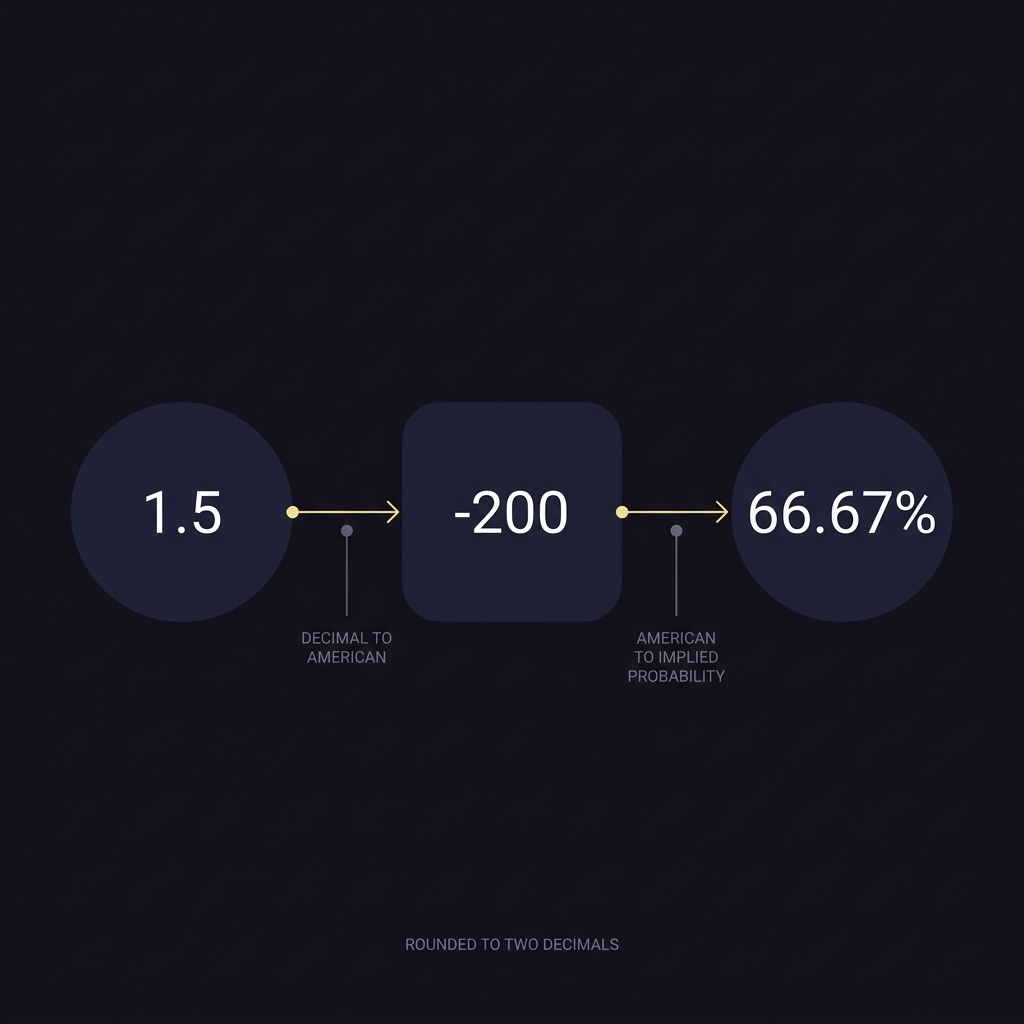
Decimal 1.5 converts to American -200, which means a $100 stake returns $150 total (a $50 profit) and the moneyline shows you must risk $200 to win $100.
Decimal 1.5 converts to American -200, implying about a 66.67% chance. In payout terms, a $100 stake at 1.5 returns $150 total (profit $50), and -200 means staking $200 to win $100; use the piecewise formulas to convert other decimals consistently.
That conversion follows the standard rule for decimals below 2.00 and gives an immediate way to compare displays that use different odds formats.
Why odds formats matter: decimal, American and implied probability
Decimal odds state the total return including the original stake, so a decimal of 1.5 means a $100 stake returns $150, profit $50, rather than showing profit alone; this framing makes decimal odds simple to read for payout calculations Covers odds guide.
American odds, often called moneyline odds, use negative numbers for favorites and positive numbers for underdogs; the sign and magnitude tell you either how much you must stake to win $100 or how much you win on a $100 stake, respectively.
Implied probability converts either format to a single percent that represents the market-implied chance of the outcome; converting between decimal, American and implied probability is useful when comparing lines across sites or when sizing stakes for predictions.

Step-by-step: convert decimal 1.5 to American odds

Start with the piecewise rule that applies when decimal odds are less than 2.00: American moneyline (ML) equals negative 100 divided by (d minus 1), written ML = -100 / (d - 1) Odds Converter.
1) Substitute d = 1.5 into the formula: ML = -100 / (1.5 - 1).
2) Compute the denominator: 1.5 - 1 = 0.5.
3) Divide: -100 / 0.5 = -200, so the American odds are -200. This result is negative because decimals below 2.00 represent favorites, and negative American odds indicate how much you must stake to win a standardized $100.

Put simply, decimal 1.5 becomes -200 by applying that single algebraic step; you can reproduce the same arithmetic on any calculator or converter that follows the standard piecewise rule.
The piecewise formula explained: when to use which conversion
Conversion uses two complementary rules depending on whether decimal odds are at least 2.00 or below; for d greater or equal to 2.00 the American line is positive and computed as ML = (d - 1) × 100, while for d below 2.00 it is ML = -100 / (d - 1).
The breakpoint at 2.00 is natural because a decimal of 2.00 implies a 50% chance and corresponds to even money; decimals above 2.00 represent underdogs (positive American values) and decimals below 2.00 represent favorites (negative American values), which explains the sign change in the piecewise rule.
Implied probability at 1.5: what 66.67% means
Compute implied probability from decimal odds with the simple inversion 1 / d, so 1 / 1.5 ≈ 0.6667, or about 66.67% implied chance for the outcome.
You can get the same implied probability from American -200 by using the favorite formula: implied = 200 / (200 + 100) ≈ 0.6667, showing both formats describe the same market-implied chance when converted consistently.
Quick check for implied probability and payouts
Use to verify simple conversions
Interpreting 66.67% practically means the market prices this outcome as more likely than not; predictors can use that baseline when comparing their own probability estimates and sizing stakes, while remembering that displayed odds reflect market pricing rather than a definitive true probability.
Stake and payout examples: translating odds into dollars
Decimal format makes payout math straightforward: total return equals stake times decimal, so a $100 stake at 1.5 returns $100 × 1.5 = $150 total, meaning $50 profit; this return-includes-stake convention is standard for decimal odds Covers odds guide.
Expressed in American terms, -200 means you must stake $200 to win $100; scaling is proportional, so a $40 stake would win $20 and return $60 total, which maps directly to the decimal math where $40 × 1.5 = $60.
To scale any stake: either multiply any stake by the decimal to get total return, or scale proportionally on the American moneyline (for favorites, profit = stake × (100 / |ML|)), then add stake back for total return.
Using conversions on skill-based prediction platforms and sweepstakes
The math for converting decimal 1.5 to American -200 is platform-agnostic: calculators and conversion rules are the same whether you are using traditional sportsbook lines or a skill-based prediction challenge on Funded Plays, because the formulas are algebraic relationships between the formats OddsJam converter.
When using any platform, confirm the site rules for rounding, settlement and how they display odds on https://www.fundedplays.com; these operational details can affect the final displayed American value or how small fractions are handled, so a quick review of house rules avoids surprises.
Explore FundedPlays challenge programs
Check the platform rules for rounding and settlement and use standard conversion formulas when estimating returns; participate responsibly and within the platform’s stated rules.
Rounding and display conventions: what changes across sites and tools
Some sites round American odds to the nearest whole number or display simplified ratios, which can make a converted value look slightly different from an exact algebraic result; this is a display choice rather than a different formula.
Rounding may cause small visible inconsistencies when a converter shows -200 but an operator displays -199 or -201 after internal rounding; these differences typically have negligible practical effect but are worth checking for large stakes or when reconciling historical results.
Common mistakes and pitfalls when converting odds
A frequent mistake is treating decimal odds as profit-only instead of total return; remember that decimal includes the stake and must be interpreted accordingly to avoid overestimating expected returns.
Another common error is sign confusion with American odds: negative numbers indicate favorites and specify the amount you must risk to win $100, while positive numbers show how much you win on a $100 stake; using the wrong piecewise formula for the decimal range can flip the sign and produce an incorrect result.
Practical scenarios: quick conversions for multiple bets and stakes
Scaling stakes across multiple single bets is linear: if -200 yields a $20 profit on a $40 stake, then two independent $40 bets yield two $20 profits each if both win; the conversion math remains the same regardless of how many parallel bets you place.
For parlays, multiply decimal odds to get a combined decimal and then convert that decimal to implied combined probability; because parlays multiply implied chance, small rounding differences in each leg can compound and change the final payout noticeably, so keep an eye on rounding when combining several lines.
Quick conversion table and mental-math shortcuts
Small table for quick reference: decimal 1.25 ≈ American -400, decimal 1.5 = American -200, decimal 2.0 = American +100; these examples show how decimals below 2.00 map to negative favorites and decimals at or above 2.00 move toward positive underdog values.
Mental shortcut for decimals under 2.00: compute (d - 1) and then divide 100 by that difference and apply a negative sign. For 1.5, that is (1.5 - 1) = 0.5, 100 / 0.5 = 200, so -200.
When precision matters or when odds include many decimal places, rely on a calculator or a reputable online converter to avoid rounding mistakes.
Why market odds differ from 'true' probabilities: margin and market factors
Operator margin, often called vigorish or juice, means displayed odds embed a profit margin for the operator and therefore implied probabilities will sum to more than 100% across mutually exclusive outcomes; conversions give market-implied probabilities, not a definitive measure of true probability.
Market factors such as balancing liability, public money, and sharp action can move odds away from a theoretical fair line; analysts should treat converted implied probabilities as a market signal rather than an exact estimate of event likelihood.
How to verify conversions and recommended calculators
Trusted converters and education pages document the same piecewise formulas and are useful cross-checks; try at least two reputable sources or the Funded Plays blog and confirm that decimal → American → implied probability yields consistent results.
A simple cross-check method: convert decimal to American using the piecewise rule, then compute implied probability from either format and ensure the two implied values match within rounding tolerance; if they do, the conversion is correct.
Conclusion: key takeaways about 1.5 and American odds
Decimal 1.5 equals American -200 and implies about a 66.67% market-implied probability; the conversion follows standard piecewise formulas used by converters and education guides.
These algebraic relationships are platform-agnostic, but always confirm rounding and settlement rules on the site where you apply the math, and use conversions as one input among disciplined, responsible prediction practices. See https://www.fundedplays.com/blogs for more.
Use the piecewise rules: for decimals below 2.00, ML = -100/(d - 1); for decimals 2.00 or above, ML = (d - 1)×100.
Negative American odds like -200 mean you must stake $200 to win $100; the sign indicates a favorite.
No, converted odds show market-implied probability and do not account for operator margin or other market factors.