
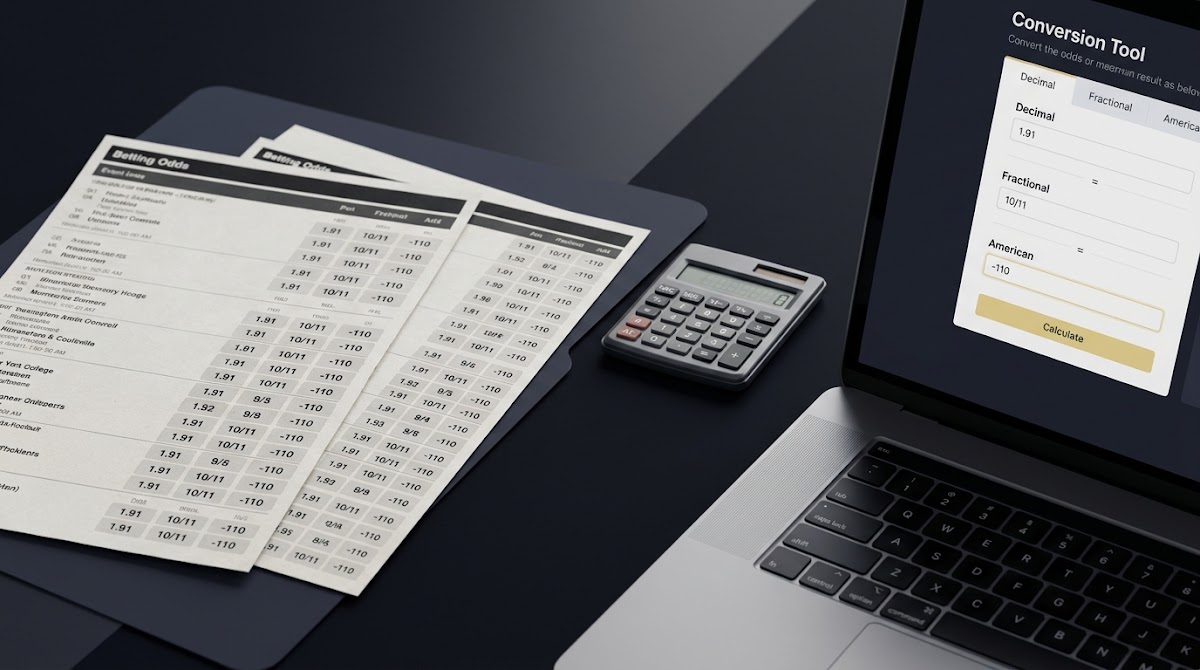
Why converting odds to probability matters
Probability and odds are two ways of describing the same uncertainty: probability is a number between 0 and 1 that measures likelihood, while odds are a price-style representation used across markets and publications. If you want to compare prices, spot value or feed market information into a forecasting model, converting odds to an implied probability is the practical first step; tools such as the aceodds odds converter make that quick to check against manual math, and the basic idea is the same regardless of format Investopedia implied probability
In everyday use you will see decimal odds, fractional odds and American moneylines. These are different ways to present the same underlying chance, so converting to a probability lets you treat prices from different sources on equal terms. That single-number view helps with side-by-side comparison, model inputs and simple bankroll decisions without changing the market meaning.
Common practical uses include comparing competing markets, checking whether a price looks like value versus your model, and standardizing inputs for statistical models. Converting early keeps your process consistent and prevents misreading a price just because it is shown in an unfamiliar format.
Try a quick conversion and verify it online
Try converting one set of odds now by picking a format and running the numbers by hand, then check the result with a converter to build confidence.
Core formulas: linking odds and probability
The algebraic link between odds and probability is straightforward: write probability as p and odds as o and the two are related by p = o / (1 + o). In words, probability is the odds divided by one plus the odds. The inverse relation is o = p / (1 - p), which converts a probability back into price-style odds Penn State STAT 504 explanation
These formulas are the foundation you will use when converting among formats or when deriving implied probability from a quoted price. A short cheat-sheet is: for odds-style numbers use p = o / (1 + o); for probability-style numbers use o = p / (1 - p). This gives a consistent interpretation no matter how the market reports the price.
How to convert decimal, fractional and American odds
Three common formats are in frequent use: decimal, fractional and American moneyline. Decimal odds are common in modelling and international markets, fractional odds appear in some traditional contexts, and American moneylines are frequent in U.S. coverage. All three convert to the same implied probability when done correctly American Gaming Association odds primer
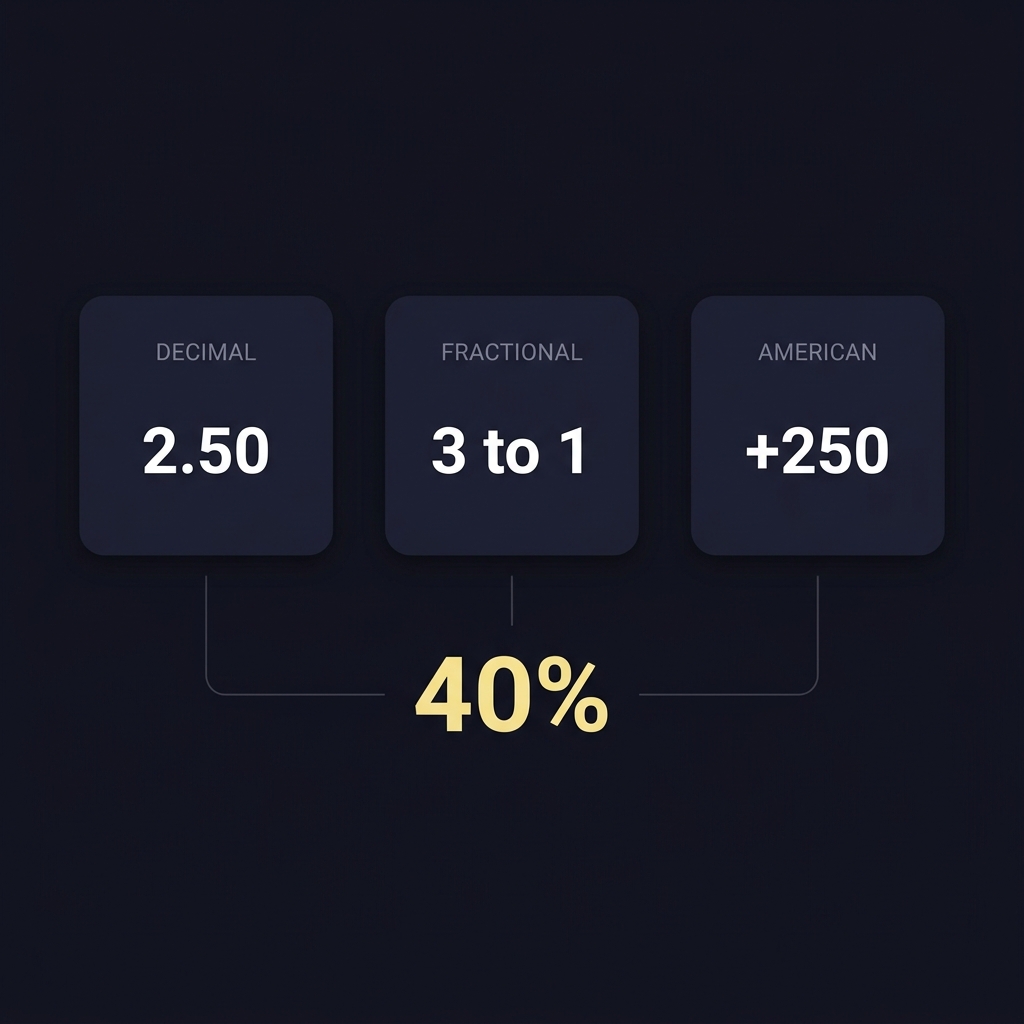
Decimal to probability is the simplest: implied probability = 1 / decimal. For example, decimal 2.50 implies 1 / 2.50 = 0.40 or 40 percent.
Fractional odds are quoted as numerator/denominator. Convert by taking denominator divided by the sum numerator plus denominator. For example, 5/2 implies probability = 2 / (5 + 2) = 2 / 7, about 28.57 percent. This method yields the same target probability as the decimal equivalent of the same price.
American moneyline uses two formulas depending on sign. For a positive moneyline (for example +150) implied probability = 100 / (moneyline + 100). For a negative moneyline (for example -150) implied probability = -moneyline / (-moneyline + 100). These map to the same underlying chance as other formats once evaluated correctly Investopedia implied probability
Quick steps to confirm a manual conversion with an online odds converter
Paste a single format into the converter and compare the implied probability
Quick step-by-step manual conversions (worked examples)
Decimal example, short and repeatable: take 2.50. Compute 1 divided by 2.50 to get 0.40, so the implied probability is 40 percent. This is a one-line calculation most calculators and spreadsheets can do in a second.
Fractional example: start with 5/2. Add numerator and denominator, 5 + 2 = 7, then compute denominator over total: 2 / 7, which is about 0.2857 or 28.57 percent. You can convert 5/2 to decimal first by computing 1 + numerator/denominator if that helps to verify the result.
American moneyline examples: for a positive line, +150, compute 100 / (150 + 100) = 100 / 250 = 0.40, or 40 percent. For a negative line, -150, compute 150 / (150 + 100) = 150 / 250 = 0.60, or 60 percent. Keep the sign rules straight to avoid errors.
Understanding bookmaker margin and the overround
Bookmakers build a margin into prices, so the sum of implied probabilities across all mutually exclusive outcomes usually exceeds 100 percent; that excess is commonly called the overround or bookmaker margin Overround explained
Convert each quoted price using the standard formula for its format: decimal uses 1/decimal, fractional uses denominator/(numerator+denominator), and American moneyline uses the positive or negative formula; normalize if you need a margin-free view.
As a simple two-outcome example imagine two quotes that both imply 53 percent when converted; the sum is 106 percent, leaving a 6 point overround. That extra amount reflects the price margin rather than extra chance, and it explains why raw implied probabilities should be treated as prices not direct estimates of objective chance UK Gambling Commission guidance
In practice this means implied probabilities are a market price that includes the operator margin. When comparing prices or building models you often want to account for that margin to see the fairer, margin-free picture.
How to remove the margin: normalizing implied probabilities
Normalization rescales implied probabilities so the total equals 100 percent. The formula for each adjusted probability is adjusted_p_i = p_i / sum(p_all). Apply this by summing the raw implied numbers across outcomes, then dividing each implied value by that total to get margin-free shares Overround discussion
Worked example across three outcomes: convert each price to implied probability, add them to get the market total, then divide each implied probability by the total to obtain normalized probabilities that sum to 100 percent. This produces a comparative, margin-adjusted view but it does not guarantee those numbers represent the true chance; normalization only removes the built-in price margin.
Using the aceodds odds converter to verify calculations
The aceodds odds converter converts across decimal, fractional and American formats and displays the implied probability so you can cross-check manual calculations quickly AceOdds odds converter. Other converters include TheRundown converter, OddsJam and Covers' odds converter.

Use the converter as a verification aid: paste the quoted price, read the implied probability and confirm it matches your manual number. Treat the tool as a fast arithmetic and format check, not as a substitute for your own model or judgement.
Choosing which format to use in practice
Format choice is primarily about audience and workflow. For more background, see Funded Plays. Decimal odds are compact for modelling and multiplication of expected returns, American moneylines are familiar to many U.S. readers, and fractional odds remain common in some traditional publications. All are representations of the same implied likelihood when converted correctly American Gaming Association odds primer
For spreadsheet models and algorithmic work pick decimal for its direct relation to return calculations. For reports aimed at U.S. audiences use American moneylines. When you share numbers with others, present the format that minimizes conversion steps for that audience.
Common mistakes and how to avoid them
Arithmetic and rounding errors are frequent. Keep clear steps: convert format to implied probability, retain extra decimal places while working, then round only for reporting. When you convert, check signs for moneylines and verify fractional notation to avoid misreading a numerator and denominator Investopedia implied probability
Misinterpreting margin as true probability is another common pitfall. If the raw implied probabilities sum above 100 percent, remember that you are looking at prices not calibrated chances. A quick fix is to normalize the implied probabilities, but normalization does not replace a well-calibrated model.
Quick self-checks: perform the conversion two ways when unsure, for example convert fractional to decimal then to probability; use the aceodds odds converter to confirm arithmetic; and log the raw odds and the implied number together so you can retrace steps if a discrepancy appears. You can also try tools such as OddsJam for a quick cross-check.
Practical example 1: single-market value check
Step 1, convert the quoted price to implied probability. Suppose a market quote implies 45 percent when converted. Record that raw implied number and keep the original format so the calculation is reproducible Investopedia implied probability
Step 2, compare the market implied probability to your model or benchmark. If your independent estimate is 52 percent and you have confidence in the model, the market price may show value. If the market has a margin, normalize the raw implied probability first to remove the operator margin and then compare.

Step 3, checklist for a quick value decision: confirm arithmetic, check for margin, compare the normalized probability to your model, and log your conclusion. Keep records of the raw odds, the implied probability and the normalized value so you can review decisions over time.
Practical example 2: multi-outcome market and parlay considerations
For a three-way market convert each quoted price into its implied probability and then sum them. If the sum is above 100 percent you can calculate the overround and observe how margin is distributed across outcomes; this exposes whether one side carries a disproportionate share of the margin Overround explained
When combining legs into parlays, remember margins compound because you multiply prices. Small overrounds in single markets can inflate quickly across multiple legs, so normalization and careful model-based checks help you understand the fair combined probability versus the market price.
In multi-leg scenarios, maintain transparency in your dataset: keep raw prices, individual implied probabilities, and any adjusted normalized probabilities so you can trace how a parlay’s implied chance was derived and where margin effects entered the calculation.

Advanced topics: implied probability versus 'true' probability
Implied probability is a market price and therefore reflects liquidity, participant bias and operator margin as well as any consensus view about the chance of an event. It is a useful signal but not a definitive measure of objective truth Investopedia implied probability
Analysts often combine implied probabilities with model outputs, historical frequencies and adjustments for market conditions to estimate a more defensible true probability. Standard adjustments include normalization, overlaying an independent model, and calibrating model outputs against historical results to improve reliability.
Store both the raw odds and the derived implied probabilities in your records, and include the normalized probabilities if you apply margin removal. Keeping the raw and processed values together makes audits and performance reviews straightforward and transparent AceOdds odds converter. See the Funded Plays blog.
Verification steps to bake into a workflow: double-check arithmetic, run a quick converter check, and log the tool version or date of verification. Present any public-facing conclusions with clear statements about assumptions, margin adjustments and uncertainty rather than as guarantees.
Summary and next steps
Core formulas to remember are p = o / (1 + o) and its inverse o = p / (1 - p). Convert decimal, fractional and American formats into implied probability to compare prices on equal terms, and account for overround by normalizing implied probabilities when you want a margin-free comparison Investopedia implied probability
Three practical next steps: practice converting three sample markets by hand, verify each with the aceodds odds converter, and log raw prices plus implied and normalized probabilities so you can review your process over time AceOdds odds converter
Review how Funded Plays evaluations work.
Implied probability is the chance implied by market odds; convert from decimal odds with 1/decimal or from fractional and American lines using the standard formulas.
Sum the raw implied probabilities across all outcomes and divide each implied probability by that total to get normalized, margin-free shares.
Yes for arithmetic and format checks, but treat converter output as a verification aid and combine it with your own model adjustments for true probability estimates.
References
- https://www.investopedia.com/terms/i/implied-probability.asp
- https://online.stat.psu.edu/stat504/lesson/3/3.1
- https://www.americangaming.org/resources/sports-betting-101/
- https://en.wikipedia.org/wiki/Overround
- https://www.gamblingcommission.gov.uk/public-and-players/guide-to-gambling/understanding-odds-and-payouts
- https://www.aceodds.com/bet-calculators/odds-converter.html
- https://www.fundedplays.com/challenges
- https://www.fundedplays.com
- https://www.fundedplays.com/blogs
- https://www.fundedplays.com/blogs/how-fundedplays-evaluations-work
- https://therundown.io/betting-calculators/odds-converter-calculator
- https://oddsjam.com/betting-calculators/odds-converter
- https://www.covers.com/tools/odds-converter