

Quick answer: how an aceodds odds converter turns quoted odds into probability
An aceodds odds converter translates quoted betting odds into implied probability using simple, standard formulas that match contemporary industry practice. For decimal odds, use p = 1 / decimal. For fractional odds a/b use p = b / (a + b). For American or moneyline odds use two cases: for positive +X use p = 100 / (X + 100), and for negative -A use p = A / (A + 100) where A is the absolute value. This set of conversions is the baseline most calculators use and is taught in current betting education material, so you can rely on these formulas for quick checks Investopedia explained implied probability.
These implied probabilities show what the quoted odds imply before you remove the bookmaker margin, also called the overround. Use raw implied probabilities to compare your own model's probabilities to market-implied prices and spot potential value opportunities, remembering that the market price usually includes a margin that pushes the sum above 100% Pinnacle explains bookmaker margin.
Understanding the three common odds formats (decimal, fractional, American)
Odds appear in three common formats depending on region and platform: decimal (for example 2.50), fractional (for example 3/1) and American or moneyline (for example +150 or -200). Decimal odds are common on many international bookmaker sites and show the total return for a one unit stake. Fractional odds are often seen in older British notation and show profit relative to stake. American or moneyline odds are common on U.S.-facing sites and indicate how much you win on a 100 unit stake or how much you need to stake to win 100 units, depending on sign. Clear identification of the displayed format is the first step before converting numbers to probability Action Network on converting odds. For additional format guidance see the Smarkets help on implied probability Smarkets help.
Quick checks to confirm the format: if the number contains a slash it is fractional; if it is a decimal with a point it is decimal format; if it has a leading plus or minus sign it is American. Mistaking one format for another will produce large conversion errors, so when using any aceodds odds converter first verify how the odds are written on the website or feed you are using UK Gambling Commission advice on checking odds formats.
Try structured sports prediction challenges
Try a quick manual conversion on one example before you rely on a tool, to make sure you and the converter agree on the format.
Step-by-step conversion formulas with worked examples
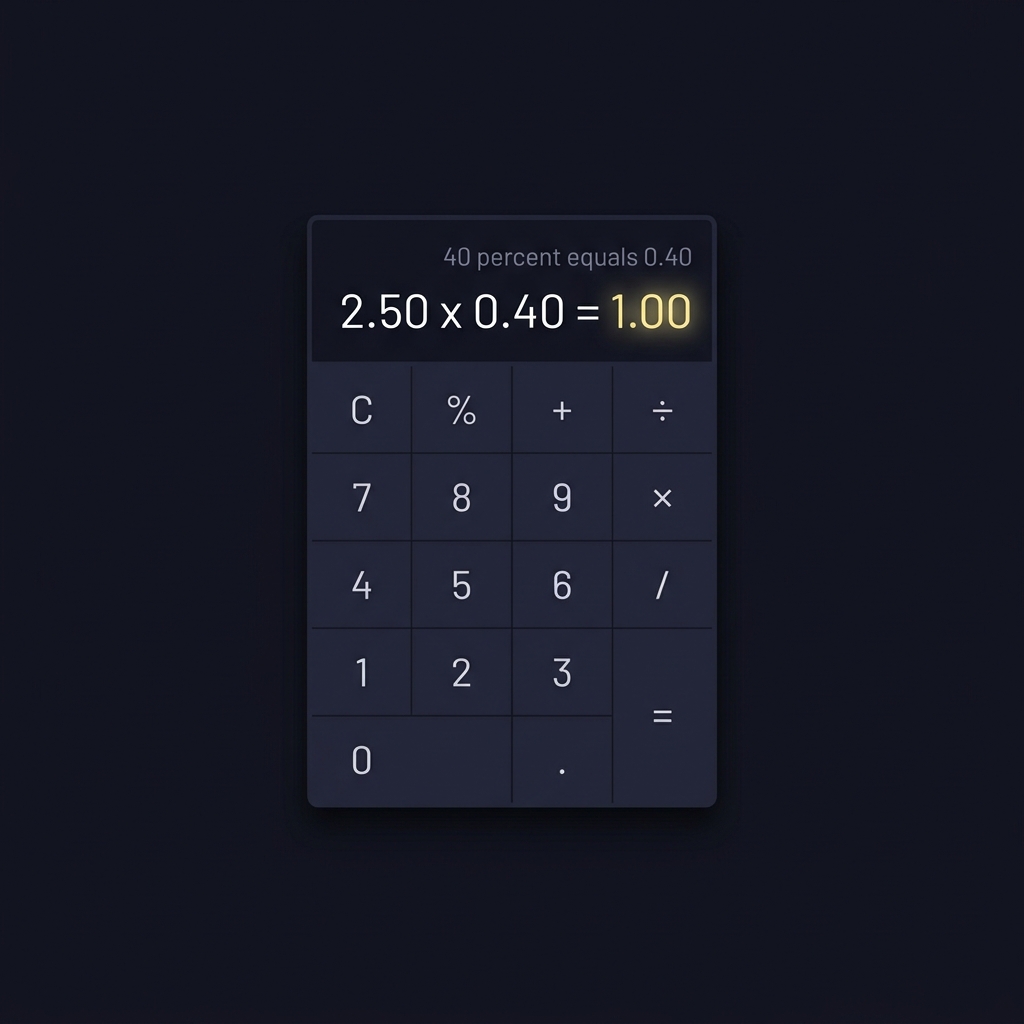
Decimal odds to probability, worked example. Formula: p = 1 / decimal_odds. If a bookmaker shows 2.50 in decimal odds, then p = 1 / 2.50 = 0.40, which as a percentage is 40 percent. This is simply the reciprocal of the decimal number and is the most direct conversion for decimal-format quotes Investopedia on decimal conversions. You can also use an online implied probability calculator such as OmniCalculator for quick checks.
Fractional odds to probability, worked example. Formula: fractional a/b maps to p = b / (a + b). If odds are 3/1, then a = 3 and b = 1, so p = 1 / (3 + 1) = 0.25, or 25 percent. Another way to see it is that fractional odds express profit relative to stake, and dividing the stake portion by total return gives the probability implied by the quoted payout Action Network fractional odds guide.
American (moneyline) odds to probability, worked examples. There are two cases to handle explicitly. For positive moneyline odds +X use p = 100 / (X + 100). Example: for +150, p = 100 / (150 + 100) = 100 / 250 = 0.40 or 40 percent. For negative moneyline odds -A use p = A / (A + 100) where A is the absolute value. Example: for -200, p = 200 / (200 + 100) = 200 / 300 = 0.6667, or 66.67 percent. These two-case rules are standard for moneyline conversions and match current educational resources Betfair Betting Education on moneyline odds.

Accounting for the bookmaker margin: overround and why implied probabilities sum above 100%
When you convert every quoted outcome in a market to implied probability and add them, the sum often exceeds 100 percent. That excess is the bookmaker margin, commonly called the overround. Bookmakers include this margin so quoted prices allow a profit margin across all possible outcomes, which explains why raw implied probabilities rarely sum to exactly 100 percent Wikipedia on overround.
Simple three-outcome overround example. Suppose a 1X2 soccer market shows implied probabilities after conversion of 45 percent, 35 percent and 30 percent. Adding those gives 110 percent, so the overround is 10 percentage points above 100. That extra 10 percent represents the built-in margin across the market rather than a true statistical probability distribution Pinnacle on calculating overround.
Use the standard formulas: decimal p = 1/decimal, fractional a/b p = b/(a+b), American +X p = 100/(X+100), and American -A p = A/(A+100); normalize if you need to remove the bookmaker margin.
Because the overround varies by sport, market and the specific bookmaker, the gap between raw implied sums and 100 percent is context dependent. Some markets are tight with small margins, others larger, so normalization is a practical step when you want to compare market-implied probabilities with a model that does not include margin Pinnacle on margin variability.
How to normalize implied probabilities to estimate fair probabilities
Normalization removes the bookmaker margin from a set of implied probabilities by scaling each implied probability so they sum to 100 percent. The exact step is: fair_p_i = implied_p_i / sum(implied_p_all). For example, if three outcomes have implied probabilities 45 percent, 35 percent and 30 percent, their sum is 110 percent. To normalize, divide each implied probability by 1.10, producing fair estimates 40.91 percent, 31.82 percent and 27.27 percent respectively. This is the standard normalization method used to estimate a market-implied fair distribution Pinnacle explains normalization.
Common mistakes, rounding errors and troubleshooting when converting odds
Frequent conversion errors come from misidentifying the odds format, forgetting the sign on American odds, and rounding intermediate steps too early. For example, treating 2.50 as fractional or stripping the negative sign from a -150 moneyline will produce large errors when you convert to probability. Confirm format and sign before you calculate Action Network on common mistakes.
Rounding can be misleading. Keep full precision through the conversion and only round the final percentage for display. Recalculate the percentages as a check: convert back from percentage to odds to see if you regain numbers consistent with the original quote. This quick sanity check catches many simple calculation-order mistakes UK Gambling Commission guidance on rounding and checks.

When you encounter inconsistent values in a data feed or a scraped price, verify the source format and any transformations applied upstream. If your toolchain normalizes or reformats odds automatically, document that step so your comparisons remain transparent and reproducible Action Network on data hygiene.
Practical scenarios: converting odds for multiple outcomes, parlays and model comparison
Converting a 1X2 soccer market. Convert each listed odds format to implied probability using the matching formula, then sum to see the overround. If the three implied probabilities are 50 percent, 30 percent and 25 percent the sum is 105 percent and the overround is 5 percentage points. Normalizing those implied probabilities gives a fairer basis to compare against a model's forecast Pinnacle on multi-outcome markets.

Parlays and accumulators change how probabilities combine: under independence, multiply the individual probabilities to get the parlay probability, but be careful because bookmaker parlay pricing often embeds its own rules and adjustments. Use normalized fair probabilities if you want a cleaner model-based parlay probability, but remember that bookmaker parlay offers are not simple multiplicative transforms of raw implied probabilities Pinnacle on practical parlay considerations.
Quick reference: aceodds odds converter cheat sheet and mini-calculator workflow
Cheat sheet, one-line formulas to copy: decimal: p = 1 / decimal. Fractional a/b: p = b / (a + b). American: +X => p = 100 / (X + 100), -A => p = A / (A + 100). These are the lines you can paste into a small spreadsheet or calculator for quick checks Investopedia quick formulas.
Mini-workflow you can follow each time: 1) Confirm the displayed format. 2) Convert each outcome to implied probability using the matching formula. 3) Sum the implied probabilities to measure the overround. 4) If you need a fair distribution for model comparison, normalize by dividing each implied probability by the sum. 5) Only then compare to your model or use multiplication for parlays. This short checklist keeps conversions consistent and traceable.
A short workflow to convert odds and check overround
Keep precision until the final step
Summary: What to remember and next steps for practicing conversions
Remember the core conversion formulas: decimal p = 1 / decimal, fractional a/b p = b / (a + b), and American +X or -A as the two-case moneyline rules. When you convert a full market, check the sum of implied probabilities: if it exceeds 100 percent you are seeing the bookmaker overround and may want to normalize before meaningful model comparison Pinnacle summary on normalization.
Practice exercises: convert several live markets in different formats, compute the overround, normalize the implied probabilities, and compare those normalized numbers to a simple model you build. Keep records of checks and rounding so you can reproduce your steps and avoid common calculation errors.
Implied probability is the percentage chance suggested by quoted odds, calculated with simple formulas that convert decimal, fractional or American odds into probabilities.
For negative moneyline odds -A, use p = A / (A + 100) with A as the absolute value, and keep the negative sign in place when identifying the format before converting.
Normalize when you want to remove the bookmaker margin and compare market-implied probabilities to a model or alternative fair estimate.
References
- https://www.aceodds.com/bet-calculator/odds-converter.html
- https://www.investopedia.com/terms/i/implied-probability.asp
- https://www.pinnacle.com/en/betting-articles/Betting-Strategy/how-to-calculate-bookmaker-margin
- https://www.actionnetwork.com/education/how-to-calculate-implied-probability
- https://help.smarkets.com/hc/en-gb/articles/214058369-How-to-calculate-implied-probability-in-betting
- https://www.gamblingcommission.gov.uk/consumer-guides/understanding-the-odds
- https://betting.betfair.com/education/what-is-implied-probability-160422-671.html
- https://en.wikipedia.org/wiki/Overround
- https://www.fundedplays.com/challenges
- https://www.fundedplays.com
- https://www.fundedplays.com/blogs/how-fundedplays-evaluations-work
- https://www.fundedplays.com/blogs
- https://www.omnicalculator.com/statistics/implied-probability