
Quick overview: what this article will cover
+8000 is a long-shot American moneyline price that many readers see and want to understand in plain terms. This article gives the exact math to convert +8000 into decimal and fractional formats, calculates implied probability, and shows concrete payout examples you can use immediately. It also points to a commonly used online verifier so you can double-check your arithmetic.
Readers who want a quick answer will find the conversion formulas, step-by-step calculations, and three stake examples ready to copy. Check our blog for related posts. The explanations follow standard, widely accepted formulas for positive American odds, and the worked conversions match calculator outputs used across the industry. For a live check, online converters reproduce the same rules used here and display decimal odds, fractional equivalents, implied probability, and example returns, which makes them useful for verification AceOdds odds converter.
The first practical point is simple: +8000 is a long-shot price that implies a small market probability and a large potential payout if the event wins. The rest of the article walks through the formulas, shows how to compute profit and total return for any stake, and gives guidance on when long-shot prices might fit a disciplined prediction or challenge plan.
Try challenge-style practice with structured evaluation
Please consider using a calculator to verify any conversions you plan to use in simulations or challenges, and continue reading for exact formulas and worked examples.
What does +8000 mean? Definition and context
In American moneyline notation, a positive price like +8000 states how much profit a typical $100 stake would earn if the selection wins. The plus sign signals a payout that is larger than the stake: +8000 means the market would pay $8,000 of profit on a $100-equivalent stake, before returning the original stake.
Calling +8000 a long-shot communicates that the market assigns a small implied probability to the outcome. Converting that price into implied probability uses a standard formula that treats the price as a market estimate rather than an objective chance; implied probabilities across markets often add to more than 100 percent because bookmakers include margin in their pricing Investopedia article on implied probability.
Put another way, +8000 sits near the long end of typical sports moneylines: it offers a high reward for a low implied chance, and it should be treated as a rare outcome in most sports contexts. The rest of this section and the article make those conversions explicit so you can judge prices responsibly.
Exact conversions: how to convert +8000 to decimal and fractional odds
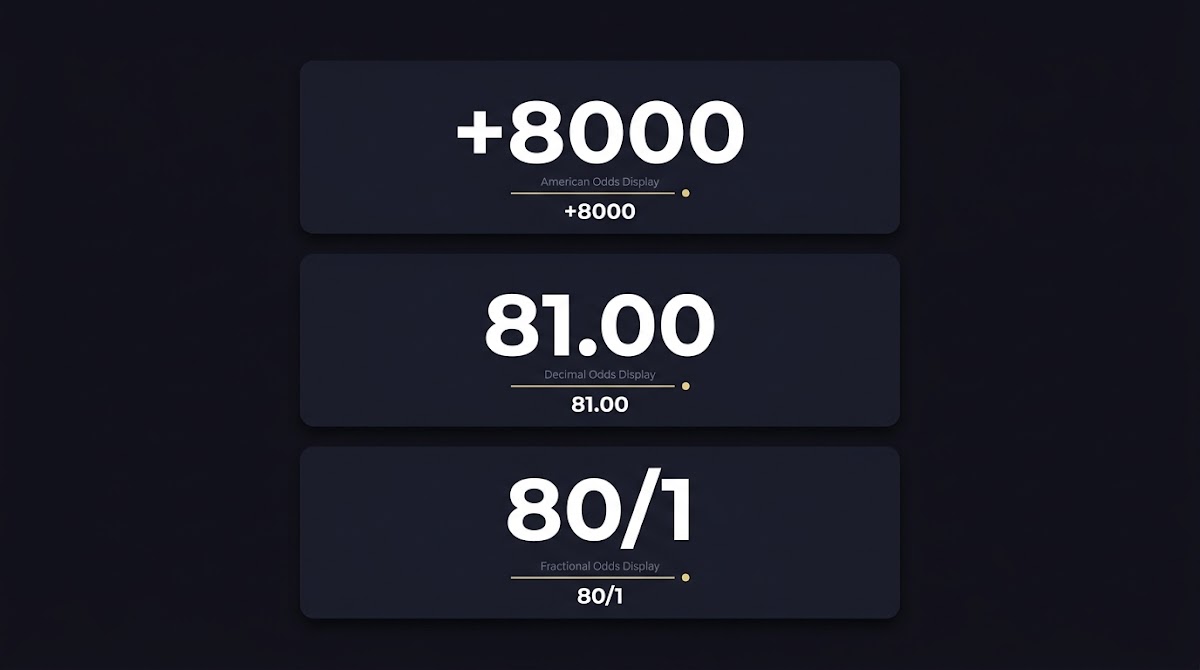
For positive American odds the standard decimal conversion is Decimal = 1 + (O ÷ 100), where O is the odds number without the plus sign. Applying that to O = 8000 gives Decimal = 1 + (8000 ÷ 100) = 1 + 80 = 81.00, so +8000 converts to 81.00 in decimal format AceOdds odds converter.
Fractional odds represent the ratio of profit to stake. For +8000 the fractional equivalent is roughly 80/1 because the profit is eighty times a $1 stake, and decimal 81.00 equals 80/1 expressed as a fraction plus the returned stake. The fractional and decimal formats map directly to the same economic outcome: a $1 stake becomes $81 total when decimal odds equal 81.00.
+8000 equals decimal 81.00 and fractional about 80/1, implies about 1.23 percent probability, and pays profit = stake × 80 so a $10 stake returns $810 total.
The conversion rule generalizes: for any positive American price O, divide O by 100 and add 1 to get the decimal number. That decimal minus 1 expresses the fractional profit relative to stake. This method works across positive moneyline prices and makes it easy to convert back and forth without specialized tools.
Quick conversion check: implied probability from +8000
To turn +8000 into an implied probability use the positive moneyline formula P = 100 ÷ (O + 100). With O = 8000 this yields P = 100 ÷ 8100, or about 0.012346, which converts to approximately 1.2346 percent implied probability Pinnacle resource on converting odds. You can also verify implied probability with an online calculator such as TheRundown implied probability calculator.
That percentage is the market price expressed as a chance, not a measured frequency. It is what a bettor would treat as the price for that outcome in a fair market model, but remember that bookmaker margin typically inflates summed implied probabilities, so the market price is not the same as an objective true probability Investopedia article on implied probability.

Payout math: how much you win at +8000
The universal payout formulas for positive American odds are straightforward. Profit = stake × (O ÷ 100). Total return = stake × (1 + O ÷ 100). These expressions give the profit separate from the stake and the combined payout including the stake, and they match standard calculators and payout tables Action Network explanation of American odds.
Apply the formulas to common stakes and you get concrete numbers that are easy to check in a calculator. The next paragraph lists three ready examples you can copy and scale to any stake.

Examples using the formulas above: for a $10 stake profit = 10 × (8000 ÷ 100) = 10 × 80 = $800 profit, so total return = 10 × (1 + 80) = $810. For a $50 stake profit = 50 × 80 = $4,000 profit and total return = $4,050. For a $100 stake profit = 100 × 80 = $8,000 profit and total return = $8,100. These calculations illustrate how the profit scales directly with stake and why small stakes are usually used on very long-shot prices to control risk.
In real systems remember to account for rounding rules, platform-specific minimums, and any fees or tax withholdings that may apply to gross returns, since those can change net payout compared to the simple arithmetic shown here Action Network explanation of American odds.
How to verify conversions quickly with a calculator
Online odds converters like AceOdds, Unabated, or Covers follow the same formulas shown earlier and display decimal, fractional, implied probability, and payout examples for the stake you enter. Using a calculator helps you avoid arithmetic slips, check rounding, and confirm that a platform returns the expected totals before you commit to a stake AceOdds odds converter.
quick verification of stake and total return for positive moneyline odds
Use integer odds without plus sign
When using any calculator, enter the positive odds number without the plus sign if the tool requests the numeric odds value. Confirm that the calculator shows the total return as stake × (1 + O ÷ 100) and the profit as stake × (O ÷ 100). A short verification step like this removes most common format mistakes and ensures the numbers you record in a simulation or challenge match expected outcomes.
When a +8000 price might be worth considering
Deciding whether to include a long-shot price like +8000 in a prediction portfolio requires a few checks. First, estimate your best assessment of the true probability and compare it to the market implied probability; if your estimate materially exceeds the implied probability then the pick has positive expected value in simple terms. Second, size the stake relative to your bankroll using a disciplined rule so a single long-shot outcome cannot ruin progress.
Long-shot prices require a very large edge to be profitable over the long run because the market already reflects vig and competition. In practical terms, only include +8000 picks when you have repeatable, evidence-based reasons to believe the true chance is meaningfully above the implied 1.23 percent, and when you can accept the high variance that comes with rare outcomes.
Common mistakes and pitfalls with long-shot odds
One frequent error is format confusion: treating decimal, fractional, and American numbers as interchangeable without conversion. That mistake leads people to misstate returns or forget to add the stake back into the total return. Always clarify whether a number is profit-only or total return to avoid this slip Pinnacle resource on converting odds.
Behavioral traps are also common. After a rare win users sometimes increase stake sizes on long shots because they overweight the recent success. That path increases volatility and undermines a disciplined expectation-driven approach. Keep stake-sizing rules fixed and record every pick to review long-run results, remembering that implied probability is a market price and not an objective likelihood Investopedia article on implied probability.
Scenarios and worked examples: $10, $50 and $100 stakes at +8000
Here are three step-by-step calculations you can copy. Start with the general total return formula: total = stake × (1 + O ÷ 100). Example 1, $10 stake: total = 10 × (1 + 8000 ÷ 100) = 10 × 81 = $810, profit = $800. Example 2, $50 stake: total = 50 × 81 = $4,050, profit = $4,000. Example 3, $100 stake: total = 100 × 81 = $8,100, profit = $8,000. These are direct applications of the earlier payout formulas and are the same numbers a standard converter will display AceOdds odds converter.
To scale the formula to any stake, substitute your stake amount into the same expressions. If you want profit only, compute stake × (O ÷ 100). If you want total cash back, compute stake × (1 + O ÷ 100). Double-check results in a calculator to avoid rounding errors and to confirm the platform you use does not apply alternate rounding or truncation rules that change the visible total Action Network explanation of American odds.
How +8000 fits into probability models and rarity context

One helpful way to think about +8000 is as an approximate 1-in-81 price in decimal terms or roughly a 1-in-80 chance when framed as a simple ratio. Saying it is about a 1-in-80 rare event helps with intuition: such outcomes are unlikely within a single trial and will typically fail many times before succeeding, which produces high variance in short samples Pinnacle resource on converting odds.
Keep perspective: implied probability is a market-derived price and can differ from true probability estimates based on deeper analysis. The inclusion of bookmaker margin means the market price is not a pure statistical estimate, so use the implied number as a pricing signal rather than a definitive measure of likelihood Investopedia article on implied probability.
Using +8000 in challenge or simulation platforms
On simulation and funded-challenge platforms long-shot results can swing short-term performance dramatically. Because a single long-shot win can create a large positive bump, and many losses produce steady drawdown, include long shots sparingly and record expected value estimates for each pick so you can review whether your selections are adding or subtracting EV over time. See Funded Plays for platform details.
When testing long shots in evaluations, use small, controlled stakes or scaled virtual units and track outcomes in a spreadsheet or the platform dashboard. Confirm platform-specific payout rules and any limits on credited returns, since simulated or challenge systems may apply different rounding or accounting that affects how wins are recorded relative to textbook math. You can read more about how Funded Plays evaluations work.
Quick checklist: what to do before you place a long-shot selection
Verify conversions: plug the American odds into a converter and confirm decimal and fractional equivalents match your calculations. Check implied probability to ensure you understand the market price AceOdds odds converter.
Decide stake size: use a bankroll rule that limits exposure to long-shot variance and record the pick. After settlement, log the result and update your long-run performance metrics so you can assess whether long-shot selections are adding expected value.
Conclusion: the short answer and next steps
Short answer: +8000 converts to decimal 81.00, fractional about 80/1, and implies roughly a 1.23 percent chance using the standard moneyline-to-probability formula, and the payout scales with stake using profit = stake × (O ÷ 100) AceOdds odds converter.

If you want to practice, run the same stake examples in a calculator and record outcomes in a tracking sheet. Use small stakes in simulations or funded-challenge environments, maintain disciplined bankroll rules, and treat implied probability as a market price rather than a guaranteed forecast Investopedia article on implied probability.
Divide 8000 by 100 and add 1; +8000 converts to decimal 81.00.
Use P = 100 ÷ (8000 + 100) to get about 1.23 percent implied probability.
A $50 stake at +8000 returns $4,050 total, which is $4,000 profit plus the $50 stake.
References
- https://www.fundedplays.com/blogs
- https://www.aceodds.com/bet-calculator/odds-converter.html
- https://www.investopedia.com/terms/i/implied-probability.asp
- https://www.pinnacle.com/en/betting-resources/betting-strategy/convert-odds-to-probability
- https://unabated.com/betting-calculators/odds-converter
- https://www.covers.com/tools/odds-converter
- https://therundown.io/betting-calculators/implied-probability-calculator
- https://www.actionnetwork.com/education/american-odds
- https://www.fundedplays.com
- https://www.fundedplays.com/challenges
- https://www.fundedplays.com/blogs/how-fundedplays-evaluations-work