
What does 0.001% mean for odds? Definition and context
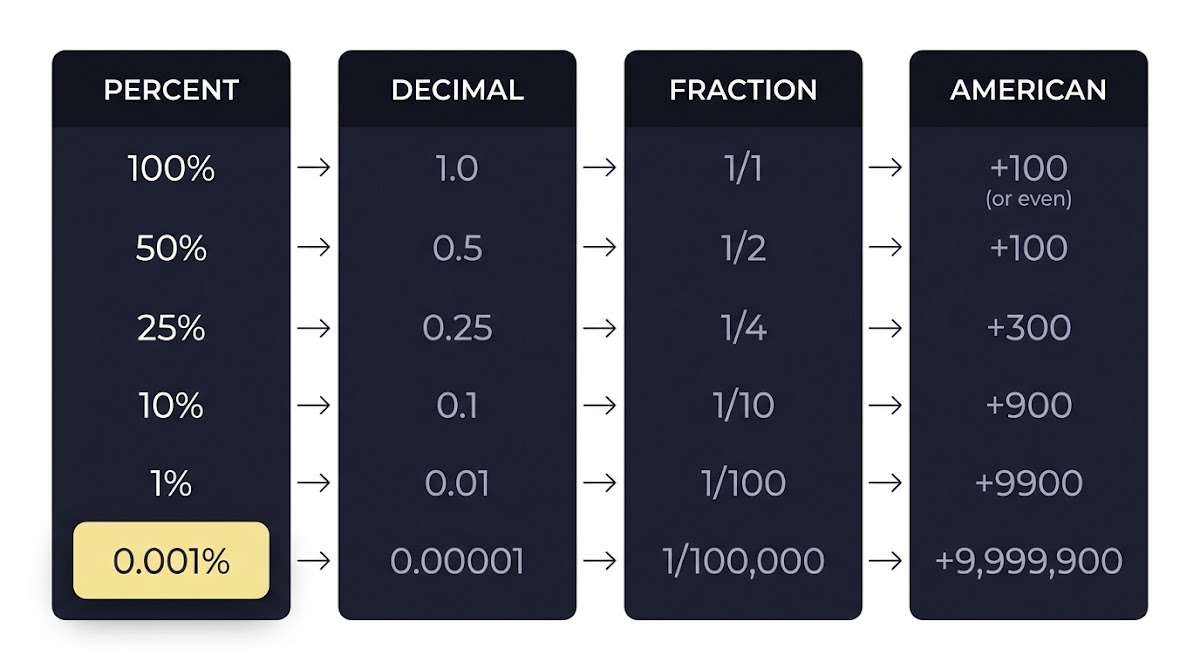
Start with the basic equality: a probability of 0.001 percent is 0.00001 in decimal form, which corresponds to a "1 in 100,000" chance when expressed as an event frequency; this simple equivalence is the foundation for all standard odds conversions and is commonly shown in reference summaries of odds and probability Odds (Wikipedia)
Probability and odds are two ways to describe the same likelihood. Probability is a share of outcomes (a percent or a decimal between zero and one), while odds compare success to failure in a profit:stake style. Translating one into the other is algebraic and exact when you assume a fair, no-margin conversion.
Convert a tiny probability into matching decimal odds using exact fields
Use high-precision input for small probabilities
That distinction matters because many displays and calculators show both representations side by side: a percent for readability, a decimal for payout math, and a "1 in X" for intuitive frequency. Keeping the units straight avoids errors later in conversion steps.
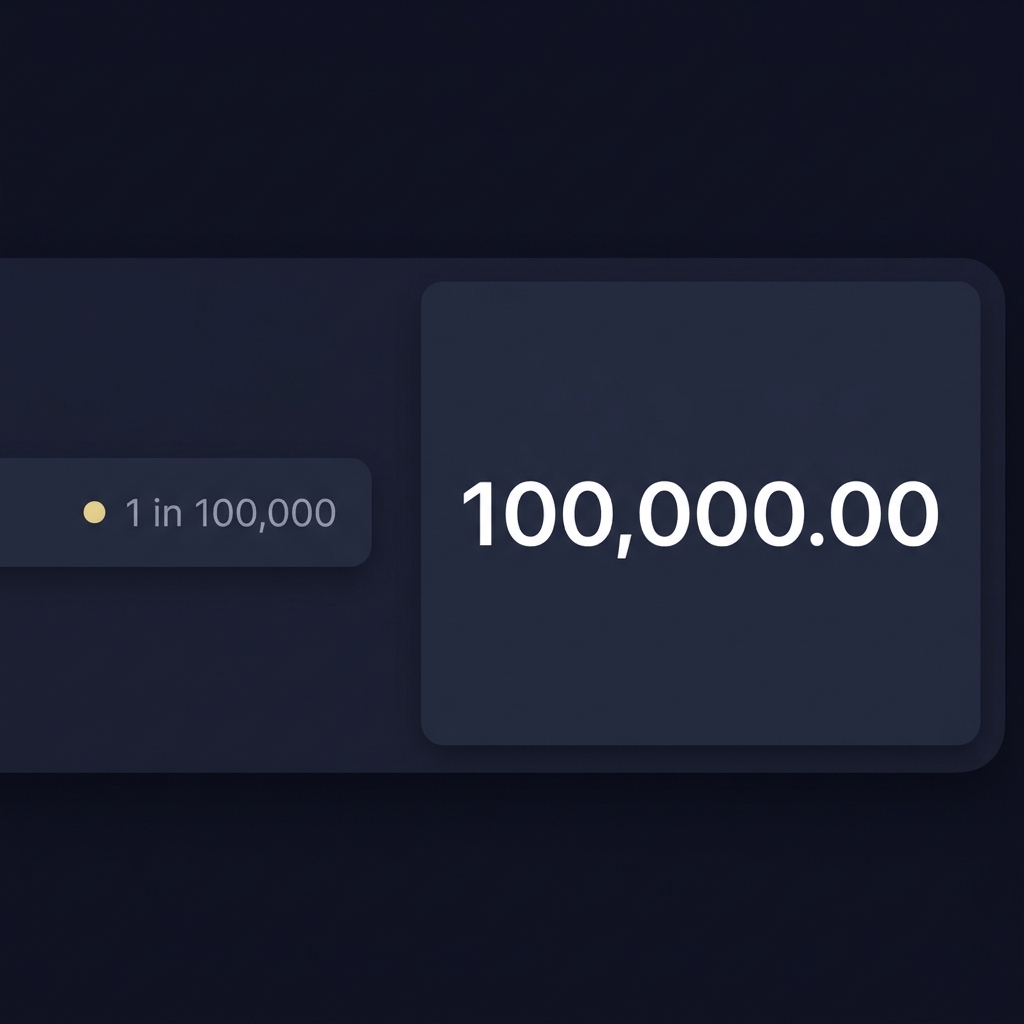
This article will use fair, no-margin formulas as the baseline. In other words, when I say "decimal odds = 100,000.00" I mean the pure mathematical reciprocal without any sportsbook margin applied; marketplaces often adjust prices to include vigorish which changes the market-expressed probability.
The first practical point is readability. Very small probabilities convert to very large odds, and different audiences prefer different displays: statisticians often prefer the decimal or scientific notation, while a general audience understands "1 in 100,000" more quickly.
For readers who work with converters or calculators, note that the label or input unit matters: some tools want percent (0.001), some want decimal probability (0.00001). Mixing those up will multiply or divide your result by 100 unnecessarily, so always confirm the expected unit before you compute.
For those who compare tool outputs, an odds converter that explicitly shows the “1 in X” line alongside decimal, fractional, and American odds is helpful for readability and cross-checking; some services include that alongside their conversions to avoid misinterpretation AceOdds odds converter and tools such as Unabated's odds converter.

To keep later steps reproducible, I will state formulas explicitly and substitute p = 0.00001 throughout. The rest of the article walks through the headline conversions, the arithmetic steps, display issues with large ratios, and practical guidance on choosing the right representation for your audience.
Quick conversion summary: 0.001% across formats
Here are the headline results for p = 0.001% (that is, p = 0.00001) under fair, no-margin assumptions: decimal odds = 100,000.00, fractional odds = 99,999/1, American moneyline (underdog) ≈ +9,999,900. These are the direct algebraic outcomes you get when you apply the standard formulas used in probability-to-odds conversion Investopedia implied probability
Expressed as an event frequency, the same input is "1 in 100,000", which is often the clearest single-line summary for non-technical readers and for display in converter results.
Each format has its practical use: decimal odds are used for payout calculations, fractional odds show profit relative to stake, and American odds show how much a bettor would win on a 100-unit stake for an underdog or how much must be staked to win 100 units for a favorite.
Step-by-step conversions and formulas
Decimal odds: reciprocal formula and precision considerations
Decimal odds are the reciprocal of the underlying probability in decimal form: decimal = 1 / p. Substituting p = 0.00001 gives decimal = 1 / 0.00001 = 100,000.00. This reciprocal relationship is the canonical definition used in implied-probability discussions and converter implementations Investopedia implied probability or a calculator such as the Action Network odds calculator.
Because this is a simple reciprocal, the main precision concern is the numeric representation: a standard calculator should show 100,000.00 for a two-decimal display, but scientific or high-precision tools avoid rounding issues when p is even smaller. For computational work, use a high-precision numeric type or a text-based fraction approach to preserve exactness.
Treat 0.001% as p = 0.00001 and apply standard formulas: decimal = 1/p = 100,000.00, fractional = (1−p)/p = 99,999/1, American (underdog) ≈ +100×(1/p − 1) = +9,999,900, with the caveat that real market prices include vigorish.
Fractional odds: deriving profit:stake and reducing large fractions
Fractional odds express profit relative to stake and convert from probability using fractional = (1 − p) / p. For p = 0.00001, substitute to get fractional = (1 − 0.00001) / 0.00001 = 99,999 / 1. That numerator is the number of units profit per unit staked under a fair conversion, which is consistent with standard fractional-odds definitions Fractional odds (Investopedia)
Large fractional ratios like 99,999/1 are mathematically valid but often impractical for display; many interfaces will either show the reduced fraction as-is, cap the display, or prefer the "1 in X" row for clarity. When you need exact payoff math, fractional odds directly map to profit calculations: stake × numerator gives profit under a single-unit stake.
American odds: formulas for favorites and underdogs
American moneyline odds convert differently depending on whether the selection is a favorite or an underdog. For an underdog, the formula under a fair conversion is American = +100 × (1 / p − 1). Substituting p = 0.00001 gives American ≈ +100 × (100,000 − 1) = +9,999,900, which is the standard moneyline expression for very longshots under no-vig math Moneyline (Investopedia)
For favorites the formula flips to a negative number and uses the inverse sign and scaling, but that scenario does not apply here because a 0.001% probability is an extreme underdog rather than a favorite.
Fractional and American odds: handling very large ratios and display choices
When fractional odds reach sizes like 99,999/1, many user interfaces prioritise readability over literal fraction display. Sites may truncate digits, use scientific notation, or show an alternative such as "1 in 100,000" to prevent confusion. The fractional result remains correct as an arithmetic expression of profit versus stake, but display conventions vary and can affect how a casual viewer interprets the number Fractional odds (Investopedia)
Similarly, American odds like +9,999,900 are mathematically correct in a fair-conversion context but quickly become unwieldy to read and to format in interfaces built around more typical market ranges. For this reason, many converters will round, cap displayed values, or present the moneyline only when the implied odds fit within a practical range for their UI; AceOdds and similar tools typically show the 1-in-X alongside other fields to preserve clarity AceOdds odds converter and others such as Covers odds converter.
From a developer or analyst perspective, choose the representation that fits the user's task: use decimal odds for payout calculations, fractional for legacy or region-specific presentation, and "1 in X" for broad comprehension.
Worked examples and AceOdds converter output
Full numeric substitution for p = 0.001% (p = 0.00001) yields these exact fair conversions: percent = 0.001%, decimal = 100,000.00, fractional = 99,999/1, American (underdog) ≈ +9,999,900, and frequency = 1 in 100,000. Each of these follows directly from the formulas shown earlier and is what a no-vig converter will report.

Converter interfaces differ in precision choices: some display decimal odds to two decimal places, some show the fractional numerator as an integer, and some present American odds rounded to the nearest whole number. When you want a consistent snapshot for reports, note the rounding policy and include a one-line note about whether numbers represent fair, no-vig math. For more background on how our evaluations are handled, see how Funded Plays evaluations work.
Real markets, sportsbook margin, rounding and display limits
In real bookmaker markets, prices include a margin called vigorish or overround, which means the posted odds imply probabilities that sum to more than 100 percent; that structural margin causes offered prices to deviate from the fair no-vig conversions shown above Vigorish (Investopedia)
Practically speaking, tiny true probabilities will rarely appear in markets at their pure reciprocal price because bookmakers round, cap, or otherwise adjust prices both for risk management and for simple display limits. For example, a site might cap displayed American odds at a fixed maximum, or show a simplified "100,000 to 1" label instead of an exact fractional numerator to keep interfaces readable.
When you are using model outputs for decision-making, treat the fair conversions as a methodological baseline and compare them to market quotes that include vig. The gap between baseline and market is a combination of margin, liquidity, and the bookmaker's internal risk policy, not a failure of the underlying reciprocal math.
One frequent error is unit mismatch: entering 0.001 when a tool expects 0.00001 (percent versus decimal) will produce a result that is off by two orders of magnitude. Always confirm the required input unit before converting and, if possible, test with a known case such as 50% = 2.0 decimal to validate the tool.
Floating-point precision is another known trap. Low-precision calculators, spreadsheets with default formatting, or languages that use single-precision arithmetic can round very small probabilities to zero or produce inaccurate reciprocals. Use high-precision types, arbitrary-precision libraries, or string-based fraction handling when exactness matters Investopedia implied probability
Quick checks for troubleshooting: verify units (percent versus decimal), confirm reciprocal arithmetic with a second tool, and compare the converter's "1 in X" line with the decimal reciprocal to ensure both match logically. If they diverge, the tool may be applying vig, rounding, or input interpretation that differs from your expectation; check its documentation.
When and how to use these conversions: decision criteria and scenarios
Use fair conversions as a baseline in modeling, academic reporting, backtests, or any context where you need an exact mathematical relationship between probability and payout. For actionable betting decisions, however, the market price matters because it reflects vig, liquidity, and competitor positioning. See the Funded Plays blog for related posts.
See how challenges and rules shape evaluation outputs
If you want to compare a model output to live converter results, use a precision-friendly odds converter and verify whether displayed fields include vig or a "1 in X" row for readability.
For presenting extreme odds to non-technical audiences, prefer the "1 in X" phrasing because it communicates rarity directly. For calculation or payout tables, show decimal odds with a brief parenthetical that states the assumed unit and whether margins are included.
Keep in mind platform rules and presentation constraints: some services cap or round odds for display, and reward mechanics on skill-based challenge platforms depend on the platform rules rather than the raw reciprocal math. For platform details, see Funded Plays.
Wrap-up: key takeaways and next steps
Core numeric summary: 0.001% equals 0.00001, which is 1 in 100,000; fair conversions give decimal 100,000.00, fractional 99,999/1, and American moneyline (underdog) ≈ +9,999,900. For clarity, an odds converter that shows the "1 in X" line alongside other formats makes interpretation easier AceOdds odds converter
If you need exact payout math, use decimal odds and high-precision arithmetic. If you are comparing model outputs to market prices, factor in vigorish and check how interfaces round or cap extreme values.
0.001% is 0.00001 in decimal probability, which corresponds to 1 in 100,000 when expressed as an event frequency.
No, sportsbooks add margin (vigorish) and often round or cap values, so posted prices will usually differ from fair no-vig conversions.
Use decimal odds for precise payout math and high-precision tools when probabilities are very small.
References
- https://en.wikipedia.org/wiki/Odds
- https://www.aceodds.com/odds-converter.html
- https://www.investopedia.com/terms/i/implied-probability.asp
- https://unabated.com/betting-calculators/odds-converter
- https://www.fundedplays.com/challenges
- https://www.investopedia.com/terms/f/fractionalodds.asp
- https://www.investopedia.com/terms/m/moneyline.asp
- https://www.covers.com/tools/odds-converter
- https://www.investopedia.com/terms/v/vigorish.asp
- https://www.actionnetwork.com/betting-calculators/betting-odds-calculator
- https://www.fundedplays.com
- https://www.fundedplays.com/blogs/how-fundedplays-evaluations-work
- https://www.fundedplays.com/blogs