
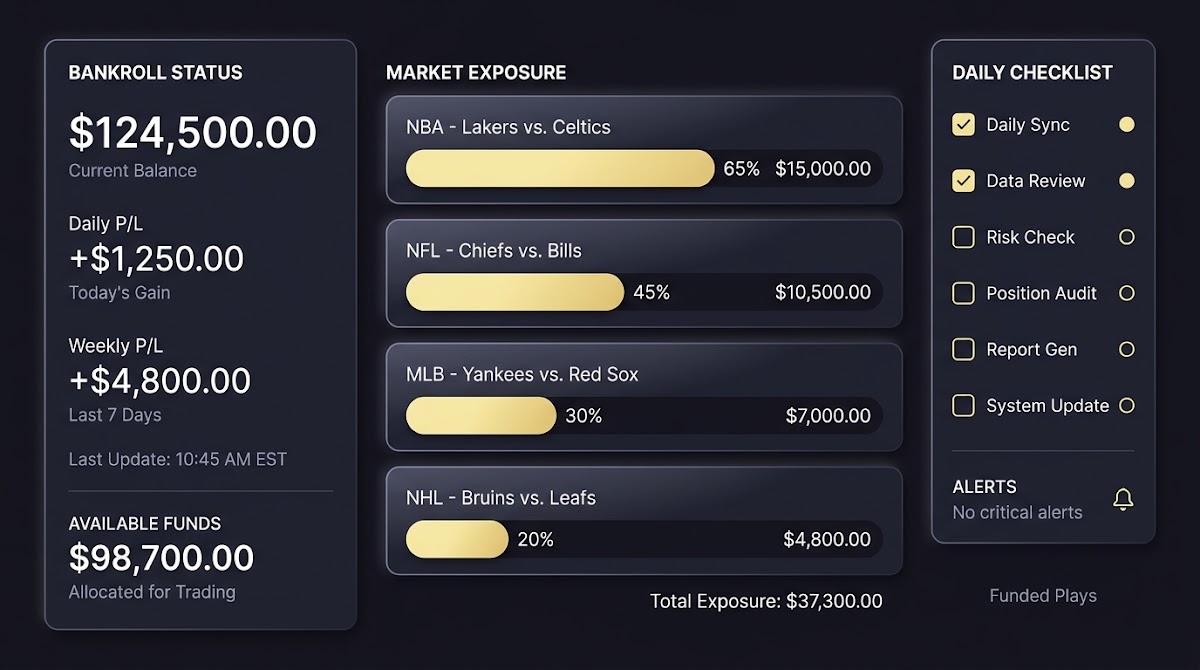
What a practical risk management framework for sports traders is and why it matters
Definition in plain terms
A Practical Risk Management Framework for Sports Traders is a compact set of rules and procedures that define what risk a trader will accept, how to measure it, and how to respond when limits are hit. The framework spells out objectives, a clear risk appetite, measurable limits and monitoring steps so decisions are repeatable and auditable. This principles-based approach mirrors established risk standards and helps sports traders treat prediction as a repeatable process rather than a string of one-off bets. For guidance on principles and continuous improvement, see the ISO risk management guidelines here ISO 31000 risk management guidelines. See also an overview at Riskonnect.
Why this matters is straightforward: without explicit appetite and limits traders tend to drift into larger stakes after wins, chase losses after bad runs, or overlook aggregate exposure across games and markets. A written policy reduces those behavioral failures by turning informal habits into concrete controls that can be measured and reviewed. That in turn supports consistent performance and loss control over sequences of predictions, even though no framework can guarantee profit or remove all risk.
Get the one-page risk policy template
Download a one-page checklist or starter policy template to turn these ideas into a practical document you can adapt for personal or small-team use.
How this differs from casual betting or investing
Compared with casual betting, a trading-style framework emphasizes repeatability, position sizing, portfolio limits and documented review steps rather than one-off wagers or gut calls. Compared with traditional investing, sports trading often involves many short-lived positions and stronger correlations across outcomes, so the framework focuses more on rapid monitoring and explicit drawdown controls. Treating sports prediction as a trading process supports disciplined learning and reduces the chance that individual mistakes compound into large losses.
Core principles: set objectives, appetite, limits and controls
Define measurable objectives and risk appetite
At the heart of an operational framework are measurable objectives, a declared risk appetite and basic governance rules. ISO 31000 lays out a principles-based process for defining appetite, implementing controls and continuously improving the policy, which is directly applicable to sports trading frameworks ISO 31000 risk management guidelines. See a practical guide by FlowForma.
Measurable objectives can be framed as non-prescriptive targets such as acceptable drawdown ranges, a tolerance for variance in returns, or performance stability goals. These examples are qualitative descriptions to guide policy design rather than numeric mandates. Clear objectives make it possible to convert appetite into concrete limits and automated checks.
Translate appetite into concrete limits and rules
Once appetite is declared, translate it into specific, auditable rules: single-position caps, daily loss stops, portfolio exposure limits and required cooldowns after breaches. Governance assigns who may change limits and how often the policy is reviewed. Having named decision-makers and a review cadence maintains the discipline that appetite alone cannot enforce.
Controls should be simple to implement and monitor. A short rulebook of measurable gates reduces ambiguity and makes it easier to detect when behavior or models stray from the intended risk profile.
A step-by-step framework: limits, sizing, monitoring and review
Step 1: Set objectives and appetite

Start by writing a one-page statement of purpose that lists what risk you accept and why. Include measurable outcomes you will track, such as realized drawdown or streak length. This statement anchors later rules and provides the basis for all limits and review triggers.
Quantify the tolerance in descriptive terms and then map those descriptions to the limits you will set in step 2. Treat the objectives as living; specify a scheduled review so they do not become stale.
Step 2: Define position sizing and exposure rules
Position sizing converts declared appetite into stake sizes for individual predictions. The sequence is important: decide how much of your bankroll you are willing to risk per position and how that changes with correlated exposure. Position sizing must be explicit and auditable so post-mortems can test whether the rules were followed.
Sizing rules should be simple enough to implement reliably. Keep sizing logic visible and testable in spreadsheets or a risk tool so edge estimates and adjustments are transparent.
Translate appetite into measurable limits by declaring objectives, mapping those objectives to single-position and portfolio caps, choosing a staking rule such as fractional Kelly or fixed fraction, and implementing monitoring and recovery protocols so execution is auditable and reviews are triggered when limits are breached.
Step 3: Implement limits and monitoring
Implement the rules as either automated checks or documented manual gates. Limits to consider include single-position caps, maximum concurrent exposure, daily loss stops and session time limits. Monitoring should produce alerts and a clear audit trail whenever limits are approached or exceeded so governance can act quickly.
Define review triggers in advance, for example when drawdown or variance crosses descriptive thresholds in your objectives statement. Those triggers ensure reviews are reactions to measurable outcomes rather than ad hoc feelings.
Step 4: Review, learn and adjust
Regular review cycles and post-mortems close the loop on learning. Use scheduled reviews to revisit assumptions, check how edge estimates behaved, and update limits when justified by evidence. Keep a revision log so changes are auditable and reversible if needed.
Documentation is part of the control: record the reason for each policy change, the data that motivated it and the expected impact. This habit reduces hindsight bias and preserves institutional memory.
Position sizing rules: applying Kelly pragmatically
Why full Kelly is rarely used as-is
The Kelly criterion is a mathematical rule that, under ideal assumptions, maximizes long-run log growth. In practice those assumptions rarely hold in sports prediction because edge estimates are noisy and win probabilities are uncertain. That makes full Kelly sensitive to estimation error and can produce large drawdowns when the assumed edge is overstated. For a foundational treatment of the Kelly approach and its limitations, see a classic discussion of the criterion The Kelly Criterion by Edward O. Thorp.
Because of estimation risk and model error, many practitioners choose more conservative approaches that preserve the spirit of proportional sizing while dampening volatility.

Fractional Kelly and safer practical alternatives
Fractional Kelly scales the full Kelly stake by a factor less than one to reduce sensitivity to estimation mistakes and to lower short-term drawdown risk. While fractional Kelly keeps the growth orientation of Kelly, it introduces an explicit conservatism that traders can tune based on confidence in their edge. This pragmatic adaptation is widely recommended in applied settings to trade off growth against drawdown risk.
Other practical rules include simple fixed-fraction staking and capped Kelly with hard maximums per position. The key is to combine sizing with portfolio-level limits and recovery rules so no single sizing approach can create outsized aggregate exposure.
Portfolio-level exposure and correlation: aggregate limits that matter
Why correlated positions amplify drawdown
When bets or predictions are correlated, their risks do not add linearly, they reinforce each other. Multiple small positions on similar underlying events can create concentrated portfolio exposure that looks safe in isolation but increases variance and drawdown in practice. Portfolio-level limits acknowledge that exposure aggregates across correlated positions and prevent unexpected large losses from a cluster of related outcomes.

Express exposure caps at the portfolio level rather than only as single-position limits. That can mean limiting maximum concurrent exposure to related markets, capping the number of simultaneous positions on the same team or player, or declaring maximum aggregate risk to a single event. These rules make concentration visible and manageable.
How to translate single-bet sizing into portfolio caps
Translate single-bet percentage rules into portfolio caps by measuring correlation and enforcing a maximum aggregate stake on correlated groups. For practical implementation, maintain a simple mapping of markets and a rulebook for which markets count as correlated. That lets you compute a running tally of aggregate exposure and apply pre-declared caps before new positions are accepted.

Make these checks part of your monitoring so decisions on new positions consider existing exposures and the portfolio-level risk budget. Where automation is not available, require manual sign-off when correlated exposure nears policy gates.
Daily limits, pre-commitment and regulatory alignment
How regulator rules inform good trading practice
Recent regulatory moves illustrate why preset limits and pre-commitment are sensible features of a risk policy. The UK Gambling Commission updated financial risk checks in 2024 and 2025 with staged deposit thresholds, highlighting the value of staged limits and oversight UK Gambling Commission financial risk checks.
Regulatory frameworks are not direct templates for all trading policies, but they underscore common sense practices such as pre-commitment, staged limits and oversight that translate into daily loss caps and cooling-off mechanisms in a trader policy.
Designing deposit, loss and time limits that align with compliance
New Jersey’s rules for internet gaming require platforms to offer deposit, spend and time limits and self-exclusion tools, which map cleanly to behavioral controls in a trader-style policy New Jersey Division of Gaming Enforcement responsible gaming guidance.
Design limits so they are simple to use, easy to change after a mandatory delay and visible in audit logs. That combination helps enforce pre-commitment while preserving an avenue for traders to reassess limits after a cooling-off period or formal review.
Monitoring, reporting and review: what to track and how often
Key risk KPIs for sports traders
Choose a compact set of KPIs that reveal risk accumulation and model drift: realized drawdown, current streaks of losses or wins, exposure concentration by market, average stake as a share of bankroll and a simple measure of edge estimation error. Keep the KPI set small so it is monitored reliably and acted on when triggers are hit.
Automated alerts tied to these KPIs help enforce limits in real time and reduce the need for manual oversight during busy sessions. Maintain an audit trail for all limit breaches and policy changes so reviews have a faithful record of what happened and why.
single-sheet risk monitoring template for daily review
Use daily to keep review cadence consistent
Automated alerts and audit trails
Automated alerts should be simple: flag when drawdown reaches a descriptive gate, when exposure concentration rises above policy rules, or when streak metrics exceed normal operating ranges. Alerts must include context and a required action, for example suspend new positions until a review is completed. Keep audit trails that record who approved any overrides and the justification for changes.
Regular governance reviews, informed by these logs and alerts, implement the ISO principle of continuous improvement and ensure controls remain relevant as trading behavior and markets evolve.
Recovery protocols, stop rules and cooling-off mechanisms
Defining stop-loss and recovery escalation
Define staged stop rules that temporarily restrict activity when adverse runs occur. A recovery protocol describes the sequence of steps after a stop is hit: immediate halt, documented post-mortem, a mandatory cool-off period and a formal review before resuming normal stake sizes. Make the escalation explicit so traders and reviewers understand the path from breach to resume.
These stages turn reactive frustration into procedural steps where the focus is on learning rather than punitive action. Document the criteria and who is responsible for each step so the process is auditable.
Behavioral cooling-off features
Cooling-off features borrowed from responsible-gaming frameworks let traders step away in a non-punitive way. Pre-committed timeouts, enforced waiting periods after large losses and optional self-exclusion functions are behavioral tools that can be adapted into a trading policy to prevent emotionally driven decisions.
Regional responsible-gaming frameworks have emphasized pre-commitment and cool-offs as practical measures that blend well with disciplined recovery protocols.
Stress testing and scenario analysis for sports trading portfolios
Designing stress scenarios using correlation and streak assumptions
Stress tests should combine correlation assumptions with streak risk to reveal hidden concentrations and tail risk. Construct scenarios that look like clusters of adverse outcomes rather than single-event shocks, because correlated losses are the main source of unexpected portfolio drawdown in sports trading.
Keep scenarios simple and conservative so they serve as actionable warnings rather than model curiosities. The goal is to ensure your portfolio limits would hold under a credible cluster of bad outcomes.
Using backtests and forward simulations carefully
Backtests are informative but limited by historical samples and changing markets. Use forward simulations with conservative assumptions about edge and variance to understand potential drawdowns under different correlation settings. Treat these exercises as complements to policy design and not as guarantees.
Document assumptions and include a record of scenario outcomes so reviews can track whether past assumptions remain valid.
Common mistakes sports traders make and how to avoid them
Overconfidence in edge estimates
One predictable mistake is over-relying on point estimates of edge and then staking too aggressively. Because edge estimates can be noisy, practitioners often prefer fractional Kelly or fixed-fraction rules to reduce the consequences of overconfidence. Combining sizing rules with portfolio limits reduces the chance a single misestimate creates outsized damage Discussion of Kelly limitations and fractional approaches.
Regular post-mortems and conservative assumptions about edge help counteract overfitting and unwarranted confidence in models.
Ignoring portfolio correlation and poor record keeping
Another common failure is focusing only on single-position rules while ignoring aggregate exposure. Correlated bets can silently concentrate risk and produce larger drawdowns than expected. Maintain simple records that map positions to correlated groups and track aggregate exposure routinely.
Good record keeping, combined with scheduled reviews, prevents small mistakes in correlation assessment from becoming major losses.
Practical scenarios and templates: conservative, balanced and growth-minded approaches
Qualitative scenario walk-throughs
Conservative: a trader focused on capital preservation uses small fixed-fraction stakes, tight portfolio caps and long mandatory cooling-off steps after any stop. The emphasis is on stable bankroll retention and frequent review rather than aggressive growth.
Balanced: a trader seeking steady growth uses fractional Kelly with conservative scaling, portfolio exposure limits and a clear recovery protocol. Reviews occur regularly and all changes are documented in a revision log.
Growth-minded: a trader willing to accept higher variance uses larger fractional scaling, wider portfolio caps and shorter cooling-off windows, but preserves hard absolute drawdown stops to avoid ruin. Even aggressive approaches benefit from explicit documentation and review rules.
Template policy elements to copy and adapt
Include these elements when drafting a policy: purpose statement, measurable objectives, single-position sizing rule, portfolio exposure rules, daily and session limits, recovery protocol, review cadence and a revision log. Keep the template concise so it is used rather than ignored.
Document assumptions behind sizing choices and list who can approve exceptions. The clarity makes enforcement practical for solo traders and small teams alike.
Quick implementation checklist and governance steps
A minimal viable policy checklist
Start with a short checklist: declare objectives and appetite, set single-position and portfolio limits, implement daily monitoring and alerts, define recovery protocol and schedule the first review. Make the checklist actionable with owners and deadlines so implementation is straightforward.
Align platform-level controls with regional regulations for deposit and time limits where applicable, and ensure all limit changes are recorded in the revision log for auditability.
Who should sign off and review
Assign a named owner for the policy and a second reviewer for periodic audits. Decide a regular review cadence and specify what triggers an extraordinary review, such as an unexpected drawdown or a significant model change. Having named responsibilities makes follow-through realistic.
Where a funded or challenge platform is used, align your personal policy with the platform rules and disclosure requirements so limits are enforceable and documented.
Conclusion: maintaining discipline and continuous improvement
Key takeaways
A practical framework focuses on measurable objectives, explicit appetite, concrete limits and continuous monitoring. Use conservative sizing adaptations of growth-oriented methods, such as fractional Kelly, and always combine sizing with portfolio-level limits and recovery procedures. Remember that a policy reduces avoidable losses but does not guarantee profits.
Next steps to adopt the framework
Write a one-page policy, implement a daily monitoring template, run a few stress scenarios and schedule a 90-day review. Keep a revision log and treat the policy as a living document that evolves with new evidence and experience. Prioritize responsible participation, clear records and disciplined review so the framework serves long-term improvement rather than short-term reaction.
Fractional Kelly reduces stake sizes compared with full Kelly to lower sensitivity to edge-estimation error and to limit short-term drawdowns, making staking more robust when win-probabilities are uncertain.
Regulatory limits are useful benchmarks; aligning personal deposit and time limits with regional responsible-gaming rules promotes safer practice and easier compliance where platform controls exist.
No. A risk framework reduces avoidable losses and manages variance, but it does not guarantee profits or eliminate risk; outcomes still depend on predictive edge and market conditions.
References
- https://www.iso.org/standard/65694.html
- https://riskonnect.com/business-continuity-resilience/the-basics-of-iso-31000-risk-management/
- https://www.flowforma.com/blog/iso-31000-risk-management
- https://www.metricstream.com/learn/iso-31000-framework-guide.html
- https://www.edwardothorp.com/sitebuildercontent/sitebuilderfiles/KellyCriterion2007.pdf
- https://www.fundedplays.com/challenges
- https://www.gamblingcommission.gov.uk/news/article/financial-risk-checks-update
- https://www.njoag.gov/divisions-and-offices/division-of-gaming-enforcement-home/responsible-gaming/
- https://www.fundedplays.com
- https://www.fundedplays.com/blogs
- https://www.fundedplays.com/blogs/how-fundedplays-evaluations-work