
Quick answer: what 8 to 1 means (and why 80 to 1 odds may show up in searches)
One-sentence bottom line
Fractional odds quoted as 8/1 mean you earn eight units of profit for every one unit you stake, and the total payout includes your original stake so the full return is nine times what you put down Investopedia odds primer.
Short note on common search phrasing
People sometimes type or read "80 to 1 odds" when they mean 8/1, or they may be looking for 80/1 which is a very different price; the numeric labels change the math and expected return, so double-check the digits before calculating any payout Odds reference and see the Funded Plays blog.
Verify payouts quickly with simple math
Try the short formulas and a couple of worked examples below to verify a payout yourself before relying on a quoted return.
How fractional odds work: the formulas for profit and payout (example 8/1)
Formal formulas
The standard formulas for fractional odds a/b are easy to remember: profit = stake times a divided by b, and payout = stake times the decimal conversion 1 plus a divided by b, so profit = stake × (a/b) and payout = stake × (1 + a/b) Odds reference.
Plain-language translation
Applied to 8/1, those formulas mean profit = 8 times the stake and payout = 9 times the stake because 1 + 8/1 equals 9, a stable relationship used across betting and educational guides Odds overview.
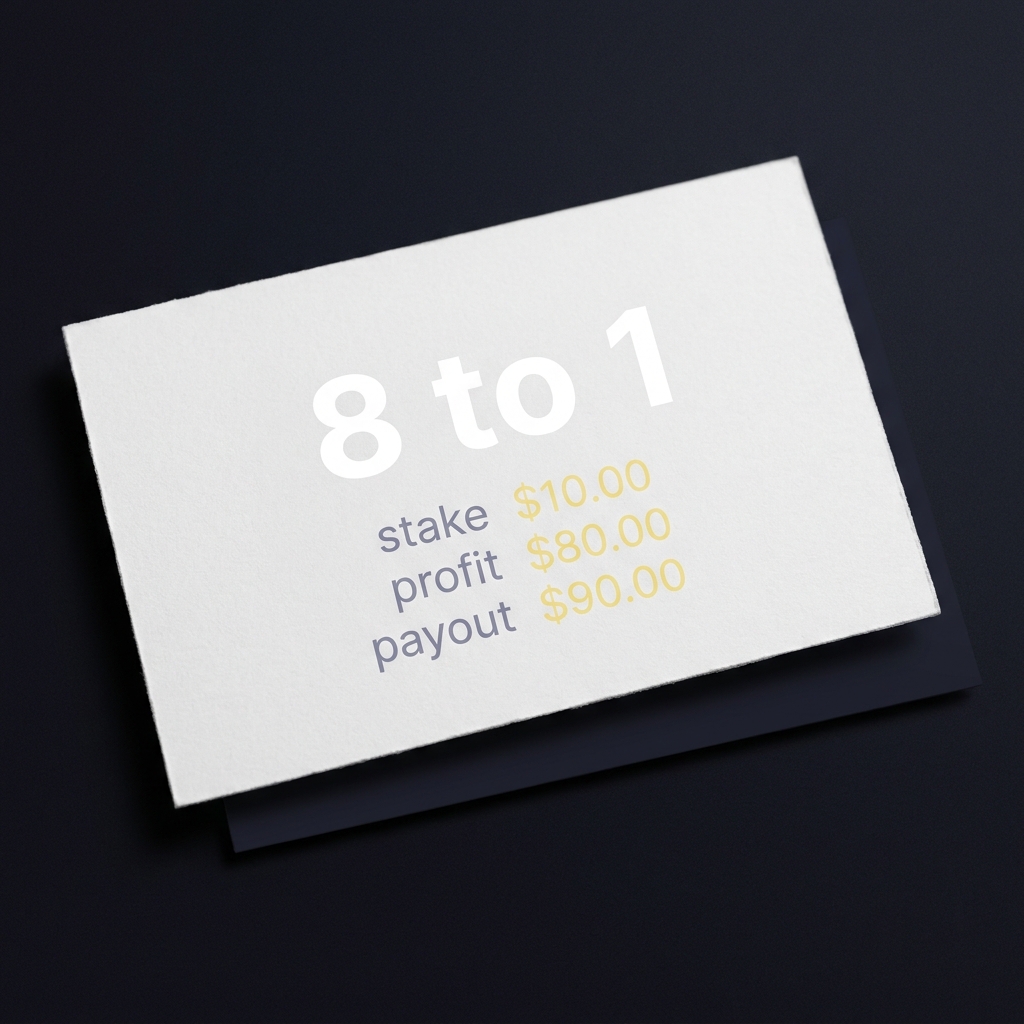
Those two lines give you both the quick calculation and an exact understanding of what the numbers represent: fractional odds show profit relative to the stake while the decimal conversion shows the full return per unit staked.
Converting 8/1 to decimal odds and implied probability
Step-by-step conversion
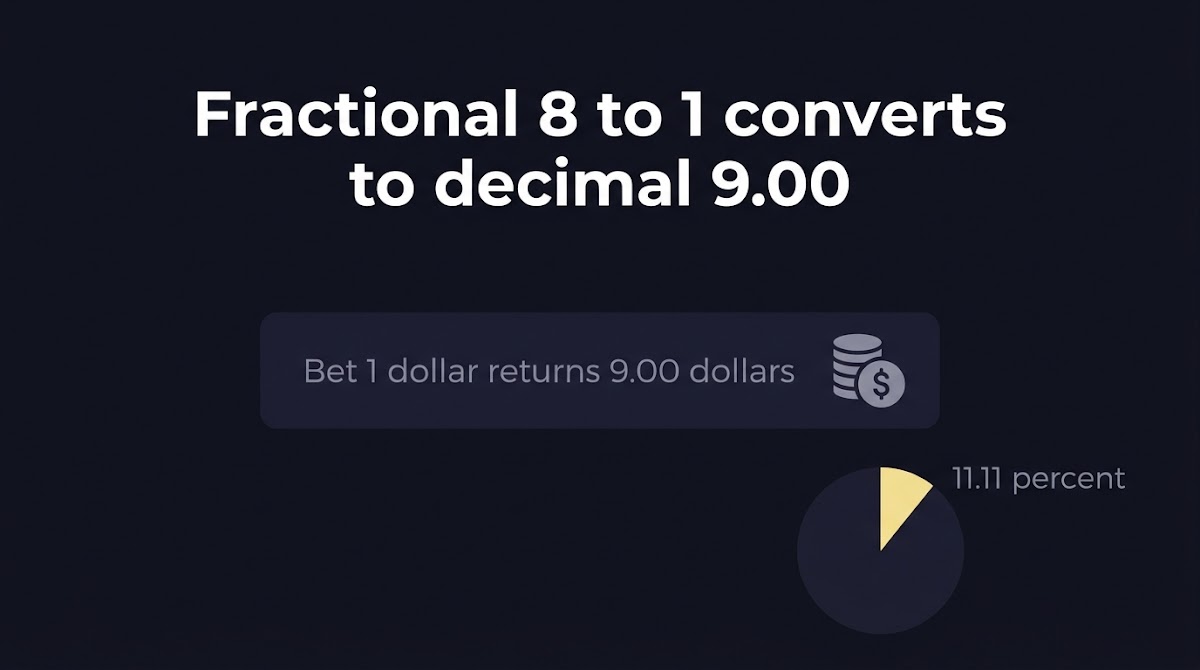
The conversion rule is decimal = 1 + a/b, so for 8/1 decimal odds equal 9.00, which is the full return per unit staked including your original stake Investopedia odds primer.
Write the fraction as a/b, perform the division, then add 1; for 8/1 that is 8 divided by 1 equals 8, plus 1 equals 9.00.
At 8/1 you earn eight times your stake as profit and receive nine times your stake as total payout, because decimal conversion is 1 + 8/1 = 9.00.
Compute implied probability
Implied probability is 1 divided by the decimal odds, so for 9.00 you get 1 ÷ 9 which is about 0.1111 or 11.11 percent; this number describes the market's suggested chance for the outcome based on the quoted price Odds reference.
Seeing the implied probability alongside the payout helps you judge whether a price represents value compared to your own estimated chance of an event occurring.
Worked examples: what $1, $10, $100 return at 8/1
Single-stake examples
At 8/1 a $1 stake returns $8 profit and $9 total payout, because profit = 1 × 8 and payout = 1 × 9 Investopedia odds primer.
For a $10 stake you get $80 profit and $90 total payout, and for $100 you get $800 profit and $900 total payout, following the same multiplication rule Investopedia odds primer.

Scaling to larger stakes
To scale the result for any stake, multiply the stake by 9 to get total payout at 8/1, or by 8 to get profit; this works for fractional or decimal stakes alike because the conversion is proportional Odds reference.
That 9× total rule makes it simple to prepare quick tables or a small spreadsheet column rather than recalculating each time.
Quick calculator methods and mental-math shortcuts for 8/1
Fast mental checks
The core shortcut is short and reliable: multiply your stake by 9 for total payout and by 8 for profit. For example, a $7 stake produces $63 payout and $56 profit, and a $25 stake produces $225 payout and $200 profit Investopedia odds primer or use a free betting odds calculator Covers odds converter.
When to use a calculator
Use a calculator when stakes include cents or fractions, or when you combine legs in parlays; calculators prevent small rounding errors from compounding and they confirm the simple mental checks. Try an online odds converter Ace Odds converter when precise decimals are needed Odds reference.

If you prefer quick automation, a small spreadsheet that multiplies the stake by 8 and 9 is all you need for accurate profit and payout results, and it adapts easily to decimal stakes and to tools like Funded Plays.
Fractional vs decimal vs American odds: presentation differences and equivalence
Why different formats exist
Different markets and user preferences explain why multiple formats persist: fractional odds are common in some countries and among certain sports, decimal odds are common where total return per unit is preferred, and American odds show how much you would win on a $100 stake or how much you must stake to win $100 Odds reference.
How they represent the same value
The formats are interchangeable because they describe the same underlying ratio; converting 8/1 to 9.00 in decimal preserves the payout and then you can translate decimal to American if needed using the standard rules Odds overview.
Remember that conversion does not change the economic reality, it only changes the display and the quick mental model users apply to interpret winning and returns.
Common mistakes: confusing payout with profit and other pitfalls
Typical misreads
A top mistake is treating the total payout as profit, for example seeing 9.00 and assuming you net nine times your stake rather than recognizing one unit of that is the returned stake; always separate profit from stake to avoid that error GamCare odds guide.
Quick conversion checklist for fractional to decimal and payout
Use this checklist before placing a stake
How to avoid them
Simple verification steps stop most errors: convert the fraction to decimal, compute implied probability, and multiply the stake by the decimal to confirm the total payout; if numbers disagree, recalculate before committing funds BeGambleAware guide.
Also check that you read 8/1 not 80/1 or 8.0/1, since mis-typing digits is an easy way to overstate potential returns.
Using 8/1 odds in decision-making: implied probability and expected value
Compute implied probability
With decimal odds of 9.00 the implied probability is 1 ÷ 9 which equals about 11.11 percent; that is the market-implied chance before you include your own assessment or edge Odds reference.
Quick expected-value example
Expected value uses your probability estimate and the payout: EV = (probability of win × profit) minus (probability of loss × stake). For a single unit at 8/1, if you estimate a 15 percent chance to win, EV = 0.15 × 8 − 0.85 × 1 which equals 1.2 − 0.85 = 0.35, a positive EV in that scenario; compute your probabilities honestly and be cautious about overconfidence Investopedia odds primer.
Examples across sports: horse racing, props, and parlays
Single bets vs parlays
An 8/1 quote on a single horse or prop uses the same math regardless of sport: multiply by 9 for total payout and by 8 for profit; the presentation may vary but the arithmetic remains consistent Odds reference.
How rules change payout presentation
Parlays require converting each fractional leg to decimal then multiplying decimals across legs to find the parlay decimal, so convert 8/1 to 9.00 before combining it with other legs to avoid calculation errors Odds overview or use a parlay calculator OddsJam betting calculators.
Different sports or operators may have minimum stakes, rounding rules, or accepted fraction formats, so check the market rules before you stake money or simulate bets in a challenge environment.
How to convert between formats: step-by-step cheatsheet
Fractional to decimal
Step 1: Write the fractional odds as a/b. Step 2: Divide a by b. Step 3: Add 1. Example: 8/1 → 8 ÷ 1 = 8 → 8 + 1 = 9.00 Odds reference.
Decimal to implied probability
Step 1: Take the decimal odds. Step 2: Compute 1 ÷ decimal. Example: 9.00 → 1 ÷ 9 ≈ 0.1111 → 11.11 percent Investopedia odds primer.
American conversions (brief)
For positive American odds you can convert from decimal by computing (decimal − 1) × 100 and prefixing with a plus sign; keep in mind the formats are presentation variants and the conversion preserves payout value Odds overview.
Responsible play: interpret odds without assuming guaranteed returns
Why clarity matters
Odds express potential returns and implied probabilities, not guarantees; outcomes depend on event results and deciding to stake funds is an individual decision that should account for bankroll rules and risk tolerance GamCare odds guide.
Where to find help
When in doubt, use trusted safer-gambling resources and calculators to confirm conversions and expected values before committing money; these resources emphasize understanding the difference between profit and payout and checking calculations BeGambleAware guide.
Cheat sheet: formulas, conversion table, and quick checks
One-line formulas
Profit = stake × (a/b). Payout = stake × (1 + a/b). Decimal = 1 + a/b. Implied probability = 1 ÷ decimal Odds reference.
Mini table for common stakes
Quick samples for 8/1: $1 → $9 payout ($8 profit), $5 → $45 payout ($40 profit), $10 → $90 payout ($80 profit), $25 → $225 payout ($200 profit), $50 → $450 payout ($400 profit), $100 → $900 payout ($800 profit) Investopedia odds primer.
Two verification steps: convert the fractional odds to decimal and multiply the stake by that decimal, and check that implied probability aligns with your independent sense of the event.
Bottom line: next steps and where to check your math
Summary bullets
At 8/1 profit equals 8× stake and payout equals 9× stake; convert fractional odds to decimal by adding 1 to the fraction and compute implied probability as 1 ÷ decimal to check your math GamCare odds guide.
Further reading
Practice with small simulated stakes or a spreadsheet, use the cheat sheet above, and consult trusted educational resources to deepen your understanding of odds and expected value before risking real funds BeGambleAware guide and review how Funded Plays evaluations work here.
8/1 means you win 8 units of profit for each 1 unit staked, and the total payout includes your stake so it is 9 times the stake.
Use decimal = 1 + a/b. For 8/1, that is 1 + 8/1 = 9.00, which represents the total return per unit staked.
Implied probability is 1 divided by the decimal odds, so for 9.00 it is about 11.11 percent.
References
- https://www.investopedia.com/betting-odds-explained-4342551
- https://en.wikipedia.org/wiki/Odds_(betting)
- https://www.fundedplays.com/blogs
- https://www.britannica.com/topic/odds
- https://www.investopedia.com/betting-odds-explained-4342551
- https://www.investopedia.com/betting-odds-explained-4342551
- https://www.en.wikipedia.org/wiki/Odds_(betting)
- https://www.gamcare.org.uk/safer-gambling/information-and-advice/how-odds-work/
- https://www.begambleaware.org/safer-gambling/understanding-gambling/odds-and-payouts
- https://www.fundedplays.com/challenges
- https://www.covers.com/tools/odds-converter
- https://www.aceodds.com/bet-calculator/odds-converter.html
- https://www.fundedplays.com
- https://oddsjam.com/betting-calculators/odds-converter
- https://www.fundedplays.com/blogs/how-fundedplays-evaluations-work