
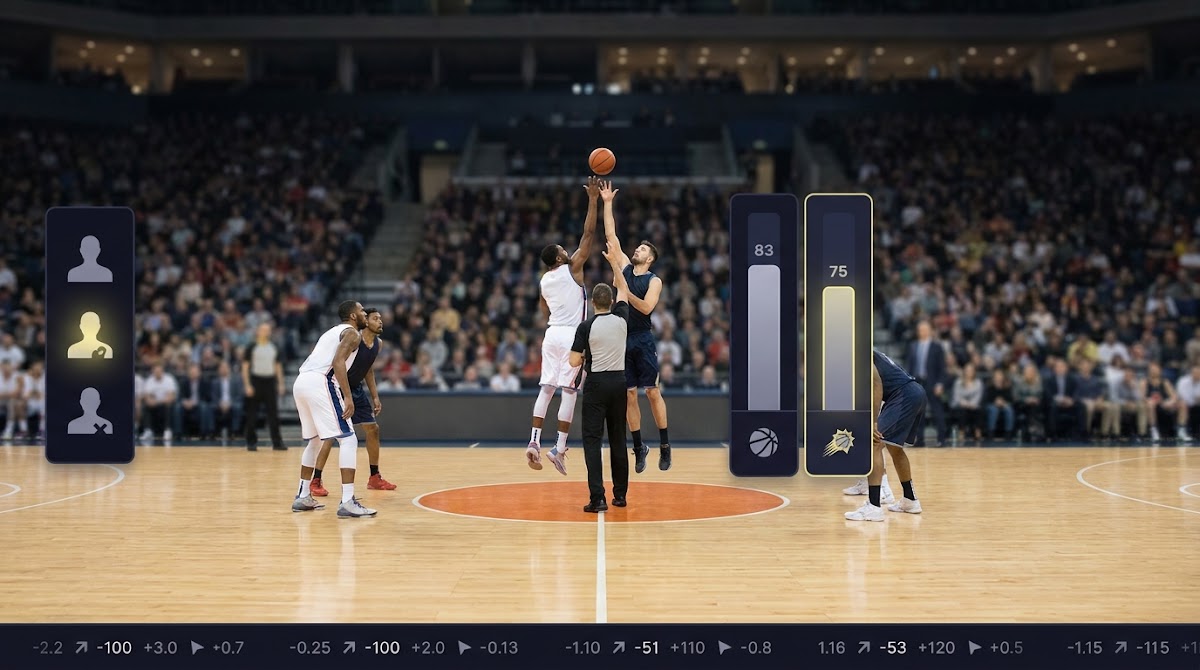
Quick answer: how to approach a 76ers prediction tonight
What 'prediction' means here, 76ers prediction
When someone asks "Who is predicted to win the 76ers game?" the practical answer is not a single blind pick but a timestamped assessment driven by three inputs: official player availability, the market's consensus line, and team strength metrics. Start by checking the NBA's official injuries and availability report because it is the primary source for same-day status updates and can change the outlook within hours of tip-off NBA Injuries (NBA.com/Stats). You can also consult the official NBA injury report for the season NBA Injury Report.
An immediate pregame view should next translate the market line into an implied probability so you have a baseline expectation to compare with model outputs and team ratings. Using the consensus odds as a baseline helps you see whether models and ratings agree with how the market is pricing the matchup.
Verify player availability before finalizing a prediction
Before finalizing any short pregame pick, check the official NBA injuries page for the latest player availability and timestamp your sources.
For a quick, defensible short answer you can say: "Based on the official availability at [time], the market-implied probability, and current team ratings, here is the expected favorite and my confidence level." That wording keeps the prediction transparent and avoids overstating certainty.
How to read the NBA injury and availability report for a 76ers prediction
Where to find accurate player statuses
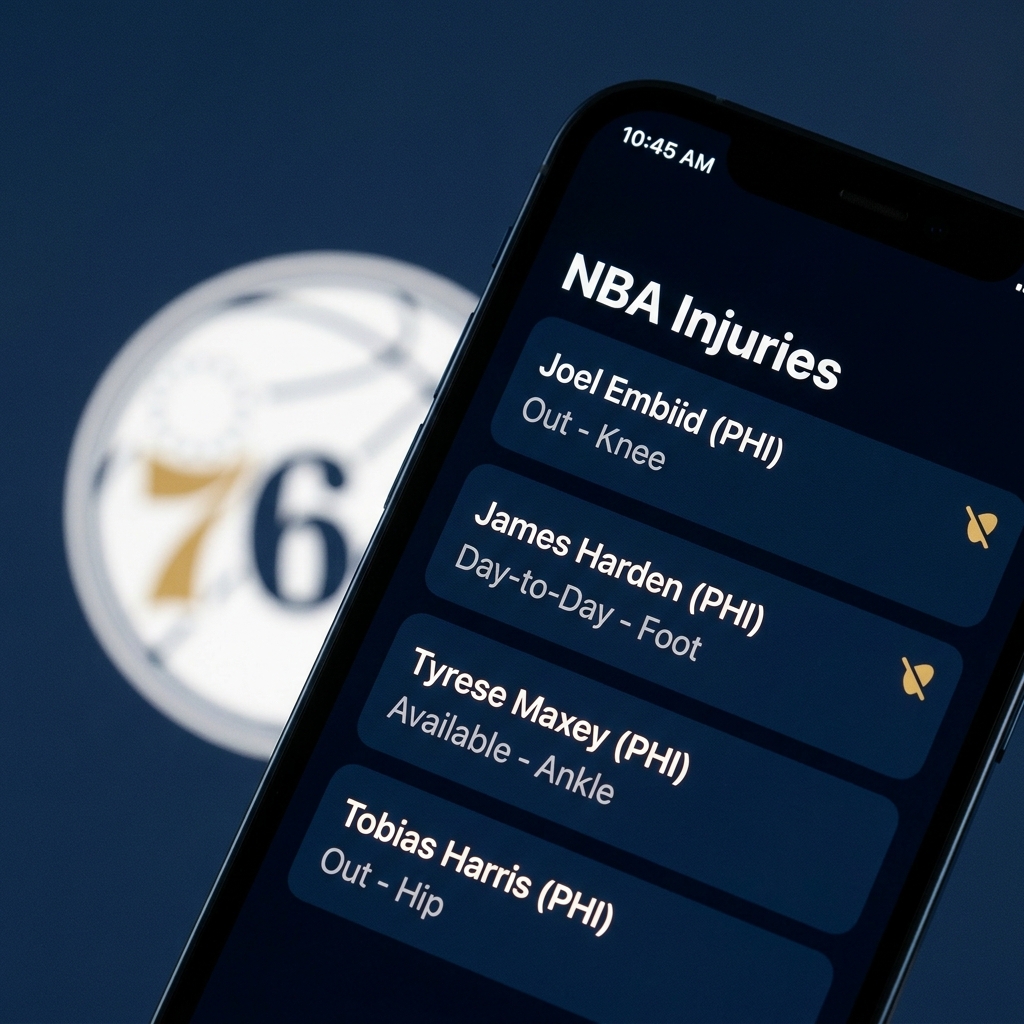
The authoritative, continuously updated source for player status is the NBA injuries page; check it close to tip-off because last-minute changes and rest decisions are disclosed there and can materially affect the expected outcome NBA Injuries (NBA.com/Stats). You can also view team-level injury listings such as ESPN's team injury page ESPN Injuries.
When you open the availability feed, note the timestamp and any explicit designations such as out, questionable, or probable. Those labels are the first filter for your prediction: an "out" typically moves win probability more than a "questionable," though context matters (who is out matters more than the label alone).

Which status changes matter most (out, questionable, probable)
Not all absences carry the same weight. A clear starter or primary playmaker missing the game usually shifts projected margins more than a role player's absence, and the injury label plus role should be recorded in your notes for transparency.
Also keep the NBA Player Participation Policy in mind because it governs how teams report rest and availability and explains why late scratches sometimes happen; that policy is the background framework for interpreting short-notice changes NBA Player Participation Policy.
Use team strength metrics in a 76ers prediction: Net Rating and SRS
What Net Rating and SRS measure
Net Rating measures point differential per 100 possessions and is one of the clearest season-level summaries of team strength you can use when forming a 76ers prediction; it is a standard input for many projections and gives a compact view of how the team performs on both ends of the court NBA Advanced Stats Glossary.
SRS and similar season ratings summarize team performance relative to the league and opponent strength; these season-level ratings are useful as a baseline, and Basketball-Reference publishes accessible team rating tables you can use to compare the 76ers and their opponent 2025-26 NBA Team Ratings (Basketball-Reference).
A defensible pregame prediction combines the NBA's official availability, current team ratings like Net Rating and SRS, public model probabilities, and the market-implied probability; use this combined view and timestamped sources to state the favorite and your confidence level.
When comparing ratings, prioritize recent splits if one team has meaningful form changes, and check home/away splits if travel or venue is likely to impact pace or defensive effectiveness.
How to compare 76ers ratings with an opponent
A simple rule of thumb is to view rating gaps as probabilistic edges: a meaningful Net Rating advantage generally translates to a higher expected win probability, though the exact conversion depends on pace and matchup context.
Use ratings to set a baseline edge, then modify that baseline for known absences or matchup quirks before checking model and market probabilities.
Compare public models and market odds when making a 76ers prediction
What public power ratings and win-prob models provide
Public power ratings and model sites publish game-level win probabilities and can be used to cross-check your rating-based baseline; these model outputs are helpful because they summarize many factors into a single probability estimate NBA Predictions & Power Ratings (TeamRankings).

As you consult public models, note their assumptions and publication time. Models are informative but vary in inputs; treat them as one component in a multi-source workflow rather than the final arbiter.
How to convert consensus odds to implied probability and compare to model outputs
Consensus market odds, such as those aggregated on ESPN's daily lines page, can be converted into implied probabilities to serve as a market baseline for a 76ers prediction NBA Daily Lines and Odds (Consensus).
For example, converting a market favorite's moneyline into implied probability gives you a percentage baseline to compare against model probabilities; when a model's probability diverges materially from the market-implied number, that gap becomes the investigative starting point.
Step-by-step workflow to produce a defensible 76ers prediction before tip-off
Checklist: data sources and order of operations
Quick pregame verification checklist for a 76ers prediction
Record time and source for each step
Follow an ordered workflow so your prediction is transparent and reproducible: 1) check official availability and timestamp it; 2) pull current Net Rating and SRS and note any recent splits; 3) consult public model probabilities; 4) convert consensus odds into implied probability; 5) reconcile differences and document reasoning.

How to weigh injury news, ratings, and market odds
When you have a confirmed absence for a starter, give the injury more weight than a questionable designation. Use Net Rating and SRS to quantify the baseline edge, then measure how much the market-implied probability moved after the news. If the market shifts more than your rating-based expectation, investigate matchup reasons or roster depth that could explain the gap.
Consult public model probabilities as a cross-check; if your rating-based view, the model, and the market line are aligned, the prediction is straightforward to state. If they diverge, list the issues you checked such as matchup specifics, recent minutes, or back-to-back fatigue and document your final confidence level.
Decision criteria: when to pick the 76ers and when to fade them
Key thresholds to look for
Use rating gaps and injury status as primary thresholds: a clear Net Rating advantage plus no key absences usually supports picking the 76ers, while losing one or more starters to confirmed injury reduces expected win probability significantly.
Also watch market-implied probability: if the market prices the 76ers as a strong favorite and models concur, that is a reason to pick them; conversely, if the market price makes them a close favorite but models show a lower probability, consider whether roster issues or matchup specifics justify fading.
Matchup-specific signs to override the market
Override the market when there are concrete matchup concerns, such as a defensive scheme that systematically limits the 76ers' primary scoring path or when opponent lineups create a size or switchability mismatch. Use those matchup observations to adjust the rating baseline before comparing with market odds.
Make decisions conditional and transparent. State the pick and include the timestamped sources and a short rationale so others can see why you chose to pick or fade the 76ers.
Common mistakes and pitfalls when making 76ers predictions
Overreacting to single data points
A common error is overreacting to an unconfirmed report or one poor performance; avoid letting isolated items override a consistent rating baseline unless they are confirmed and directly relevant to the lineup for the upcoming game. Remember that late scratches are covered by the official availability feed and should be confirmed there NBA Injuries (NBA.com/Stats) or on CBS Sports' team injury page CBS Sports Injuries.
Another mistake is using stale season averages when recent splits or home/away form matter. Always check recent games and minutes trends before finalizing a pregame assessment.
Ignoring substitution and minutes impacts
Role and minutes shifts matter more than raw roster names. If a bench player is suddenly slated for starter-level minutes due to an absence, that substitution can change how meaningful the absence is to win probability.
Track projected minutes after an injury report to see whether the replacement preserves the team structure or meaningfully lowers expected efficiency; that context often explains why some absences hurt more than others.
Practical examples: applying the workflow to three common matchup scenarios
Scenario A: 76ers favored at home with no injuries
Data to pull: timestamped NBA availability showing all primary players available, current Net Rating and SRS comparison, model probability, and the market-implied probability from consensus lines. If the ratings and model both favor the 76ers and the market-implied probability aligns, the prediction is a straightforward pick with a clear confidence statement.
Document the prediction as: time checked, sources used, model probabilities, market probability, and a final statement such as "76ers favored, moderate confidence," plus caveats about same-day updates.
Scenario B: road game with a questioned starter
Data to pull: the official availability entry for the questioned starter, any Player Participation Policy notes about rest, opponent ratings, and model probabilities. A questionable tag requires follow-up close to tip-off because the injury designation can flip to out and materially change the projected margin NBA Player Participation Policy.
If the model still favors the opponent after treating the starter as out, document that assumption and the resulting recommendation; include confidence and note the need to re-check availability within an hour of tip-off.
Scenario C: matchup vs a strong defensive team with close ratings
Data to pull: Net Rating and defensive efficiency splits, model probabilities, and market odds. In close-rating matchups, matchup details such as primary defender assignments and recent defenses against similar offense types can be the tiebreaker and are worth a focused check.
If models and market disagree in this scenario, use the divergence to examine game-level specifics like minutes, matchup rotations, and recent form before stating a tentative pick with low to moderate confidence.
Putting it together: final tips, responsible participation, and next steps
How to communicate your prediction clearly
When you share a 76ers prediction, always include the timestamped sources you used, the market-implied probability, model probabilities you consulted, and a short confidence level. That structure keeps your forecast reproducible and honest.
Funded Plays emphasizes skill-based prediction and transparent record-keeping rather than promises of results.
Next actions: tracking, reviewing, and improving predictions
Track your predictions over time and review where your calibration was off. Recording timestamped sources and short notes about the decisive evidence will help you iterate and identify consistent edges. See our blog for additional guidance Funded Plays Blog.
Finally, treat this workflow as a living process: keep checking the official injury feed, update your models and rating checks, and refine the documentation steps that work best for your process. A useful starting read is how our evaluations work how Funded Plays evaluations work.
The NBA's official injuries and availability report is the primary source to verify player status before finalizing a pregame prediction.
Convert the market moneyline or spread into an implied percentage to use as a baseline, then compare that percentage with model probabilities and ratings.
Use public models as a cross-check; if they diverge from the market, investigate matchup specifics, recent minutes, and injury context before deciding.
References
- https://www.nba.com/stats/injuries
- https://official.nba.com/nba-injury-report-2025-26-season/
- https://www.espn.com/nba/team/injuries/_/name/phi/philadelphia-76ers
- https://official.nba.com/player-participation-policy/
- https://www.nba.com/stats/help/glossary#netRating
- https://www.basketball-reference.com/leagues/NBA_2026_ratings.html
- https://www.teamrankings.com/nba/predictions
- https://www.fundedplays.com/challenges
- https://www.espn.com/nba/lines
- https://www.cbssports.com/nba/teams/PHI/philadelphia-76ers/injuries/
- https://www.fundedplays.com
- https://www.fundedplays.com/blogs
- https://www.fundedplays.com/blogs/how-fundedplays-evaluations-work