
What this prediction question means and why it matters
Why readers ask 'Who will win the 76ers game?', 76ers prediction
When people ask, "Who will win the 76ers game?" they want a short, defensible answer that reflects current information, not a guess. A solid 76ers prediction blends four inputs into one clear call so you can explain why you chose a side in simple terms. That structure makes the pick repeatable and easy to evaluate.
Start by defining the four inputs: the NBA official injury report, model probabilities, betting-market odds, and aggregated expert picks. The NBA official injury report is the authoritative record for player availability and should be checked close to tip-off to capture late status changes, which often decide a game outcome NBA Official Injury Report.
Model probabilities such as ESPN BPI give forward-looking estimates of team strength and per-game win probabilities that can anchor your forecast before markets fully respond ESPN BPI. Independent aggregators like TeamRankings publish per-game probabilities that let you compare models and spot agreement or divergence TeamRankings game predictions.
Market odds translate news and model views into implied win probabilities, and these lines update rapidly as new information arrives Philadelphia 76ers odds and lines. Aggregated expert picks provide a qualitative consensus check but should be weighted behind injury, model, and market signals CBS Sports NBA picks. Aggregated expert picks were also highlighted in recent local coverage SI Live experts coverage.
Start by defining the four inputs: the NBA official injury report, model probabilities, betting-market odds, and aggregated expert picks. The NBA official injury report is the authoritative record for player availability and should be checked close to tip-off to capture late status changes, which often decide a game outcome NBA Official Injury Report.

Short-term forecasts must be timestamped and reproducible. Note each input, the time you checked it, and the reason it shifted your view. That habit turns a guess into a testable prediction and speeds learning when results arrive.
A simple four-input framework to call the 76ers game
Step 1: Injuries first
Make the NBA injury report your first check on game day. Player availability, especially for core starters, changes the expected outcome more than most model differences. Always pull the official NBA report close to tip-off because a late scratch can flip the likely winner NBA Official Injury Report. Also consult local injury coverage for context Yahoo Sports injury reporting.
Step 2: Compare model probabilities
After injuries, anchor your view with model probabilities. Look at ESPN BPI for a baseline probability, then compare that to TeamRankings to see if models agree. When both models put the 76ers above a clear threshold compared with the opponent, that is a strong signal ESPN BPI.
quick converter for moneyline or spread into win probability
Use for last-minute checks
Step 3 is to read market odds. Convert the listed moneyline or spread into implied probability, and use that as a real-time benchmark. Markets aggregate news, model views, and money flow. If markets differ materially from models, dig into why and check for late injury or sharp movement Philadelphia 76ers odds and lines.
Step 4 uses expert picks as tie-breakers. Expert consensus can confirm a call, but experts often chase public narratives and may lag injury or model updates. Use experts to check for overlooked context, not as the primary driver CBS Sports NBA picks.
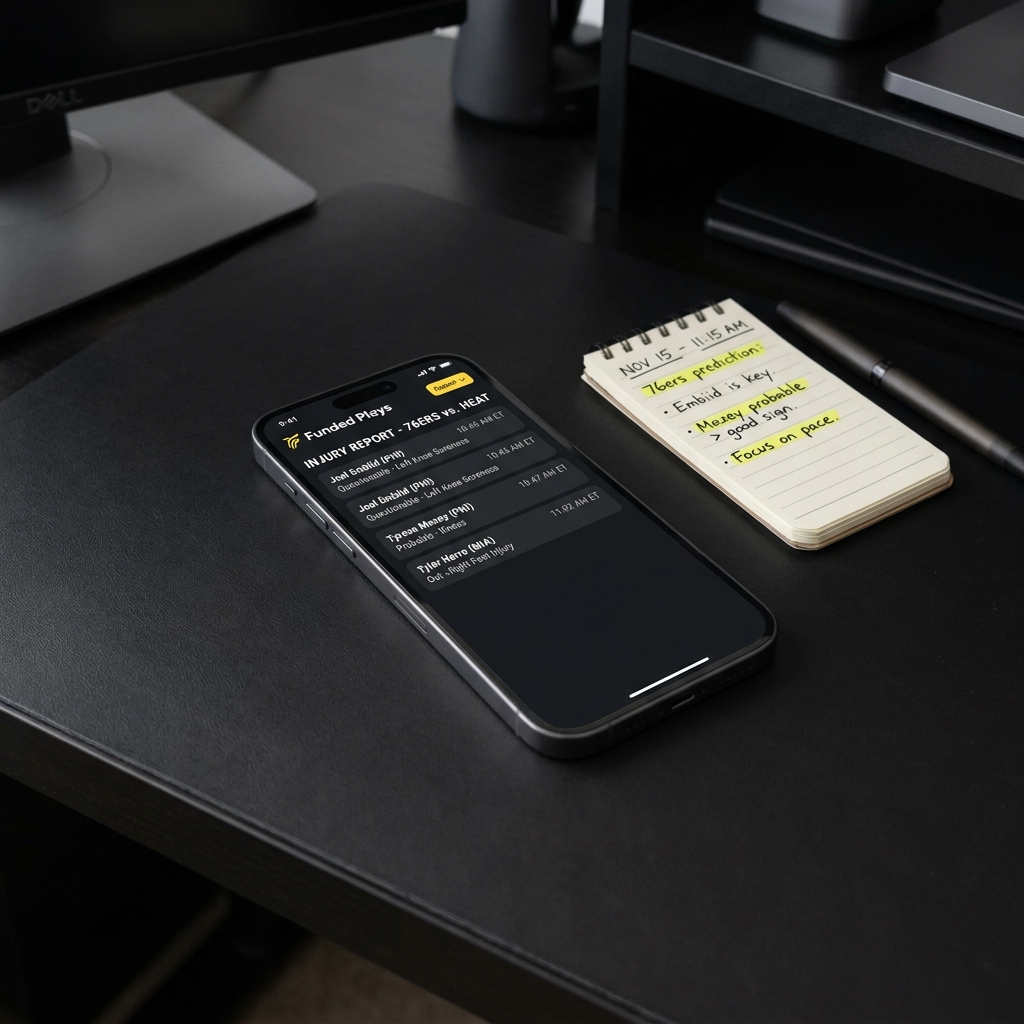
Document your reasoning with timestamps. Record the injury check time, the model probabilities you used, the market odds and implied probability, and the expert consensus snapshot. A simple log improves accountability and helps you refine thresholds when you review outcomes.
How to read each source accurately
Reading the NBA official injury report
The NBA injury report lists player statuses such as out, questionable, or probable. Treat an "out" as decisive for availability and a "questionable" as a potential last-minute change. Check the report near tip-off because designations are updated through game day NBA Official Injury Report.
Practice structured prediction challenges on FundedPlays
Save this four-input checklist and check the official injury report within 30 minutes of tip-off to avoid avoidable mistakes.
Interpreting model probabilities: ESPN BPI and TeamRankings
ESPN BPI provides forward-looking team strength and per-game win probabilities that reflect roster health, schedule, and recent performance. Use BPI as the baseline probability before markets move ESPN BPI.
TeamRankings offers per-game probabilities that you can compare with BPI. Look for model agreement; when both models are within a few percentage points, that raises confidence. If they diverge notably, examine inputs like injury assumptions or home-court adjustments TeamRankings game predictions.
Decoding betting markets and implied probabilities
Convert a moneyline into implied probability using a standard formula and adjust for the house edge if you want a cleaner comparison. Market odds represent what bettors are willing to pay at a moment in time and often react fastest to late news Philadelphia 76ers odds and lines.
Watch for sharp line moves that indicate informed money or large public sweeps. Sharp movement can reflect information not yet in public model feeds. When markets move sharply and no injury explains it, consider whether model assumptions need updating. For coverage of major oddsmaker moves see recent reporting SI Betting.
Using Basketball-Reference for matchup context
Basketball-Reference offers objective metrics like Simple Rating System and offensive and defensive ratings that summarize team form and matchup edges. Use SRS to check whether roster changes or recent form make a matchup easier or harder than model probabilities suggest Philadelphia 76ers roster and stats.
Metrics on Basketball-Reference help when starters are missing. For example, compare offensive and defensive ratings with and without a given player to estimate the likely in-game impact when a starter is listed as out or questionable.
Weighing aggregated expert picks
Expert picks are a qualitative check. They can highlight stylistic matchup considerations, coaching tendencies, or rotation patterns that models may underweight. Treat expert consensus as supporting evidence, not the driver, and be mindful that experts can follow public sentiment CBS Sports NBA picks.
When experts disagree, examine the reasoning behind divergent calls. The best expert notes often point to specific injury implications, matchup edges, or timing issues that you can incorporate into your logged decision.
Decision criteria: when to pick the 76ers
Start with quantitative threshold rules. A useful example: if both ESPN BPI and TeamRankings give the 76ers a higher win probability than the market implied probability by 4 percentage points or more, that gap can justify a contrarian pick in favor of the 76ers, provided no critical injuries are present ESPN BPI.

Handle late injuries conservatively. If the injury report shows a starter is out within one hour of tip-off, allow that update to override model-market divergence unless you have convincing counter-evidence from matchup metrics NBA Official Injury Report.
Account for sharp market moves. If the market moves more than a few ticks without a public injury, it could reflect sharp money. Investigate news feeds and market depth before contrarianizing against a sharp line Philadelphia 76ers odds and lines. For broader reporting on market shifts see SI Betting.

Common prediction mistakes and how to avoid them
Overreacting to a single source
Relying solely on one model or an early market line can mislead a prediction. Models differ in inputs and assumptions, and markets can be noisy. Cross-check before finalizing a call TeamRankings game predictions.
Trust a structured process that starts with the NBA injury report, uses model probabilities as an anchor, references market implied probabilities as a benchmark, and treats expert picks as confirmation rather than the primary driver.
Failing to check the official injury report near tip-off is another frequent error. A late scratch or upgraded availability can reverse the expected outcome, so include a last-minute injury check in your final routine NBA Official Injury Report.
Confirmation bias is common when reviewing expert picks. If you favor a team, you may overweight analysts who support that view. Counter this by intentionally seeking the strongest opposing rationale and testing whether it changes your quantitative thresholds CBS Sports NBA picks.
Step-by-step example: applying the framework to a 76ers matchup
Assemble the four inputs with timestamps
Example checklist, with timestamps you can copy: 1) 2:15 PM, NBA official injury report checked and noted that the 76ers have all starters probable; 2) 2:20 PM, ESPN BPI lists the 76ers at 62 percent win probability; 3) 2:22 PM, TeamRankings lists 60 percent; 4) 2:25 PM market lists the 76ers at -130 moneyline, implied probability roughly 56 percent. Record each item in a simple log and keep snapshots of the model pages if possible ESPN BPI.
Compare signals and make the pick
If models and markets align within a few percentage points, pick the side with the higher probability. In the example above, models lean stronger than the market, suggesting a model-based pick for the 76ers. Confirm no late injury or sharp move before locking the choice Philadelphia 76ers odds and lines.
How to record outcomes and learn
After the game, log the result and update your note with any new information that mattered. Compare actual outcomes against the model probabilities and market implied probability to identify where your process could improve. Over time, aggregate these records to see whether you are systematically over- or under-estimating certain matchups, rotation changes, or injury effects using Basketball-Reference to contextualize trends Philadelphia 76ers roster and stats. See our blog for more on tracking performance Funded Plays blog.
Quick checklist and final guidance before tip-off
One-minute pre-game checklist
One-minute checklist: final injury report check, last market odds and implied probability, quick look at ESPN BPI or TeamRankings, capture expert consensus, then record your pick and timestamp it. This short routine reduces avoidable errors and keeps your decision traceable NBA Official Injury Report.
Responsible participation reminder
Predictions are probabilistic, not guaranteed. Use forecasts to test hypotheses and build skill, and treat any platform participation as a form of structured practice rather than a promise of earnings. FundedPlays is one example of a skill-based platform that lets users practice structured prediction challenges and track performance without implying guaranteed outcomes.
Check the NBA injury report within 30 minutes of tip-off to catch late status changes that can alter a game's expected outcome.
Use ESPN BPI as a baseline and compare it with another model like TeamRankings to see consensus; treat model agreement as higher confidence.
Convert market odds to implied probability and use that as a real-time benchmark; investigate sharp moves or unexplained divergence before contrarian picks.
References
- https://official.nba.com/nba-injury-report-2025-26-season/
- https://www.espn.com/nba/bpi
- https://www.teamrankings.com/nba/game-predictions/
- https://www.vegasinsider.com/nba/teams/76ers/
- https://www.cbssports.com/nba/picks/
- https://www.basketball-reference.com/teams/PHI/2026.html
- https://www.fundedplays.com/challenges
- https://www.fundedplays.com
- https://www.fundedplays.com/blogs/how-fundedplays-evaluations-work
- https://www.fundedplays.com/blogs
- https://www.si.com/betting/76ers-nba-finals-odds-drop-following-latest-joel-embiid-injury-update
- https://www.silive.com/betting/2026/05/76ers-vs-knicks-odds-update-experts-alter-predictions-for-game-1-amid-joel-embiid-injury-news-jalen-brunson-highlights-player-props.html
- https://sports.yahoo.com/articles/joel-embiid-headlines-76ers-injury-160216446.html