

4 horse trifecta box cost: quick answer and formula
Short result: a 4-horse trifecta box contains 24 individual permutations, so at a $2 base bet the total cost is 24 times $2, or $48.
Why 24 bets? For a trifecta you need three horses to finish first, second, and third in a specific order. With four horses selected, the count of unique ordered outcomes is 4 times 3 times 2, which equals 24. Multiply that ticket count by the base bet to get the dollar cost.
One-sentence caveat: this calculation assumes a straight $2 base unit per permutation and does not account for local track minimums, allowed increments, or platform rules that can change how you place bets.
Try a structured challenge to practice decision-making
Try the worked example below, then use the same formula for any base bet or different number of boxed horses. The steps are compact and repeatable so you can confirm cost before you place a wager.
Short result
The immediate numeric answer is simple: 24 bets by $2 equals $48 total. That is the 4 horse trifecta box cost when the base bet is $2 and you box four horses.
Simple formula you can reuse
The compact formula is the permutation 4 x 3 x 2 to get the number of ordered tickets, then multiply by the base bet amount. For a $2 base bet the short formula becomes 4 x 3 x 2 x $2 = $48.
How a trifecta box works
A standard trifecta requires picking which horse finishes first, which finishes second, and which finishes third in the correct order. If you name three horses and specify their order, that is a single straight trifecta.
A boxed trifecta lets your chosen horses finish in any of the possible orders for the first three places. When you box four horses, you are asking the tote to pay any outcome where any three of those four horses cross the line in any order, and each distinct order is a separate ticket.
Because order matters for trifecta payouts, boxing increases the number of distinct permutations you cover. Each permutation is its own bet, and each bet costs the base unit. That is why boxing four horses leads to a multiplication of tickets rather than a single multi-outcome ticket.

Common base units at tracks and on many platforms are $1 and $2, with $2 often used because it keeps ticket totals rounder. When you change the base unit, you scale the total cost by that same factor; the base unit does not change the number of permutations, only the per-ticket price.
Definition of a trifecta vs boxed trifecta
A straight trifecta names three horses in exact finishing order for first, second, and third. A boxed trifecta names a set of horses and buys every ordered combination of three of them for a given base bet. Boxed tickets therefore become multiple straight tickets combined into one order instruction at the betting window or on-screen form.
Why order matters and what 'boxing' changes
Order is the key difference between exact-type bets and boxed versions. A boxed trifecta converts order specificity into multiple straight bets that together allow any order among the chosen horses. Consequently, a box increases the chance of covering a winning finish among your selected horses at the cost of more tickets.
Step-by-step: Calculate the cost of a 4 horse trifecta box
Step 1, count horses and compute permutations. For a trifecta you need three finishing positions. If you choose 4 horses, compute the number of ordered triples by multiplying descending integers: 4 x 3 x 2. That gives 24 distinct permutations to cover.
Step 2, multiply by your base bet amount. With a $2 base bet multiply 24 by $2 to reach the total dollar exposure: 24 x $2 = $48. If your base bet were $1 the same 24 tickets would cost $24.
Worked example with numbers: choose Horses A, B, C, and D. The 24 permutations include A-B-C, A-B-D, A-C-B, A-C-D, A-D-B, A-D-C, B-A-C, and so on until all ordered triples are listed. Each of those is a straight trifecta ticket, and each costs $2 in this example. Add them and the total becomes $48.

Adapting the steps for other base bet sizes is straightforward. Replace $2 with any base unit and perform the same multiplication. For example, with a $5 base bet the cost would be 24 x $5 = $120.
To adapt for a different number of boxed horses, adjust the permutation count. For five boxed horses the permutation count for a trifecta is 5 x 4 x 3 = 60, and then multiply by your base bet to calculate total cost.
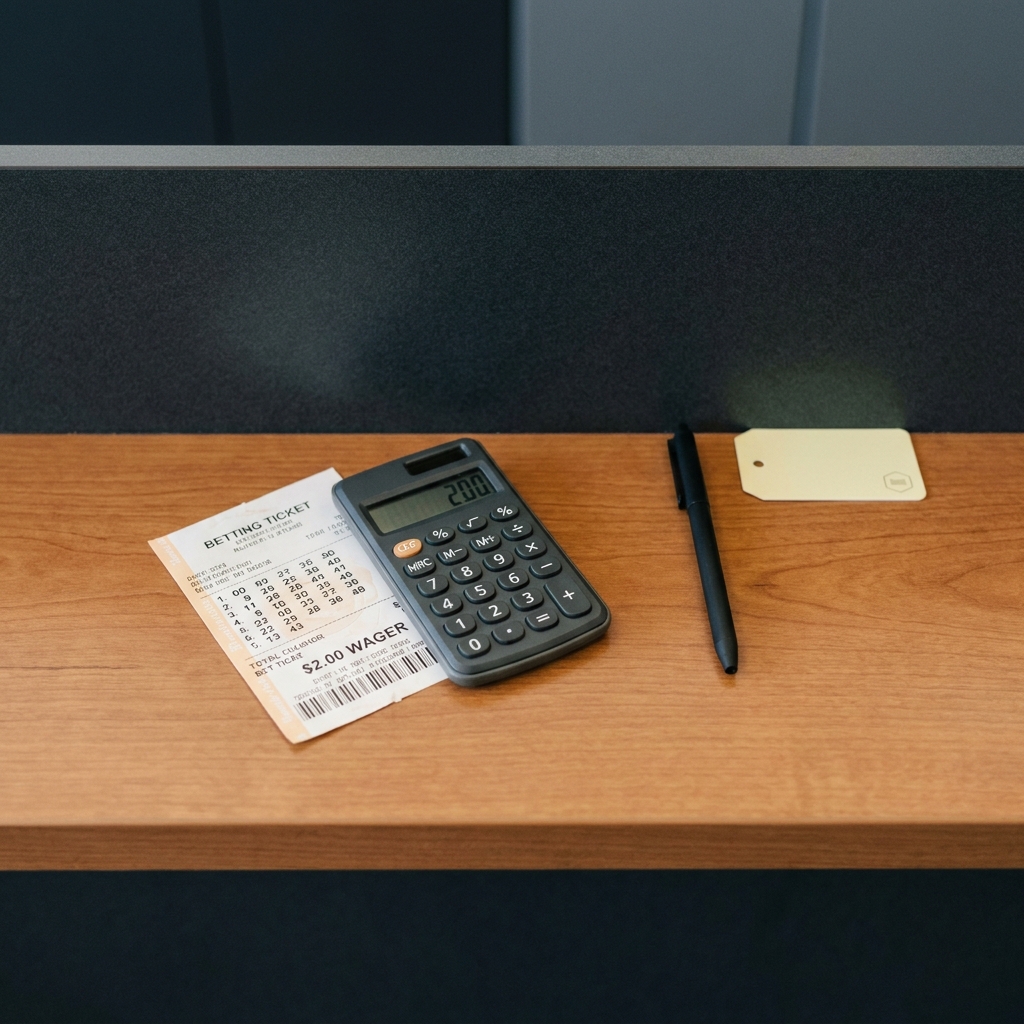
Think in terms of positions to fill. For a trifecta you fill first, second, and third. With 4 distinct horses available you have 4 choices for first, then 3 for second, and 2 for third. Multiply those choices to get the number of distinct ordered outcomes.
Step 2: Multiply by your base bet amount
Once you have the ticket count multiply by the base bet amount to get your final cost. The ticket count is purely combinatorial, the base bet scales the cost. Confirm the track or platform allows the chosen base bet because some venues have minimums or increments that affect what you can actually place.
Worked example with numbers
List the math plainly: 4 x 3 x 2 = 24 bets. 24 bets x $2 = $48 total. That is the concrete arithmetic any bettor can repeat before submitting bets to a teller or app.
Examples: $2 trifecta box with 4 quick scenarios
Scenario 1, all favorites boxed. Suppose horses A, B, C, and D are the top four betting choices. The 4 horse trifecta box cost remains $48 at $2 per ticket. Expected payout expectations may be lower because favorites tend to reduce tote returns when they finish in payout combinations.
Scenario 2, a mix of favorites and a longshot. If you box three expected favorites and add one longshot the total ticket count remains 24 and the cost remains $48 at a $2 base. The presence of a longshot changes payout distribution and the chance of a large payoff, but not the number of tickets you purchase.
Quick cost calculator for boxed trifectas
Use whole numbers for Horses and Base bet
Scenario 3, three contenders plus a surprise runner. Even if you have three strong contenders and one erratic horse, the mechanical cost of boxing those four horses at $2 is still 24 x $2 = $48. How those horses perform affects payout, but not ticket count.
Across all scenarios the key point is constant: the 4 horse trifecta box cost at $2 is $48. Scenario differences influence how worthwhile that cost is, in terms of expected return, but the arithmetic stays the same.
All favorites boxed
When all four selections are favorites, payouts tend to be smaller if favorites finish in the top three. You still pay $48 for the box, and the trade-off is lower cost per probability versus lower payout when favorites hit.
Mix of favorite and longshot
Including a longshot can increase potential returns if that longshot places in the top three, but you still buy 24 separate $2 tickets. The more unlikely the finishing combination, the larger the tote payout could be, but the cost is unchanged.
Three contenders plus a longshot
This is a common approach when a bettor wants to cover likely outcomes yet keep a chance at a bigger payoff. The 4 horse trifecta box cost remains identical regardless of runner quality; what changes is expected payout distribution.
Common mistakes and pitfalls when boxing a trifecta
Miscounting permutations is the most frequent arithmetic error. A quick way to check your math is to list ordered triples or use the permutation formula n x (n-1) x (n-2) where n is the number of boxed horses.
Forgetting to multiply by the base bet or using the wrong base unit is another common mistake. Confirm the base unit on your ticket slip before you complete the purchase so you do not accidentally pay twice or half of what you intended.
A $2 4-horse trifecta box costs $48 because there are 24 ordered permutations among four horses and each permutation is a $2 straight trifecta ticket; the count comes from 4 x 3 x 2.
Ignoring track minimums or allowed increments can also change what you actually pay. Some tracks or platforms set $2 as a minimum for certain exotic bets, while others allow $1 or even smaller increments. Verify local rules before you submit your wager.
Another pitfall is confusing a 'box' with a 'wheel'. A wheel fixes one or more horses in a specific position while allowing others to rotate in remaining positions, which changes the ticket count. Make sure you understand the difference so you buy the number of tickets you expect.
Miscounting permutations
Double-check calculations by writing out a few permutations or using the n x (n-1) x (n-2) shortcut. That habit reduces counting errors and ensures the total cost you plan for matches what you will be charged.
Forgetting base bet size
Always confirm the base bet amount on the betting slip. A mismatch between what you think you bought and what the teller or app processes can lead to surprises in your outlay.
Ignoring track rules or minimums
Before placing bets check the track program or platform help for minimum bet sizes and permitted increments. Those rules determine whether you can place $1 units or must use $2 or other amounts.
Bankroll and staking: is a $2 box worth it for you?
Pros of a $2 base bet include a balance between affordability and coverage. A $2 base keeps the total ticket count meaningful without the low returns that sometimes come with a single cheap unit for exotic payouts.
Cons are that even at $2 a full 4-horse box can add up if you play many races or multiple boxes in a card. For example, two full 4-horse boxes in a meet add to $96 total exposure at $2 each, so factor repeated play into bankroll planning.
How to size boxes within your betting bankroll. Treat each box as a single unit of exposure and decide how many of those units fit your discretionary betting pool. A common rule of thumb among bettors is to limit any single race exposure to a small percentage of your total play bankroll, though this is guidance rather than a guarantee of results.
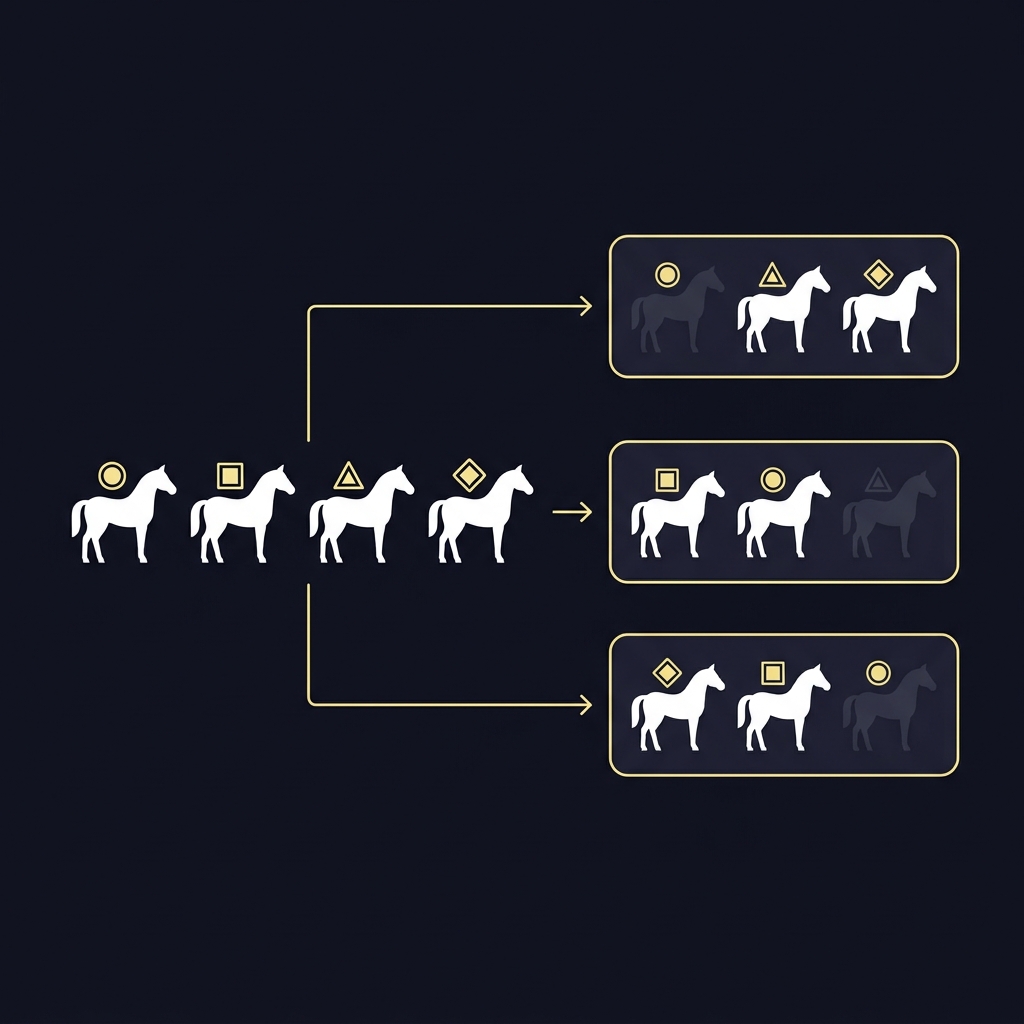
Consider partial boxes or banker strategies if $48 is more than you want to risk for a single race. Partial boxes fix one horse and box the others, or box only three horses, which reduces ticket count while still providing partial coverage of outcomes.
Pros and cons of a $2 base bet
A $2 base often feels like a practical minimum for exotic bets because it produces ticket totals that are substantial enough to matter for payout, yet not so high that one race dominates your bankroll. At the same time, $2 units double a $1 base exposure, so they raise the stakes for frequent players.
How to size boxes within a betting bankroll
Decide what percentage of your discretionary bet funds you are willing to expose in a single race. If you plan to play many races in a session, scale down per-race exposure accordingly. The goal is to avoid a single losing streak wiping out a significant portion of your bankroll.
Alternatives and variations to a 4 horse trifecta box
A trifecta wheel fixes one or more horses in a specific finishing position and rotates other selections through the remaining positions. Compared with a full box, wheels can reduce ticket counts when you have a high-confidence pick for a particular spot.
Partial or banker boxes fix one horse and box the remaining horses for the other positions. For example, banking Horse A for first place and boxing B, C, and D for second and third reduces the ticket count compared with a full box and lowers cost while preserving targeted coverage.
Exactas cover the first two finishers in exact order, or as a box to cover either order of two horses. Exactas have fewer permutations and therefore lower cost. If you prefer a simpler, less expensive bet, exactas or daily doubles may fit better than a full trifecta box.
Trifecta wheel
A wheel expands or restricts coverage depending on how many horses you fix. Wheels can be efficient when you have one horse you trust and several that could fill the remaining spots. Ticket math differs from a box, so calculate ticket counts carefully to compare costs.
Smaller box sizes and partial boxes
Boxing three horses is the minimum for a trifecta and costs 3 x 2 x 1 = 6 bets. At $2 per bet that is $12. Smaller boxes reduce exposure but also limit which finishing combinations you can win on.
Using wagers like exactas instead
If budget is a concern but you still want exposure to top finishes, exactas or quinella-style plays offer simpler, cheaper alternatives with different payout profiles compared with trifectas.
When to choose a 4 horse trifecta box: decision checklist
Factors to weigh include your confidence in the top contenders, the size of your bankroll, expected payout potential, and track or weather conditions that influence results. If you have moderate confidence in four horses and the cost fits your bankroll, a 4-horse box can be an efficient way to cover many likely orders.
Quick checklist before you bet: one, confirm the combinatorial math 4 x 3 x 2 equals 24 permutations; two, decide on your base bet and confirm permitted increments; three, compare the $48 cost at $2 against partial box or wheel alternatives if the price is too high.
Next steps include deciding whether a full 4-horse box is the right choice for a given race, or whether a partial box or wheel better matches your confidence level and bankroll. Re-check track rules before placing your wager and use the simple formula provided to verify cost every time.
Factors to weigh
Consider the field size, likely pace scenarios, and how much you trust each selection. If one horse is a heavy favorite and you are uncertain about which other two will follow, a banker approach might be better than a full box.
Quick checklist
Use this simple checklist at the race: confirm horse names and program numbers, verify the base bet, check the displayed ticket count, and only then confirm the wager.
Summary and next steps
Key takeaways: the 4 horse trifecta box cost with a $2 base bet is 24 permutations times $2, which equals $48. The formula behind that figure is the permutation count 4 x 3 x 2, and the arithmetic repeats for other base bet sizes or numbers of boxed horses.
How to practice safely: use a calculator or the worked examples in this article to confirm ticket counts before you place a bet. Consider practicing with simulation tools or small units to build familiarity with exotic bet math before increasing exposure.
Next steps include deciding whether a full 4-horse box is the right choice for a given race, or whether a partial box or wheel better matches your confidence level and bankroll. Re-check track rules before placing your wager and use the simple formula provided to verify cost every time.
A 4-horse trifecta box creates 24 distinct ordered permutations, so it contains 24 individual bets.
Some tracks and platforms allow $1 base bets, in which case the same 24 tickets would cost $24, but you should check local minimums and increments before placing the wager.
Cheaper options include boxing only three horses, using a banker or partial box, or switching to exactas, all of which reduce ticket counts and total cost.