

What does 'best sport bettor' actually mean?
Definitions: skill versus luck (1bettor sports)
When someone asks, "Who is the best sport bettor?" the first step is to translate the question into measurable terms. Skill implies a reproducible, persistent edge that leads to above break-even returns over a long time horizon. Luck means short streaks or isolated winning periods that are likely to regress. Because betting outcomes are binary and noisy, a reputation alone is not sufficient to establish skill; objective, comparable metrics and transparent records are required to separate skill from variance. For readers used to evaluating competitors, this distinction matters because it sets the evidentiary bar for any claim about being "the best".
Binary outcomes, like individual bets, have high variance, so apparent superiority can appear and disappear over short samples. Detecting a modest, real edge requires many observations and an understanding of how sample size affects uncertainty, not just a handful of headline wins. For a technical introduction to variance and interval estimation in binary outcomes, see a practical overview of confidence intervals for the binomial proportion, which underlines why long horizons matter NIST statistical methods guide.
There is no single universally accepted best sport bettor; determine superiority by verified ROI, consistent positive closing line value, sufficient sample size, and transparent, time-stamped records before naming a top bettor.
Finally, remember that publicly auditable records remain rare. Many top-performing names operate privately or lack third-party verification, so public claims should be scrutinized by their evidence quality, time-stamped records, and auditability rather than by reputation alone.
Core metrics: ROI and how to calculate it consistently
Formal ROI definition and example calculation
Return on investment, or ROI, is the foundational metric for comparing bettors when stake levels vary. Define ROI as net profit divided by the total amount risked over the chosen period. Expressed as a percentage, ROI shows how much a bettor earned relative to the money they put at risk. Using a consistent formula lets evaluators compare records without being misled by raw win counts.
For example, if a bettor places 1,000 individual wagers, risking a total of 100,000 units and finishes with a net profit of 4,000 units, the ROI is 4,000 divided by 100,000, which equals 4 percent. That single percentage conveys performance normalized for stake volume and is more informative than win rate alone. For a formal definition and context on ROI as an evaluative metric, see an authoritative overview on how ROI is defined and used for performance comparisons Investopedia on ROI.
Why consistent units and comparable periods matter
When comparing ROI across bettors, ensure the units and periods are comparable. Mixing sports, stake sizing philosophies, or non-overlapping time windows can distort conclusions. If one record covers several seasons in college basketball and another covers a single NFL season, simple ROI comparison is misleading unless you normalize for sport mix and seasonality. That normalization often means reporting ROI per sport, per season, or per standardized unit size.
Also avoid over-relying on raw win percentage. A high win rate with low average odds can produce a lower ROI than a lower win rate with larger average odds. Because ROI incorporates stake and odds implicitly, it is the single measure to prioritize when stake transparency exists.
Market signal: closing line value and what it shows about skill
What closing line value (CLV) is
Closing line value, or CLV, measures the difference between the odds at which a bettor placed a wager and the market closing odds immediately before the event starts. Positive CLV means a bettor regularly secures odds that are better than the market close. Over time, consistently positive CLV suggests the bettor finds value relative to the market, which is a useful proxy for skill because it indicates they often act on information or interpretation that the market later adjusts toward.
However, CLV is a proxy, not a guarantee of profit in small samples. Market movements reflect many factors, and timing of bets matters. For a practical primer on why beating the closing line is considered important and how to interpret CLV, see an industry overview on closing line value and its implications Pinnacle on closing line value, and a complementary guide on tracking CLV from OddsJam.
How positive CLV relates to finding value
Positive CLV implies a bettor is, on average, getting better prices than the final market, which tends to correlate with long-term profitability if stake sizing and ROI are sound. A bettor who shows small, consistent CLV across large volumes more plausibly has an informational edge than one who posts sporadic CLV gains over a few high-profile bets. Still, because small CLV effects interact with variance, evaluators should combine CLV analysis with ROI, sample size considerations, and verification checks before concluding a bettor is demonstrably skilled. For a readable primer on CLV fundamentals, see SportsBettingDime.

Verification: time stamps, independent odds, and audit trails
What good verification looks like
Credible verification requires time-stamped picks, independent odds snapshots that show the odds at bet entry and at market close, and an immutable audit trail that links picks to outcomes. Without those elements, a record can be easily cherry-picked or reconstructed, which undermines claims of consistent skill. Evaluators should prefer records that include third-party archives, timestamped exportable logs, or service-based snapshots that are hard to alter after the fact.
Regulatory guidance reinforces this need for robust evidence. When tipsters or vendors make performance claims publicly, they are increasingly required to substantiate those claims with time-stamped picks, independent odds sources, and clear audit trails as part of advertising standards and consumer protections Advertising Standards Authority guidance.
quick verification items to collect for each pick
save copies of external odds snapshots
Practically, a verification package should let an independent reviewer reconstruct ROI and CLV without relying on the bettor's private spreadsheets. Good packages include exported logs, screenshots from independent odds archives, and a clear mapping from each pick to the official outcome. That degree of transparency reduces disputes over formatting and prevents common tampering tactics.
Public benchmarks: handicapping contests and verifiable leaderboards
Why operator-run contests are useful benchmarks
Operator-run handicapping contests create one of the few contexts where bettors compete under a single set of rules and where final standings are published and verifiable. These contests standardize stake rules, entry criteria, and reporting formats, which allows direct comparisons between participants within the same format and season. Because operator-run leaderboards are public, they form a rare, externally verifiable dataset for judging relative performance.
Examples of transparent contest formats include season-long handicapping challenges and structured competitions that publish full standings, rules, and payout calculations. For concrete contest leaderboards and official contest rules, consult operator pages that publish standings and contest information Circa Sports contests and leaderboards and official season products like the SuperContest.
How many bets do you need? Sample size and statistical confidence
Understanding variance and confidence intervals for win rates
Because individual bets are binary events, sample variance can be large, and early performance can be misleading. Confidence intervals for proportions show how wide uncertainty is around observed win rates, and they shrink only as sample size grows. That mathematical reality means you need many bets to confidently distinguish a small skill edge from noise. For technical background on confidence intervals for binomial proportions, see a practical statistical reference on interval estimation for proportions NIST statistical methods guide.
In practice, evaluators should combine sample size checks with effect size, such as ROI or average CLV per bet. A large sample with a tiny positive ROI can be more convincing than a small sample with a large ROI, because the latter is more likely to be explained by variance rather than sustainable skill.
Practical thresholds for volume when judging an edge
There is no universal cutoff that guarantees a bettor is skilled, but practical thresholds help. Look for multi-season samples or thousands of individual wagers for small edges, and treat single-season or low-volume records as suggestive rather than conclusive. The exact threshold depends on the observed effect size. Small edges require larger samples to reach statistical significance, while larger edges may be detectable with fewer observations. Always interpret short-term results with caution and seek independent verification.
Checklist: decision criteria to judge who is better
A practical, ordered checklist for evaluators
Use a simple, ordered checklist to weigh evidence objectively before naming a top bettor. Key items should include: verified ROI calculated on comparable units, consistent positive CLV across a large sample, clear time-stamped records and independent odds snapshots, transparent stake sizing, and public or third-party verification when available. Apply these items in order, giving more weight to verification and volume than to headline streaks.
When you score candidates, combine metrics rather than rely on a single number. For example, a good candidate shows positive verified ROI and CLV, plus a sample size that reduces the likelihood of a chance result. Beware of red flags such as unverified claims, opaque stake reports, or cherry-picked timeframes that overstate performance.
Common mistakes and pitfalls when judging bettors
Misleading metrics and survivorship bias
Common errors include over-relying on win percentage, confusing headline winnings with sustained ROI, and falling prey to survivorship bias where only successful records remain visible. Survivorship bias inflates perceived skill because failed systems or bettors who disappeared are not represented in public comparisons. Always ask whether a published track record includes losers and full history, not just highlights.
Another pitfall is misinterpreting short-term CLV or small-sample ROI. Because market movements and timing can create temporary edges, a few correct early bets do not necessarily indicate long-term skill. Use statistical checks that account for variance and require larger sample sizes before drawing firm conclusions. For guidance on the statistical behavior of binary outcomes and why larger samples matter, consult established interval estimation resources NIST statistical methods guide.
Practical examples: comparing two hypothetical bettor records
Example A: high volume, small ROI but positive CLV
Consider two hypothetical records. Bettor A placed 5,000 wagers across multiple seasons, had a verified ROI of 1.5 percent, and showed consistent, small positive CLV when compared to closing odds. The record is fully time-stamped and includes independent odds snapshots, so an auditor can reproduce ROI and CLV calculations. In this scenario, the combination of volume, positive CLV, and verification makes the small ROI more believable as evidence of skill rather than luck.
Example B: low volume, high short-term ROI but unverified
Bettor B posted a 20 percent ROI over a single season with 150 wagers, but the record lacks independent timestamps and odds archives. Despite the headline ROI, the low sample size and lack of verification make it difficult to conclude the result reflects repeatable skill. Without third-party evidence, the long-term prospects remain uncertain. Evaluators should downgrade confidence in such a record until independent verification and larger volume are available.
When comparing A and B, evidence weighting favors A because verification and sample size reduce the probability that results are due to chance. This example illustrates why the checklist prioritizes verified ROI and CLV over isolated, unverified results.
How funded challenge platforms fit into verification and skill testing
What funded challenge models measure
Funded challenge platforms create structured conditions for testing prediction skill. They typically provide simulated or virtual bankrolls, clear drawdown limits, and defined progression rules so participants can demonstrate consistency under standardized constraints. Because the environment is controlled, these platforms can make comparisons more directly than informal public records, assuming their rules and reporting are transparent. For an example of how these evaluations work in practice, see how Funded Plays evaluations work.
How virtual bankrolls and structured rules improve comparability
Structured rules reduce ambiguity about stake sizing and allowed strategies, which helps evaluators compare outcomes across participants. Virtual bankrolls and explicit drawdown rules make results reproducible within the platform's framework, although results remain conditional on the platform's design and should not be conflated with guaranteed winnings. As an example of a funded sports prediction platform, consider a challenge page that describes evaluation programs, virtual bankrolls, and progression rules

Tools and methods to track and verify picks yourself

Recording formats and time stamps
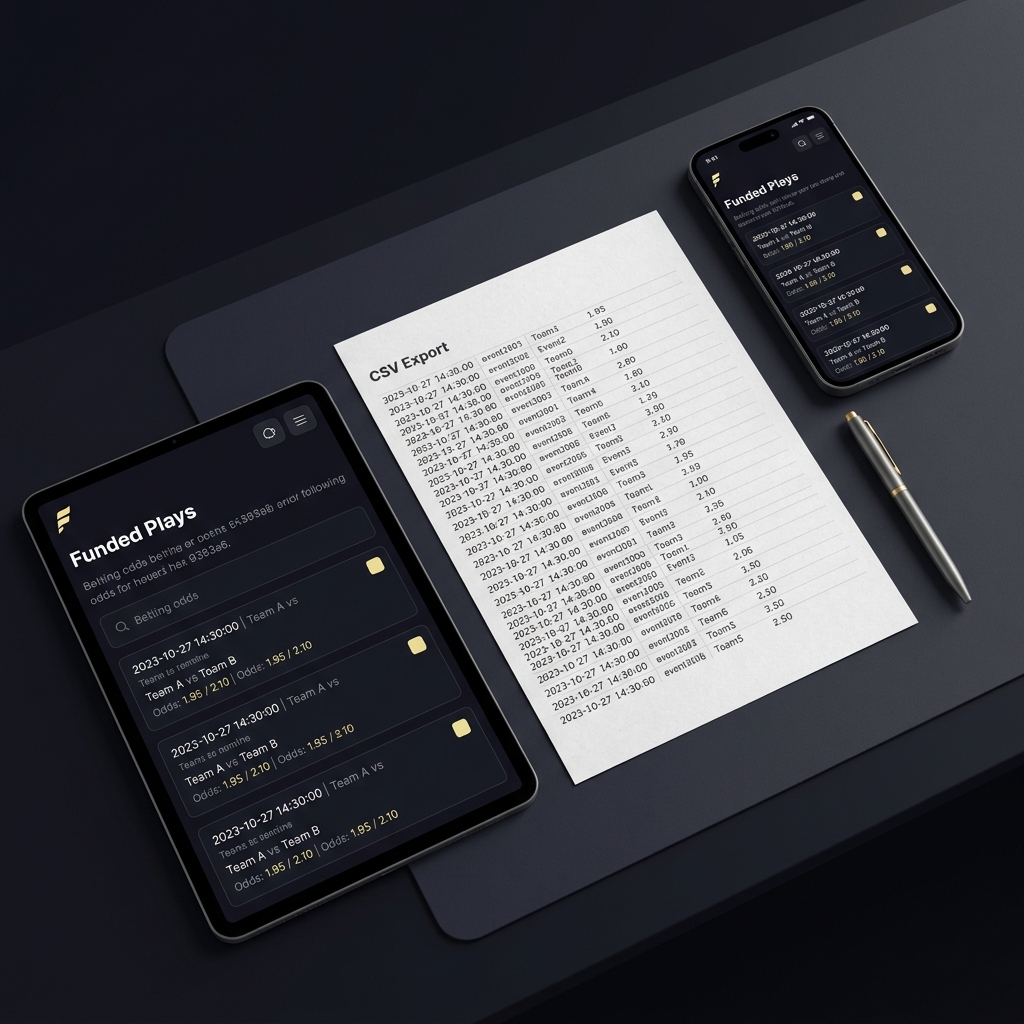
Build a simple, consistent record format: date and time stamp, event identification, market and odds at entry, stake, outcome, and a link or file name for an independent odds snapshot. Store logs in a format that can be exported, such as CSV, and keep copies of screenshots or archived pages that show the market at both entry and closing times. This habit makes later audit and ROI reconstruction straightforward. See our blog for further notes on record keeping.
Independent odds archives and third-party snapshots are valuable for closing line comparisons. Use publicly archived pages or dedicated odds-archive services to capture closing prices so you can compute CLV without relying on self-reported numbers. Regulatory guidance emphasizes the credibility value of independent sources and time stamps when substantiating performance claims. For additional detail on precise CLV measurement, see Getting Precise About Closing Line Value.
Bankroll management and stake sizing when comparing results
Why stake sizing matters for ROI comparability
Stake sizing policies affect ROI directly, so reviewers should normalize for stake methods when comparing bettors. A bettor who stakes large on longshots can generate volatile ROI numbers, while a unit-based approach provides a clearer basis for comparison. When stake transparency is absent, ROI can still be compared if total amount risked is reported, but missing stake details reduce confidence in cross-candidate comparisons.
Common stake sizing methods used by professionals
Professionals often use unit-based staking, percent of bankroll approaches, or flat stakes per identified edge. When records show unit sizes or percent-of-bankroll rules, it is easier to normalize outcomes and compare ROI across different bettors. Ask for stake sizing granularity when evaluating records, and treat opaque stake reports as a red flag.
Regulatory and ethical considerations when declaring 'the best'
Advertising rules and substantiation
Regulators and advertising standards increasingly require substantiation for public claims about tipster performance, including time-stamped picks and independent odds sources. When a service or individual claims to be the "best," expect them to provide auditable evidence that aligns with these standards. Absent that evidence, such claims should be treated skeptically and evaluated under the same checklist used for any public performance claim Advertising Standards Authority guidance.
Responsible messaging and avoiding guaranteed claims
Ethical communication avoids promising returns, guaranteed qualifications, or implying that short-term success ensures future results. Always present limitations, sample sizes, and verification methods alongside any performance claims. That approach is both regulatory-safe and helpful for readers who need to weigh uncertain evidence.
Final takeaways: a framework for naming a top bettor
A short rubric to summarize the article
To name a top bettor with confidence, apply a rubric that requires verified ROI expressed as net profit divided by amount risked, consistent positive CLV, sufficient sample size to reduce statistical uncertainty, transparent stake sizing, and independent verification such as time-stamped picks and odds archives. Combine these elements rather than relying on a single metric, and downgrade claims that lack independent evidence or that rest on short samples. For related resources see the Funded Plays homepage.
Apply the rubric and track a verified record
Use the rubric on a candidate record, collect time-stamped logs and independent odds snapshots, and track performance across multiple seasons before drawing a final conclusion.
In many cases, the correct conclusion is to remain agnostic until evidence meets the standard above. Naming a single, universal "best sport bettor" is rarely justified without multiple lines of verified evidence that survive statistical scrutiny. Ongoing tracking, transparent reporting, and skepticism toward unverified claims will lead to better, more defensible assessments.
Calculate ROI as net profit divided by total amount risked over the same period, and compare on consistent units and sports to avoid misleading results.
CLV shows whether a bettor consistently secures better odds than the market close, which is a useful proxy for an informational edge, but it must be paired with sample size and ROI.
Contests provide verifiable, standardized comparisons within their format and timeframe, but results are only comparable within the contest rules and may not generalize outside that context.
References
- https://www.itl.nist.gov/div898/handbook/prc/section2/prc241.htm
- https://www.investopedia.com/terms/r/returnoninvestment.asp
- https://www.pinnacle.com/en/betting-resources/educational/closing-line-value
- https://oddsjam.com/betting-education/closing-line-value
- https://www.sportsbettingdime.com/guides/betting-101/closing-line-value/
- https://www.asa.org.uk/advice-online/betting-tipsters.html
- https://www.circasports.com/contests
- https://www.superbook.com/supercontest/
- https://www.fundedplays.com/blogs/how-fundedplays-evaluations-work
- https://www.fundedplays.com/blogs
- https://www.fundedplays.com
- https://unabated.com/articles/getting-precise-about-closing-line-value
- https://www.fundedplays.com/challenges